Textile Documents › Publications › Publication: American Anthropologist
10 documents found
Sort: 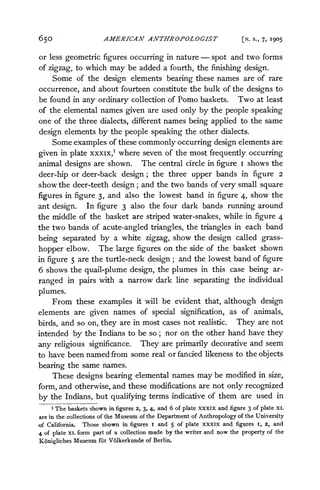
Basket Designs of the Pomo Indians
Article · 8 pages
A preliminary account by S. A. Barrett of the design vocabulary in Pomo basketry from central California, based on 1904 fieldwork. It outlines the coiled and twined techniques and basket forms, then describes the 29 named design elements (animal, plant, and geometric), the qualifying terms that modify them, and how complex pattern names are built. Two plates show Pomo baskets with animal designs and arrowhead variations. Comparisons are made with design naming among the Hupa, Karok, Yurok, and Maidu.
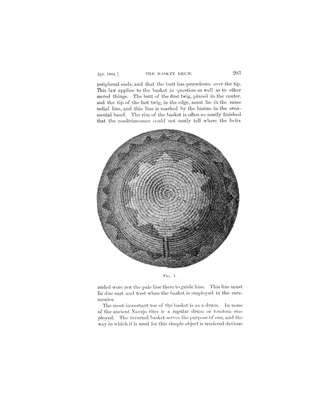
Basket Drum
Article · 7 pages
Article by Washington Matthews on the Navajo ceremonial basket drum, a coiled sumac-twig basket used inverted as a drum in the nine-night night-chant ceremony. It covers the basket's construction, butt-and-tip rules, decorative band with a gap, plaited rim finish and its legend, and the ritual handling of the basket. A second part describes the yucca-leaf drumstick, how its leaves are gathered, its ritual use and ceremonial unraveling. Two figures show the basket and the drumstick.
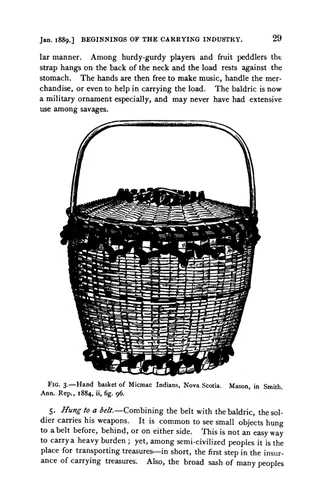
Beginnings of the Carrying Industry
Article · 26 pages
Otis T. Mason's 1889 essay in American Anthropologist surveys the origins of human burden-carrying as the starting point of transport and commerce, using the railway as a modern analogy. It catalogs the methods of bearing loads on the human body (hand, arm, shoulder, back, head, forehead, pockets) and goes on to combined effort, hauling, tossing, caravans, trails, couriers and professional carriers, drawing on ethnographic examples. Basketry and carrying devices appear in the illustrations (Hupa cradle, Ute seed basket, Micmac hand basket, Aleutian twined wallet, Zuni head pad, Gallinomero burden basket). The scan ends with two short unrelated notes.
Certain Rare West-Coast Baskets
Article · 30 pages
An 1912 ethnological article describing five rare Northwest Coast and lower Columbia River baskets in the collections of the Academy of Natural Sciences of Philadelphia. It covers a Tlingit covered rattle-lid basket, a Tlingit embroidered hat, a Tlingit berrying basket, a fine grass cup, and a basket wallet with woven masks and animal figures. The author details construction (two-strand twining, false embroidery or overlay twining, wrapped twining, tee/lattice twining, selvage and border finishes), designs and their native names, and discusses tribal attribution and the raven-tail pattern. Illustrated with plates and line drawings of designs and borders.
Hudson Collection of Basketry
Article · 8 pages
Otis T. Mason describes the Hudson collection of Pomo basketry from the Russian River region of California, acquired by the U.S. National Museum in 1899. He tabulates the plants, minerals and animal materials used, with scientific and Pomo names, and explains their preparation, colors and trade values in shell and magnetite money. He then classifies the baskets into twined and coiled types, giving Pomo names and technical descriptions of each. He closes with notes on ornamentation, including feather-work and the symbolic meaning of patterns.
Hudson Collection of Basketry
Article · 8 pages
Otis T. Mason describes the Hudson collection of Pomo basketry from the Russian River region of California, acquired by the U.S. National Museum in 1899 from Dr. J. W. Hudson. The article lists the plants, minerals, and animal materials used, with Pomo names and the parts used. It then classifies the baskets into twined and coiled weaving types, with Pomo terms for each. It closes with notes on ornamentation, feather and shell decoration, and the meanings of patterns.
New Type of Spinning in North America
Article · 8 pages
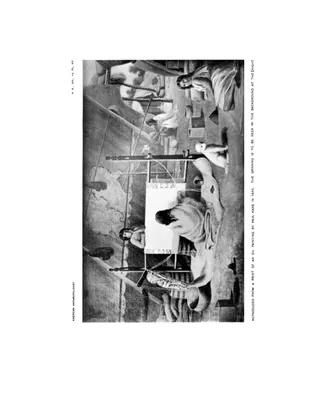
Article describing a previously unrecorded method of spindle spinning among the Cowichan and Thompson Salish peoples of British Columbia, using a very large spindle held in the hands and a tension ring or chair back to draft the roving. Kissell compares it with free-spindle and sustained-spindle spinning, Tlingit hand spinning, ancient Egyptian and Greek practices, and neighboring tribes, and argues it is the most elementary use of the spindle. Illustrated with a Paul Kane painting (1846) and a 1915 photograph taken at Musqueam.
Technic of Aboriginal American Basketry
Article · 20 pages
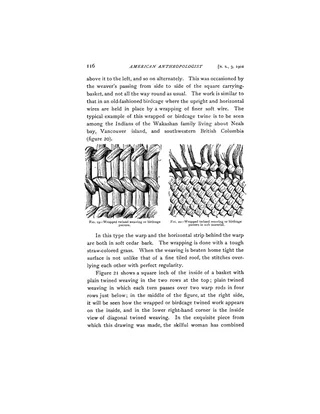
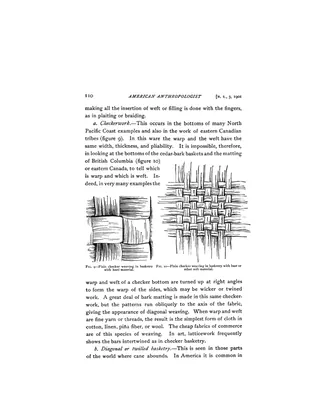
Otis T. Mason's 1901 article classifies the technical methods of Native American basketry into woven (plicated) and coiled types. Woven types covered are checkerwork, diagonal or twilled work, wickerwork, and twined work, the last with plain, diagonal, wrapped (birdcage), lattice (tee), and three-ply varieties. Coiled types are classed by foundation: single-rod, two-rod, rod and welt, three-rod, splint (including the imbricated Klikitat style), and grass or shred. Forty numbered figures illustrate the structures, with examples from the Pomo, Hopi, Tlingit, Aleut, Nez Percé, Thompson River and other peoples. Decoration is explicitly left for a later paper.
Technic of Aboriginal American Basketry
Article · 20 pages
Otis T. Mason's 1901 article classifies Native American basketry by technique. It covers woven basketry (checkerwork, diagonal or twilled, wickerwork, and several forms of twined weaving, including plain, diagonal, wrapped, lattice or tee, and three-ply) and coiled basketry (single-rod, two-rod, rod and welt, three-rod, splint, and grass or shred foundations, plus the imbricated Klikitat technique). Forty line drawings and photographic figures illustrate the structures, with examples from the Pomo, Hopi, Tlingit, Aleut, Nez Percé, Thompson River, and other peoples. Ornamentation and geographic distribution are deferred to a later paper.
Textile Fabrics of the New England Indians
Article · 10 pages
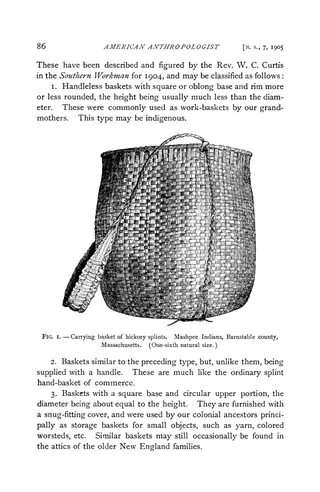
A 1905 article by Charles C. Willoughby surveying the textile arts of the New England Indians, drawing on early colonial accounts and museum specimens. It covers splint basketry (including Mashpee pack-baskets), baskets and bags of rush, maize husk and hemp, wigwam mats, twined robes, and turkey-feather mantles. It closes with a detailed description of a twined Indian-hemp wallet embroidered with moose hair (false embroidery), made by Mollocket of Maine about 1778-1785, with a technical diagram of the weave.
10 documents found