Textile Documents › Publications › Publication: Manufacturer and Builder
59 documents found
Sort: 
Aluminum with Textiles fabrics, Cord, Rope, etc.
Manufacturer and Builder, 1884
Article · 1 page
A short notice in The Manufacturer and Builder describing an invention by W. Darlow of Plaistow, London. It covers weaving or intertwining aluminum threads, alone or combined with the usual materials, in cloth, lace, rope, cord and similar goods. It is a single brief paragraph with no technical detail or drawings.
Aniline Colors
Manufacturer and Builder, 1869
Article · 2 pages
A two-page 1869 article by Dr. M. Reiman of Berlin on the adoption of aniline dyes in the 1860s. It explains that aniline colors dye wool and silk without mordants, and describes how cotton is prepared by 'animalizing' with albumen or casein, oil mordants, soap, or sumac and gall-nut tannin. It also covers the economy and brilliancy of aniline colors, and their instability compared with indigo and madder.
Aniline Gray
Manufacturer and Builder, 1869
Article · 1 page
A short 1869 article giving M. Bloch's recipe for producing an aniline gray dye. It describes heating aniline with arsenic acid, purifying the black product with muriatic acid and carbonate of soda, and dissolving it in alcohol with sulphuric acid. The resulting liquor is used to dye silk or wool in shades of gray and for dyeing and printing. Reprinted from Moniteur Scientifique.
Asbestos Rope
Manufacturer and Builder, 1884
Article · 1 page
A short 1884 note from The Manufacturer and Builder on the prospects of making rope from asbestos in England. It gives the rope's strength relative to hemp (about one-fourth), the breaking strength and weight of a 1¼-inch rope, and its proposed uses in theaters, fire brigades and building escapes. It states the rope is made like ordinary rope from Italian asbestos thread.
Bamboo
Manufacturer and Builder, 1869
Article · 1 page
A very short note from The Manufacturer and Builder on the many uses of the bamboo, especially in China. It lists uses including shelter, food, boats, furniture, writing materials, clothing and punishment. It has no technical detail on processing or textile use.
Chrome Green
Manufacturer and Builder, 1869
Article · 2 pages
A short 1869 article from The Manufacturer and Builder on chrome green pigment, reprinted from Moniteur Scientifique. It describes how MM. Casthelaz and Leune prepared a brilliant emerald 'imperial green' by slowly precipitating chrome salts by the wet process, using reagents such as zinc oxide, zinc carbonate, gelatinous alumina, iron or zinc. It presents this as a safer replacement for copper and arsenic greens in printing on stuffs, paper, paints, glass and ceramics.
Chrome Orange
Manufacturer and Builder, 1869
Article · 1 page
A short 1869 article from The Manufacturer and Builder on making chrome-orange pigment, a basic lead chromate. It describes preparing it from chrome-yellow with caustic potash, soda or lime, or directly from lead solutions, and how alkalinity controls the shade. It also discusses adulteration of chrome yellows and oranges with plaster of Paris and heavy spar, and the need to test the pigment's covering power.
Coralline Dye-Injurious Effect Therefrom
Manufacturer and Builder, 1869
Article · 1 page
A short 1869 magazine item reporting a case in which a French chemistry professor, Mr. Bidard of Rouen, wore stockings with red silk lines dyed with coralline. The wearer suffered painful burn-like inflammation and mild poisoning, certified by two physicians in Havre. Analysis found the red dye was coralline, derived from carbolic acid, while the lilac ground was harmless aniline violet.
Corset and Bag Weaving
Manufacturer and Builder, 1877
Article · 3 pages
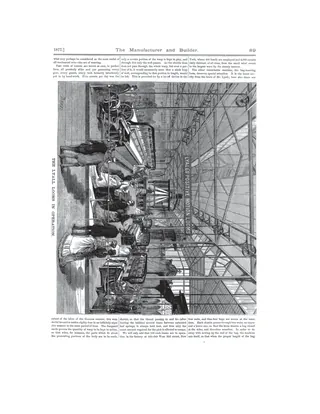
A short 1877 magazine article describing Lyall's corset-weaving and bag-weaving looms shown at the Centennial Exhibition. The corset loom combines power-loom principles, Lyall's positive shuttle motion and Jacquard cards to weave four shaped corset webs at once, and the bag loom weaves four seamless bags at a time as double cloth. It notes production figures at a New York factory and includes an engraving of the Lyall looms in operation.
Cotton Velvet
Manufacturer and Builder, 1877
Article · 1 page
A short note from The Manufacturer and Builder (March 1877) on cotton velvet made in China, described as soft and durable. It gives the dyeing method: dark-blue color from an indigo solution (one part indigo to thirteen parts water, with a little wine and lime), soaking about half an hour, wringing, sun-drying, repeating eleven times, then dampening with slightly acidulated water.
The Detection of Dyes
Manufacturer and Builder, 1869
Article · 1 page
A one-page article from The Manufacturer and Builder (page 275) reporting M. Tardieu's chemical tests for identifying red dyes on fabric, prompted by accidents from stockings dyed with coralline. It describes how garancine, cochineal, murexide, carthamus, aniline and coralline reds react to acids, ammonia, soap solution, water and alcohol, and how to test fibers for coralline.
Embroidering and Braid-Making Machine
Manufacturer and Builder, 1877
Article · 1 page
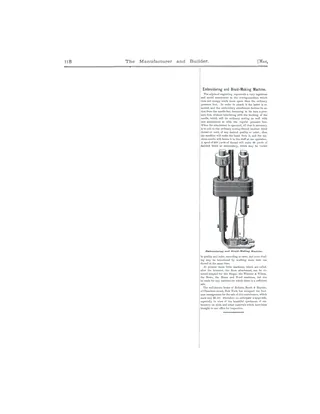
A short 1877 notice from The Manufacturer and Builder describing the Rose attachment, a sewing-machine accessory that replaces the pressure foot and makes braid or embroidery from an added thick thread or cord while the needle stitches it to the fabric. It gives yield (200 yards of thread makes 86 yards of braid), the machines it fits (Singer, Wheeler & Wilson, Howe, Home, Weed), the price of $1.50, and the New York sales agents. An engraving shows the attachment.
Enormous Rope
Manufacturer and Builder, 1869
Article · 1 page
A short 1869 magazine article reprinting a Birmingham Daily Post report on an enormous wire and hemp rope made by John and Edwin Wright at Universe Works, Birmingham. The rope is about 11,000 yards long, 5.25 inches in circumference and over sixty tons, built of six strands of ten charcoal-iron wires around a hemp centre. It closes by comparing it with a 5,900-foot iron wire rope made by Roebling of Trenton, N.J., for planes on the Lehigh and Susquehanna Railroad.
Felt
Manufacturer and Builder, 1869
Article · 1 page
A short 1869 magazine item on the legendary and early history of felt and felt hats. It recounts the story of St. Clement discovering felting with wool in his sandals, his role as patron saint of hatters, and the introduction of felt hats in Paris and their later manufacture in England.
A Fiber of Silk: From the Worm to the Finished Fabric, Part V.
Article · 2 pages
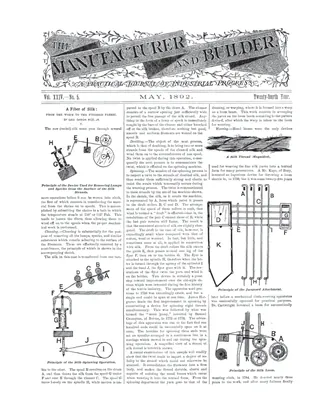
Part V of a serial on silk manufacture in The Manufacturer and Builder, May 1892. It covers the steps after reeling: winding skeins onto spools, cleaning, doubling, and spinning (twisting) on the flyer machine, followed by warping. It then gives a short history of spinning and power-loom inventions (Hargreaves, Crompton, Kay, Cartwright) and explains the Jacquard attachment and the silk power loom with diagrams.
Flax Manufacture in the United States
Manufacturer and Builder, 1881
Article · 1 page
A short magazine article arguing that the United States should develop a domestic linen manufacturing industry. It gives import figures for flax manufactures, including a breakdown by product category for 1883. It notes that the US makes cordage, carpet yarns, threads and coarse cloth from flax but no fine linens, and that American-grown flax is said to be of good enough quality for fine linen.
Gloss on Silk
Manufacturer and Builder, 1869
Article · 1 page
A short 1869 magazine article on how an artificial gloss is given to woven silk. It recounts the accidental discovery in 1663 by Octavio Mey, a Lyons merchant, then describes the finishing process: silk stretched between two rollers, coated with gum and dried over a tender of hot coals, then rolled under cylinders to soften it again.
Hemp
Manufacturer and Builder, 1869
Article · 1 page
A very short 1869 magazine item on hemp as a fiber plant, noting its use for thread, cloth, and cordage and comparing it to flax in form, culture, and use. It says the bark of the stalk is the useful part and that the fiber is coarser and stronger than flax. It begins a remark on the limited cultivation of hemp in Great Britain, and the text ends partway through that remark.
How Silk Lace is Made
Manufacturer and Builder, 1893
Article · 1 page
A short 1893 magazine article, reprinted from the Brooklyn Eagle, describing how machine-made silk lace is produced in Brooklyn at A. G. Jennings's mill. It follows the silk from raw skeins through throwing, boiling, spooling, warping, beaming and bobbin preparation, then threading the lace machine and using Jacquard punched cards. It ends with examining, dyeing, finishing and carding. It also gives a brief account of the American lace industry, with Brooklyn as its center.

Imitation of Lace by Photography
Manufacturer and Builder, 1876
Article · 1 page
A short 1876 note from The Manufacturer and Builder describing a photographic method of imitating black lace, noticed at the last London exposition. The lace is placed in a printing frame over sensitized albumen paper and exposed for a long time, then fixed and dyed so it can be used as a negative. The result is meant to reproduce lace designs like those covering light silk parasols.
Important Improvement in Looms
Article · 2 pages
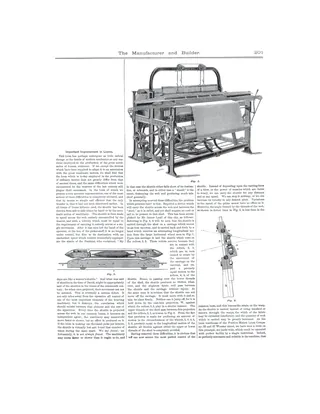
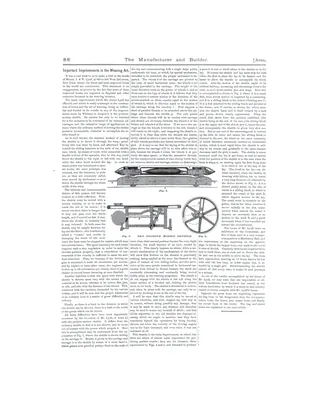
A short magazine article describing James Lyall's positive-motion power loom, in which the shuttle is carried through the shed on a roller-equipped carriage running on an iron raceway rather than being thrown freely. The text explains the problems of the thrown shuttle, how the carriage and rollers avoid friction on the warp threads, and the claimed benefits: controlled shuttle speed, very wide fabrics (a six-yard-wide loom is mentioned), less warp strain and a firm selvage. Three engraved figures show the loom, the shuttle and carriage, and an enlarged view of the shed.
Important Improvement in Looms
Manufacturer and Builder, 1869
Article · 2 pages
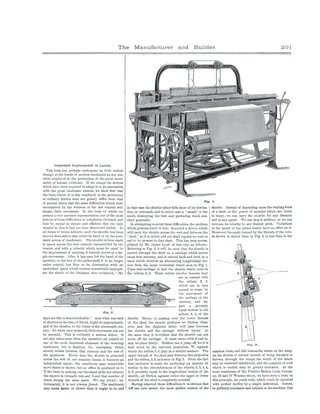
A short 1869 magazine article describing James Lyall's improved power loom, in which the shuttle rides on a roller-equipped carriage along an iron raceway instead of being thrown freely across the shed. The article explains how this gives control over shuttle speed, reduces friction and warp strain, allows very wide cloth (a six-yard-wide loom is mentioned), and produces a firm selvage. Three figures show the loom, the shuttle carriage, and the shed.
Important Improvement in the Weaving Art
Manufacturer and Builder, c. 1877
Article · 1 page
A one-page article from The Manufacturer and Builder describing James Lyall's positive-motion shuttle for power looms, made by J. & W. Lyall of New York. It explains the drawbacks of thrown shuttles (smashes, speed regulation, width limits) and how the carriage-driven shuttle avoids them, with mechanisms for shuttle and lay dwell. It also describes Lyall's looms shown at the Centennial, including a very wide loom for oilcloth foundations.
Jute
Manufacturer and Builder, c. 1881
Article · 1 page
A short 1881 magazine article on jute, covering U.S. import values, the botany of the plant, and how the fiber is harvested and steeped. It lists uses such as gunny cloth, burlap, bagging, matting and cheap carpets, and notes that jute is poor for ropes. It argues that jute could be grown profitably in the Southern States and California to supply American demand, citing cotton baling needs.
Jute
Article · 2 pages
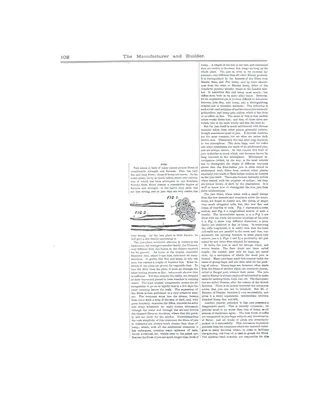
A two-page magazine article describing jute fibre: the plant (Corchorus olitorius), its tropical Asian origin, retting and fibre separation, and how it compares with flax, hemp, ramie and other bast fibres. It gives a chemical test (acid sulphate of aniline) and microscopic features for telling jute from hemp and flax and for detecting adulteration with malva fibres. It also covers uses (bags, gunny cloth, ropes), bleaching, the smell prejudice, growth of European consumption after the Crimean War, and its use for ladies' false hair pieces.
Lace
Manufacturer and Builder, 1872
Article · 2 pages
A short 1872 magazine article giving a general overview of lace: its antiquity, the main centers of production, and the different types such as Brussels, Mechlin, Valenciennes, Chantilly, Alençon and bobbinet. It describes how pillow lace is made with bobbins and a pricked parchment pattern, and how machine lace began with Hammond's stocking-frame experiments at Nottingham around 1768. It also covers embroidering and dressing lace net and the making of gold lace from gilt silver wire wound on silk thread.
Lace-Making
Manufacturer and Builder, 1870
Article · 1 page
A short 1870 magazine piece on machine lace-making in England, centered on Nottingham. It reports that over 660 patents were taken out in ninety years, mostly by working-men, and that much machinery was discarded as obsolete. It recounts Charles Babbage's visit to a Nottingham lace machine and argues that inventors would benefit from theoretical mechanical education. The data come from remarks at a British Association meeting in Nottingham.
Laces
Manufacturer and Builder, 1869
Article · 1 page
A short 1869 magazine piece, reprinted from the Chicago Tribune, giving a general account of lace history. It traces point lace from fourteenth-century nuns' needlework to the sixteenth-century introduction of pillow lace and the later perfection of machine lace at Nottingham. It lists well-known needle laces and pillow laces and the places that produced them.
Lake Colors -- Their Nature and Manufacture
Manufacturer and Builder, 1869
Article · 1 page
A short 1869 magazine article describing what lake pigments are and how they are made from vegetable and animal dyestuffs. It covers blue lakes (litmus and soluble indigo or indigo-carmine), yellow lakes (quercitron, weld, yellow berries, annotto) and red and violet lakes (cochineal, madder, Brazil-wood, logwood). Procedures given include alum and alkali precipitation, use of tin salts, and filtering and drying into cakes.
Lisieux and its Linen Factories
Article · 1 page
A short magazine article describing a visit to linen mills in Lisieux, France, on the Touques river, whose undershot water wheels drive the factories. It walks through the carding room, the hot, steamy wet-spinning room where operatives work in minimal clothing, and the later processes of reeling, drying, hanking and baling. It ends with an explanation of how the wet spinning system strengthens the thread by dissolving glutinous substances in the flax.
Magenta
Manufacturer and Builder, 1869
Article · 3 pages
A nineteenth-century magazine article on magenta (fuchsine, aniline red), tracing its manufacture from coal-tar through benzol, nitrobenzol and aniline oil to the arsenic acid oxidation process. It then describes dyeing silk and wool with magenta, with tips for even shades, and dyeing cotton using tannin mordants or animalizing agents. It closes with methods of printing magenta on animal and vegetable fibres using albumen, tannin or caseine.
Manilla Hemp in Plaster
Manufacturer and Builder, 1888
Article · 1 page
A short 1888 trade-journal article reporting architects' tests of fibers used as binders in plaster. Plates containing Manilla hemp, Sisal hemp, jute and goat's hair were loaded with weights, and the Manilla plate carried the most (195 pounds) and cracked without separating. A second test stored lime-and-sand mortar with Manilla hemp or goat's hair for nine months; the hair was largely consumed by the lime, while the hemp mortar stayed cohesive.
Mohair
Manufacturer and Builder, 1876
Article · 1 page
A short 1870s magazine article on mohair, the fiber from the Angora goat. It describes the fiber's qualities (strength, luster, dye uptake), its use in place of silk in Irish poplins, and the trade in fleeces from Asia Minor and England. It then traces the introduction and breeding of Angora goats in the United States (South Carolina, Georgia, California and the Pacific states) and at the Cape of Good Hope.
Mohair
Manufacturer and Builder, 1876
Article · 1 page
A short 1876 news item from The Manufacturer and Builder reporting that John S. Harris of California brought twelve Angora goats from Asia Minor to Baltimore after a year-long journey. It gives the cost per goat and in total, and notes his California flock and the prospects for producing mohair there.
New Chrome Yellow
Manufacturer and Builder, 1869
Article · 2 pages
A short 1869 article from The Manufacturer and Builder on two chromium yellow pigments little known at the time: chrome baryta (barium yellow) and zinc yellow (chrome zinc). It gives preparation methods using barium chloride, zinc sulphate, chromate of potash and caustic soda or lye. It also describes a test-tube procedure for finding the right alkali proportion. The text concerns paint pigments, not textile dyeing as such.
New Process of Casting Iron and other Metals upon Lace, Embroideries, Fern Leaves, and other Combustible Materials
Manufacturer and Builder, 1887
Article · 3 pages
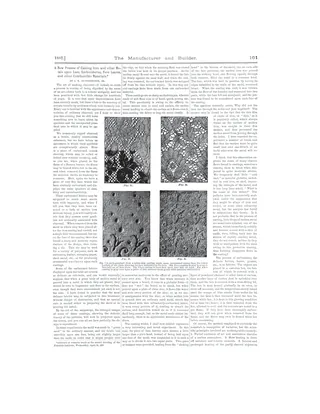
Abstract of remarks by A. E. Outerbridge, Jr. to the Franklin Institute (April 20, 1887) describing a process for casting iron and other metals against lace, embroidery, fern leaves and other delicate materials after carbonizing them. The carbonized fabrics survive molten iron intact and leave a sharp impression of their pattern on the casting, which can serve as a die for embossing. The article explains the sand-mold method, the carbonizing procedure in a closed iron box with powdered charcoal, and a suggested explanation of casting flaws. Illustrated with photographs of cast iron pieces showing reproduced lace patterns.
The Old Weavers
Article · 1 page
A short one-page piece describing the social position of hand weavers in rural communities in the days of home spinning. It portrays them as pale, solitary itinerant craftsmen carrying bags of linen thread and cloth, viewed with suspicion and superstition by villagers. The text is a literary or social sketch with no technical weaving content. It is credited to the U. S. Economist.
On the Employment of Aloes as a Dye-Stuff
Manufacturer and Builder, 1869
Article · 1 page
A short 1869 article from The Manufacturer and Builder on using aloes as a source of dyes. It explains that treating aloes with nitric acid produces chrysammic acid, gives a preparation procedure, and lists proportions for dyeing wool (brown, black, grayish blue), silk, cotton and linen. It also covers calico printing and use of the acid to fix archil and cudbear dyes as "liquid archil".
[Pattern Book of Old Italian Linen Embroidery]
Article · 1 page
A short review in The Manufacturer and Builder of two collections of old Italian linen embroidery patterns, edited by Frieda Lipperheide and published by Franz Lipperheide in Berlin. Each quarto volume has 30 plates with explanatory text, and the review recommends them as pattern sources and for art education. It also notes the earlier three collections of Old German Linen Embroidery in the same series and gives the price of 6 marks each.
The Pennsylvania Museum and School of Industrial Art
Manufacturer and Builder, September 1891
Article · 2 pages
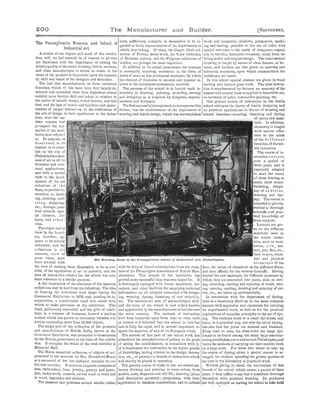
A 1891 magazine article reviewing the Pennsylvania Museum and School of Industrial Art in Philadelphia. It covers the institution's founding after the 1876 Centennial Exhibition, its museum collections (British India, Moore memorial lace and embroidery, Fulgence textiles), and its art school courses. Most attention goes to the three-year textile school covering design, weaving, dyeing, fibers and chemistry. Illustrated with a photograph of the school's weaving room and a prize design for a Brussels carpet ground.
The Philadelphia School of Industrial Arts
Manufacturer and Builder, June 1894
Article · 1 page
The concluding portion of a June 1894 article on the Philadelphia School of Industrial Arts. It reports growth in enrollment under Prof. L. W. Miller, from 30 pupils and one teacher to 536 pupils and 27 teachers, and praise for the school's World's Fair display. It quotes a local newspaper account of the closing exhibition, covering the art department and the Textile School, where students designed, dyed yarn, cut loom cards and wove silks, dress goods, vestings and woolens.
The Principle of the Loom
Manufacturer and Builder, 1890
Article · 1 page
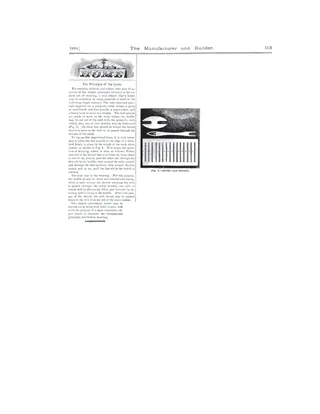
A short 1890 article giving instructions for building a simple model loom from household materials to teach children the basic principles of weaving. It uses two pencils as warp beams, a cardboard heddle with slits, and card shuttles, with a book as a weight. It explains warping, raising and lowering the heddle to open the shed, passing the weft, and beating it with a paper-cutter.
Ramie Culture in Pennsylvania
Manufacturer and Builder, 1889
Article · 2 pages
A short 1889 notice from The Manufacturer and Builder reporting that a company has been formed in Pennsylvania to cultivate ramie and manufacture its fiber. It says 2,000 plants were brought from Louisiana, that the Landreth seedsmen will devote several acres near Philadelphia to the crop, and that a new decorticating machine is being built.
Restoring Silk Hats
Manufacturer and Builder, 1869
Article · 2 pages
A short 1869 magazine article describing how men's silk hats are made and how they are renovated by hatters. It covers the hat body, silk plush cover and trimmings, the dyeing and cleaning of old plush with logwood extract, and the reshaping with shellac and hot irons. It also warns that many hats sold as new are actually renovated ones, and advises buyers to be wary of low prices.
Revolution in Looms
Manufacturer and Builder, 1877
Article · 1 page
A short 1877 news item announcing a new upright, all-metal power loom invented by J. Melledge Flagg of Providence, Rhode Island. It describes the shuttle passing through the warp, metallic harnesses in place of twine, stationary shuttle boxes with only the reed moving to beat up, and two looms built into one frame driven by a single pulley.
Roofing Linen
Article · 1 page
A short note in The Manufacturer and Builder, citing the Deutsche Bauzeitung, on a new roofing material called "roofing linen." It consists of a layer of coarse linen between two layers of thin roll paper, bonded with an asphalt composition called "roofing paint." The note gives application advice and approximate costs, and says the material's value cannot yet be judged without years of use.
Rope Making
Manufacturer and Builder, 1873
Article · 2 pages
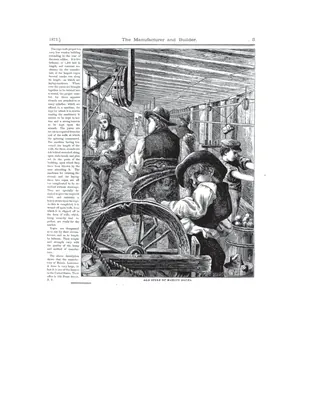
A short 1889-catalogued magazine article on rope making from The Manufacturer and Builder. It describes the traditional hand method in a rope-walk, where spinners twist hemp yarns while walking backward from a wheel, then tarring and laying into rope. It then describes the machinery-based Lawrence and Sons rope works in Brooklyn, N.Y., which processed manila, sisal and jute into yarn, strands and rope. An engraving shows workers in a long rope-walk.
Silk and Silk Manufacture, No. III: The Silk Industry in England
Manufacturer and Builder, August 1873
Article · 1 page
A one-page 1873 magazine article, third in a series on silk, covering the silk industry in England. It describes how French Huguenot exiles brought silk weaving to England and Spitalfields, then gives an anecdotal account of Joseph Marie Jacquard, his loom, and its reception in Paris and Lyons. It closes with a summary of world raw silk production and silk manufacturing countries in the early 1870s.
Spider's Silk
Manufacturer and Builder, 1869
Article · 1 page
A short 1869 magazine piece on the silk of spiders, especially Nephila plumipes. It quotes Dr. Wilder on the golden and silvery lustre of the silk and gives a strength comparison: a thread from a Southern species is said to bear 54 grains, equal to about 61½ tons per square inch, against iron wire, steel and gun-metal.
Spinning and Weaving Glass
Manufacturer and Builder, 1881
Article · 1 page
A short 1881 magazine article reporting on Atterbury & Co. of Pittsburgh, who drew colored glass rods into fine threads on a large spinning wheel and wove them into fabrics. It describes the process, including the gas burners, the 8½-foot wheel, and the reeling speed, and mentions a tablecloth and ornamental plumes made from glass. The editors conclude that glass cloth is impractical for clothing because the fibers are brittle, though it could serve for ornamental objects.
59 documents found