Textile Documents › Authors › Author: H. Ling Roth
8 documents found
Sort: 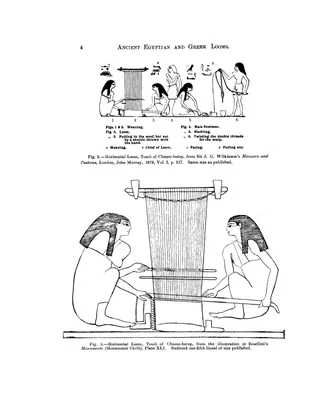
Ancient Egyptian and Greek Looms
Monograph · 45 pages
Bankfield Museum Notes, Second Series No. 2 (Halifax, April 1913), in which the museum's keeper H. Ling Roth examines how looms were built and used in ancient Egypt and Greece. He compares published copies of Egyptian tomb paintings (Beni Hasan, Thebes, El Bersheh) with new drawings by N. de G. Davies, and discusses horizontal and vertical Egyptian looms, loom parts such as beaters-in, laze rods, heddles, reeds and warp weights, and the Rameses III linen girdle. A section by W. W. Midgley gives a microscopic examination of fifteen Egyptian mummy wrappings, with a table of thread counts and fibre measurements. The Greek section covers vase paintings, warp-weighted looms, and Scandinavian, Icelandic and English chalk-weight parallels.
Loom from Iquitos
Article · 3 pages
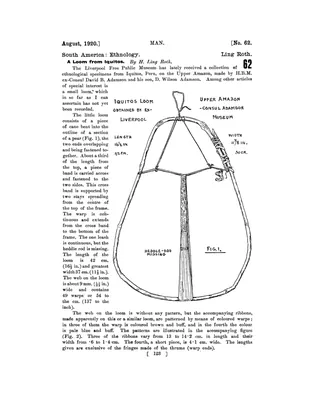
A short note in Man (August 1920, no. 62) describing a small pear-shaped cane loom from Iquitos, Peru, collected by ex-Consul David B. Adamson for the Liverpool Free Public Museum. Roth gives its dimensions, warp count and construction (cross band, two stays, continuous leash, missing heddle rod), and describes four accompanying warp-patterned ribbons or wrist-bands and four pot-whorl spindles. Adamson's notes on local weaving and ornament are included, with a comparison to similar looms in British Guiana and in Farabee's Central Arawaks. Figures show the loom, the ribbons and the spindle whorls.
Models of Ancient Looms
Article · 7 pages
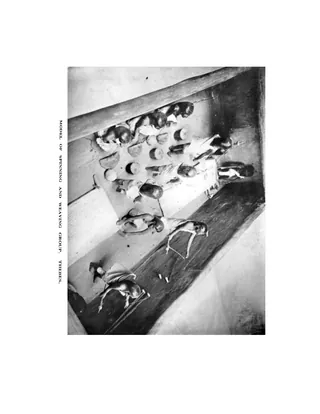
Two-part note on the model of Egyptian textile work found in an XIth dynasty tomb at Thebes by Winlock and Burton. H. Ling Roth describes the model from photographs, comparing its flax preparation, spinning, warping and two horizontal looms with the XIIth dynasty wall drawing in the tomb of Tehuti-hetep. G. M. Crowfoot then compares the model with spinning, warp laying on pegs and horizontal two-beam looms she saw in the Sudan, and discusses the puzzling wooden implements beside the looms. Illustrated with the model, the wall drawing and diagrams of a Sudani warp and wooden implements.
Studies in Indanthren Colours
Article · 4 pages
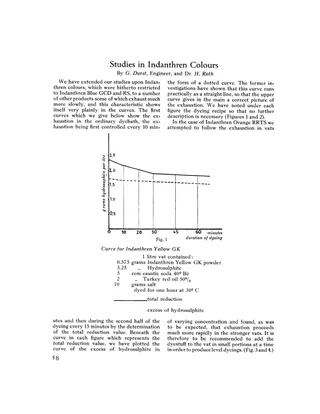
A short technical article reporting experiments on the vat dyeing behavior of Indanthren colors, extending earlier work on Indanthren Blue to Yellow GK, Brown R and Orange RRTS. Graphs show how dyebath exhaustion and hydrosulphite content change over time and with temperature, caustic soda quantity and vat concentration. The authors also give figures for hydrosulphite loss by oxidation and the caustic soda it consumes, with advice for jigger dyeing.
Studies in Primitive Looms
Article · 26 pages · weaving drafts
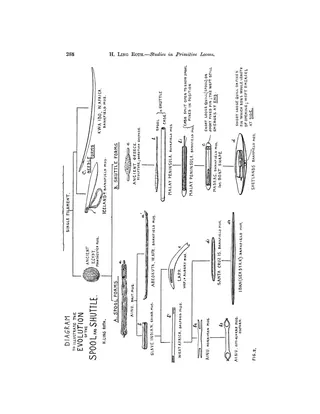
H. Ling Roth's 1916 anthropological article on primitive looms, from the Journal of the Royal Anthropological Institute. It defines loom terms (warp, weft, shed, heddle, lease rods, warp spacer, reed) and traces the evolution of the spool and shuttle. It then describes the Ainu backstrap loom in detail from museum specimens, and surveys looms from North and South America (Slave Indian quill belt loom, Hopi, Kachiquel, Uitoto, Peruvian, Apache, and a Mazatec gauze loom). The article is illustrated with many line drawings of loom parts, tools and warp layouts, and includes a plate of the Mazatec loom.
Studies in Primitive Looms
Article · 39 pages · weaving drafts
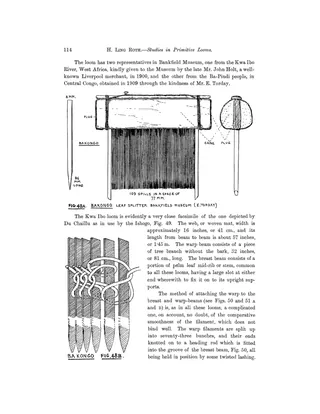
Part II of H. Ling Roth's series on primitive looms, covering African looms. He identifies seven forms: vertical mat loom, horizontal fixed heddle loom, vertical cotton loom, horizontal narrow band treadle loom, pit treadle loom, Mediterranean or Asiatic treadle loom, and the "carton" loom. The text describes museum specimens (Bankfield, Liverpool, Glasgow, Edinburgh, Brighton, British Museum) from Kwa Ibo, Ba-Pindi, Old Calabar, Madagascar, Nyasaland, Abeokuta and Opobo, with dimensions, warp attachments, heddles, selvedges, needles, spools, reeds and shuttles. It has many line drawings and diagrams, including pattern-heddle and herring-bone rod threading diagrams for the vertical cotton loom. It ends with a tentative distribution map of loom types in Africa and discussion of their origins.
Studies in Primitive Looms
Article · 44 pages · weaving drafts
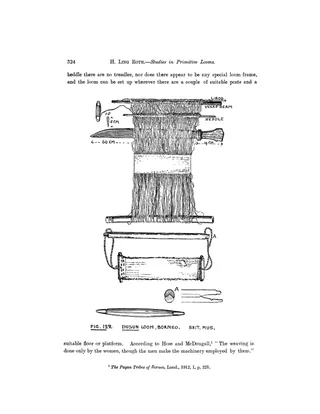
Part III of H. Ling Roth's comparative study of primitive looms, covering Indonesian looms (Dusun, Iban/Sea Dyak, Ilanun, Igorot, Bugis, Malay, Javanese, Cambodian) and the related Bhotiya, Korean, Santa Cruz and Caroline Islands looms. It describes loom parts such as warp beams, laze rods, heddles, sword beaters-in, temples, spools and reeds, with museum specimen dimensions, thread counts and comparison tables. Roth traces the evolution of the reed from a pegged warp spacer, discusses the migration of the Santa Cruz loom across the Pacific, and notes ritual practices tied to weaving. Numerous line drawings and a migration map accompany the text.
Studies in Primitive Looms
Article · 42 pages
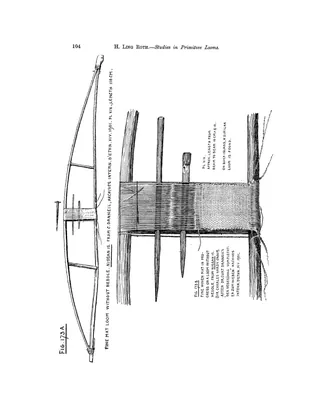
Concluding part (Part IV) of H. Ling Roth's series on primitive looms, from the Journal of the Royal Anthropological Institute, 1918. It describes and compares the Solomon Island (Nissan/Buka) frame loom, a Lapp braid loom with bone heddle, Norwegian and English rigid-heddle looms, Oriental vertical mat looms (Ceylon, Hong Kong, Ainu), upright and warp-weighted looms from classical sources (the Vatican Virgil, Braunius) and Egypto-Greek models, and Indian and Turkish rug looms. It also examines toothed beaters-in and bone combs from Mortlake, Kent's Cavern and Glastonbury, disputing their interpretation as weaving tools, and closes with a discussion of the origin and distribution of looms, arguing for independent invention in some cases. Illustrated with many line drawings of looms and tools.
8 documents found