Textile Documents › Publications › Publication: The Melliand (specimen)
35 documents found
Sort: 
The Acme of Achievement in the Production of Auxiliary Media for the Textile Industry
Article · 4 pages
A 1929 article by Dr. W. Kling on chemical auxiliary products used in textile finishing, such as washing, bleaching, dyeing, carbonizing and mercerizing. It sets out the properties an ideal auxiliary should have, divided into indispensable requisites and valuable qualities. It then reviews actual products from soap and Turkey red oil to the proprietary lines of H. Th. Böhme A.G. of Chemnitz (Tetracarnit, Novocarnit, Oleocarnit, Avirol, Lanaclarin, Floranit, Eucarnit). It concludes that a universal ideal auxiliary is probably unattainable and that special-purpose products are the practical course.
The Application of the Neolan Dyestuffs in Wool and Silk Printing
Article · 5 pages
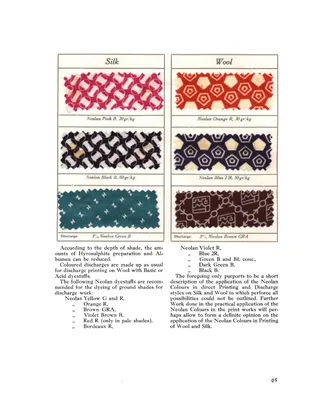
A 1929 technical article by Dr. H. Bernhard on using Neolan dyestuffs (chrome-complex acid dyes) for printing silk and wool. It gives printing recipes with British gum thickening, glycerine, acetate of chrome and ammonium tartrate, plus steaming and finishing instructions. It also covers Vigoureux (slubbing) printing and hydrosulphite discharge printing on silk and wool, with lists of suitable Neolan colours. The final page shows printed swatches of silk and wool samples, including discharge effects.
Black and Navy Blue Shades, Dischargeable to White, on Pure Acetate Silk
Article · 2 pages
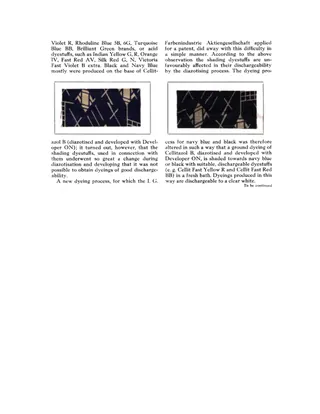
A short 1929 article from The Melliand by Dr. Fischer on printing pure acetate silk fabrics, especially voiles. It lists dyestuffs that discharge well and explains a new I. G. Farbenindustrie dyeing process in which a Cellitazol B ground is diazotised and developed, then shaded with dischargeable dyes in a fresh bath. This gives black and navy blue that discharge to a clear white. The article is marked "To be continued".
Control of Output and Operating Efficiency which must Precede the Reorganization of the Production of a Weaving Mill
Article · 3 pages
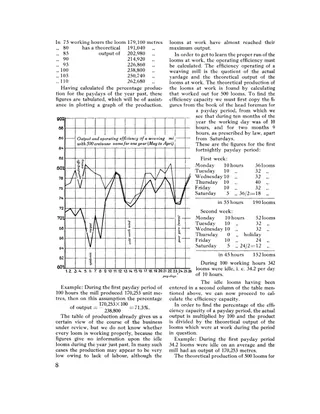
A 1929 article by Professor Th. Abt explaining how to measure output and operating efficiency in a weaving mill before attempting to reorganize production. Using a worked example of a cretonne mill with 500 power looms, it shows how to calculate theoretical output from average loom speed and picks per centimetre, then percentage of output and operating efficiency allowing for idle looms. It includes a 26-payday table and a graph of the two curves, with causes of dips such as influenza, cold weather affecting conditioning, and poor warp yarn.
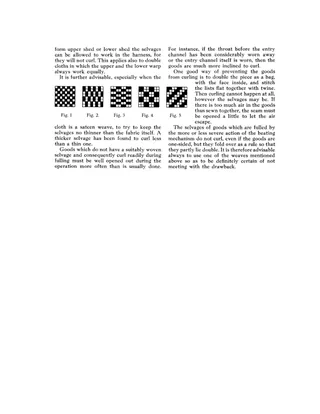
The Curling of the Selvages in Fulling
Article · 2 pages · weaving drafts
A short article by a weaving mill manager on why selvages curl during fulling, particularly in one-sided fabrics such as twills and sateens where weft floats lie on one side. It recommends weaving the selvages in a different, balanced weave (plain-weave derivatives shown in Figures 1-5) and offers practical fulling-room measures such as opening out the pieces, keeping selvages as thick as the cloth, and sewing the piece into a bag.
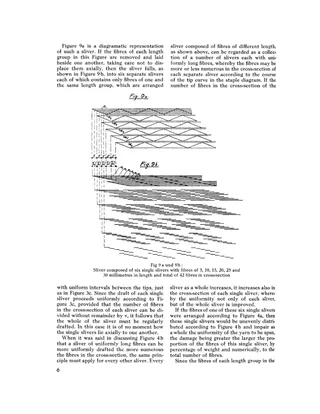
Drawframe Draft
Article · 7 pages
A 1929 technical article by H. Weissbach on drafting in the drawframe, the machine that draws out slivers of fibre in spinning preparation. It uses an idealised drawframe and geometric diagrams to show how the distances between fibre tips grow by the draft factor. It examines three cases: uniform fibres with evenly spaced tips, uneven tip distribution, and mixed fibre lengths. It concludes that combining several single slivers offset against one another gives a more uniform yarn, and works through calculated proportional figures for fibre counts in cross-sections.
The Dyeing of Acetate Silk
Article · 5 pages
A technical article on dyeing acetate silk, explaining how its acetylated cellulose chemistry differs from regenerated cellulose rayons and why it needs special dyes and low-temperature, non-alkaline baths. It covers cleaning, preliminary washing, bleaching (permanganate and hypochlorite processes), and the main acetate dye classes (Celloxane/mordant with basic dyes, Cellit Fast, Celliton and Celliton Fast, Cellitazols), with recipes and temperatures. It also describes dyeing mixed fabrics of acetate with cotton, viscose, wool and real silk, including multi-colour effects, and notes on finishing and care.
How Should Artificial Silk Be washed?
Article · 3 pages
A 1929 article from The Melliand giving guidance on washing artificial silk (rayon) garments. It explains how the fibre loses strength when wet and is sensitive to caustic alkalis and soda. It compares soap flakes and powders such as Lux, Perflor and Persil, recommends washing at 30-35 °C, corrects common advice such as cold-water washing and vinegar rinses, and ends with short general washing and ironing directions.
An Important Advance in the Dyeing of Artificial Silk
Article · 2 pages
A short 1929 trade article describing a new spray dyeing machine for artificial silk (rayon) skeins, built by Tillmann Gerber Söhne & Gebr. Wansleben of Krefeld. The author explains the causes of uneven dyeing and how the machine sprays dye liquor over skeins on rollers while they are immersed. He reports on a demonstration in a German dyehouse where about 100 kilos of yarn were dyed in three quarters of an hour with one operator, and he lists further advantages such as porcelain-lined cisterns and dye reuse.
Indigosols in Textile Printing
Article · 3 pages
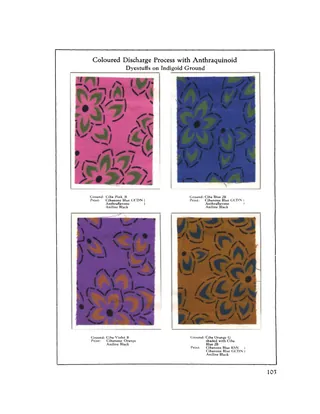
Specimen article from The Melliand on printing with Indigosol dyes, which are water-soluble, stable vat dyes, on cotton and viscose. It covers the chlorate steaming process, the Indigosol Developers, and the nitrite process for combining Indigosols with Rapid Fast Colours. It also covers aftertreatment and gives sample print paste recipes in a table. The two following pages show printed swatches: coloured discharge prints on indigoid grounds, and Naphtol AS combinations and Rapid Fast Colours on artificial mixed fabrics. The article ends with "To be continued".
International New Inventions
The Melliand (specimen), 1929
Article · 26 pages
A specimen section of patent reports from The Melliand (1929) summarizing recent international textile machinery inventions, mostly German, British, French, Czechoslovak, Swiss and American patents from 1924-1926. Entries are short abstracts grouped by process: fibre preparation, artificial silk spinning, spinning and winding, weaving and sizing, knitting and lace, and dyeing and finishing. Coverage includes looms, dobbies, Jacquard harness, pile and velvet cutting wires, shuttles, knitting machines and viscose and acetate silk processes. It is useful for researchers on the history of textile machinery, but contains no weaving drafts.
International Survey of Periodicals
The Melliand (specimen), 1929
Article · 26 pages
A 26-page specimen section of the 1929 Melliand "International Survey of Periodicals", made up of short abstracts of articles from textile journals worldwide, mostly from 1926-1927. The abstracts are grouped by subject: raw materials and fibre preparation, spinning and winding, weaving and loom mechanisms, knitting, bleaching, dyeing, printing, finishing, and artificial silk. Each abstract gives the source journal, the author, and a summary of the article.
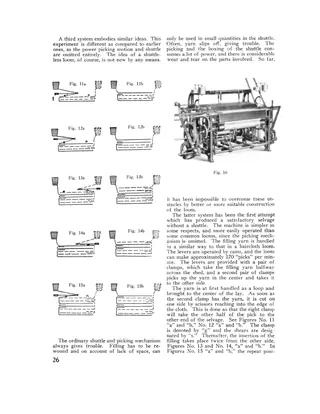
Mechanical Methods to Increase Loom Production
Article · 4 pages
A 1929 survey article by H. Wagenknecht on mechanical ways to raise loom output in the weave room. It covers weaving several cloths side by side or one above another, larger shuttles, automatic bobbin changing, nipper shuttles, and shuttleless looms using clamps, reachers and shears to insert filling from large cones. It ends with a double-shed system using a comb in place of the reed and half-heddles, and uses diagrams to compare the methods.
Modern Points of View in the Construction of Textile Machinery
Article · 6 pages
A 1929 article by consulting engineer Conr. J. Centmaier on design principles for textile machinery. It covers the construction materials (cast iron, steel, aluminium and brass alloys, metal testing methods) and argues for greater attention to static and dynamic forces, noise, and breakage. It also discusses automation, ergonomic control layouts, and electric drives such as individual spindle motors. The article is technical and engineering-oriented, with no weaving drafts.
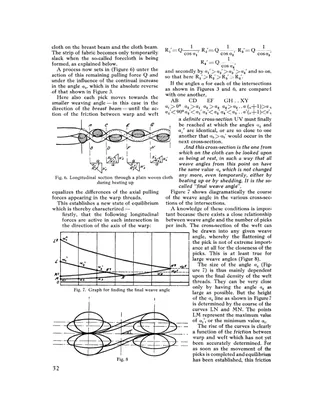
Nature of Plain Weave
Article · 8 pages
A technical article by Dr. Fr. Stein analysing the mechanics of plain weave cloth formation on the loom. It uses force diagrams and the "weave angle" to explain warp and weft tensions, warp contraction, the return of picks after beating up, the final weave angle and pick density, and the forecloth limit. It also treats reed marks, the effect of lease rod rocking on warp spacing, and post-loom shrinkage, crepe effects and curling compared with sateen.
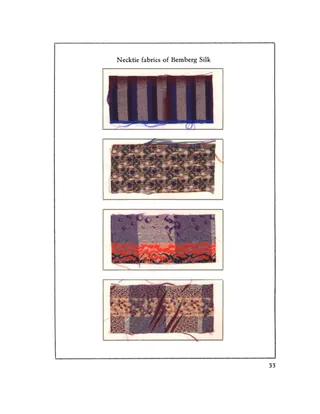
Necktie Fabrics of Bemberg Silk
The Melliand (specimen), 1929
Article · 1 page
A single-page specimen from The Melliand showing four mounted swatches of woven necktie fabric made with Bemberg silk (cuprammonium rayon). The swatches include vertical stripes and small-scale geometric patterns. The page carries only a heading and the samples, with no explanatory text or weaving drafts.
Nekal BX Dry in the Indigo Vat
Article · 2 pages
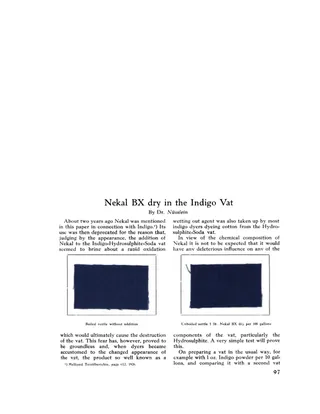
A two-page article from The Melliand by Dr. Nüsslein on using Nekal BX dry, a wetting agent, in the indigo-hydrosulphite-soda vat for dyeing cotton. It reports on how Nekal changes the vat's appearance, the particle size and filtration of precipitated indigo, and the effects on vat stability and shade depth at different concentrations per 10 gallons. The text ends with "To be continued"; two photographs show dyed nettle samples.
New Automatic Adjusting Swift
Article · 2 pages
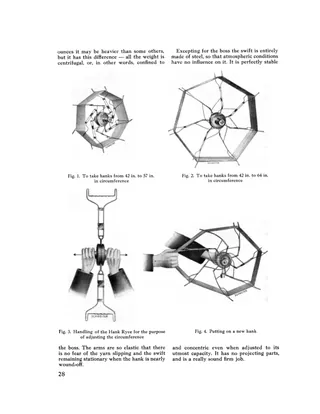
A short trade article from The Melliand describing the Schweiter Hank Ryce D.H. 545, an automatic adjusting swift for holding yarn hanks during winding. It explains the two sizes (hanks of 42 to 57 inches and 42 to 64 inches circumference), the pull-and-turn boss adjustment, and the flexible piano-wire arms. Four diagrams illustrate the swift's sizes, adjustment and loading of a hank.
New Mordant Colours for Cotton Printing
Article · 3 pages
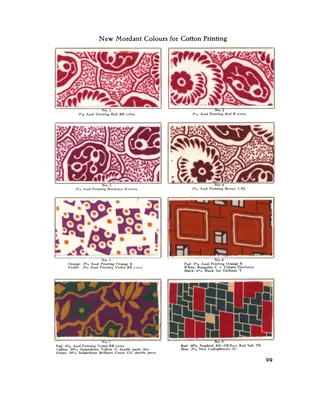
A 1929 specimen from The Melliand on Azol Printing Colours, a new series of chrome mordant dyestuffs from I. G. for printing cotton, especially upholstery goods and hangings. It covers the fastness properties, the available shades, a print-paste recipe with acid starch-tragacanth thickening and acetate of chrome, and steaming, padding and discharge methods. Sample swatch pages give the dye recipes used. The scan also includes a page of swatches from a following article, The Indigosols in Textile Printing by Kerth and Pfeffer.
On the Physics and Chemistry of Dyeing Phenomena: IV. On Phenomena Observed in the Dyeing of Silk and Wool
Article · 8 pages
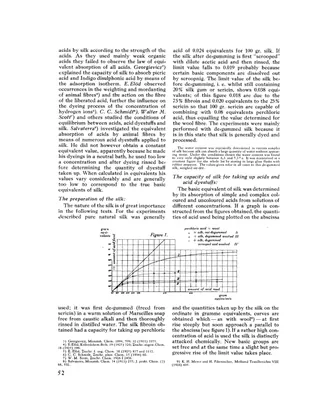
A 1929 article from The Melliand, Part IV of a series on the physics and chemistry of dyeing, reporting experiments on how silk and wool take up acids, acid dyestuffs and o-nitraniline. It gives tables of equilibrium absorption (limit values in gram equivalents per 100 g fibre) for many acids and dye acids on degummed silk, compared with wool, silkworm gut, acetylated wool and casein. The authors conclude that wool fixes 3-4 times more acid than silk, that dyeing involves both salt formation and solution (Henry's law), and discuss solution versus adsorption and the partly crystalline structure of silk. Includes two graphs and eleven data tables.
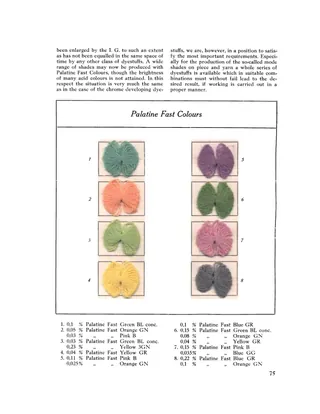
Palatine Fast Colours in Wool Dyeing
Article · 4 pages
A 1929 article by Dr. Nüsslein on Palatine Fast Colours, a class of dyestuffs that behave like chrome-developing dyes in fastness but are applied like acid dyes. It covers the history of colour fastness in wool dyeing, the dyeing method (sulphuric acid, no Glauber's salt), suitable end uses such as suitings, costume cloths, linings and hosiery yarns, and limitations such as milling fastness and cost. A plate of eight dyed swatches lists the dye recipes used.
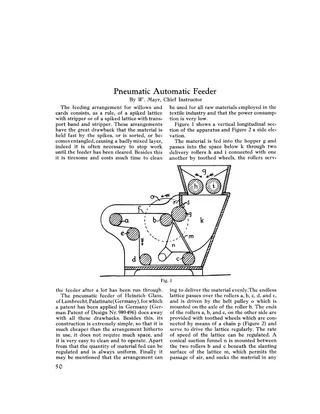
Pneumatic Automatic Feeder
Article · 2 pages
A short 1929 article by W. Mayr describing a pneumatic automatic feeder for willows and cards (opening and carding machinery) in textile preparation, patented by Heinrich Glass of Lambrecht, Germany. It explains how a fan and suction funnel draw raw material onto a moving lattice, with delivery rollers and a fluted roller giving an even, adjustable feed, and notes advantages over spiked-lattice feeders. Two figures show the apparatus in section and elevation, and a closing note covers oiling wool with an automatic spraying device.
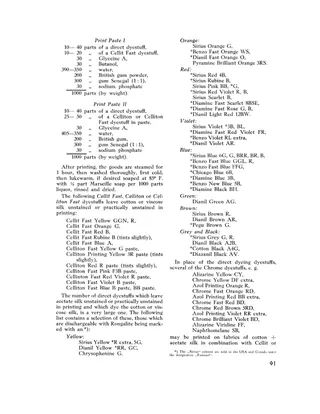
Printing of Acetate Silk and Fabrics Containing Acetate Silk
Article · 6 pages
A 1929 technical article from The Melliand on printing acetate silk (acetate rayon) and fabrics that mix it with other fibres. It surveys dyestuff classes for all-acetate fabrics (basic, acid, mordant, vat, Indigosol, Cellit Fast, Celliton) with fixing and discharge methods. It then covers mixed fabrics of cotton or viscose with acetate, wool with acetate, and real silk with acetate, with sample print paste recipes and dyestuff lists.
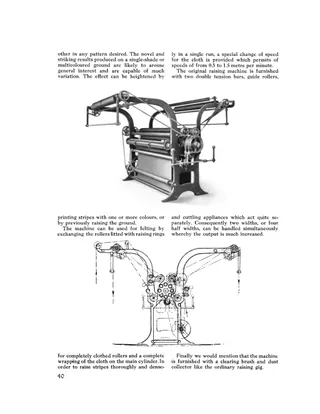
Producing Raised Effects in Stripes on Fabrics
Article · 2 pages
A short 1929 article from The Melliand describing a novel raising (gigging) machine from Ernst Gessner A.-G., Aue, Saxony, which produces longitudinal and wavy striped raised effects on fabric without stencils. Differently fluted raising rollers are positioned in pairs to vary stripe width and pattern. The text covers cloth speed control, tension bars, guide rollers, cutting appliances, handling of multiple widths, use for felting, and combination with printed stripes or a pre-raised ground.
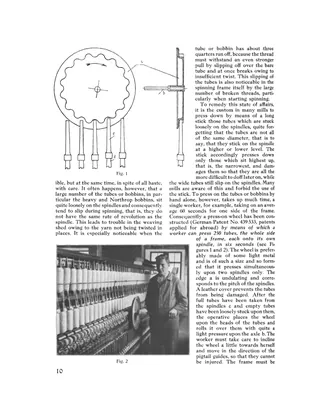
A Rapid Method of Doffing or Changing Bobbins on Spinning or Doubling Frames
Article · 4 pages
A 1929 article by engineer E. Toenniessen describing two devices for speeding up doffing (changing full bobbins or tubes) on cotton spinning and doubling frames: a press-on wheel that seats empty tubes on all spindles of a frame side in seconds, and a press-off fork carriage that lifts 20 to 25 tubes at once. It explains the problems of loose tubes slipping, the drawbacks of pressing them by stick or by hand, and the time savings found in mill trials. Two line drawings and two photographs illustrate the devices, and a recommended doffing procedure is given.
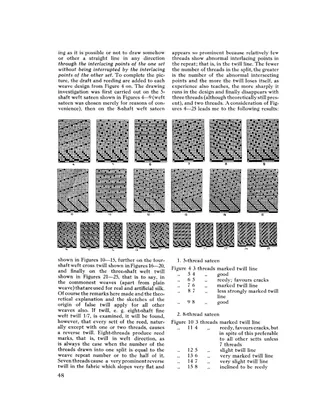
Reeding and False Twill
Article · 4 pages · weaving drafts
A 1929 article from The Melliand on how the choice of reed pitch (number of threads per dent) can produce false twill lines in silk, artificial silk and mixed fabrics. The author uses point-paper drawdowns to predict, before reeding, which reeding is suitable for a given weave and sett. He tests 5-shaft and 8-shaft weft sateens, a 4-shaft cross twill and a 3-shaft twill with 3 to 8 threads per dent, and rates each as good, reedy or showing a twill line. He also discusses the effect of coarse weft and of yarn twist direction, and distinguishes this fault from false twill caused by faulty binding of double cloths.
Sizing of Artificial Silk
Article · 2 pages
A two-page 1929 article on sizing artificial silk (nitro, acetate, viscose and cuprammonium rayon) warps before weaving. It covers hank and beam sizing, sizing machines, the equipment for a size kitchen, and size preparation using farina, wheat starch, dextrin, oil and the diastase Diastafor, with temperatures and mixing procedure. It also discusses problems such as uneven sizing, fuzzing and desizing, and why gelatine sizes are unsatisfactory.
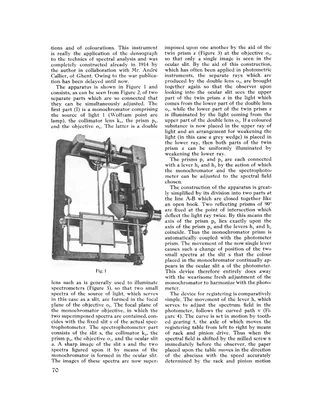
The Spectrodensograph, A Registering Apparatus for Determining the Absorption Curves of Dyestuffs
Article · 5 pages
A 1929 technical article by Professor E. Goldberg describing the spectrodensograph, an instrument that automatically records the absorption curves of dyestuffs. It explains the optical layout (monochromator coupled to a spectrophotometer, grey wedge, twin prism), the registering table and pin that prick the curve onto graph paper, and the method of measurement. It also covers measuring dyed paper and fabric by reflected light and lists the instrument's advantages over conventional spectrophotometers. Illustrated with eight figures of the apparatus and ray paths.
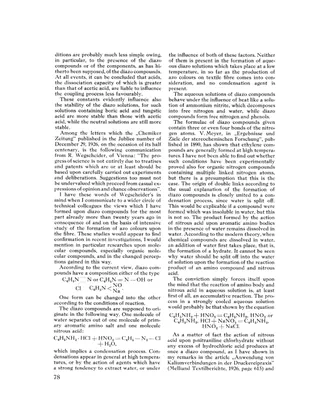
Stable Diazo Printing Colors and a New Explanation of the Constitution of Diazo Compounds
Article · 5 pages
A paper by Dr. W. Sieber, read at the Twelfth Congress of the International Society of Chemists and Colourists in Carlsbad, on stabilizing diazo printing colours used with beta-naphthol prepares on cotton. He reports that boric acid and tungstic acid can replace acetic acid, gives recipes for preparing the stable diazo colours from p-nitraniline, m-nitraniline or p-nitro-o-anisidine, and compares dissociation constants of the acids. The second half proposes a new explanation of the constitution of diazo compounds, arguing that nitrous acid first forms an addition (molecular) compound with the amine rather than a condensation product.
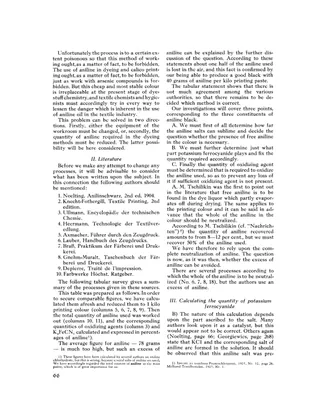
Steam Aniline Black
Article · 5 pages
Article by Professor N. Wosnessensky on steam aniline black for calico printing. It argues that the aniline content of printing colours can be cut sharply because roughly half is lost by evaporation, and it reviews 20 published recipes in a comparative table. It calculates the potassium ferrocyanide and sodium chlorate needed, reports volatility tests on aniline chlorhydrate, tartrate and ferrocyanide, and gives a working recipe using 40 g aniline per kilo of colour, which was used in production at the Trechgornaia Manufaktur.
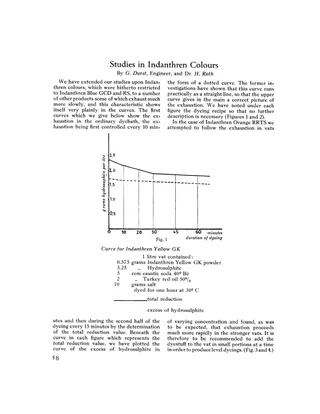
Studies in Indanthren Colours
Article · 4 pages
A short technical article reporting experiments on the vat dyeing behavior of Indanthren colors, extending earlier work on Indanthren Blue to Yellow GK, Brown R and Orange RRTS. Graphs show how dyebath exhaustion and hydrosulphite content change over time and with temperature, caustic soda quantity and vat concentration. The authors also give figures for hydrosulphite loss by oxidation and the caustic soda it consumes, with advice for jigger dyeing.
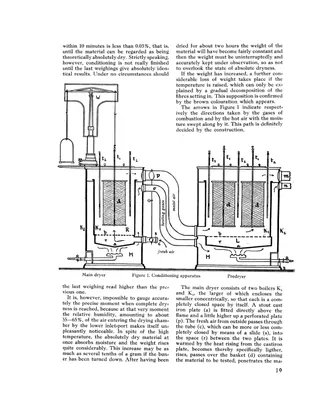
Technical Basis of the Examination of Textile Materials and the Influence of Moisture Thereon
Article · 12 pages
A 1929 article by Professor F. Pichler on the technical basis of testing textile yarns and fabrics, with emphasis on how atmospheric humidity and fiber moisture content affect results. It lists the instruments of a textile testing office and describes the conditioning (drying) apparatus of the Schopper type. It then covers the effect of moisture on yarn number, bundle and tube weights, yarn strength, ash content, and fat extraction. It also gives trade tolerances under the Vienna and Prague exchanges and the German cotton contract, plus a method for determining cotton in union fabrics.
Technical Information
The Melliand (specimen), 1929
Article · 7 pages
A specimen set of 'Technical Information' reader inquiries and replies from The Melliand, a textile trade journal, with page numbers 157-162. Topics include removing oil stains from cotton cloth, milling overcoatings, automatic loom bobbin batteries and take-up motions, jacquard shedding types, sizing bump yarn, jigger dyeing faults, finishing fine shirtings, and purifying recovered milling oil. Each inquiry is followed by several numbered answers from different practitioners, often naming German and Swiss suppliers and giving recipes or mechanical descriptions.
The Use of Weave and Material for Effects in Artificial Silk Fabrics
Article · 5 pages
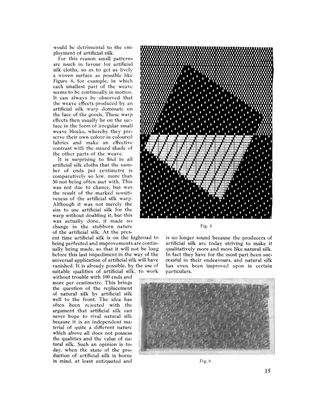
A 1929 trade article by F. Müller on how weave and material interact in artificial silk (rayon) fabrics, especially Jacquard cloths for items such as cravats. It discusses the difficulties of using artificial silk as warp (sizing, close sets, sagging threads), the use of satin, taffeta, twill and plain weaves, draughts-board and block patterns, shot effects from warp and weft stripes, and appliqué-style figuring by changing weave. It closes with comments on artificial silk replacing natural silk and organzine/tram. Six figures show weave plans and Jacquard patterns, but there are no standard weaving drafts.
Which is the Right Side of a Fabric?
Article · 2 pages · weaving drafts
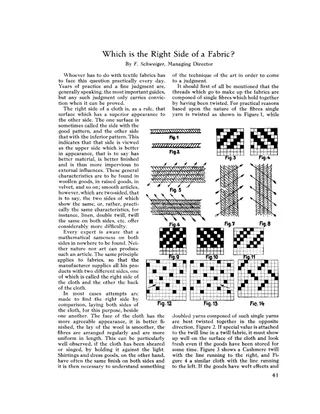
A short 1929 article by F. Schweiger on how to tell the right side (face) of a woven cloth from the back, especially for smooth fabrics that look much the same on both sides. It explains how yarn twist direction (single and doubled yarns) interacts with the direction of the twill line in twill and sateen weaves, and when a right- or left-hand twill gives the better face. Fourteen figures show twist diagrams, twill drawdowns and sateen weaves.
35 documents found