Textile Documents › Authors › Author: C. A. Fisher
3 documents found
Sort: 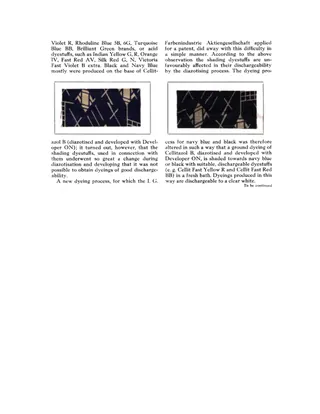
Black and Navy Blue Shades, Dischargeable to White, on Pure Acetate Silk
Article · 2 pages
A short 1929 article from The Melliand by Dr. Fischer on printing pure acetate silk fabrics, especially voiles. It lists dyestuffs that discharge well and explains a new I. G. Farbenindustrie dyeing process in which a Cellitazol B ground is diazotised and developed, then shaded with dischargeable dyes in a fresh bath. This gives black and navy blue that discharge to a clear white. The article is marked "To be continued".
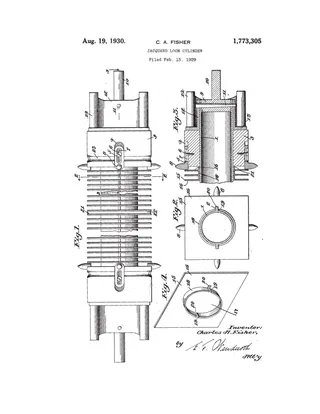
Jacquard Loom Cylinder, US Patent No. 1773305
Patent · 5 pages
US Patent No. 1,773,305, granted August 19, 1930 to Charles A. Fisher of Kannapolis, North Carolina (filed February 15, 1929), for an improved Jacquard loom cylinder. The cylinder is built from thin rectangular plates spaced along a shaft, so the needles enter the gaps rather than striking solid sides, and a damaged plate can be replaced without replacing the whole cylinder. The document has a drawing sheet with four figures, the specification describing the shaft, heads, pins for card tapes, spacing flanges and collars, and 17 claims.
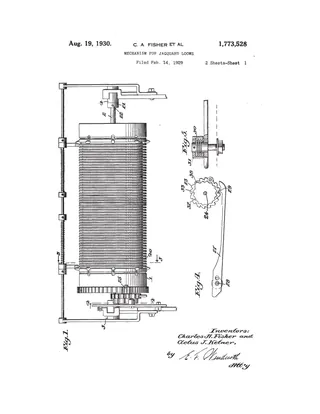
Mechanism for Jacquard Looms, US Patent No. 1773528
Patent · 6 pages
US Patent 1,773,528, granted 19 August 1930 to Charles A. Fisher and Cletus J. Ketner of Kannapolis, North Carolina, assignors to Cannon Mills Company. It describes a Jacquard card cylinder that advances in small steps of one row of perforations instead of a whole card, so one card serves 8 or 12 picks when weaving narrow figures, saving about 90% of cards. The mechanism uses a ratchet, pawl, and detent cam, and the cylinder has continuous circumferential grooves in place of individual holes so vertical misalignment with the needles cannot cause defects. The scan has two sheets of drawings, the specification, and seven claims.