Textile Documents › Publications › Publication: Ancient Egypt
3 documents found
Sort: 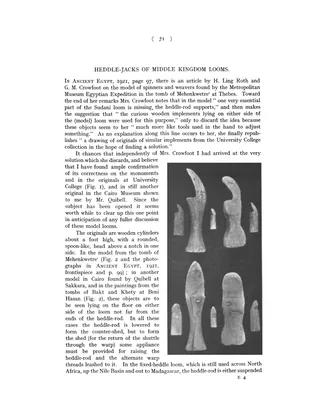
Heddle-Jacks of Middle Kingdom Looms
Article · 4 pages
Article arguing that the small wooden cylinders with spoon-shaped heads found beside Middle Kingdom Egyptian model looms and shown in tomb paintings are heddle-rod jacks. The author reasons from the models, tomb scenes at Beni Hasan and Thebes, and originals at University College and Cairo, and tests the idea with a working model loom. He concludes that the heddle was movable, with jacks set up and knocked out for every two shuttle shots, and that the fixed-heddle looms of Libya and the Sudan descend from it. Fig. 2 compares ancient tomb drawings with diagrams of the working model.
Loom Weights in Egypt
Article · 3 pages
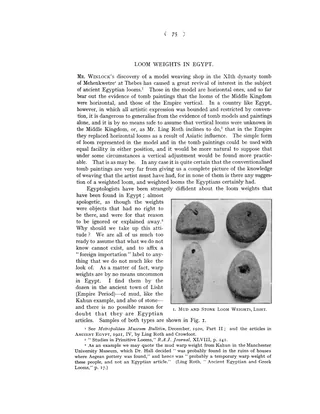
Short 1922 article by A. C. Mace arguing that warp-weighted looms were used in ancient Egypt, based on mud and stone loom weights found in large numbers at the Empire-period town of Lisht. Mace argues that tomb paintings and models give an incomplete picture of Egyptian looms and criticizes the tendency to dismiss the weights as foreign. He suggests the weights were used on a two-beam loom, comparing it to a modern pit treadle loom at Maharraqa near Lisht in which bunched warp threads are held taut by stone weights. Illustrated with a photograph of the modern loom and a photograph of the Lisht weights.
Models of Ancient Looms
Article · 7 pages
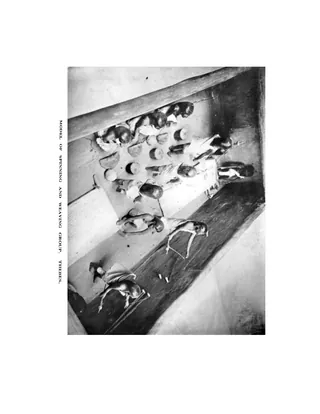
Two-part note on the model of Egyptian textile work found in an XIth dynasty tomb at Thebes by Winlock and Burton. H. Ling Roth describes the model from photographs, comparing its flax preparation, spinning, warping and two horizontal looms with the XIIth dynasty wall drawing in the tomb of Tehuti-hetep. G. M. Crowfoot then compares the model with spinning, warp laying on pegs and horizontal two-beam looms she saw in the Sudan, and discusses the puzzling wooden implements beside the looms. Illustrated with the model, the wall drawing and diagrams of a Sudani warp and wooden implements.