Textile Documents › Publications › Publication: Journal of The Royal Anthropological Institute of Great Britain and Ireland
7 documents found
Sort: 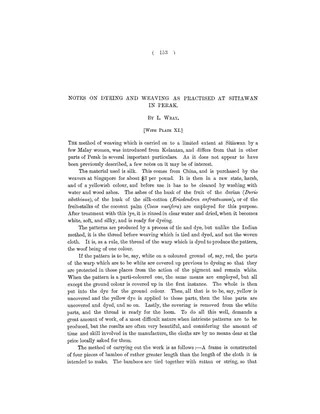
Notes on Dyeing and Weaving as Practised at Sitiawan in Perak
Article · 4 pages
A short 1902 article by L. Wray describing silk weaving by Malay women at Sitiawan in Perak, a method introduced from Kelantan. It explains how raw Chinese silk is degummed with ash lye, how warp bundles are tied with waxed thread and banana-stem strips on a bamboo frame, and how they are dyed in stages with lac, kadrang, turmeric and purchased blue and green dyes. It also describes a diamond-patterned sarong with gold-thread weft and the supplementary gold flower patterning added during weaving. A plate shows the tied warp on the frame and a silk sarong in the Perak Museum.
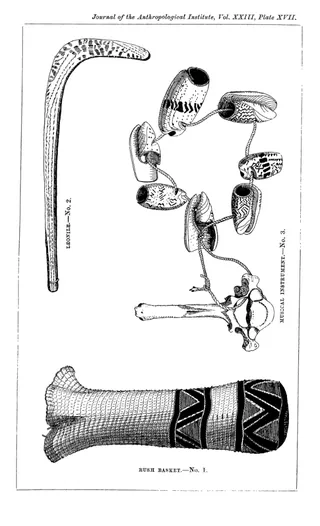
On an Unusual Form of Rush Baskets from the Northern Territory of South Australia
R. Etheridge Jr. · Journal of The Royal Anthropological Institute of Great Britain and Ireland, 1894
Article · 3 pages
A short 1894 article by R. Etheridge Jr. describing an unusual cylindrical rush basket with a bell-shaped mouth, collected from the Alligator Rivers Tribe in the Northern Territory of South Australia. It gives dimensions, the stake-and-siding plaiting structure, the twisted-fibre rim, and the decoration in black bands, white pipe-clay and Indian red triangles. It compares the form with other Australian aboriginal baskets, and Plate XVII illustrates the basket together with a leonile and a musical instrument.
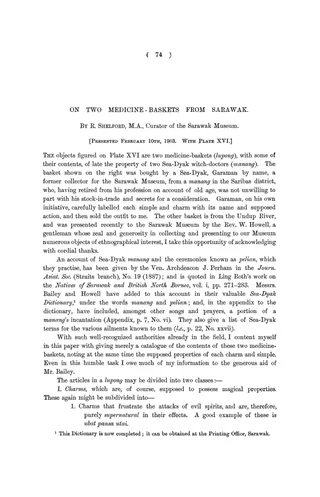
On Two Medicine-Baskets from Sarawak
Article · 9 pages
A 1903 article by R. Shelford, Curator of the Sarawak Museum, cataloguing two medicine-baskets (lupong) that belonged to Sea-Dyak witch-doctors (manang), one from the Saribas River and one from the Undup River. It describes the construction of the baskets, including wooden bodies covered with plaited rattan, and lists each charm and simple inside with its Dyak name, material and supposed use. It also discusses Sea-Dyak beliefs about the soul (samengat). Plate XVI shows photographs of the baskets and their contents.
Studies in Primitive Looms
Article · 26 pages · weaving drafts
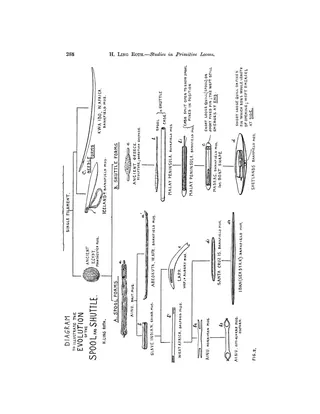
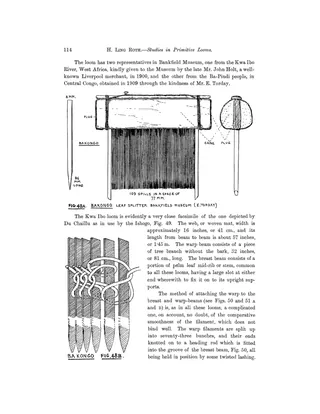
H. Ling Roth's 1916 anthropological article on primitive looms, from the Journal of the Royal Anthropological Institute. It defines loom terms (warp, weft, shed, heddle, lease rods, warp spacer, reed) and traces the evolution of the spool and shuttle. It then describes the Ainu backstrap loom in detail from museum specimens, and surveys looms from North and South America (Slave Indian quill belt loom, Hopi, Kachiquel, Uitoto, Peruvian, Apache, and a Mazatec gauze loom). The article is illustrated with many line drawings of loom parts, tools and warp layouts, and includes a plate of the Mazatec loom.
Studies in Primitive Looms
Article · 39 pages · weaving drafts
Part II of H. Ling Roth's series on primitive looms, covering African looms. He identifies seven forms: vertical mat loom, horizontal fixed heddle loom, vertical cotton loom, horizontal narrow band treadle loom, pit treadle loom, Mediterranean or Asiatic treadle loom, and the "carton" loom. The text describes museum specimens (Bankfield, Liverpool, Glasgow, Edinburgh, Brighton, British Museum) from Kwa Ibo, Ba-Pindi, Old Calabar, Madagascar, Nyasaland, Abeokuta and Opobo, with dimensions, warp attachments, heddles, selvedges, needles, spools, reeds and shuttles. It has many line drawings and diagrams, including pattern-heddle and herring-bone rod threading diagrams for the vertical cotton loom. It ends with a tentative distribution map of loom types in Africa and discussion of their origins.
Studies in Primitive Looms
Article · 44 pages · weaving drafts
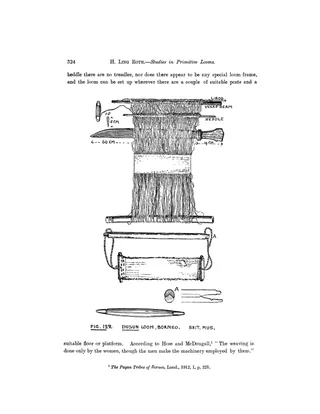
Part III of H. Ling Roth's comparative study of primitive looms, covering Indonesian looms (Dusun, Iban/Sea Dyak, Ilanun, Igorot, Bugis, Malay, Javanese, Cambodian) and the related Bhotiya, Korean, Santa Cruz and Caroline Islands looms. It describes loom parts such as warp beams, laze rods, heddles, sword beaters-in, temples, spools and reeds, with museum specimen dimensions, thread counts and comparison tables. Roth traces the evolution of the reed from a pegged warp spacer, discusses the migration of the Santa Cruz loom across the Pacific, and notes ritual practices tied to weaving. Numerous line drawings and a migration map accompany the text.
Studies in Primitive Looms
Article · 42 pages
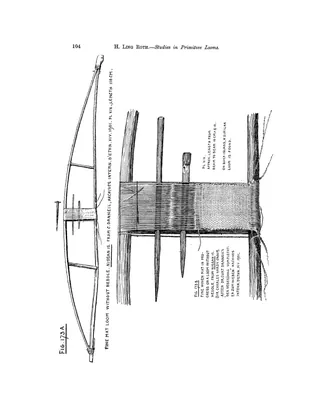
Concluding part (Part IV) of H. Ling Roth's series on primitive looms, from the Journal of the Royal Anthropological Institute, 1918. It describes and compares the Solomon Island (Nissan/Buka) frame loom, a Lapp braid loom with bone heddle, Norwegian and English rigid-heddle looms, Oriental vertical mat looms (Ceylon, Hong Kong, Ainu), upright and warp-weighted looms from classical sources (the Vatican Virgil, Braunius) and Egypto-Greek models, and Indian and Turkish rug looms. It also examines toothed beaters-in and bone combs from Mortlake, Kent's Cavern and Glastonbury, disputing their interpretation as weaving tools, and closes with a discussion of the origin and distribution of looms, arguing for independent invention in some cases. Illustrated with many line drawings of looms and tools.
7 documents found