Textile Documents › Publications › Publication: Harper's New Monthly Magazine
35 documents found
Sort: 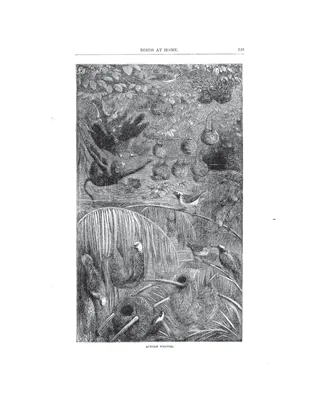
African Weavers (Birds)
Illustration · 1 page
A single engraved illustration from Harper's New Monthly Magazine showing African weaver birds in a tropical setting. Several birds perch or hang from branches around pendant nests of woven grass, with some nests shown in cross-section. The page carries the running head "Birds at Home" and the caption "African Weavers"; it concerns the nest-building of birds rather than human weaving.
Among the Silk-Worms and Velvet Looms
Harper's New Monthly Magazine, c. 1870
Article · 11 pages
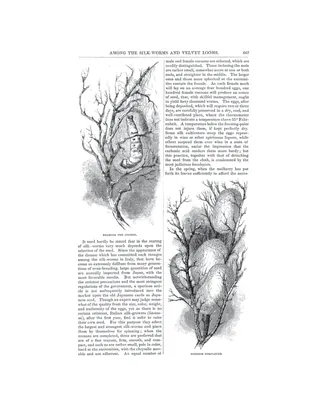
An illustrated article from Harper's New Monthly Magazine on sericulture in Italy and the silk and velvet industry. It covers the history of silk from China and India to Europe and America, the life cycle and moults of the silk-worm, cocoonery construction, feeding, seed selection, and cocoon yields and prices. It ends briefly with reeling and throwing silk, velvet weaving in Genoa on home looms using wires and a third warp, and how satin is woven.
Bamboo
Illustration · 1 page
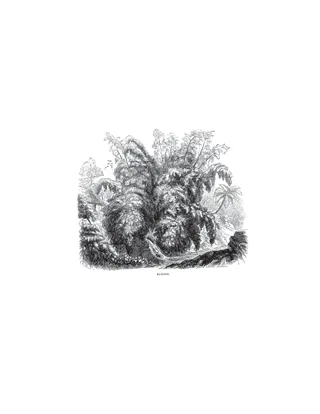
A single-page engraved illustration titled "Bamboo" showing a dense bamboo grove with tall feathery stalks and arching foliage. A palm tree stands at the right, a small thatched hut at the left, and a stream or waterfall runs through the lower center. The only text is the caption.
Basket Seller
Illustration · 1 page
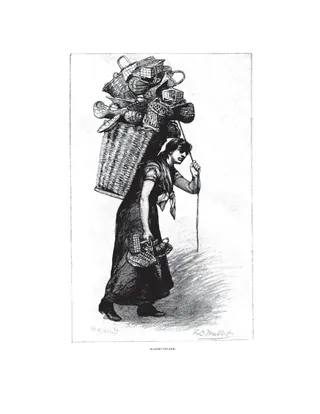
A single engraved illustration titled "Basket-Seller" from Harper's New Monthly Magazine, 1885. It shows a woman walking with a staff, carrying a large load of woven baskets on her back and head and holding smaller baskets in her hand. The page has only the caption and no accompanying article text.
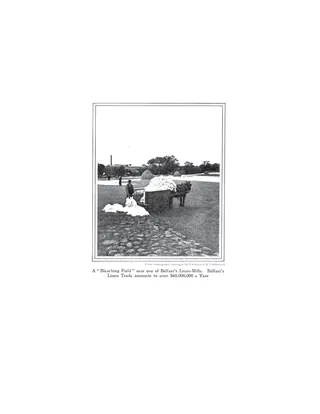
[Bleaching Field Near One of Belfast's Linen Mills]
Illustration · 1 page
A single-page photograph of a bleaching field near one of the linen mills in Belfast, reproduced from a stereograph. It shows a horse-drawn cart loaded with white linen bundles, a man standing beside a pile of cloth, and mill buildings and a chimney in the background. The caption notes that Belfast's linen trade amounted to over $60,000,000 a year.
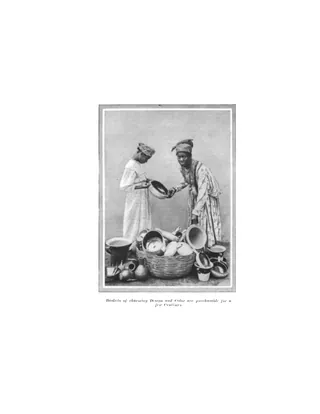
[Caribbean Basketry]
Illustration · 2 pages
Two halftone photographs with captions, apparently from Harper's New Monthly Magazine, showing Caribbean basketry. One shows a seated woman among round and rectangular baskets and bundles, captioned as baskets of charming design and color purchasable for a few centimes. The other, captioned "A Martinique Basket-maker," shows a standing man beside a seated figure surrounded by baskets and a large basket-work piece. No weaving drafts or technical descriptions are included.
Coloring Matter in Coal Tar
Article · 1 page
A short magazine item from Harper's New Monthly Magazine on the coloring matter obtainable from coal tar, a by-product of gas manufacture. It traces the yield chain from tar to benzole, nitro-benzole, rosaniline, aniline red and pure fuchsine, and estimates how much coal is needed per pound of fuchsine and the potential annual output from European gas-works.
Cotton and its Cultivation
Article · 17 pages
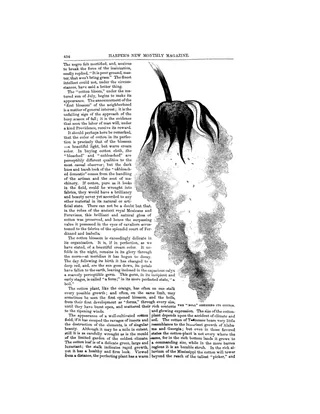
An illustrated 1850s magazine article on the history, botany, and cultivation of cotton, written from the viewpoint of a Louisiana planter. It covers cotton's early use in Egypt, Asia, and Europe, its varieties, its introduction into the United States, and Eli Whitney's invention of the saw-gin. It also describes the planting, picking, ginning, and baling cycle on Southern plantations, with engravings of the plant, bloom, and boll. The final sections cover Christmas customs on plantations and the question of England's dependence on American versus Indian cotton.

Crochet
Other · 1 page
A single-page poem titled "Crochet" in which the speaker reflects on her devotion to crochet work. She compares the crochet hook to Izaak Walton's fishing hook, and compares her thread to the thread spun by Clotho, the Fate of Greek myth, and to the thread of life. She also treats a hidden knot in the worsted as a figure for concealed sorrow. It has no instructions or patterns and is of interest as literary and cultural material on women's needlework.
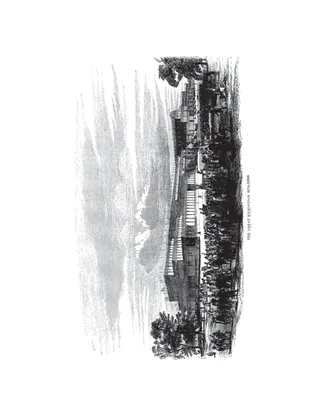
Crystal Palace
Harper's New Monthly Magazine, c. 1851
Article · 4 pages
A mid-19th-century magazine article on the Crystal Palace, built in Hyde Park for the Great Exhibition of 1851 in London. It tells how Joseph Paxton's glass-and-iron design, inspired by his greenhouse for the Victoria Regia lily, replaced the Building Committee's own plan. It then gives the building's dimensions, construction methods, ventilation and drainage, interior color scheme, cost, and proposed future use. One page carries an engraving of the building's exterior.
Dyeing Alpaca with Iodine Green
Article · 1 page
A short note from the Editor's Scientific Record in Harper's New Monthly Magazine describing a procedure for dyeing alpaca cloth with iodine green. It gives approximate quantities for the dye bath (iodine green, spirit of sal ammoniac, sulphuric acid, soda water-glass) and the sequence of baths, including a hot tannin solution and a final acid bath.
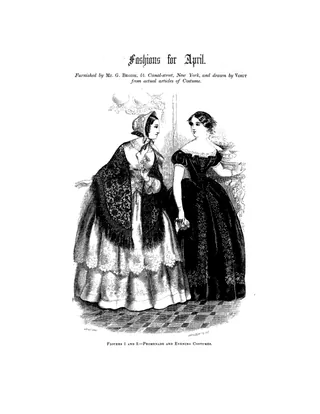
Fashions for April
Harper's New Monthly Magazine, April 1854
Article · 2 pages
A two-page fashion feature from Harper's New Monthly Magazine, April 1854, with engraved plates of promenade and evening costumes, a chemisette, a sleeve and a child's dress. The text describes the bonnet, guipure mantilla, taffeta and velvet dresses, trimmings and a merino child's dress with embroidery. Fabrics and trims such as blonde lace, guipure, quilling and silk fringe are named. The plates were drawn by Voigt from articles supplied by G. Brodie of New York.
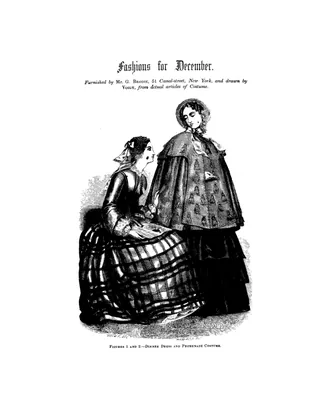
Fashions for December
Harper's New Monthly Magazine, December 1853
Article · 2 pages
A two-page fashion column from Harper's New Monthly Magazine, December 1853, with engraved plates of a dinner dress, a promenade cloak and a bonnet. The text describes winter styles: plaid silks and Irish poplin, flounced skirts, jacket bodices, wide sleeves, cloaks and mantillas, and bonnets of velvet, satin and lace. It gives details of fabrics, colors and trimmings such as moire antique, Maltese lace and fringe.
Fashions for Early Summer
Article · 3 pages
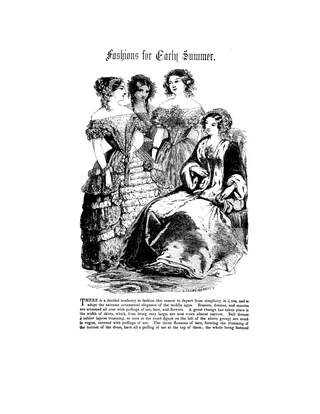
A three-page fashion report from Harper's New Monthly Magazine describing women's styles for early summer 1850. It covers ball dresses trimmed with puffings of net and lace, flowered and fruit wreaths, light chiné and barège silks, worsted lace mantle trimmings, pagoda sleeves, straw and tulle bonnets, and black lace jackets. Engraved fashion plates show the dresses, promenade hats, a tulip bonnet and a lace jacquette.
Fashions for February
Harper's New Monthly Magazine, February 1854
Article · 2 pages
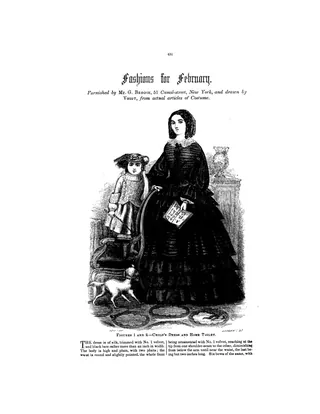
A two-page fashion plate article from Harper's New Monthly Magazine, February 1854, with engraved figures supplied by a New York dealer, Mr. G. Brodie. It describes a child's silk dress with velvet and black lace trim, a green velvet bonnet with ostrich feather, a cap of silk ribbon and lace, and a boy's black velvet hat. A general commentary covers current styles in bodices, sleeves, flounced skirts, plaid dress fabrics, cashmere trimmings and bonnet shapes.
Fashions for March
Harper's New Monthly Magazine, March 1854
Article · 1 page
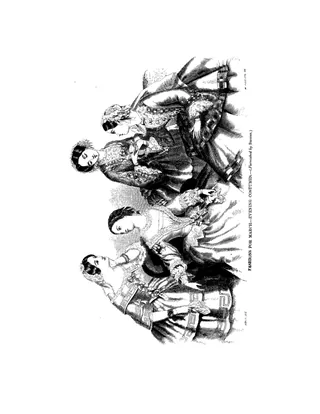
A single-page engraved fashion plate of evening costumes for March, furnished by Brown, from Harper's New Monthly Magazine. It shows four women in evening dress, including a bodice and skirt border with a Greek-key pattern. The page carries only a caption, with no descriptive text about fabrics or construction.
Fashions for May
Harper's New Monthly Magazine, May 1854
Article · 2 pages
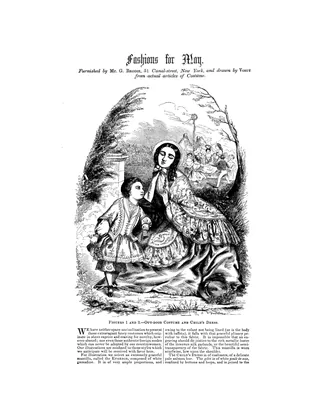
A two-page fashion plate article from Harper's New Monthly Magazine, May 1854, with engravings of women's and children's clothing supplied by a New York dealer. It describes an Eugenie mantilla of white grenadine with inwoven silk garlands, a child's cashmere dress and Leghorn hat, and several bonnets and caps trimmed with blonde lace, ribbon, flowers and feathers. The text gives fabrics, trimmings and colors for each figure.
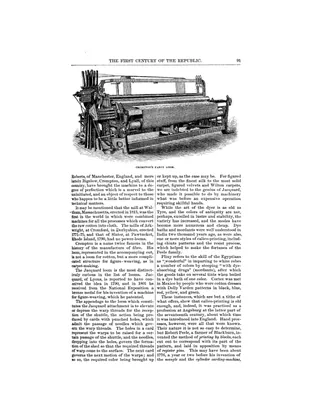
First Century of the Republic, Second Paper: Cotton Manufacture
Article · 8 pages
A popular 1874 magazine article on the history of cotton manufacture, written for Harper's series on the first century of the United States. It traces cotton from antiquity and its arrival in Europe and America through the cotton gin, carding, and the spinning machines of Hargreaves, Arkwright and Crompton (jenny, water frame, mule). It then covers the power loom, the Jacquard attachment, and calico printing and dyeing, with engravings of the main machines.
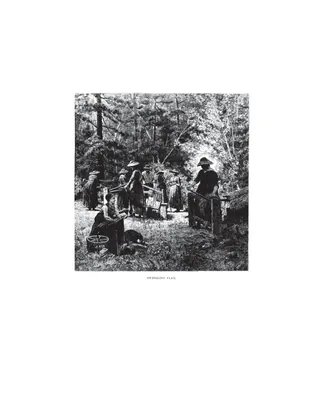
Flax Swingling in Canada
Illustration · 1 page
A single-page wood engraving from Harper's New Monthly showing flax swingling in Canada. Several workers, mostly women in long skirts and wide-brimmed hats, stand and kneel at wooden swingling benches in a forest clearing, beating flax to separate the fibre. The only printed text is the caption "Swingling Flax."
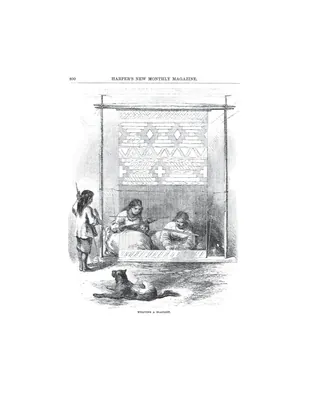
(Indians) Weaving a Blanket
Illustration · 1 page
A single page from Harper's New Monthly Magazine bearing a wood engraving titled "Weaving a Blanket." It shows two Native American women working at an upright loom on a blanket with geometric patterning (diamonds, zigzags, crosses), while a standing man with feathers in his hair looks on. There is no text beyond the caption and running head.
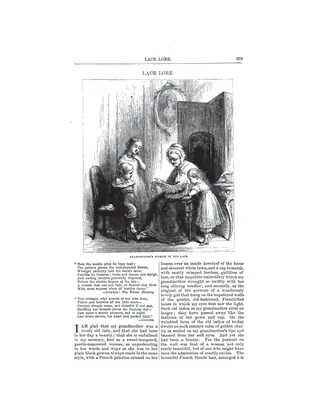
Lace Lore
Article · 11 pages
A popular 1876 essay on the history and legends of lace, framed as a grandmother's stories. It covers the legend of Venice point, early and ancient references to lace, Colbert's founding of Point de France at Alençon in 1665, and the lace industries of Belgium, France and England (Honiton). It also tells the legends of St. Jean François Regis, patron saint of lace-workers, and of Barbara Uttman of Annaberg, and includes a footnote on how pillow and needle lace are made. Illustrated with engravings of lace specimens (Venice point, Mechlin, Alençon, Honiton), lace-trimmed canons and a pillow lace-maker after Martin de Vos.
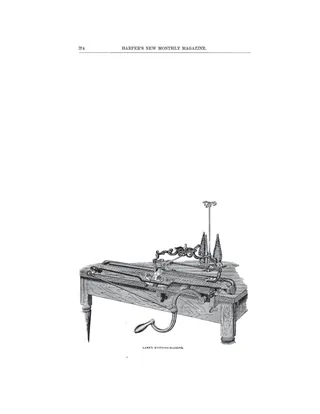
Lamb's Knitting Machine
Illustration · 1 page
A single magazine page with an engraving of Lamb's knitting machine, printed in Harper's New Monthly Magazine. The illustration shows a table or stand with turned legs supporting a cast-iron knitting frame with a row of needles, ornamental scrollwork, and yarn cones or spools on upright supports. Only a caption is given on the page, with no descriptive article text.
New Vegetable Fibres
Article · 1 page
A short magazine item on newly promoted vegetable fibers, China grass and ramie, both species of the nettle genus Boehmeria. It describes the fiber qualities, compares fiber cell length with cotton and flax, and notes that ramie was being grown in the warmer United States from seeds distributed by the Agricultural Department. It also covers the plant's yield, its traditional use for nets in the Indian Archipelago, and its use spun alone or mixed with wool or cotton.
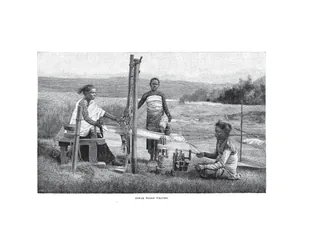
Newar Women Weaving
Illustration · 1 page
A single-page engraving titled "Newar Women Weaving," showing three Newar women weaving outdoors in a grassy field with trees and hills in the background. One woman sits at a loom made of wooden posts and cross-bars, and another stands nearby. The only text is the caption. It is useful as a 19th-century visual record of Nepalese hand weaving and loom construction.
[The Plough, the Loom, and the Anvil]
Article · 2 pages
A short review from the Literary Notices section of Harper's New Monthly Magazine of volume 2 of The Plough, the Loom, and the Anvil, a monthly journal edited by J. S. Skinner of Philadelphia. The reviewer describes its argument for harmony among agriculture, manufacturing and the mechanical trades, and for importing people rather than manufactured goods such as iron and cloth. It also gives practical details: 64 pages monthly, $3 for one subscriber or $5 for two.
Rheea, or China Grass
Article · 1 page
A single magazine page from Harper's New Monthly Magazine (1870) on rheea, or China grass (ramie), a fibre plant of the nettle family. It reports the Indian government's $25,000 prize, announced January 11, 1870, for a machine that can separate the fibre from the stem and bark cheaply. It also notes that rheea and ramie both come from Boehmeria tenacissima and that ramie was being distributed in the United States.
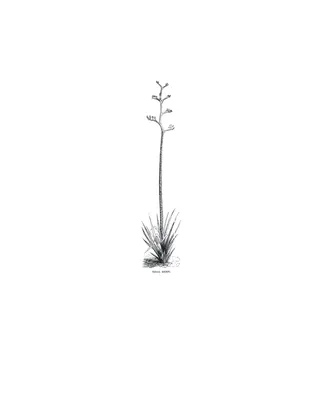
Sisal Hemp
Illustration · 1 page
A single engraved illustration of the sisal hemp plant (Agave sisalana) from Harper's New Monthly Magazine, 1871. It shows a rosette of long, pointed, sword-like leaves with a tall, branching flowering stalk. The page carries only the caption "Sisal Hemp" and no accompanying article text.
Spider's Silk
Harper's New Monthly Magazine, c. 1850-1851
Article · 2 pages
A two-page magazine article, reprinted from Dickens's Household Words, on early eighteenth-century attempts to use spider silk as a textile fibre. It describes M. Bon's collection of silk spiders, his cleaning, boiling and carding of their egg cocoons, and the gloves and stockings he made from the silk. It also covers M. Reaumur's objections: the thread was weaker, the lustre poorer, the spiders cannibalistic, and the yield too small. The article closes by calling spider silk an untried raw material.
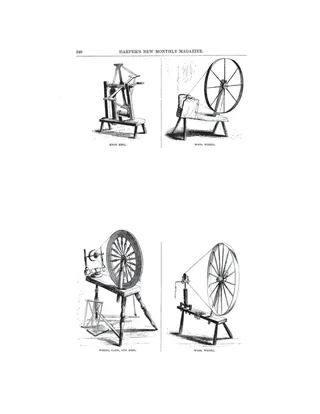
Spinning Wheels of 1776
Illustration · 1 page
A single magazine page of four wood engravings showing colonial-era spinning equipment: a knot reel, two wool wheels, and a group of a wheel, card, and reel. Captions are brief and there is no running text on the page. It is useful as a visual reference for American hand-spinning tools of the 18th century.
The Tapestry Weavers
Illustration · 1 page
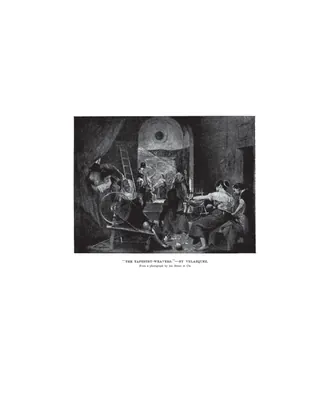
A single-page reproduction of Velázquez's painting 'The Tapestry Weavers' (Las Hilanderas), printed in Harper's New Monthly and taken from a photograph by Ad. Braun et Cie. It shows a dim workshop with a large arched opening in the background, where a tapestry with figures is visible, and a ladder against the left wall. The page has only the caption and credit, with no article text or weaving drafts.

Value of Bamboo as a Fiber
Article · 1 page
A short note from Harper's New Monthly Magazine on the growing commercial importance of West Indian bamboo as a fibre. It reports large exports from Jamaica to the United States and describes crushing the bamboo between mill rollers and baling it with a screw press to reduce bulk and freight costs. It also refers back to an earlier item on palmetto leaves as a textile material.
Weaving
Illustration · 1 page
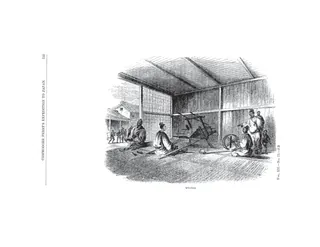
A single-page wood engraving from Harper's New Monthly Magazine showing a Japanese weaving workshop with an open front and wooden-framed walls. A seated woman works a loom with a warp beam and a sword-like beater, while a second seated woman tends a large piece of equipment. The page belongs to the magazine's coverage of Commodore Perry's expedition to Japan.

Weaving Among Lake-Dwellers
Harper's New Monthly Magazine, c. 1860-1880
Article · 2 pages
A short note from the Editor's Scientific Record summarizing a paper by Dr. Weigert on spinning and weaving remains from the Swiss pile dwellings. It reports that flax was widely grown and made into thread, rope, plaited mats and other fabrics even in the Stone Age, and that stone and clay spindle whorls are common finds. Weigert concludes the lake-dwellers used a vertical-warp loom, as the Greco-Italian peoples did, unlike the horizontal loom of India and Egypt, and argues from this that European culture developed independently.
Whitening Linen
Article · 1 page
A short magazine item on whitening linen laundry, reporting a French writer's claim that crystallized carbonate of soda weakens linen fibre. It describes an alternative wash solution of soap, warm water, turpentine and ammonia, with instructions for soaking, rinsing and reusing the solution, and claims it saves time, labor and fuel without harming the cloth.
Ygorrote Woman Weaving
Illustration · 1 page
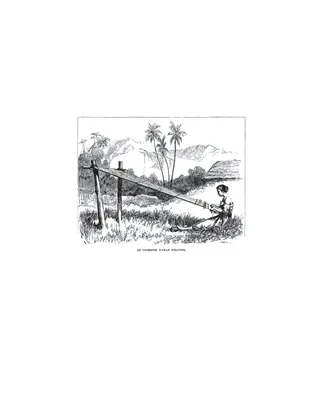
A single engraved illustration captioned "An Ygorrote Woman Weaving," showing a seated woman at a backstrap-style loom stretched between two upright posts. The setting includes palm trees, a thatched hut, and mountains. It was published in Harper's New Monthly in 1876 and documents Philippine (Igorot) weaving practice as seen by a 19th-century Western audience.
35 documents found