Textile Documents › Topic: Ancient and archaeological textiles
272 documents found
Sort: 
Ancient Egyptian Textiles - Abu Seiffein
Article · 1 page
A one-page article by Cherilyn Nelson on textiles recovered in the winter of 1981 from the churchyard of Abu Seiffein, a Coptic cemetery in Akhmim, Egypt. It describes the site, burial customs, coffin types, and how bodies were clothed, along with the plain, striped and checked fabrics and a sheer garment called a shala. It also outlines how the textiles were handled, catalogued and divided between Egyptian museums and the University of Minnesota, whose Akhmim project made the excavation.
[Ancient weavers and their art, from Antiquity Explained]
Article · 2 pages
A short excerpt from Montfaucon's Antiquity Explained discussing what surviving ancient monuments and manuscripts reveal about weavers and their craft. It describes figures of women spinning, dressing cloth, and weavers standing at the loom, citing the Vatican Virgil (4th century) and a 10th-century commentary on Job in the King's Library. A engraved plate shows classical-style figures handling cloth and a loom.
Notes on Chinese Silk Found in the South of Russia
Article · 10 pages
Translated article by N. P. Toll on a small piece of Chinese silk with a rhomb (lozenge) pattern found in a first- or second-century A.D. burial mound at Kerch in the Crimea. Toll dates the burial from the associated carved cypress tripod, compares the pattern with Chinese silks from Lou-lan and Mongolia and with Chou-dynasty bronze ornament, and argues the silk is Chinese rather than Roman or Egyptian. The second half reviews trade routes by which Chinese silk could reach southern Russia: the Mediterranean land and sea routes and a northern steppe route described by Herodotus, Pliny, Strabo and Chinese chronicles, including Hiung-nu silk trade. Illustrated with a plate of the Kerch silk, line figures and two maps.
Society of Arts Lectures. Egyptian Tapestry
Article · 3 pages
Continuation of Alan S. Cole's Society of Arts lecture on Egyptian tapestry, published in The Textile Mercury, 19 Oct. 1889. It discusses Akhmim tunic bands, panels and cloths woven in purple wool and flax, and traces their Roman, Persian, Sassanian, Greek and Byzantine parallels in mosaics, sculpture, metalwork and ivories. Subjects covered include Hermes, horsemen, birds, lion-slaying scenes, animal bands and a winged angel. The scan also includes the preceding trade news and two short miscellaneous items.
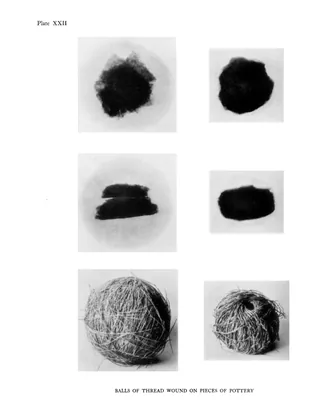
Balls of Thread on Pieces of Pottery
Article · 2 pages
A short note describing X-ray photographs of two balls of linen thread in the Metropolitan Museum of Art, dated to about 1200-1000 B.C. (Twentieth to Twenty-second Dynasties). The X-rays show that the Egyptians wound thread around small pottery fragments used as cores. The author notes similar worked potsherds found without thread at Lisht, and a thumb-hole in the smaller ball. A plate of six photographs shows the balls and their X-rays.
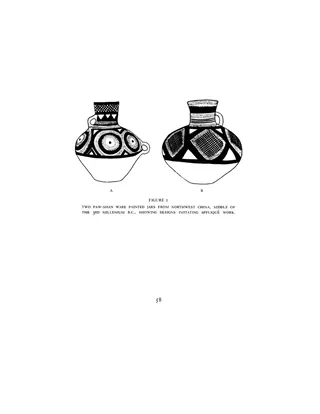
Early Textile Production in China
Article · 12 pages
Article by Phyllis Ackerman on the origins and organization of textile production in ancient China, drawing on archaeology, painted Pan-shan pottery, and Chinese tradition. She argues that pottery designs copy appliqué needlework and point to silk by the mid-third millennium B.C. She also discusses Shang silk fragments from An-Yang, including a dispute over whether they show twill, and Chou-period domestic production by peasant women. Footnotes with sources appear at the end.
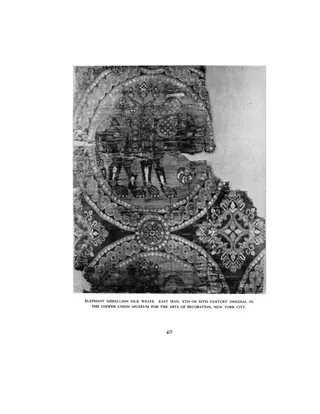
Elephant Medallion Silk in the Cooper Union Museum
Article · 5 pages
Article from the Bulletin of the Needle and Bobbin Club on a medieval silk with an elephant medallion design, formerly in a Spanish church and now in the Cooper Union Museum, New York. It describes the weft-twill technique (single warp, three wefts of white, red and yellow), compares the piece with the Aix-la-Chapelle elephant silk and with Aurel Stein's lion silk from Turkistan, and discusses its dating and attribution (East Iran, 10th-11th century). A frontispiece photograph shows the textile; there are no weaving drafts.
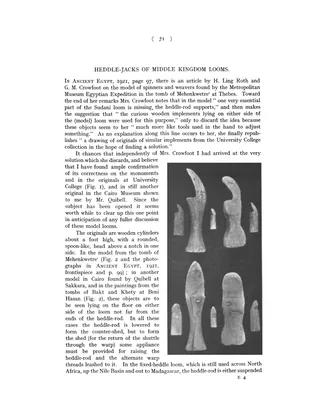
Heddle-Jacks of Middle Kingdom Looms
Article · 4 pages
Article arguing that the small wooden cylinders with spoon-shaped heads found beside Middle Kingdom Egyptian model looms and shown in tomb paintings are heddle-rod jacks. The author reasons from the models, tomb scenes at Beni Hasan and Thebes, and originals at University College and Cairo, and tests the idea with a working model loom. He concludes that the heddle was movable, with jacks set up and knocked out for every two shuttle shots, and that the fixed-heddle looms of Libya and the Sudan descend from it. Fig. 2 compares ancient tomb drawings with diagrams of the working model.
Loom Weights in Egypt
Article · 3 pages
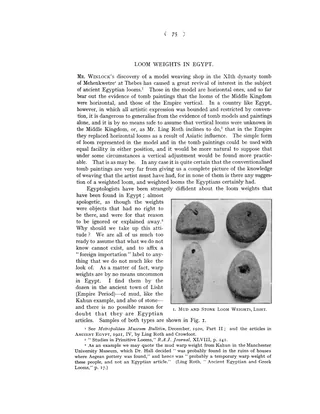
Short 1922 article by A. C. Mace arguing that warp-weighted looms were used in ancient Egypt, based on mud and stone loom weights found in large numbers at the Empire-period town of Lisht. Mace argues that tomb paintings and models give an incomplete picture of Egyptian looms and criticizes the tendency to dismiss the weights as foreign. He suggests the weights were used on a two-beam loom, comparing it to a modern pit treadle loom at Maharraqa near Lisht in which bunched warp threads are held taut by stone weights. Illustrated with a photograph of the modern loom and a photograph of the Lisht weights.
Notes on an Early Silk Weave
Article · 8 pages
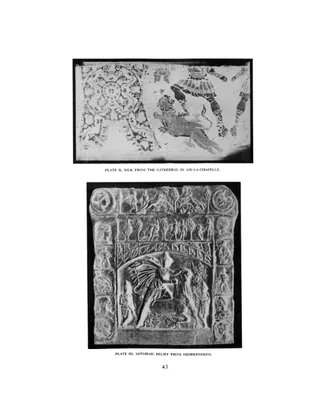
An article on a patterned silk of the 6th-8th century in the Dumbarton Oaks Collection, showing a youth wrestling a lion. It discusses whether the silk came from Alexandria, Syria or Constantinople, and traces the motif to Roman arena combats, Mithraic bull-sacrifice reliefs and the biblical David. It describes the weave as a compound weft twill with a red warp and wefts in several colors, and ends with a list of related silks in museums and church treasuries. Illustrated with five plates of the silk, a silk fragment from Aix-la-Chapelle, Mithraic reliefs and a silver plate.
Textile Art in Prehistoric Archaeology
Article · 6 pages
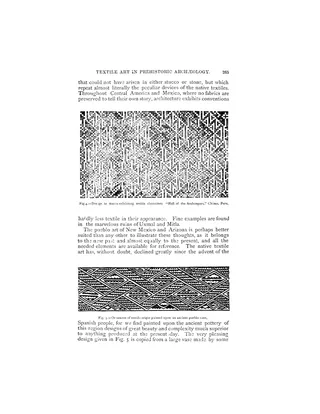
An 1886 essay by W. H. Holmes arguing that the textile art, especially basketry, strongly shaped the form and decoration of other prehistoric arts. It reviews how ancient fabrics survive (dry Peruvian sands, Egyptian balsam, copper salts, charring, Swiss lake dwellings, and impressions on pottery) and uses pueblo pottery, Peruvian stucco at Chimu, and Central American architecture as examples. Five line illustrations show a pueblo basket, a pottery cup imitating woven work, and painted or stucco designs of textile origin.
Textile Fabrics of the Ancient Inhabitants of the Mississippi Valley
Article · 1 page
A short note in Science summarizing a paper by Judge J. G. Henderson on the textile fabrics of the ancient inhabitants of the Mississippi Valley. It describes similarities between the spinning and weaving tools and processes of modern Indians and these ancient peoples, and lists the materials used: tree bark, nettle, and the hair of bear, buffalo, deer and dog. It outlines the development from rolling fiber on the thigh to spindles and looms, and notes the paper was illustrated with drawings, raw materials and models.
"Textile Fabrics" from The Stone Age in North America
Monograph · 13 pages
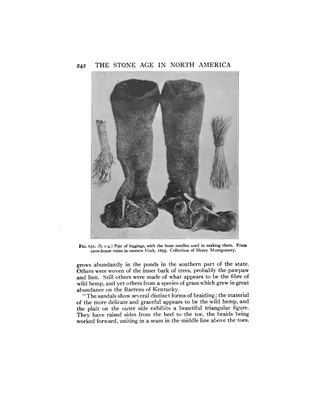
Chapter XXXI of Warren K. Moorehead's The Stone Age in North America (Vol. II, 1911), a short survey of prehistoric textile fabrics in North America. It notes that few perishable textiles survive outside dry caves and Southwestern cliff-houses, and quotes Colonel Bennett H. Young's account of braided sandals, moccasins, bags and cloth fragments of cat-tail, bark and wild hemp from Salts Cave, Kentucky. Figures show sandals, moccasins, cloth, leggings, Zuñi baskets and a Utah basket-maker coiled tray.
Textiles from the Excavations in the Orléans Cathedral
Article · 18 pages
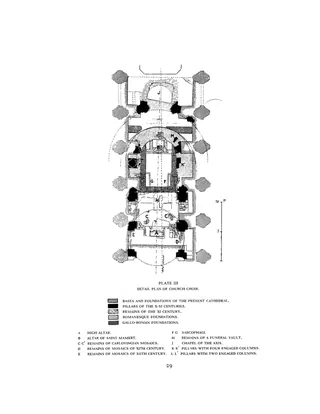
Article describing the 1937-38 excavations beneath Orléans Cathedral, which uncovered remains of earlier churches, mosaic pavements and three bishops' tombs. The author concentrates on the silk textiles from the tombs: a bishop's hose (caligae) and sandals, a twill-woven chasuble with griffin, lion and eagle motifs, and a possible alb with a lozenge pattern and decorative border. Also covers the crozier, chalice and enamel glove medallions found with them. Illustrated with plates of the site, mosaics, metalwork, textile fragments and pattern reconstructions.

Weaving Among Lake-Dwellers
Harper's New Monthly Magazine, c. 1860-1880
Article · 2 pages
A short note from the Editor's Scientific Record summarizing a paper by Dr. Weigert on spinning and weaving remains from the Swiss pile dwellings. It reports that flax was widely grown and made into thread, rope, plaited mats and other fabrics even in the Stone Age, and that stone and clay spindle whorls are common finds. Weigert concludes the lake-dwellers used a vertical-warp loom, as the Greco-Italian peoples did, unlike the horizontal loom of India and Egypt, and argues from this that European culture developed independently.
Das Weben antiker nahtloser Gewänder [The Weaving of Ancient Seamless Garments]
Article · 2 pages · German
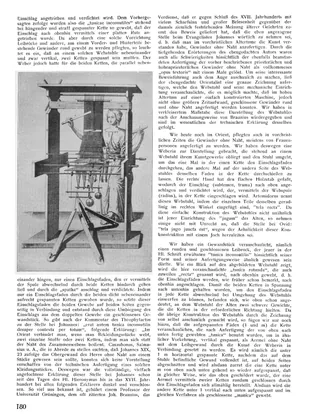
A 1927 article by Franz M. Feldhaus on how seamless garments such as the biblical tunica inconsutilis were woven in antiquity. Drawing on Franz Bock, Jerome, Josephus, Herodotus, Theophylactus and Johannes Braunius, it explains that a standing weaver worked two warps side by side on a vertical warp-weighted loom, passing a single weft alternately through both and beating it upward with a flat wooden stick (spatha), so that the two cloths joined at the edges into a closed tubular garment. A woodcut-style illustration of the loom and a female weaver accompanies the text, and the sleeves are described as woven the same way.
[Ancient Egyptian Weaving]
Article · 2 pages
Two pages from George Rawlinson's History of Ancient Egypt (pp. 228-229) on Egyptian weaving. They cover Herodotus's claim that only men wove, evidence from monuments that both sexes spun and wove, the simple Egyptian loom, and the fine linen produced, including dyed edges, inwrought patterns, printed designs and gold threads. The passage ends with an Egyptian poem on the weaver's hard working conditions.
Chinese Weaves of the Second Century A. D.
Article · 4 pages
A short article reprinting an extract from the London Times of July 27, 1917, describing Chinese silk brocades, tapestry weaves and plain fabrics that Sir Aurel Stein excavated from grave pits at Loulan in Central Asia. It describes the burial context, the colours and animal and scroll designs of the brocades, the slit-joining technique in the tapestry fragments, and plain cloths such as fine jean, teazled flannel, felt and very fine silk. It is descriptive and has no weaving drafts.
Complex Weavers Medieval Textiles Study Group Newsletter 23
Nancy M. McKenna · March 2000
Web Doc · 8 pages
Issue 23 (March 2000) of the Complex Weavers Medieval Textile Study Group newsletter. It opens with coordinator business: newsletter costs, address changes and an erratum for a weaving draft sent with the previous issue. Articles cover Hawaiian kapa (tapa) bark cloth making, based on a Field Museum handout, Peggy Hoyt's essay on 9000 years of flax and linen in European culture, and Harry McCoy's overview of draw harness types, uses, construction and weaving considerations. The rest is a continued annotated bibliography (Carolyn Priest-Dorman) of archaeological and medieval textile sources, an update on the December 2000 twill sample project, and a list of upcoming events.
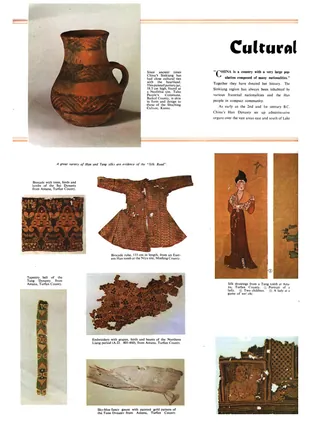
Cultural Relics Unearthed in Sinkiang
China Pictorial, 1976
Article · 2 pages
A two-page illustrated feature from China Pictorial showing archaeological finds from Sinkiang (Xinjiang), China. Photographs with captions show Han, Sui, Northern Liang and Tang textiles from Astana (Turfan County) and the Niya site (Minfeng County), including brocades, a brocade robe, a tapestry belt, embroidery, painted gauze and batik-dyed cotton, along with a Neolithic painted jar and silk paintings. The short text introduces the region, the Silk Road and the preservation of relics, and notes that cotton was first grown in Sinkiang.
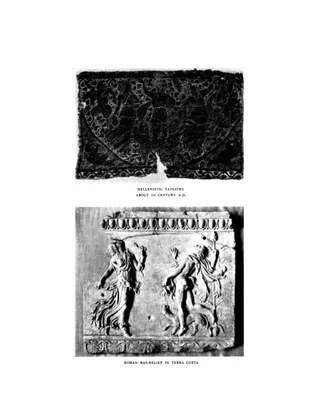
Embroidery in Ancient Egypt
Article · 5 pages
A 1917 article from the Bulletin of the Needle and Bobbin Club on decorative textiles from ancient and early Christian Egypt. It covers Coptic loom work from the cemeteries of Akhmim (Panopolis), tapestry-woven tunic ornaments, and two Metropolitan Museum pieces: a third-century Hellenistic tapestry panel with a Dionysiac scene, compared with a Roman terra-cotta bas-relief, and a sixth-to-eighth-century Coptic silk embroidery with Sassanian-style horsemen. Illustrated with two plates and a photograph of the embroidery fragment.
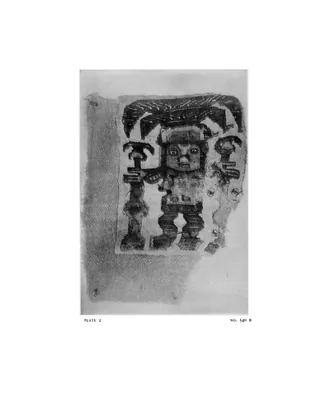
Group of Ancient Peruvian Fabrics
Article · 16 pages
Philip Ainsworth Means describes a group of twenty-four small ancient Peruvian textile specimens (catalogued 540-A to 540-X) from the collection of H. A. Elsberg. The pieces are assigned to the Tiahuanaco (c. 600-900 A.D.) and Late Chimu (c. 900-1400 A.D.) periods of the Peruvian coast. Each entry gives size, fibers, colors, weave (double-cloth, basket weave, tapestry with kelim slots or jours, dropped weft, fringes), design and a stylistic date. Plates reproduce several of the specimens, and a short conclusion notes the collection's blue and green dyes, bast fibers, fringes and an unusual brocade-like technique in 540-G.
History of Weaving
Baldwin's Textile Designer, September 1889
Article · 1 page
A one-page article from Baldwin's Textile Designer on the origins of weaving. It discusses linen fabrics, fringe and ribbon recovered from Swiss lake dwelling sites such as Robenhausen and Irgenhausen, drawing on Dr. Keller's reports, and the simple looms that could have produced them. It then compares Egyptian and Indian hand weaving, including the cost breakdown of a Cashmere shawl, with the labor-saving machinery of nineteenth-century manufacture.
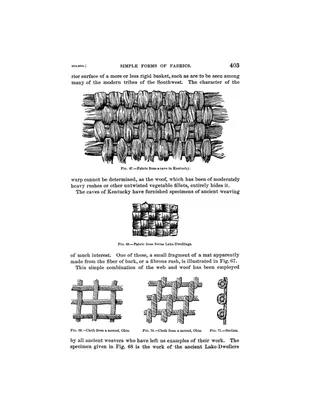
Prehistoric Textile Fabrics of the United States Derived from Impressions on Pottery
Monograph · 34 pages
William H. Holmes's 1884 study, published in the Third Annual Report of the Bureau of Ethnology, examines textile impressions left on prehistoric pottery from the eastern and central United States. He sorts the fabrics into six groups plus miscellaneous forms: plain weave, paired and twisted warp, diagonal weaves, plaiting, knotted nets, and cord markings. Many illustrated figures show the impressions and restorations, with comparisons to Swiss Lake-Dwelling fabrics and modern Northwest Coast work. The text discusses how the fabrics may have been made, using pegs and frames, and how they were used in shaping and decorating pottery.
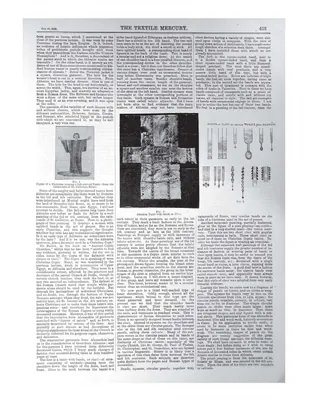
Society of Arts Lectures. Egyptian Tapestry
Article · 3 pages
Second lecture in Alan S. Cole's Society of Arts series on Egyptian tapestry, reprinted in The Textile Mercury (Oct. 12 and 19, 1889). It examines the tunics and garment fragments found at Akhmim, comparing their shapes with Egyptian, Assyrian, Hebrew, Roman and Peruvian tunics. It discusses the three decorative types (clavi bands, tabulae adjunctae squares, and roundels), dates them by comparison with catacomb paintings, a silver disc of Theodosius and the Ravenna mosaic of Theodora, and concludes that the ornaments were mostly tapestry-woven. Illustrated with line diagrams, photographs and engravings.
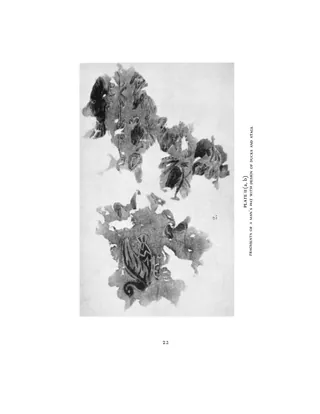
Some Ancient Greek Textiles Found in South Russia
Article · 42 pages
An English adaptation, with added notes by Eugenia Tolmachoff, of Ludolf Stephani's 1881 study of Greek textiles excavated from tombs around Kerch, the Taman peninsula and the Seven Brothers mounds in South Russia, now in the Hermitage. The textiles are grouped as woven fabrics (hats, a garment, a kerchief, a sarcophagus cover and a silk fabric), painted fabrics (a sarcophagus cover with mythological figures and inscriptions, and a fifth-century B.C. painted wool), and embroidered fabrics (a woman's dress with an Amazon and gold-embroidered wool). It discusses the weave and stitch descriptions (rep, twill, velvet-like, chain and satin stitch), dyes, motifs such as ducks and stags, and Dreger's comments on the batik-like painting. It has numbered plates, a sketch map, a glossary of mythological names and a bibliography.
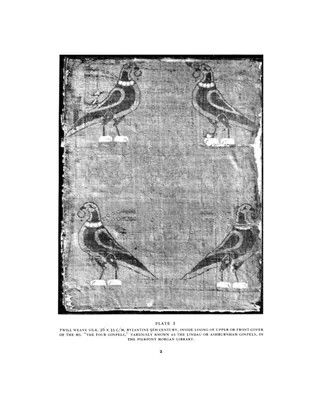
Two Mediaeval Woven Silk Fabrics in the Bindings of the 9th Century MS. The Four Gospels" in the Pierpont Morgan Library, New York City
Article · 10 pages
Article by H. A. Elsberg describing two Byzantine or Hither Asian woven silk fabrics used as linings in the bindings of the 9th-century manuscript 'The Four Gospels' (the Lindau or Ashburnham Gospels) in the Pierpont Morgan Library. It analyzes the weft twill technique, with main and supplemental warps and multiple colored wefts, along with the designs (eight-pointed stars, paired griffons, paired birds with ribbons) and their Persian, Sassanian and Byzantine influences. It also covers dating, probable origin, comparisons with other silks, and the manuscript's provenance. Five plates show the silks and the jeweled covers.
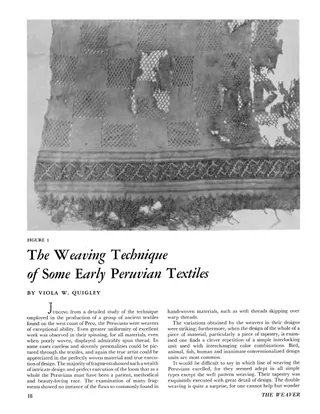
Weaving Technique of Early Peruvian Textiles
Article · 6 pages · weaving drafts
Viola W. Quigley describes the weaving techniques found in a group of ancient Peruvian textiles from the west coast of Peru, mostly from the Field Museum collection. She covers a lace-weave shirt, interlocking and slit tapestry, warp-pattern bags and ties, double-woven ties, and ponchos woven with the pattern running lengthwise. The article gives thread counts, construction details, and figures. It ends with definitions of plain weave, warp pattern, weft pattern, tapestry, slit tapestry, and interlocking tapestry.
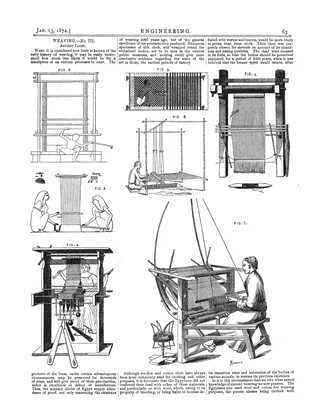
Weaving. -- No. III: Ancient Looms
Article · 2 pages
Third installment of a series on weaving in the periodical Engineering, surveying ancient and primitive looms. It covers Egyptian mummy linen, Egyptian vertical and horizontal looms from Theban paintings (after Wilkinson), the Greek warp-weighted loom compared to the Icelandic loom, a loom from the Vatican Virgil manuscript, the Indian loom used for Dacca muslins, and a Chinese loom. It gives a detailed account of Dacca loom construction, working conditions and figured muslin technique, and includes seven figures of looms.
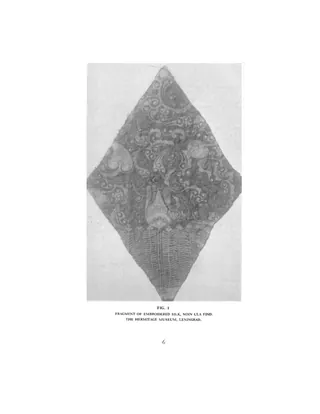
Archaeological Background of Textile Production in the Soviet Russian Territory
Article · 13 pages
An article surveying archaeological finds of textiles in Russian and Soviet territory, from Scythian graves on the Black Sea to Han-period burials at Noin Ula (Mongolia), Oglakty and Pazirik (Siberia), and later T'ang, Sung and Byzantine imports. It describes Chinese embroidered silks and woolen embroideries with tiger-skin motifs, argues for Chinese use of wool in Han times, and discusses how steppe nomads used imported fabrics and felt. Illustrated with photographs of Hermitage fragments; extensive footnotes cite Russian and Western scholarship.
The Bulletin of the Needle and Bobbin Club, Vol. 26, No. 2 (1942)
Periodical · 60 pages
Issue of the Needle and Bobbin Club Bulletin devoted to textiles from Russian territory. Alfred Salmony's article surveys the archaeological background of textile production in the Soviet Union, covering Scythian graves, Greek woolens, Han Chinese silks from Noin Ula and Oglakty, and later T'ang and Sassanian-influenced silks. The second article, adapted by Eugenia Tolmachoff from Ludolf Stephani, describes ancient Greek textiles from the Seven Brothers mounds near Kerch, grouped as woven, painted and embroidered fabrics, with plates, a glossary of mythological names, and Club Notes and a list of officers for 1942-1943.
The Bulletin of the Needle and Bobbin Club, Vol. 40, Nos. 1 & 2 (1956)
Periodical · 50 pages
A double issue of the Bulletin of the Needle and Bobbin Club devoted to a single article by John F. Haskins on the Pazyrik kurgans (frozen tombs) of the Siberian Altai. It covers the excavations by Griaznov and Rudenko, the dating and the identity of the people buried there (Scythians, Massagetae, Ta Yueh-chih), and the preserved textiles of Kurgan Five. These include felt wall hangings with appliqu\u00e9s, felt saddle covers, linen and wool tapestries, Chinese silk with chain-stitch embroidery, and the pile carpet called the world's oldest. The issue has plates and line drawings, endnotes with Russian and Western references, club notes and a list of officers.
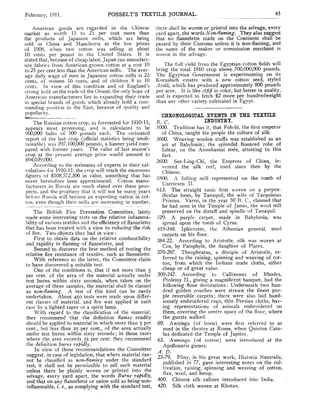
Chronological Textile Events
Article · 2 pages
A two-page excerpt from the February 1911 issue of Posselt's Textile Journal. It opens with short trade news items on Chinese and Japanese cotton competition, the Russian and Egyptian cotton crops, and British fire tests for flannelette. It then begins a chronology of textile history from 5000 B.C. to 1605 A.D. (to be continued), covering silk, wool, cotton, linen, lace, knitting and weaving guilds. The second page also starts a technical article on cotton carding and fly frame management, covering spindle speeds, creel bobbins and machine cleaning.
Complex Weavers Medieval Textiles Study Group Newsletter 25
Nancy M. McKenna · September 2000
Web Doc · 6 pages · weaving drafts
Issue 25 (September 2000) of the Complex Weavers Medieval Textiles Study Group newsletter, coordinated by Nancy McKenna. It covers the twill sample exchange update, a note on ISSN numbers and copyright, and a continuing series on Aztec textiles with a pick-up weaving method and pelican motif. It also has excerpts from an online discussion on women in medieval weaving guilds, a note on wool cards and teasels, and a corrected Halvorstn #5 pebble weave draft. Carolyn Priest-Dorman's article on 2/1 twills (rippenköper) comes with two drafts and a bibliography, and the issue ends with upcoming events and a Piers Plowman fulling verse.
Complex Weavers Medieval Textiles Study Group Newsletter 27
Nancy M. McKenna · March 2001
Web Doc · 27 pages · weaving drafts
Issue 27 (March 2001) of the Complex Weavers Medieval Textiles Study Group newsletter, coordinated by Nancy M. McKenna. It covers the 2001 sample exchange, members' replies to a survey, and an essay on making modern clothing from medieval-draft cloth. The bulk is a long compiled article on women's clothing in Kievan Rus (10th-15th centuries), covering garments, headdresses, jewelry, fabrics, dyes, embroidery and footwear. It also includes Carolyn Priest-Dorman's article on warp-float weaves with deflected wefts (Wabengewebe) with drafts for Alladorf 60 and Jorvik 1336, and McKenna's article on Coptic textiles in North European graves with drafts, sources, and upcoming exhibitions.
Coptic Wool-Weaves with Patterns in Undyed Linen
Article · 25 pages
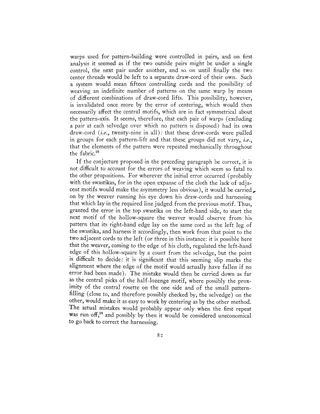
R. J. Charleston studies Coptic Egyptian woolen bands woven of blue or red wool with patterns in undyed linen, used as tunic ornaments in the 6th to 8th centuries. He describes their structure (plain-weave wool ground with brocaded linen pattern weft), yarn twists, thread counts and selvedges, and reports a full dissection of one piece in his own collection. He argues against embroidery and hand-brocading and concludes that the bands were made on a draw-loom, comparing their motifs with contemporary Egyptian silks. The article has plates of bands from the Bankfield Museum, Halifax, a technical diagram and pattern charts, a descriptive list of the pieces with thread counts, and extensive notes.
Models of Ancient Looms
Article · 7 pages
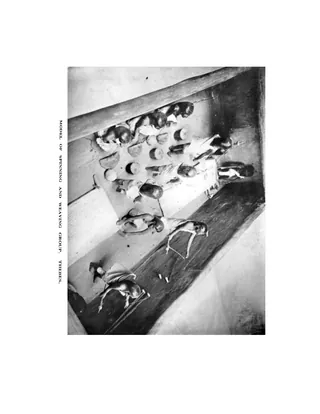
Two-part note on the model of Egyptian textile work found in an XIth dynasty tomb at Thebes by Winlock and Burton. H. Ling Roth describes the model from photographs, comparing its flax preparation, spinning, warping and two horizontal looms with the XIIth dynasty wall drawing in the tomb of Tehuti-hetep. G. M. Crowfoot then compares the model with spinning, warp laying on pegs and horizontal two-beam looms she saw in the Sudan, and discusses the puzzling wooden implements beside the looms. Illustrated with the model, the wall drawing and diagrams of a Sudani warp and wooden implements.
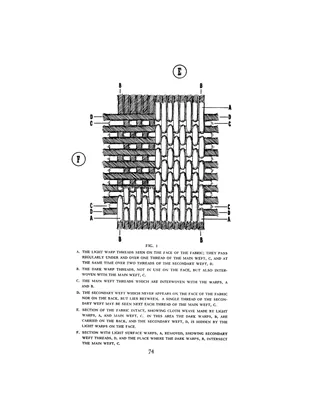
Notes on the Weaves of a Group of Silk Fabrics from the Burial Mounds of Noin-Ula Now in the Pennsylvania Museum of Art, Philadelphia
Article · 5 pages
Article by Eleanor B. Sachs, compiled from notes by Nancy Andrews Reath, on the weave structures of Han Dynasty silks from the Noin-Ula burial mounds in the Pennsylvania Museum of Art. It explains the complex warp-faced compound cloth weave, with several colored warps, a main weft and a hidden secondary weft, which is the same technique as the Lou-lan silks found by Stein. It also describes a fine fancy gauze weave. Technical analyses of two examples give materials, colors, thread counts and sizes, and a diagram (Fig. 1) shows the layered structure.
Prehistoric Textile Art of the Eastern United States
Monograph · 50 pages
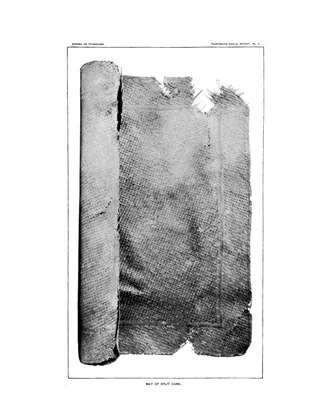
William Henry Holmes's study of the textile arts of the prehistoric mound-building peoples of the eastern United States, from the Thirteenth Annual Report of the Bureau of Ethnology. It covers wattle work, basketry, matting, and pliable fabrics (cloth, nets, feather-work, embroidery), drawing on early European accounts and on archaeological remains. Surviving fabrics come from caves and shelters, charred mound deposits, contact with copper, and impressions on pottery. It is illustrated with plates and figures, including drawings that analyze twined and woven structures; it contains no weaving drafts.
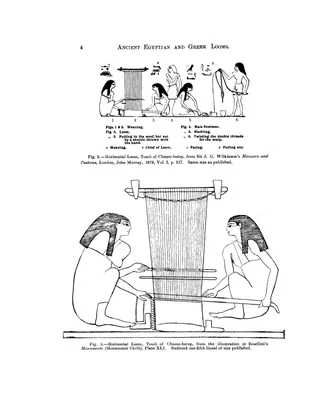
Ancient Egyptian and Greek Looms
Monograph · 45 pages
Bankfield Museum Notes, Second Series No. 2 (Halifax, April 1913), in which the museum's keeper H. Ling Roth examines how looms were built and used in ancient Egypt and Greece. He compares published copies of Egyptian tomb paintings (Beni Hasan, Thebes, El Bersheh) with new drawings by N. de G. Davies, and discusses horizontal and vertical Egyptian looms, loom parts such as beaters-in, laze rods, heddles, reeds and warp weights, and the Rameses III linen girdle. A section by W. W. Midgley gives a microscopic examination of fifteen Egyptian mummy wrappings, with a table of thread counts and fibre measurements. The Greek section covers vase paintings, warp-weighted looms, and Scandinavian, Icelandic and English chalk-weight parallels.
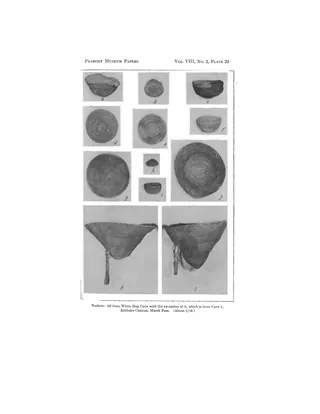
Basket-Maker Caves of Northeastern Arizona
Samuel James Guernsey; Alfred Vincent Kidder · Peabody Museum of American Archaeology and Ethnology, 1921
Book · 172 pages
Report on the 1916-17 Peabody Museum explorations of Basket-Maker burial and storage caves near Kayenta, northeastern Arizona, including Sunflower, Goat and White Dog Caves and caves in Sayodneechee and Sagiotsosi Canyons. It describes the sites, cists, burials and mummies, then catalogs the material culture: dress and ornaments, cradles, baskets, twined-woven bags, cloth, fur-string robes, netting, cordage, atlatls, stone and wooden tools, and ceremonial objects. Many plates and diagrams show twining structures and weft patterns. It closes with conclusions on the Basket-makers' culture and their relation to the later Cliff-dwellers.
The Bulletin of the Needle and Bobbin Club, Vol. 12, No. 1 (1928)
Periodical · 46 pages
Issue of the Bulletin of the Needle and Bobbin Club (New York) devoted largely to Germaine Merlange's study and catalogue of the Elsberg Collection of Egypto-Arabic embroideries of the medieval period. The catalogue describes numbered fragments (tapestry borders on wool gauze, embroidered linen borders with Kufic inscriptions, a fringed scarf) with notes on stitches, colors, dating and find-spots such as the Fayoum and Fostat. It also includes a short article on a Medici brocade at the Metropolitan Museum, Club Notes (including a talk on opus Anglicanum), Book Notes, club officer lists and period advertisements.
Complex Weavers Medieval Textiles Study Group Newsletter 24
Nancy M. McKenna · June 2000
Web Doc · 9 pages · weaving drafts
Issue 24 (June 2000) of the Complex Weavers Medieval Textiles Study Group newsletter. It covers subscription business, member sample updates, and weaving drafts of 2/2 broken twill, honeycomb/Wabengewebe and related structures from NESAT III finds at Coppergate, York. Carolyn Priest-Dorman writes on the kreuzköper (cross twill) with thread counts and comparative finds from Britain, Germany, Sweden and Lithuania. Lynn Meyer contributes a research paper on the textiles of Islamic Spain (linen, cotton, wool, silk, dyes, trade) with bibliography, and the issue ends with upcoming events.
Complex Weavers Medieval Textiles Study Group Newsletter 33
Nancy M. McKenna · September 2002
Web Doc · 8 pages · weaving drafts
Issue 33 (September 2002) of the Complex Weavers Medieval Textiles Study Group newsletter. The main article by Carolyn Priest-Dorman discusses kruiswerk, a figured linen weave, and presents a 12-shaft draft of a c. 15th-century textile (Tx 60) from the Abbey of St. Truiden, Belgium, linking it to the 'crosse werk' of the 1456 London weavers' ordinances. The coordinator's news covers the Shroud of Turin restoration, the Genghis Khan tomb expedition, digitized Gutenberg and Vatican manuscripts, and the Halmyris martyrs' tombs. Other items include part III of a tapestry-weave sample series, a Weavers' Gallery of reconstructed cloth and pouches, a review of Fustat Finds, upcoming exhibitions, and a call for samples.
Complex Weavers Medieval Textiles Study Group Newsletter 34
Nancy M. McKenna · December 2002
Web Doc · 6 pages
Issue 34 (December 2002) of the Complex Weavers Medieval Textiles Study Group newsletter. It includes Jan Ward's account of weaving and testing a wool sample for a 14th-century Greenland-style cotehardie, Cerise Moodey's overview of fiber arts at the SCA's Pennsic event, and Alexis Abarria's annotated bibliography on medieval weaving, twills and band weaving. It also has a weaving-term crossword, upcoming museum exhibitions, photos with details of a lozenge twill dress, and the coordinator's news with survey results and plans for future issues.
Complex Weavers Medieval Textiles Study Group Newsletter 35
Nancy M. McKenna · March 2003
Web Doc · 10 pages · weaving drafts
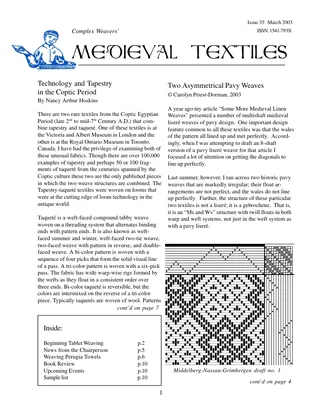
Issue 35 (March 2003) of the Complex Weavers Medieval Textiles Study Group newsletter. It includes Carolyn Priest-Dorman's analysis of two irregular medieval pavy weaves (gebrochene structures) from a Middelburg antependium and a linen fragment from St. Truiden, with drafts. It also has Nancy Arthur Hoskins's article on Coptic tapestry-taqueté textiles and her recreation, Cerise Moodey's introduction to cardweaving with warping instructions, and Joanne Burrows's account of weaving linen 'Perugia towels' with diamond twill ground and brocaded borders. The issue closes with a chairperson's column, a comic strip about a medieval cloth merchant, upcoming exhibitions and a review of Mazzaoui's book on the Italian cotton industry.
Fragments from the Tomb of an Unknown Bishop in Saint Denis, Paris
Article · 8 pages
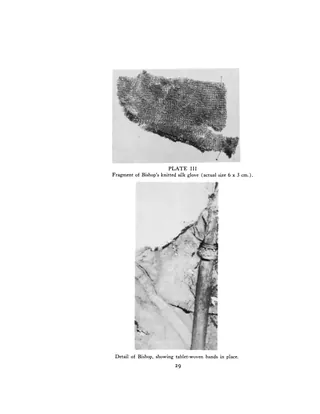
Margaret Rowe describes thirteenth-century textile fragments from an unmarked bishop's burial found during Sumner Crosby's excavations at the Abbey Church of Saint Denis, now mounted in plastic at the Yale University Art Gallery. She covers the circumstances of the find, the fiber and dye analysis (silk, madder-dyed red, silver-gilt thread on silk core), the plastic embedding conservation, and the vestments. She gives particular attention to a knitted silk glove and to tablet-woven trim bands, with measured descriptions of the mounted band fragments. The article is illustrated with plates of the burial, fragments, glove and bands.
The History of Textiles in the New World
Article · 6 pages
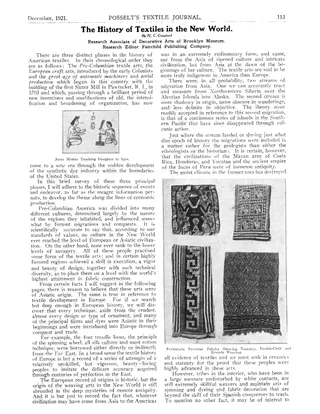
An article from the December 1921 issue of Posselt's Textile Journal surveying textile history in the Americas in three phases: Pre-Columbian textile arts, Colonial European crafts, and the machine age. It covers Peruvian, Alaskan and Cliff Dweller textiles, fibers, looms, dyeing and printing, then Colonial spinning, weaving and calico printing, the British inventions of the 18th century, and the growth of the American cotton, silk and wool industries. Illustrations show an Aztec spinning scene, Peruvian tapestry, double-cloth and brocade fragments, a Cliff Dweller cotton fabric, a terra cotta printing roller and an Inca poncho. The final page also carries a short item on saving money and a cotton spindle activity report.
Die Konstanzer Textil-Bilder [The Konstanz Textile Pictures]
Article · 3 pages · German
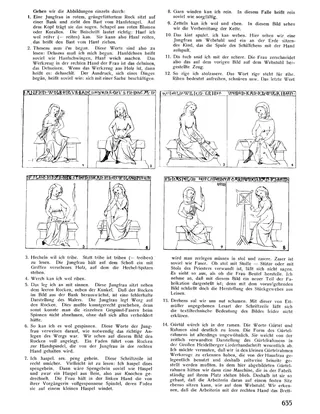
Article by Franz M. Feldhaus on the Konstanz textile wall paintings, made around 1300 in a burgher's house in Konstanz and showing women at textile work. He reproduces the pictures and their inscription bands from an 1866 publication and explains each of the roughly 18 scenes. The scenes cover hemp processing, hackling, tow spinning with distaff and spindle, reeling, warping, linen weaving at a loom with a child winding the bobbin, cutting cloth, belt weaving on a frame, and silk preparation. Feldhaus discusses the Middle High German wording of the inscriptions and the tools shown, and asks textile specialists for comments.
Pazyrik, the valley of the Frozen Tombs
Article · 46 pages
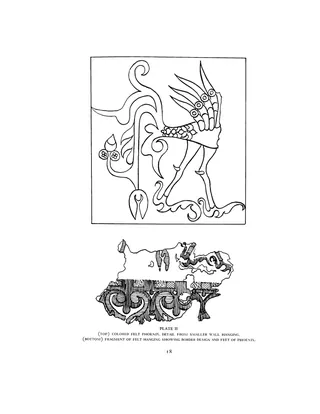
An article by John F. Haskins, based on a 1955 lecture to the Needle and Bobbin Club, on the Pazyryk (spelled Pazyrik) burial mounds of the Siberian Altai and their frozen contents. It covers the Griaznov and Rudenko excavations, the debate over whether the builders were Scythians or Massagetae (Ta Yüeh-chih), and the dating of the finds. The main focus is Kurgan Five and its textiles: felt wall hangings and saddle covers with appliqué, linen and wool tapestries, imported Chinese silk with chain-stitch embroidery, and a knotted-pile woolen rug with elk, griffon and horseman borders. Plates and line drawings illustrate the textiles, and endnotes cite Russian, Chinese and classical sources.
272 documents found