Textile Documents › Authors › Author: Phyllis Ackerman
7 documents found
Sort: 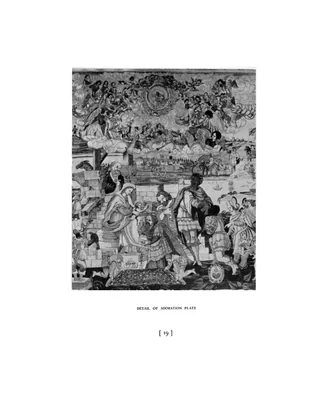
Adoration of the Magi in Embroidery
Article · 7 pages
An iconographic essay by Phyllis Ackerman on a seventeenth-century Italian embroidered altarfrontal showing the Adoration of the Magi. It describes the central scene and the many surrounding episodes (animals, travelers, Old Testament parallels, heavenly choir) and reads them as a Christian allegory of the Fall and Redemption. It also notes Oriental influences such as a Persian-style textile pattern and a Polonaise-type carpet. Illustrations include the altarfrontal, a detail of the Adoration, and a center panel of embroidered netting.
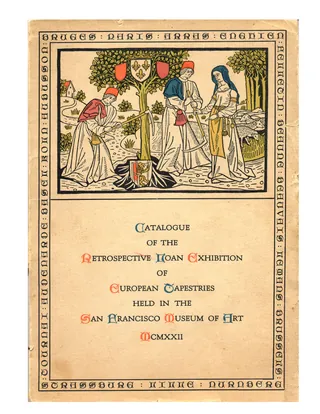
Catalog of the Retrospective Loan Exhibition of European Tapestries Held in the San Francisco Museum
Phyllis Ackerman · 1922
Other · 90 pages
Catalogue of the 1922 retrospective loan exhibition of European tapestries at the San Francisco Museum of Art, written by Phyllis Ackerman with a preface by director J. Nilsen Laurvik. It opens with an historical and critical introduction to tapestry weaving, then lists about 79 tapestries in order of date and place of origin (Franco-Flemish, Flemish, Brussels, Tournai, Fontainebleau, Gobelins, Beauvais, Aubusson, Mortlake, Russian, Spanish and others, 14th to early 19th century). Each entry gives materials, dimensions, subject, commentary and lender. Many plates reproduce the tapestries, and the book ends with a list of weavers and a subject and title index.
Early Textile Production in China
Article · 12 pages
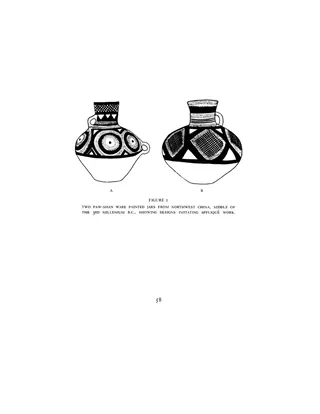
Article by Phyllis Ackerman on the origins and organization of textile production in ancient China, drawing on archaeology, painted Pan-shan pottery, and Chinese tradition. She argues that pottery designs copy appliqué needlework and point to silk by the mid-third millennium B.C. She also discusses Shang silk fragments from An-Yang, including a dispute over whether they show twill, and Chou-period domestic production by peasant women. Footnotes with sources appear at the end.
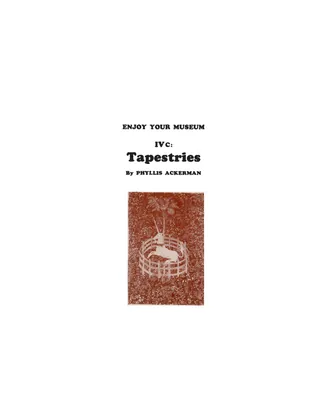
Enjoy Your Museum. IVc: Tapestries
Monograph · 17 pages
A short popular booklet in the Enjoy Your Museum series that surveys the history of tapestry from the 14th to the 19th century. It follows changes in subject and style from Gothic hunting and religious scenes through Renaissance, Rubens, Teniers and 18th-century French work (Gobelins, Beauvais, Aubusson), then Morris's Merton Abbey looms. It also notes tapestry weaving in Egypt, Persia, China and Peru, and explains true tapestry technique: weft-faced weave, slits, high-warp and low-warp looms, cartoons and shading.
Polish Belts
Article · 18 pages
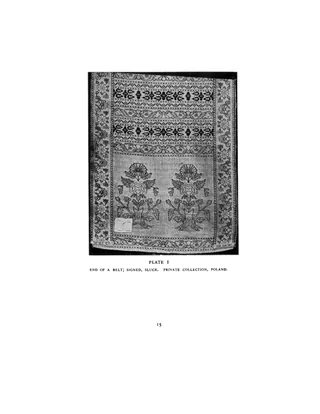
Article on eighteenth- and early nineteenth-century Polish silk and metal-thread sashes (Persiarnia belts) made in the Persian style. It surveys the factories at Sluck and Kobylka and their directors and signatures, then the minor factories at Cracow, Dantzig and elsewhere. It discusses design (floral and geometric stripes, side and end borders), colors, and technique (compound cloth, selvage treatment). Nine plates show belt ends signed by various makers; no weaving drafts are included.
Some Mediaeval Silks from the Caspian Provinces of Iran
Article · 17 pages
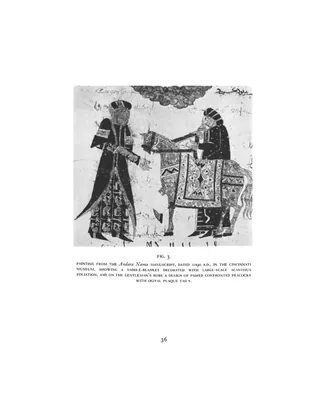
Phyllis Ackerman examines the history of silk production and weaving in Iran's Caspian provinces (Gurgan, Tabaristan, Gilan, Dailam) using medieval Persian and Arab sources. She then analyzes the textile designs painted in the 1090 Andarz Nama manuscript in the Cincinnati Museum (foliated stripes, split acanthus bracts, peacock and dove patterns). She links these to surviving silk twills from Rayy, Brussels, the Musée de Cluny and Canterbury Cathedral, and to designs in Echternach codices, arguing for a Caspian-European silk trade. Footnotes cite Persian, Arabic and European sources.
Some Shiraz Silks
Article · 24 pages
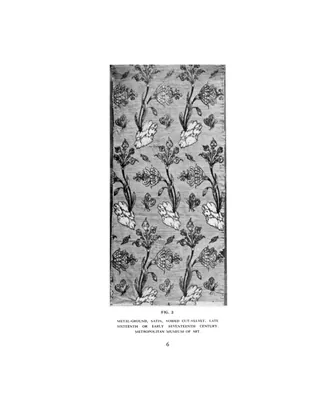
An article by Phyllis Ackerman attributing a group of Safavid silks (satins, compound cloths, a voided cut-velvet and a trimming band) to Shiraz. She argues that concealed figures and void patterns, matching those in Shiraz manuscript painting, mark them as Shiraz work. She traces the void motifs, such as a bow-legged manikin and phallic cypress, back through Mongol, Buvayhid and Sasanian silks. She reads them as Mazdean symbols kept alive by Sufis. The article includes seventeen outline sketches of void patterns, plates of the silks discussed, and footnotes citing the Survey of Persian Art and museum collections.
7 documents found