Textile Documents › Authors › Author: Alan Summerly Cole
24 documents found
Sort: 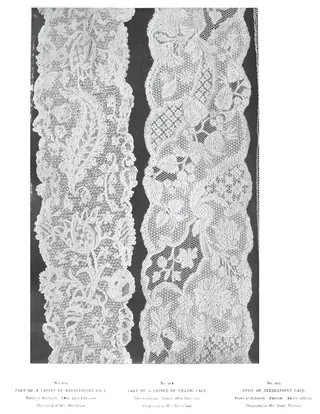
Ancient Needlepoint and Pillow Lace
Book · 59 pages
An 1875 Arundel Society publication describing twenty photographed examples of ancient needlepoint and pillow lace, drawn largely from the 1874 International Exhibition at South Kensington. It opens with a preface, explanations of lace terms, and a history of lace-making, then gives a short commentary for each plate. Types covered include punto a reticella, punto in aria, punto a maglia (lacis), rose point, Point de Venise à réseau, Point d'Alençon and Argentan, Valenciennes, Mechlin, Genoese, Milanese, and Brussels lace. Lists of the specimens and their owners are included.
Brocade
Article · 3 pages
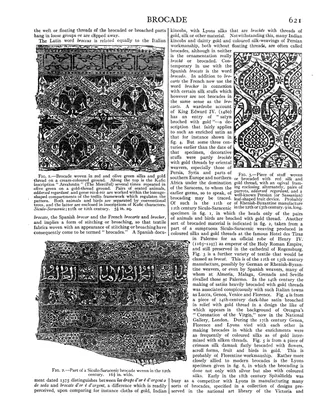
Encyclopedia Britannica (11th ed.) entry defining brocade as a decorative shuttle-woven fabric with ornament added in supplementary weft, often in coloured silks and gold or silver thread. It covers the etymology of the word, the Saracen and Siculo-Saracenic origins, Italian, French and English (Spitalfields) production from the 14th to 18th centuries, and early Chinese brocading. Six photographs of fragments illustrate the types discussed, and no weaving drafts are given.
Carpet
Article · 10 pages
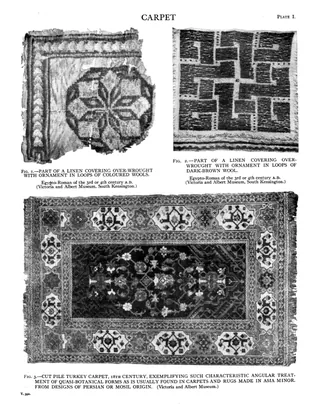
Encyclopedia Britannica (11th ed.) article on carpets covering their definition, etymology, and history from ancient Egypt, Assyria and Greece through Egypto-Roman looped textiles to later pile carpets. It describes the Oriental hand-knotted method and surveys carpet making in Persia, Turkey, India, Spain, England and France, followed by the introduction of Jacquard and steam power looms in the 19th century. Four plates illustrate Egypto-Roman loop-worked linens, Turkey, Persian, Lahore and Spanish cut pile carpets, and the Ardebil carpet; a bibliography closes the article.

Descriptive Catalogue of the Collection of Lace in the South Kensington Museum
Alan Summerly Cole · 1881
Book · 234 pages
Third edition of the South Kensington Museum's descriptive catalogue of its lace collection, published in 1881. It opens with a historical introduction on the origins and development of needlepoint and pillow lace, with notes on lace-making by country. The catalogue proper lists specimens by country (Italian, Belgian, Dutch, French, Spanish and Portuguese, English and Irish, German, Danish, Swedish, Russian, Maltese, Cretan and others), giving type, dimensions, date, acquisition and museum number. It also includes a list of books on lace, a table of reference and a general index, with about 20 plates of lace specimens and line drawings of lace stitches.
Embroidery
Article · 10 pages
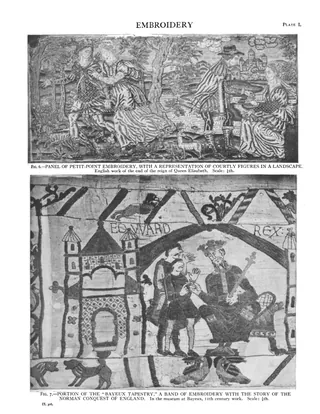
Reprint of the Encyclopaedia Britannica (11th ed.) article on embroidery, with six plates. It surveys the history of decorative needlework from ancient Egypt, Persia and Greece through medieval and later European work (France, the Netherlands, Italy, Spain, Germany, Scandinavia), and also covers the Near East, India, China, Japan, Persia, Turkestan and North Africa. The article closes with a bibliography of older works on embroidery. The plates show English, German, Italian, Chinese, Icelandic, Cretan, Persian and Sicilian pieces, including the Bayeux Tapestry, the Syon Cope and a Sicilian Tristan quilt.
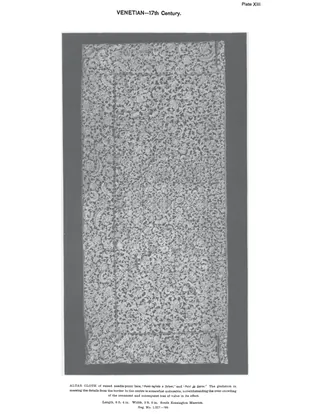
Hand-Made Laces from the South Kensington Museum
Book · 35 pages
A plate book from the 'Studies from the Museums' series, edited by Alan S. Cole, reproducing photographs of 30 hand-made laces from the South Kensington Museum. A short introduction covers the nature of lace, needlepoint lace (reticella, punto in aria, Venetian raised point, French points), pillow or bobbin lace, pattern development, descriptive terms and uses of lace. Each plate has a caption giving origin, century, description, dimensions and museum registration number. Specimens include Italian and German lacis (darned netting), Venetian raised needle-point vestments and flounces, Alençon and Brussels lappets, Mechlin, Valenciennes, English or Danish, and Japanese lace.
Honiton Lace Industry: Copy of Report
Alan Summerly Cole · 1888
Book · 22 pages
A British House of Commons parliamentary paper (1888) reproducing Alan S. Cole's report to the South Kensington Museum on the state of the Honiton pillow-lace industry in Devon, based on a tour in late May and June 1887. Cole records interviews with lace dealers and makers at Exeter, Beer, Colyton, Branscombe, Sidmouth, Sidbury, Honiton, Ottery St. Mary, Exmouth, Otterton and Woodbury, covering worker numbers, wages, thread sizes, pricing and the decline of lace schools. He closes with recommendations on teaching lace-making in elementary schools, instruction by lace part, and new designs and prizes. Plates show pillow lace samples from Colyton, Sidmouth and Honiton with thread sizes and prices.
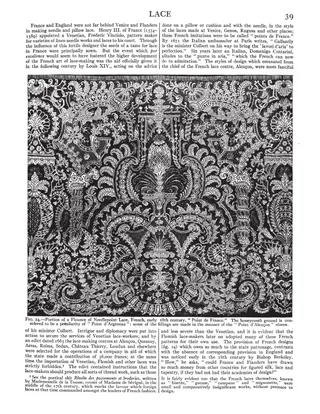
Lace
Article · 18 pages
Encyclopaedia Britannica (11th ed.) article on lace by Alan S. Cole. It defines lace and traces its origins from braids and cords through lacis (darned netting), cut and drawn work and reticella to needlepoint and pillow lace. It covers the main centres (Venice, Flanders, France, England, Ireland, Germany), the techniques of needle, pillow and machine lace, and Irish crochet, and ends with a bibliography of pattern books and lace histories. It has many plates and figures of lace specimens and portraits showing lace costume.
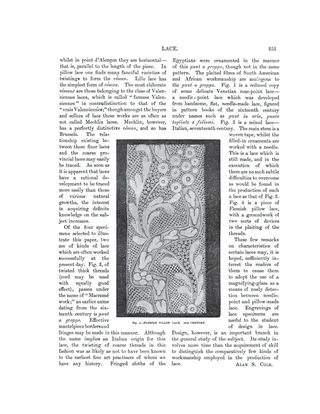
Lace
Article · 3 pages
A short 1879 magazine article urging amateurs and lace wearers to study actual lace specimens rather than rely on illustrated books. It explains how to use a magnifying glass to tell needle-point lace (looped threads) from pillow lace (twisted and plaited threads) and from machine-made lace, and how to read the réseau (net ground) to identify types such as Alençon, Venetian, Lille, Valenciennes, Mechlin and Brussels. Four illustrated specimens are discussed: Venetian rose-point, macramé (punto a groppo), Italian tape lace with needle-point fillings, and Flemish pillow lace.
Lace at the South Kensington Museum
Article · 4 pages
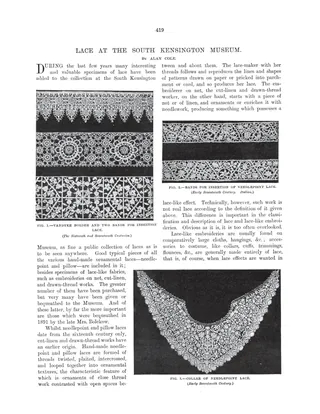
A 1894 Magazine of Art article by Alan Cole surveying recent additions to the lace collection at the South Kensington Museum, including the Bolckow bequest of 1891. It distinguishes true needlepoint and pillow lace from lace-like embroideries on net, cut-linen and drawn-thread work. It traces changing lace designs from geometric 16th-century types through scroll patterns, Venetian rosepoint and pseudo-Chinese styles of the late 17th and early 18th centuries. Twelve photographs illustrate specimens, and the article ends with remarks on how the museum displays lace.
"Of Lace" in Arts and Craft Essays
Monograph · 13 pages
A short historical essay on hand-made lace, distinguishing true laces from embroideries on net, cut work, drawn thread work and machine imitations. It separates needlepoint lace from bobbin or pillow lace, and traces the development of patterns from the sixteenth-century geometric bands to the filmy, naturalistic laces of the eighteenth century, then their decline. It ends with a brief note on where the industry survived in the early 1900s and on the competition from machine-made lace.
Recent Honiton Lace
Article · 4 pages
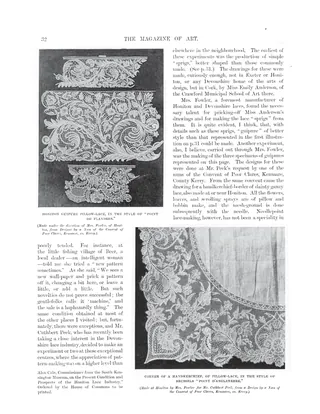
Article by Alan S. Cole in The Magazine of Art (1892) on Honiton, or Devonshire, lace made in the preceding five or six years. Cole discusses the history of bone lace and the influence of Flemish and Brussels refugee lace-makers after 1685. He distinguishes Point d'Angleterre from Point de Flandres guipure and describes experiments in new designs by Cuthbert Peek, Mrs. Fowler and Mrs. Treadwin, including designs from Cork and a Kenmare convent. He also covers the decline of lace schools and the state of the industry after his 1887 report. Illustrated with photographs of guipure, sprigs, a handkerchief corner and needlepoint and pillow-lace reproductions.
A Renascence of the Irish Art of Lace-Making
Book · 38 pages
An 1888 pattern book promoting new designs for Irish lace, with introductory notes by A. S. C. (Alan S. Cole) and twelve photographic plates of lace made from specially commissioned patterns. Each plate has a caption naming the designer, the convent or school that made the lace, and the lace type: raised needlepoint, crochet, Carrickmacross appliqué, Limerick tambour and run lace, and cut linen. It also gives the history of the 1884 Committee for new Irish lace patterns, its proposal for maintaining the industry, and a list of subscribers.
Society of Arts Lectures. Egyptian Tapestry
Article · 3 pages
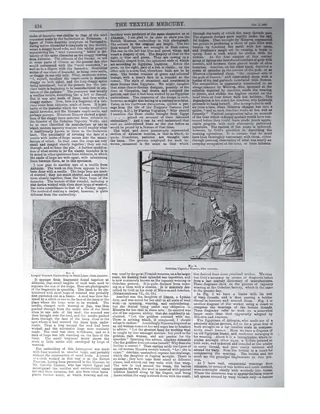
Part of a lecture by Alan S. Cole on Egyptian tapestry, printed in The Textile Mercury on 5 Oct 1889 as a continuation of an earlier instalment. It discusses textiles from the Akhmim graves in Upper Egypt: shaggy looped linens (the Greek kaunakes), looped worsted embroidery worked over small reeds, and tapestry weaving with bobbin and comb on linen warps. It follows the technique through Ovid's account of Minerva and Arachne, the Gobelins weavers and the Peruvian textiles of Ancon. The scan also includes surrounding trade news and textile market reports.
Society of Arts Lectures. Egyptian Tapestry
Article · 3 pages
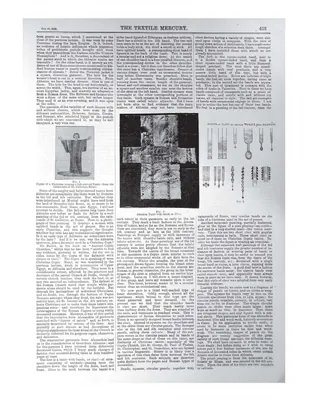
Second lecture in Alan S. Cole's Society of Arts series on Egyptian tapestry, reprinted in The Textile Mercury (Oct. 12 and 19, 1889). It examines the tunics and garment fragments found at Akhmim, comparing their shapes with Egyptian, Assyrian, Hebrew, Roman and Peruvian tunics. It discusses the three decorative types (clavi bands, tabulae adjunctae squares, and roundels), dates them by comparison with catacomb paintings, a silver disc of Theodosius and the Ravenna mosaic of Theodora, and concludes that the ornaments were mostly tapestry-woven. Illustrated with line diagrams, photographs and engravings.
Society of Arts Lectures. Egyptian Tapestry
Article · 3 pages
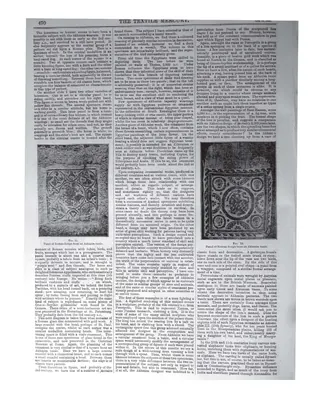
Continuation of Alan S. Cole's Society of Arts lecture on Egyptian tapestry, published in The Textile Mercury, 19 Oct. 1889. It discusses Akhmim tunic bands, panels and cloths woven in purple wool and flax, and traces their Roman, Persian, Sassanian, Greek and Byzantine parallels in mosaics, sculpture, metalwork and ivories. Subjects covered include Hermes, horsemen, birds, lion-slaying scenes, animal bands and a winged angel. The scan also includes the preceding trade news and two short miscellaneous items.
Society of Arts Lectures. Egyptian Tapestry
Article · 1 page
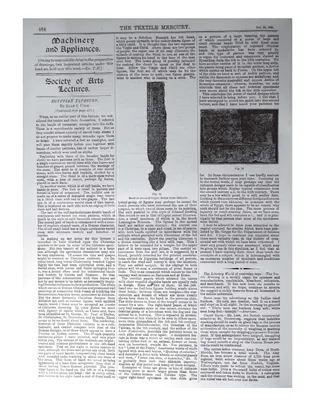
The concluding part of Alan S. Cole's second Society of Arts lecture on Egyptian (Coptic) tapestry, printed in The Textile Mercury of 26 October 1889. It discusses tapestry-woven cuff and tunic bands from Akhmim, from vine-scroll and ivy patterns to barbaric Christian figure subjects, circular panels and medallion patterns. Cole relates the designs to Greco-Roman, Persian, Syrian and Byzantine sources and dates them from the 2nd to the 10th century A.D. Two figures of Akhmim bands are included.
Some Recent Irish Laces
Article · 6 pages
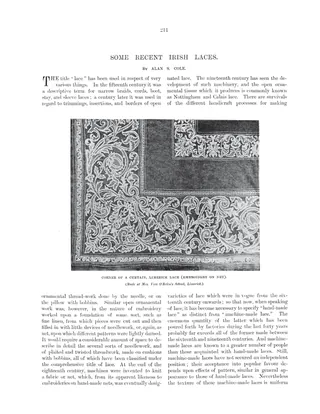
A 1891 Magazine of Art article by Alan S. Cole on new Irish lace designed and made in the preceding few years, mostly in convents and schools. It covers Limerick net embroidery, crochet, Carrickmacross cut-linen and appliqu\u00e9, and flat and raised needle-point lace from Youghal, Kenmare, Innishmacsaint and New Ross. It stresses the value of new designs from art schools and compares hand-made lace with machine-made lace. Each specimen is illustrated and credited to its designer and workers.
Supplemental Descriptive Catalog of Specimens of Lace Acquired for the South Kensington Museum Between June 1890 and June 1895
Monograph · 48 pages
A museum catalogue of lace and related needlework specimens acquired by the South Kensington Museum between June 1890 and June 1895. Entries are arranged by country (Italian, Belgian, Flemish, French, Spanish, English and Irish, Brazilian, Russian) and then alphabetically by object type, such as borders, flounces, lappets, cuffs, cloths and altar frontals. Each entry describes the technique, pattern, date, dimensions, acquisition (purchase price, gift or Bolckow Bequest) and register number. A table of reference at the end links register numbers to pages.
Tapestry
Article · 13 pages
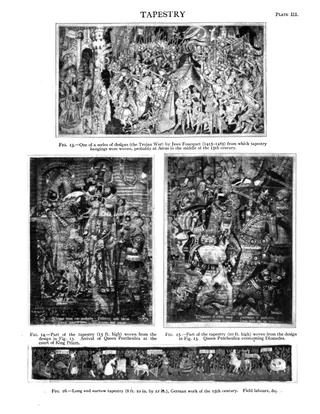
Encyclopedia article on tapestry from the 11th edition of the Encyclopaedia Britannica. It explains tapestry weaving on high-warp (haute lisse) and low-warp (basse lisse) frames as practised at the Gobelins and Beauvais. It then surveys the history of the art from ancient Egypt, Greece and Rome through medieval and Renaissance Europe to Morris's Merton Abbey work, and closes with where major collections are held. Eight plates and several figures show Egypto-Roman, Peruvian, medieval German and Flemish, English, Italian and Irish examples.
Tapestry-Weaving
Article · 6 pages
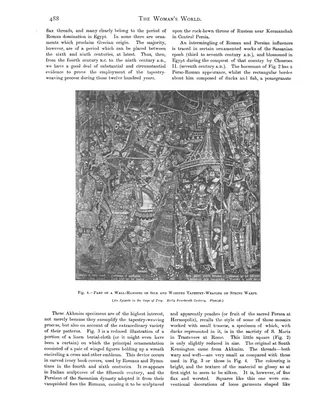
A 1888 magazine article by Alan S. Cole explaining tapestry-weaving and how it differs from embroidery and from shuttle loom-weaving. It surveys the technique from Greek and Egypto-Roman insertions (the Kouban ducks, Akhmim finds, tabulae adjunctae) through medieval and Flemish wall-hangings such as the Siege of Troy to modern Chinese silk tapestry. Illustrated with five halftone figures of historic specimens.
Textile-Printing
Article · 17 pages
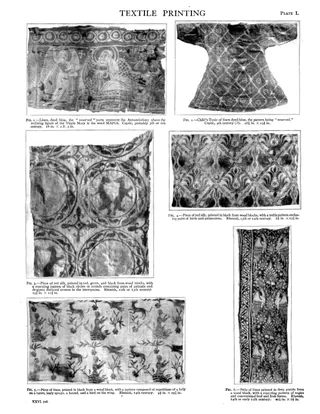
Encyclopedia Britannica (11th ed.) article on textile printing, covering the history of the craft and its technology. Part I describes the five printing methods (hand block, perrotine, engraved plate, engraved roller, stencilling), roller engraving, thickeners, dyes and mordants, discharge and resist styles, steaming/ageing apparatus, finishing and wool printing, with some recipes. Part II covers art and archaeology, from Coptic and medieval Rhenish printed textiles to later European cotton prints, illustrated by two plates of fragments.
Weaving
Article · 16 pages · weaving drafts
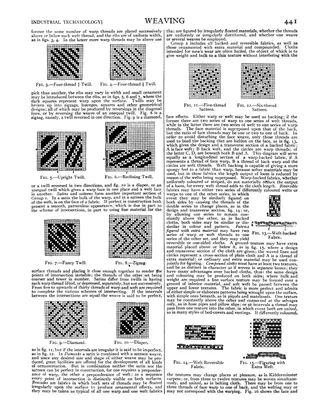
The 11th edition Britannica article on weaving, in two parts. The first, on industrial technology and machinery, defines weaving and describes basic weave groups (plain, repp, twill, satin and satteen, damask, brocade, backed and compound fabrics, tapestries, piled fabrics, gauze, lappet). It then covers the hand-loom, draw loom harness, Jacquard machine, power loom, warping, sizing, drawing-in and stop motions. The second part, on archaeology and art, surveys historical woven textiles: Egyptian, Syrian, Byzantine, Sassanian, Saracenic, Italian silks, damask and linen weaving, with a short bibliography.
Word on the Outlook of Lace-Making in Ireland
Article · 3 pages
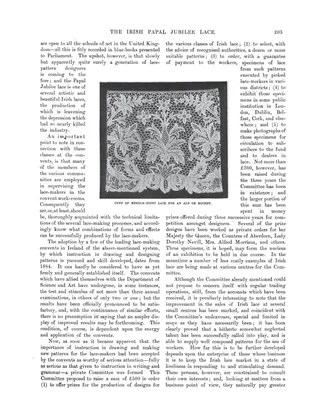
A 1888 Magazine of Art article by Alan S. Cole on the state and prospects of Irish lace-making, prompted by the needle-point laces given to the Pope for his Jubilee. It describes lace-making as a cottage industry supported by convents, and the effort since the 1883 Cork Exhibition to improve pattern design through drawing classes, Department of Science and Art grants and a private committee offering design prizes. Two illustrations show needle-point lace: a cuff for an alb or rochet and an altar-cloth trimming.
24 documents found