Textile Documents › Publications › Publication: Magazine of Art
47 documents found
Sort: 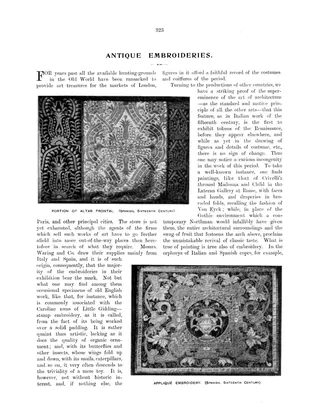
Antique Embroideries
Magazine of Art, 1896-1897
Article · 3 pages
A short illustrated article from The Magazine of Art reviewing an exhibition of antique Italian and Spanish ecclesiastical embroideries at Messrs. Waring and Co. It discusses the shift from Gothic to Renaissance style in orphreys, altar frontals and vestments, notes Oriental influence, and mentions English stump embroidery. It closes with a survey of stitches such as raised gold, couching, feather, chain and tent stitch, laid work and appliqué.
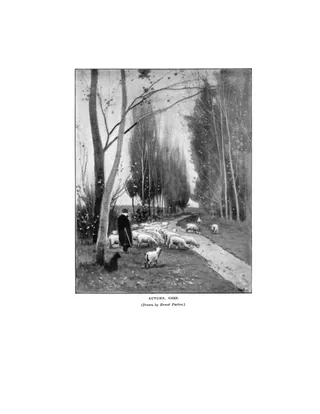
Autumn, Grez
Illustration · 1 page
A single-page black-and-white reproduction of a drawing titled "Autumn, Grez" by Ernest Parton, published in the Magazine of Art in 1894. It shows a wooded autumn landscape with tall slender trunks, sparse leaves, arching branches and a path or stream curving through the scene. The page carries only the caption and has no textile or weaving content.
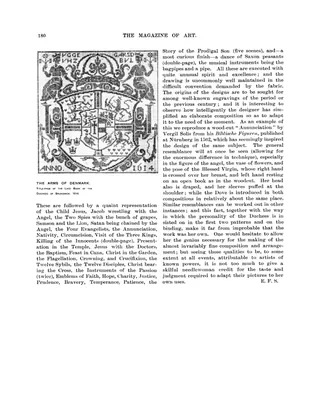
A Book of Lace Patterns in the National Art Library
Magazine of Art, 1902
Article · 2 pages
A short article from The Magazine of Art (1902) describing a manuscript lace pattern book recently acquired by the National Art Library, made in 1614-1615 for Elizabeth of Denmark, Duchess of Brunswick. The designs are for lacis (darned netting) worked on squares. The article lists the 43 designs, which include heraldic pieces, biblical scenes, Sibyls, virtues and a peasant dance. It compares the 'Annunciation' design to a Virgil Solis woodcut of 1562 and suggests the Duchess may have made the book herself. Two illustrations are included: the Annunciation and the title page with the arms of Denmark.
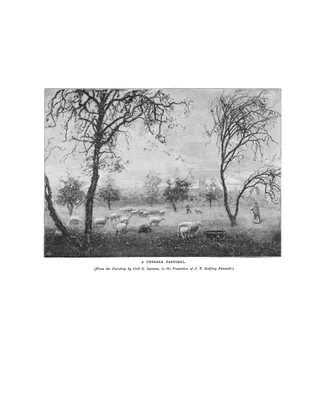
Chelsea Pastoral
Illustration · 1 page
A single-page halftone reproduction of a landscape painting by Cecil G. Lawson titled "A Chelsea Pastoral," printed in the Magazine of Art. The image shows large trees, dense shrubbery and low hedges along a grassy path. The caption notes the painting was then in the possession of J. T. Godfrey Faussett. The page has no weaving content.
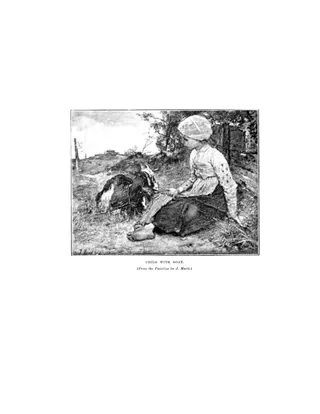
Child with Goat
Illustration · 1 page
A single-page black-and-white halftone reproduction of a painting titled 'Child with Goat' by J. Maris, published in the Magazine of Art. It shows a child in a bonnet seated outdoors beside a goat, with a white wall or building at upper left and grassy ground below. The page carries only a caption and has no weaving or textile instruction.
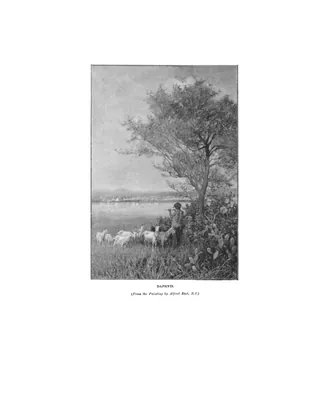
Daphnis
Illustration · 1 page
A single-page reproduction of the painting 'Daphnis' by Alfred East, R.I., printed in the Magazine of Art in 1891. The image is a high-contrast pastoral landscape with foliage, a dark wooded area, and a pale path or stream. It contains only a caption and no textile or weaving content.
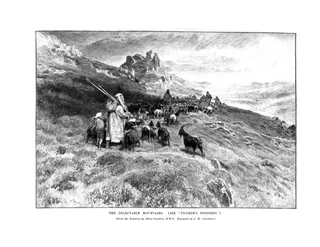
Delectable Mountains
Illustration · 1 page
A single black-and-white engraving of the Delectable Mountains from Bunyan's Pilgrim's Progress, after a drawing by Albert Goodwin and engraved by J. M. Johnstone. It shows pilgrim figures, one in a long light garment with a staff, walking a path up toward distant hills with rocky slopes. The page carries only a caption and has no textile content.
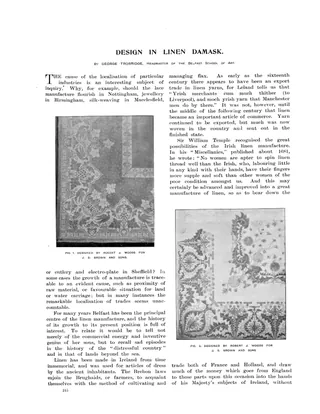
Design in Linen Damask
Article · 4 pages
Article by George Trobridge, headmaster of the Belfast School of Art, on design for Irish linen damask. It sketches the history of the Irish linen industry and explains how damask is woven on the Jacquard loom, with pattern repeats controlled by punched cards. It then discusses the quality of commercial damask design and the efforts of the Belfast School of Art to improve it. Six black-and-white illustrations show damask designs by Robert J. Woods, Lewis F. Day, James Ward, Edwin A. Morrow and David Gould.
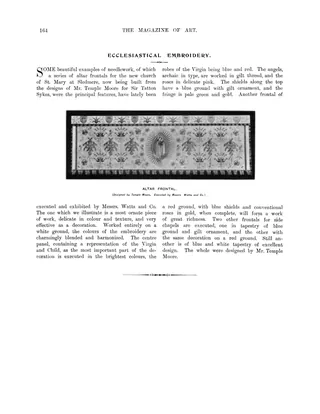
Ecclesiastical Embroidery
Magazine of Art, 1898
Article · 1 page
A one-page note from The Magazine of Art (1898) on altar frontals designed by Temple Moore for the new church of St. Mary at Sledmere, made for Sir Tatton Sykes and executed and exhibited by Watts and Co. It describes an illustrated frontal embroidered on a white ground with a central Virgin and Child, gilt angels, pink roses and shields, and mentions other frontals in embroidery and tapestry in red and blue schemes.
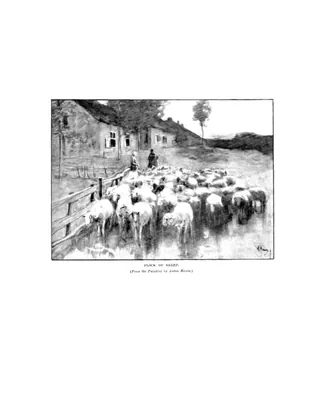
Flock of Sheep
Illustration · 1 page
A single-page halftone illustration reproducing a painting of a flock of sheep in a pen beside a fence, with a shepherd figure nearby and trees and sky above. The caption credits the painting to Anton Mauve. It contains no technical textile content.
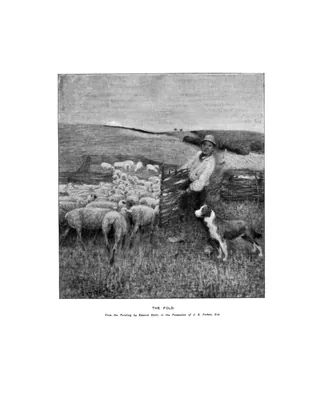
The Fold
Illustration · 1 page
A single-page halftone reproduction of the painting 'The Fold', showing a pastoral scene with a fold of sheep and a partly visible shepherd figure. The caption credits the painting to Edward Stott and notes it was in the possession of J. S. Forbes, Esq. It has no weaving content and appears to be an illustration from the Magazine of Art.
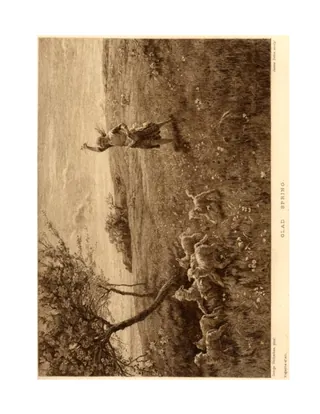
Glad Spring
Magazine of Art, 1891
Illustration · 1 page
A single-page engraved illustration titled 'Glad Spring', published in the Magazine of Art. It shows a woman in a long dress running or dancing across a meadow, with flowering branches in the foreground and a group of figures behind her. The caption credits George Wetherbee as the painter and Anna Brain as the engraver. It contains no weaving content.
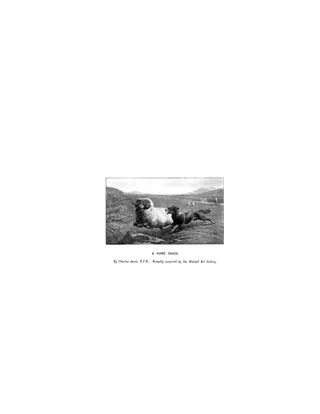
A Hard Chase
Illustration · 1 page
A single-page reproduction of the painting 'A Hard Chase' by Charles Jones, R.C.A., printed in the Magazine of Art in 1899. The caption notes that the work was recently acquired by the Walsall Art Gallery. The image is a dark landscape with a hillside and a pale animal running across the middle ground, possibly a hare or a sheep. There is no weaving content.
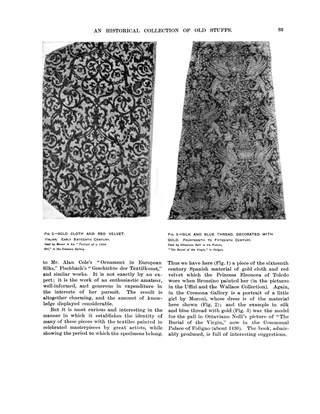
Historical Collection of Old Stuffs
Magazine of Art, 1902
Article · 2 pages
A two-page review in The Magazine of Art of Madame Isabelle Errera's catalogue of her collection of about 400 historical textile specimens, which she donated to the Musée du Cinquantenaire in Brussels. The collection runs from the fourth century onward, with most coverage of the twelfth to eighteenth centuries. The review notes that several specimens match fabrics painted by Old Masters such as Bronzino, Moroni and Ottaviano Nelli, and illustrates three of them: gold cloth with looped red velvet, gold cloth and red velvet, and silk and blue thread with gold.
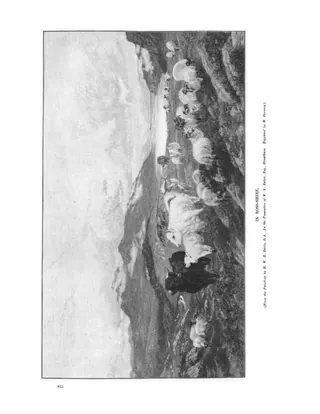
In Ross-Shire
Illustration · 1 page
A single page carrying an engraved illustration titled "In Ross-Shire," reproduced from a painting by H. W. B. Davis, R.A., and published in the Magazine of Art in 1893. The image shows a rocky coastal scene with dark cliffs, surf and rocks in the foreground. The caption credits the engraver as M. Dorway and the owner of the painting as W. Y. Baker, Esq., of Streatham. It has no weaving or textile content.
Irish Lace
Magazine of Art, 1883
Article · 2 pages
A short 1883 magazine article reviewing the Irish lace shown at the Mansion House Exhibition in London. It traces how Irish lace-making grew out of famine relief, describes the main centres (Carrickmacross, Limerick, Innishmacsaint, Youghal, Clones) and the kinds of lace made there, and notes the decline of net laces and the lack of participation by Irish trading firms.
Irish Papal Jubilee lace
Article · 2 pages
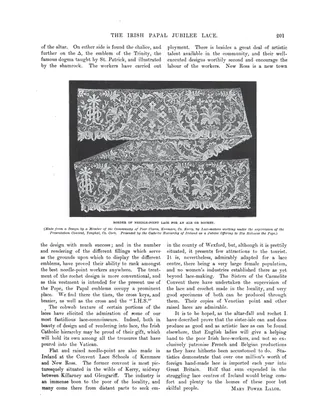
A short 1888 magazine article describing the set of Irish needle-point lace presented by the Irish Catholic bishops to Pope Leo XIII for his priestly Jubilee. It covers the design competition among Irish art schools, the winning Kenmare design, and the making of the altar-fall and rochet lace by workers at the Presentation Convent, Youghal. It also notes the lace schools at Kenmare and New Ross and urges English buyers to support Irish lace. Two photographic illustrations show a cuff and a border of the needle-point lace.
Lace
Article · 3 pages
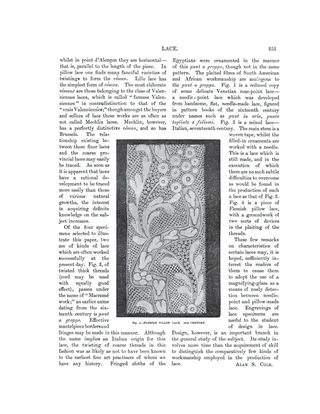
A short 1879 magazine article urging amateurs and lace wearers to study actual lace specimens rather than rely on illustrated books. It explains how to use a magnifying glass to tell needle-point lace (looped threads) from pillow lace (twisted and plaited threads) and from machine-made lace, and how to read the réseau (net ground) to identify types such as Alençon, Venetian, Lille, Valenciennes, Mechlin and Brussels. Four illustrated specimens are discussed: Venetian rose-point, macramé (punto a groppo), Italian tape lace with needle-point fillings, and Flemish pillow lace.
Lace
Article · 4 pages
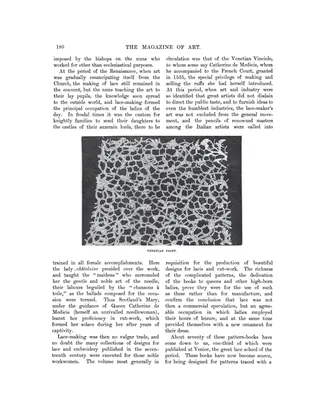
A short illustrated article from The Magazine of Art, described as the last paper written by Mrs. Bury Palliser, sketching the early history of lace. It traces lace from convent work and open-work embroidery through cut-work, lacis, point coupé, drawn-work and reticella, and discusses Renaissance pattern books such as Vinciolo's. Illustrations show Venetian point, Reticella (Greek lace from Zante), Passement au fuseau and Point coupé from Vinciolo.
Lace at the South Kensington Museum
Article · 4 pages
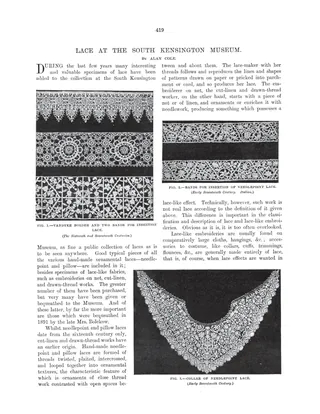
A 1894 Magazine of Art article by Alan Cole surveying recent additions to the lace collection at the South Kensington Museum, including the Bolckow bequest of 1891. It distinguishes true needlepoint and pillow lace from lace-like embroideries on net, cut-linen and drawn-thread work. It traces changing lace designs from geometric 16th-century types through scroll patterns, Venetian rosepoint and pseudo-Chinese styles of the late 17th and early 18th centuries. Twelve photographs illustrate specimens, and the article ends with remarks on how the museum displays lace.
Near the Sea
Magazine of Art, 1895
Illustration · 1 page
A single-page reproduction of a landscape picture titled "Near the Sea," printed in the Magazine of Art in 1895. The caption notes it was in the possession of Lady Sutton. The image is a high-contrast black-and-white view with a cloudy sky, a dark foreground, and a tree at the right. The catalog lists sheep as a topic, though the page overview does not describe any in the image.
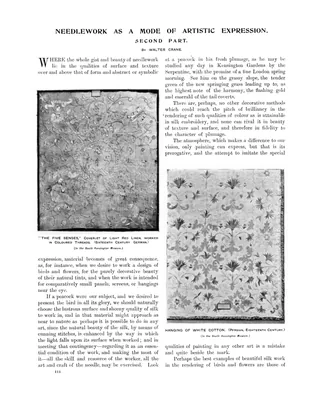
Needlework as a Mode of Artistic Expression; Second Part
Article · 6 pages
Second installment of Walter Crane's essay on embroidery as an art form, discussing how silk, gold and silver thread suit the rendering of birds, flowers, leaves and animals, and how stitch direction should follow natural growth and structure. He draws on Persian, Chinese, Japanese, Indian and Spanish examples in the South Kensington Museum, which are illustrated with halftones and a few stitch diagrams (laid work, spiral laying of gold thread). He closes by arguing that needlework design should develop its own distinctive character rather than imitate other arts or cultures, and adds a correction to the first installment.
The Nursery
Magazine of Art, 1895
Illustration · 1 page
A single-page halftone reproduction of the painting "The Nursery" by Ernest A. Waterlow, A.R.A., printed in the Magazine of Art. The image shows children in white clothing playing among foliage and blossoms in a garden or orchard. A credit line notes publication by permission of the Berlin Photographic Company.
An October Storm
Magazine of Art, 1895
Illustration · 1 page
A single-page illustration titled "An October Storm," reproduced from the Magazine of Art, 1895. It shows a stormy landscape with dark rough ground, bushes or trees along the sides, and a large cloudy sky. The caption notes that the original is in the possession of Miss Kempe. The page has no weaving or textile content.
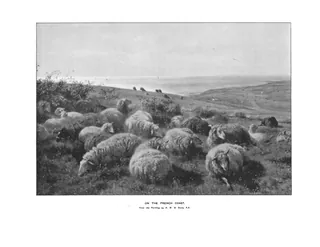
On the French Coast
Illustration · 1 page
A single-page black-and-white halftone reproduction of a painting titled "On the French Coast" by H. W. B. Davis, R.A., from the Magazine of Art. It shows a low, dark shoreline with distant buildings or rocks beneath a pale sky, with breaking waves and surf in the foreground. The page carries only the title and painter credit, with no textile or weaving content.
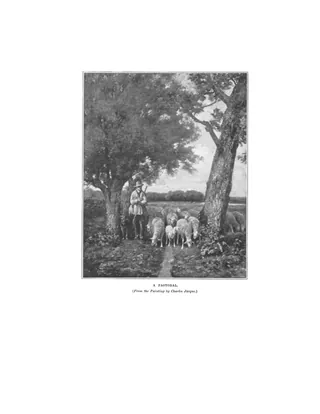
A Pastoral
Illustration · 1 page
A single-page reproduction of a pastoral painting by Charles Jacque, printed in the Magazine of Art. The high-contrast image shows a large leafy tree with figures and livestock grouped beneath it. The only text is the caption crediting the painting.
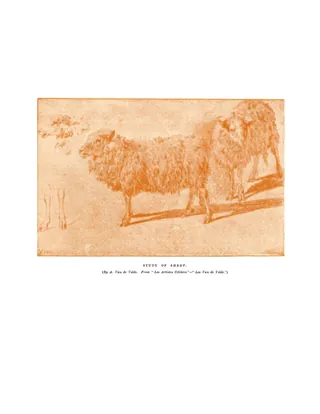
Pastoral
Illustration · 1 page
A single-page black-and-white halftone reproduction of a pastoral study of sheep, captioned "Study of Sheep" by A. Van de Velde. It shows two heavily fleeced sheep resting or standing near a low fence against a sparse background. The caption says it comes from "Les Artistes Célèbres" in the volume on the Van de Velde family. It is an illustration with no weaving content.
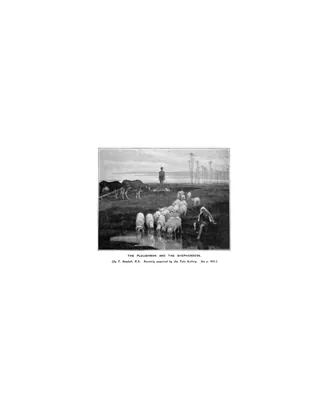
The Ploughman and the Shepherdess
Illustration · 1 page
A single-page black-and-white halftone reproduction of the painting 'The Ploughman and the Shepherdess' by F. Goodall, R.A., printed in the Magazine of Art. It shows a shepherdess and her flock of sheep in the foreground among bushes and flowers, with a ploughman and plough team on the distant horizon. The caption notes the painting was recently acquired by the Tate Gallery.
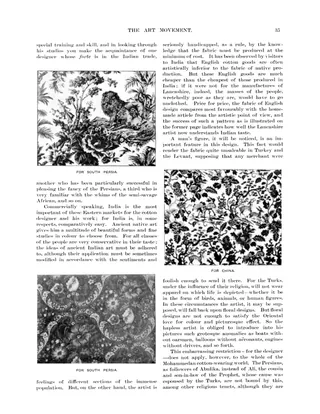
The Quaint and Grotesque in Cotton Designing
Magazine of Art, 1899
Article · 4 pages
A 1899 Magazine of Art article by Frederick Dolman on how Manchester designers create printed cotton patterns for Eastern and other export markets. It describes the studios of Joseph Waterhouse, the demands of markets such as India, Turkey, Persia, China, Japan and Zanzibar, and religious restrictions on depicting living creatures. It also credits the Manchester Municipal Art School with training the designers. Illustrations show sample prints labeled for India, Constantinople, Persia, Zanzibar, China, Java and Singapore.
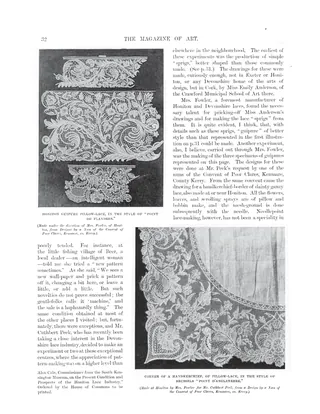
Recent Honiton Lace
Article · 4 pages
Article by Alan S. Cole in The Magazine of Art (1892) on Honiton, or Devonshire, lace made in the preceding five or six years. Cole discusses the history of bone lace and the influence of Flemish and Brussels refugee lace-makers after 1685. He distinguishes Point d'Angleterre from Point de Flandres guipure and describes experiments in new designs by Cuthbert Peek, Mrs. Fowler and Mrs. Treadwin, including designs from Cork and a Kenmare convent. He also covers the decline of lace schools and the state of the industry after his 1887 report. Illustrated with photographs of guipure, sprigs, a handkerchief corner and needlepoint and pillow-lace reproductions.
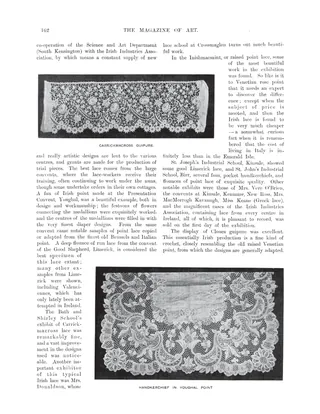
Recent Irish Textile Exhibition
Magazine of Art, 1898
Article · 3 pages
A 1898 magazine review of the Irish Textile Exhibition held in Dublin and organised by Countess Cadogan, with the Irish Industries Association. It surveys Irish laces (Carrickmacross, Youghal point, Limerick, Clones crochet guipure, Inishmacsaint raised point), the convent and school lace centres, and the embroidery and Linen/damask sections. Illustrated with photographs of Carrickmacross guipure, a Youghal point handkerchief, a Clones crochet collarette and Carrickmacross appliqué lappets.
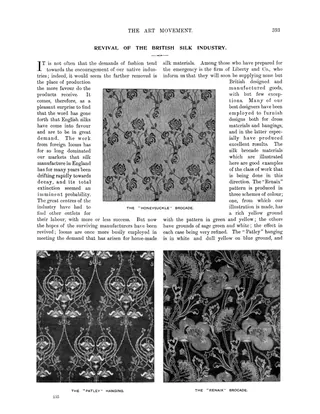
Revival of the British Silk Industry
Magazine of Art, 1898
Article · 2 pages
A short 1898 magazine article reporting a revival of British silk manufacture, with Liberty and Co. committing to supply British-designed and British-made goods. It describes silk brocades, hangings and dress stuffs by name, including Renaix, Patley, Honeysuckle, Sakura, Guelder Rose and Orion, noting their colors and the Japanese influence on the designs. Illustrated with several fabric pictures.
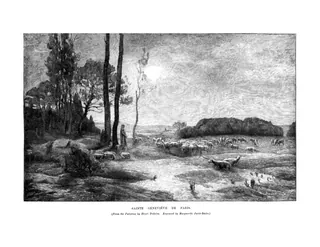
Sainte Geneviéve de Paris
Illustration · 1 page
A single-page engraving titled 'Sainte Geneviève de Paris', reproduced from a painting by Henri Duhem and engraved by Marguerite Jacob-Bazin. It shows a rural landscape with tall slender trees, dense foliage and a standing figure near the trunks, with an open pale field beyond. The only text is the caption; there is no weaving content.
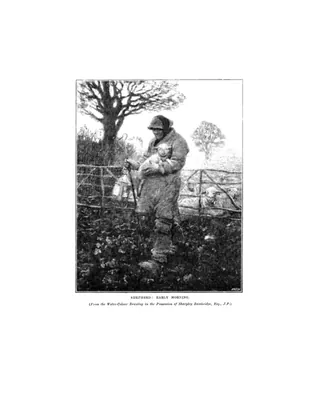
Shepherd: Early Morning
Magazine of Art, 1895
Illustration · 1 page
A single-page black-and-white halftone reproduction of a water-colour drawing titled "Shepherd: Early Morning," showing a shepherd in a hat and long coat standing beside a bare-branched tree and a wooden gate, with sheep nearby. The caption states the original was in the possession of Sharpley Bambridge, Esq., J.P. It has no weaving content and appears to be a magazine plate.
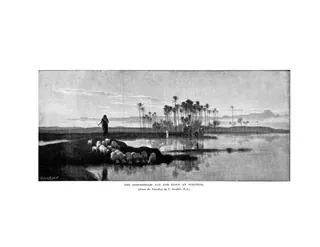
Shepherdess and Her Flock at Eventide
Illustration · 1 page
A single-page black-and-white halftone reproduction of a painting by F. Goodall, R.A., titled The Shepherdess and Her Flock at Eventide. It shows a shepherdess in a dark robe standing near a flock of sheep in a landscape with palm trees and distant hills under an evening sky. It is a pictorial illustration with no weaving or textile instruction.
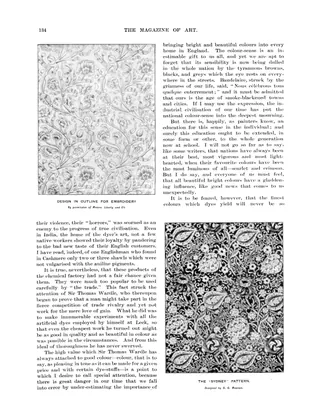
Sir Thomas Wardle and the Decorative Treatment of Textile Fabrics
Magazine of Art, 1899
Article · 4 pages
A 1899 Magazine of Art article on Sir Thomas Wardle, the Leek dyer and printer who worked alongside William Morris in reviving dyeing. It discusses his work to improve the colour of dyed and printed goods, his use of natural and aniline dyes, and his collection of Indian and Persian fabrics and printing blocks. It also describes wax-resist printing on silk and the chemical weighting and adulteration of silk. Illustrated with textile designs including the 'Lily', 'Sydney', 'Red Admiral' and 'Tiger Lily' patterns, and an embroidery outline design for Liberty and Co.
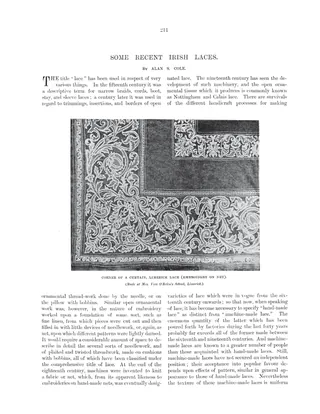
Some Recent Irish Laces
Article · 6 pages
A 1891 Magazine of Art article by Alan S. Cole on new Irish lace designed and made in the preceding few years, mostly in convents and schools. It covers Limerick net embroidery, crochet, Carrickmacross cut-linen and appliqu\u00e9, and flat and raised needle-point lace from Youghal, Kenmare, Innishmacsaint and New Ross. It stresses the value of new designs from art schools and compares hand-made lace with machine-made lace. Each specimen is illustrated and credited to its designer and workers.
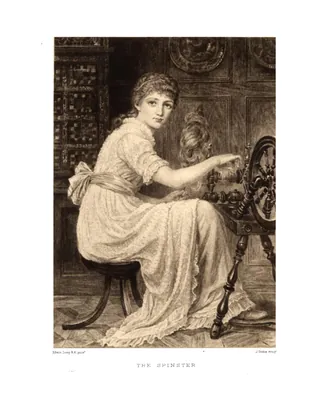
The Spinster
Magazine of Art, 1893
Illustration · 1 page
A single-page black-and-white engraving titled "The Spinster," reproduced from the Magazine of Art. It shows a seated woman in a flowing robe turning her head to one side, with fabric draped across her lap and the floor. The plate is credited to Edwin Long, R.A., as painter and J. Dobie as engraver. There is no accompanying article text.
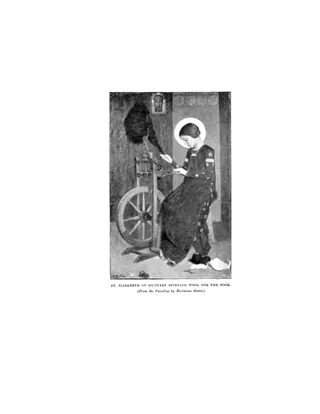
St. Elizabeth of Hungary Spinning Wool for the Poor
Illustration · 1 page
A single-page halftone reproduction of a painting by Marianne Stokes showing St. Elizabeth of Hungary, haloed, seated at a spinning wheel and spinning wool for the poor. A bundle or basket of wool rests on the floor beside her. The page carries only the caption and the painter's credit.
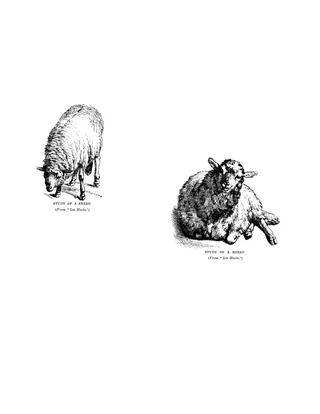
Study of a Sheep
Magazine of Art, 1893
Illustration · 1 page
A single page from the Magazine of Art (1893) reproducing two pen-and-ink engravings of sheep, each captioned "Study of a Sheep" and credited as from "Les Huëts." One sheep stands grazing with its head lowered; the other lies down with its head turned back. There is no weaving or textile instruction, only animal illustration.
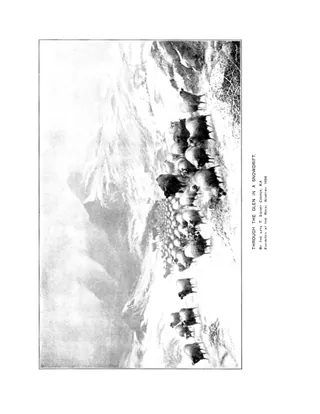
Through the Glen in a Snowdrift
Illustration · 1 page
A single-page reproduction of a painting by T. Sidney Cooper, R.A., showing a flock of sheep moving through a snowy glen toward a dark hillside, with bare trees and snowdrifts in the foreground and misty hills behind. The caption notes it was exhibited at the Royal Academy in 1894. The page has no weaving content and is of interest mainly for its sheep subject.
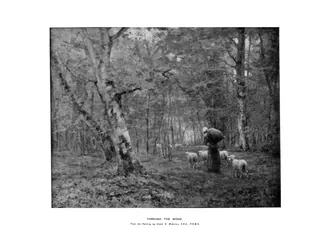
Through the Wood
Illustration · 1 page
A single-page reproduction of the painting "Through the Wood" by Ernest A. Waterlow, printed in the Magazine of Art. The image is a high-contrast view of a wooded landscape with sunlit patches among the trees. The catalog lists sheep as a topic, but the page shows no sheep.
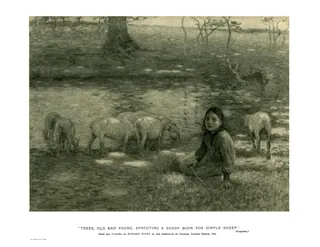
Trees, Old and Young, Sprouting a Shady Boon for Simple Sheep
Illustration · 1 page
A single-page reproduction of a painting by Edward Stott, captioned with a line from Keats's Endymion, "Trees, old and young, sprouting a shady boon for simple sheep." The image shows trees against a dark ground and is a heavily thresholded, high-contrast print. The caption states that the painting was in the possession of Charles Thomas Harris, Esq. It has no weaving content.
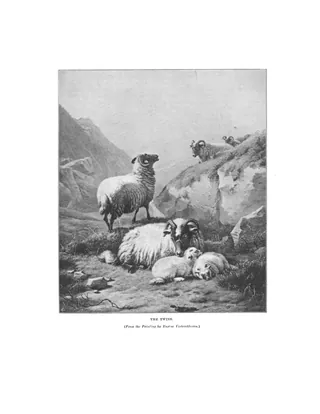
The Twins
Illustration · 1 page
A single-page halftone reproduction of Eugène Verboeckhoven's painting "The Twins," showing a ewe with lambs in a grassy landscape with a dark hillside, bushes or a tree at right, and a small figure in the background. The page carries only the title and a credit line, with no accompanying article text.
Vanished Art
Article · 3 pages
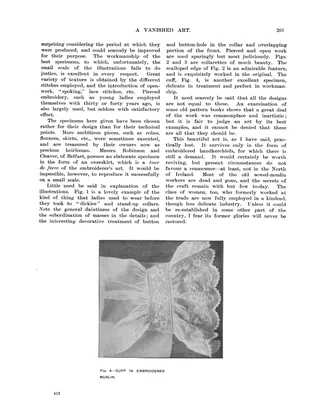
A 1902 Magazine of Art article on the rise and collapse of the Irish embroidered (sewed) muslin industry, centered in County Down, in the early Victorian period. It describes the workers, wages, the role of Glasgow merchants, the effect of a firm's failure and changing fashion, and the near disappearance of the craft. Four halftone illustrations show an embroidered front, two collarettes and a cuff, with comments on design and stitches such as openwork and spoking.
Word on the Outlook of Lace-Making in Ireland
Article · 3 pages
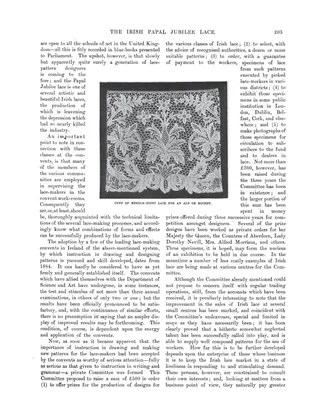
A 1888 Magazine of Art article by Alan S. Cole on the state and prospects of Irish lace-making, prompted by the needle-point laces given to the Pope for his Jubilee. It describes lace-making as a cottage industry supported by convents, and the effort since the 1883 Cork Exhibition to improve pattern design through drawing classes, Department of Science and Art grants and a private committee offering design prizes. Two illustrations show needle-point lace: a cuff for an alb or rochet and an altar-cloth trimming.
Woven Memento of the Jubilee
Magazine of Art, 1899
Article · 1 page
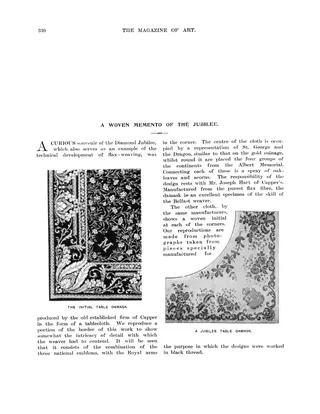
A short magazine article describing a damask tablecloth woven by the firm of Capper as a souvenir of Queen Victoria's Diamond Jubilee (1897). The border combines the three national emblems with the Royal arms, and the centre shows St. George and the Dragon with groups from the Albert Memorial. A second Capper cloth with woven corner initials is also noted, and both are illustrated from photographs of specially made pieces.
47 documents found