Textile Documents › Publications › Publication: Chapman and Hall
8 documents found
Sort: 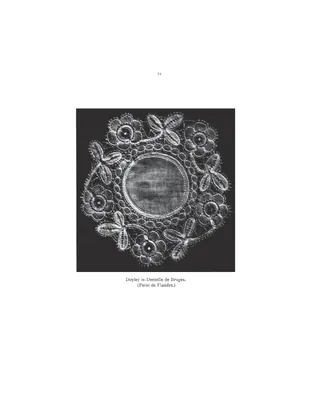
The Art of Bobbin Lace
Book · 105 pages
A practical instruction manual on making bobbin lace, written by a London lace teacher and published in 1907. It covers equipment and preparation (cushion, bobbins, winding, thread and pins), the basic cloth, half and plait stitches, and step-by-step directions for specimen pieces in Italian, Dentelle de Bruges (Point de Flandre), Guipure de Flandre, Honiton (including appliqué and raised work), Duchesse and Brussels lace. Separate sections explain ornamental filling stitches such as reseau, honeycomb, festoon, spider web, lead, diamond, double reseau and rose, and the book closes with advice on repairing and cleaning valuable lace. It is illustrated with photographs of finished pieces (doyley, collars, yoke, vest, bolero, scarf, flounce, handkerchief, berthe), pattern line drawings and stitch diagrams.
The Art of Bobbin Lace Supplement
Book · 87 pages
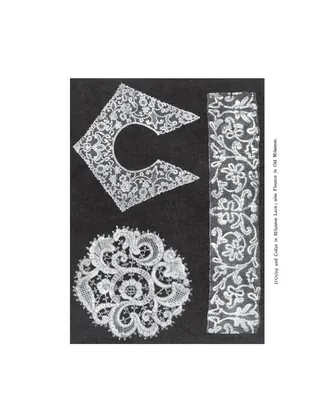
A 1911 supplement to Louisa and Rosa Tebbs' practical textbook The Art of Bobbin Lace, giving step-by-step bobbin-working directions for 38 advanced lace specimens in Venetian, Milanese, Genoese, Guipure de Flandre, Flemish, Honiton, Duchesse and Brussels laces. Pieces include collars, d'oyleys, flounces, a yoke, a cravat, a table centre, a fan, an opera bag and baby's shoes, and a section covers rare fillings and grounds such as hexagon net, honeycomb, spot insertion and woven bar. Photographic plates of the finished lace are included. The back matter reprints press notices and reviews, advertises the authors' school, their punto tagliato embroidery book, and supplies such as bobbins, cushions and thread.
Church Embroidery
Book · 222 pages
Anastasia Dolby's 1867 handbook on ecclesiastical needlework, with practical instruction on designing and working embroidery for the church. It opens with a history of English church embroidery (Opus Anglicanum), then describes eight altar designs with colour schemes and working dimensions, followed by super-frontals, monograms, powderings, pulpit and desk hangings, sermon-cases, alms-bags, dish-mats, book-markers and church linen. Later chapters cover appliqué, embroidery frames and hand care, gold work (couching, bullion, passing, pearl-purl), long-stitch and French knots, and suitable fabrics and liturgical colours. Illustrated with line-drawn plates and photographed stitch samples; an index and publisher's advertisements follow.
Embroidery section from Historic Ornament: Treatise on Decorative Art and Architectural Ornament
Monograph · 8 pages
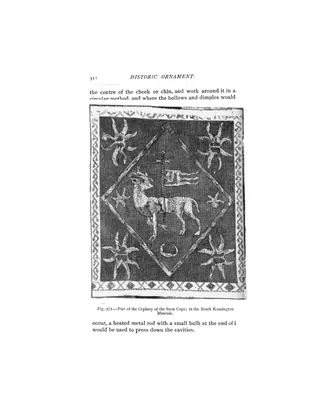
An excerpt on embroidery from James Ward's Historic Ornament (1897), covering pages 319-325 of the Textile Fabrics chapter. It traces embroidery from Egypt, Assyria, Persia and Phrygia through Greece and Anglo-Saxon and Norman England, including Opus Anglicum and the Bayeux Tapestry. It describes stitch types (feather, chain, crewel, satin, darning), gold and silver thread, and cut work or appliqué. Illustrations show a Norman archer from the Bayeux Tapestry, the Syon Cope orphrey, a Persian gold and silver embroidered velvet carpet, and the state gloves of Louis XIII.
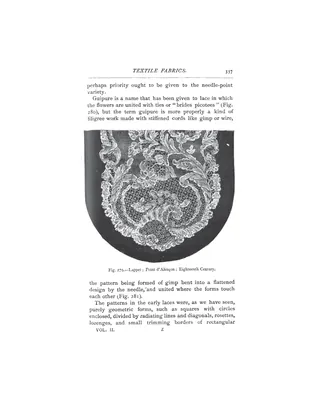
Lace section from Historic Ornament: Treatise on Decorative Art and Architectural Ornament
Monograph · 12 pages
An extract on lace from James Ward's Historic Ornament (1897), covering the Textile Fabrics chapter pages 333-343. It surveys hand-made lace, distinguishing needle-point from pillow-made, and traces lace from lacis and cutwork through Venetian pattern-books to the main national types: Italian, Flemish, French, English and Irish. It also describes grounds, cordonnet, brides and guipure, and closes with the Burano revival and machine-made lace from Nottingham. Illustrated with photographs of Genoese, Brussels, Alençon, guipure, Venetian, Mechlin, Honiton and Irish point laces and a diagram of lace grounds.
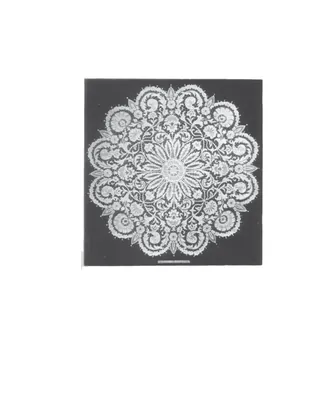
A Renascence of the Irish Art of Lace-Making
Book · 38 pages
An 1888 pattern book promoting new designs for Irish lace, with introductory notes by A. S. C. (Alan S. Cole) and twelve photographic plates of lace made from specially commissioned patterns. Each plate has a caption naming the designer, the convent or school that made the lace, and the lace type: raised needlepoint, crochet, Carrickmacross appliqué, Limerick tambour and run lace, and cut linen. It also gives the history of the 1884 Committee for new Irish lace patterns, its proposal for maintaining the industry, and a list of subscribers.
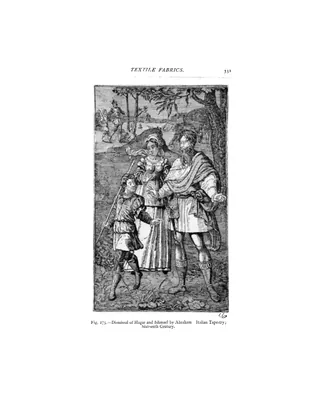
Tapestry section from Historic Ornament: Treatise on Decorative Art and Architectural Ornament
Monograph · 9 pages
An excerpt (pp. 325-332) from James Ward's Historic Ornament (1897), covering tapestry in the chapter on textile fabrics. It explains high-warp and low-warp tapestry weaving, the weaver's technique and the problems of colour gradation, then surveys the history of tapestry making in Flanders, France (Gobelins, Beauvais, Aubusson, Savonnerie), Italy and England (Mortlake, Barcheston). It closes with a short section on carpet manufacture in England and the East. One halftone shows a sixteenth-century Italian tapestry of Hagar and Ishmael.
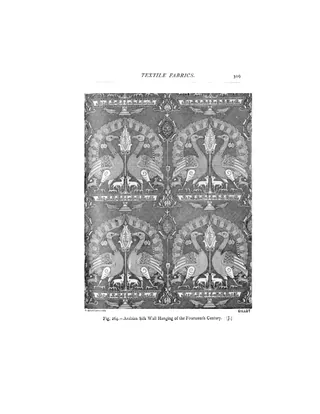
Textile section from Historic Ornament: Treatise on Decorative Art and Architectural Ornament
Monograph · 25 pages
Chapter VI, "Textile Fabrics," extracted from James Ward's Historic Ornament (1897, pp. 295-318). It surveys the history of weaving and textile ornament: linen in Egypt and Europe, the Jacquard machine, the spread of silk from China to Byzantium, Persia, the Saracens, Sicily, Italy, France and England, and a section on the textiles of India (kincobs, Dacca muslin, Cashmere shawls, cotton printing). It closes with notes on wool, worsted, cotton, fustian, and the inventions that mechanized spinning, weaving and printing. Illustrations show Assyrian tree-of-life motifs and silk damasks, brocades and velvets from Saracenic, Sicilian, Florentine and Italian sources, with commentary on pattern development.
8 documents found