Textile Documents › Authors › Author: James Ward
4 documents found
Sort: 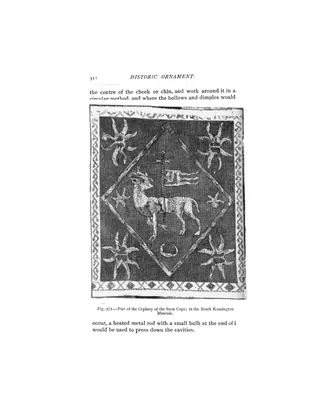
Embroidery section from Historic Ornament: Treatise on Decorative Art and Architectural Ornament
Monograph · 8 pages
An excerpt on embroidery from James Ward's Historic Ornament (1897), covering pages 319-325 of the Textile Fabrics chapter. It traces embroidery from Egypt, Assyria, Persia and Phrygia through Greece and Anglo-Saxon and Norman England, including Opus Anglicum and the Bayeux Tapestry. It describes stitch types (feather, chain, crewel, satin, darning), gold and silver thread, and cut work or appliqué. Illustrations show a Norman archer from the Bayeux Tapestry, the Syon Cope orphrey, a Persian gold and silver embroidered velvet carpet, and the state gloves of Louis XIII.
Lace section from Historic Ornament: Treatise on Decorative Art and Architectural Ornament
Monograph · 12 pages
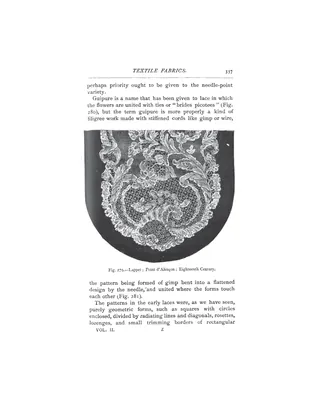
An extract on lace from James Ward's Historic Ornament (1897), covering the Textile Fabrics chapter pages 333-343. It surveys hand-made lace, distinguishing needle-point from pillow-made, and traces lace from lacis and cutwork through Venetian pattern-books to the main national types: Italian, Flemish, French, English and Irish. It also describes grounds, cordonnet, brides and guipure, and closes with the Burano revival and machine-made lace from Nottingham. Illustrated with photographs of Genoese, Brussels, Alençon, guipure, Venetian, Mechlin, Honiton and Irish point laces and a diagram of lace grounds.
Tapestry section from Historic Ornament: Treatise on Decorative Art and Architectural Ornament
Monograph · 9 pages
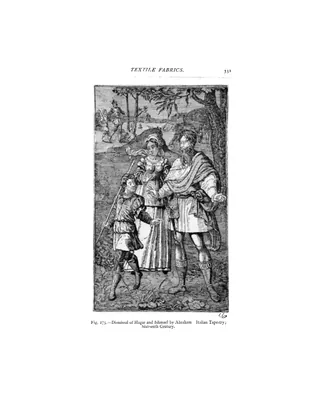
An excerpt (pp. 325-332) from James Ward's Historic Ornament (1897), covering tapestry in the chapter on textile fabrics. It explains high-warp and low-warp tapestry weaving, the weaver's technique and the problems of colour gradation, then surveys the history of tapestry making in Flanders, France (Gobelins, Beauvais, Aubusson, Savonnerie), Italy and England (Mortlake, Barcheston). It closes with a short section on carpet manufacture in England and the East. One halftone shows a sixteenth-century Italian tapestry of Hagar and Ishmael.
Textile section from Historic Ornament: Treatise on Decorative Art and Architectural Ornament
Monograph · 25 pages
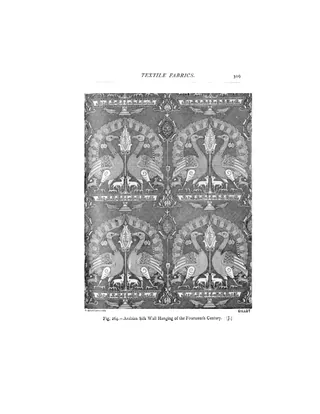
Chapter VI, "Textile Fabrics," extracted from James Ward's Historic Ornament (1897, pp. 295-318). It surveys the history of weaving and textile ornament: linen in Egypt and Europe, the Jacquard machine, the spread of silk from China to Byzantium, Persia, the Saracens, Sicily, Italy, France and England, and a section on the textiles of India (kincobs, Dacca muslin, Cashmere shawls, cotton printing). It closes with notes on wool, worsted, cotton, fustian, and the inventions that mechanized spinning, weaving and printing. Illustrations show Assyrian tree-of-life motifs and silk damasks, brocades and velvets from Saracenic, Sicilian, Florentine and Italian sources, with commentary on pattern development.
4 documents found