Textile Documents › Publications › Publication: Woman's World
9 documents found
Sort: 
Adulteration of Silk
Article · 2 pages
A short 1890 magazine article on how raw and thrown silk was adulterated with moisture, gum, sugar and fatty substances to add weight, and how continental "conditioning houses" assayed silk to detect it. It describes the tests for humidity, boiling-off loss, length per weight, elasticity, twist and lustre. It also argues that British silk manufacturers lagged behind the French in applying chemistry to their trade.
Lace-Makers of Le Puy
Article · 5 pages
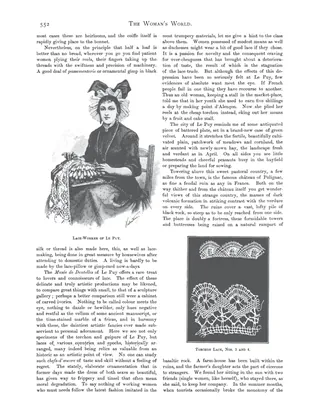
A travel and trade essay on the declining hand-made lace industry of Le Puy in the Haute-Loire, France, written for The Woman's World in 1890. It describes the town and its setting, the women who make torchon lace and gimp on pillows at their doorways, the fall in earnings caused by changing fashion and machine-made lace, and the lace museum (Musée de Dentelles). It closes with the ribbon-weaving trade of St. Étienne, its low wages, its museum of ribbons, and competition from Lyons. Illustrated with engravings of Le Puy and photographs of torchon lace specimens.
Lace-Making in Ireland
Woman's World, 1888
Article · 5 pages
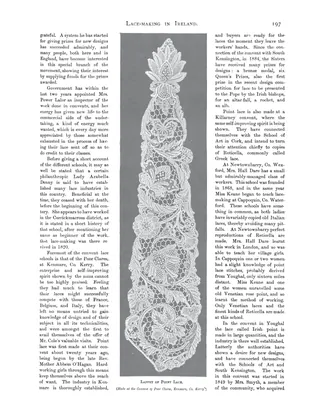
An 1888 magazine article by H. E. Keane surveying the revival and state of lace-making in Ireland. It argues for hand-made lace over machine work and describes the role of South Kensington, the Schools of Art and convent schools in improving design. It then reviews individual centres: Kenmare, Youghal, Cappoquin, Newtownbarry, Limerick and Carrickmacross, along with a few pillow lace efforts. Illustrations show Venetian point, Limerick lace, a point lace lappet and Greek lace (Reticella).
Macramé Lace
Woman's World, 1890
Article · 5 pages
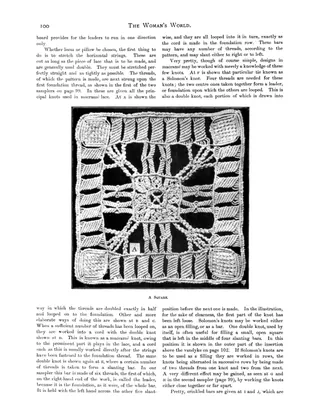
A Victorian magazine article on making macramé lace, with a short history of the craft and its supposed Arabic origin. It explains the equipment (a weighted pillow or a board loom) and the main knots shown on two knot samplers: the double macramé knot, slanting bars, Solomon's knot, crinkled bars, the raised picot knot, and picot bars. It then gives working instructions for a vandyked edging with fringe, a square panel with added corner threads, and an insertion, plus advice on cutting thread lengths. The article is signed Ellen T. Masters.
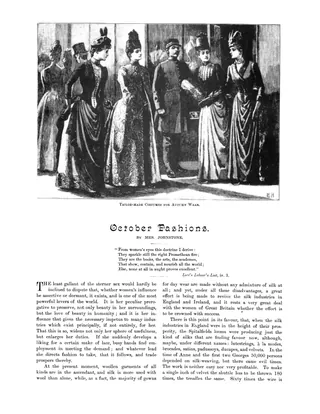
October Fashions
Woman's World, 1888
Article · 8 pages
An article from The Woman's World (1888) on autumn fashions, in two parts. The first, by Mrs. Johnstone, covers London styles: tailor-made costumes by Redfern, new hats and bonnets, woollen cloths and their colours and borders, waterproofs, gloves, and gowns from Debenham and Freebody. It also briefly notes the Spitalfields silk-weaving industry and the effort to revive English silk. The second part, a Paris letter signed Violette, describes bridal trousseaux, lingerie, silk crepe underclothing, morning gowns, ribbons, hand embroidery and lace, and Mme. de Valsayre's dress-reform petition. It is illustrated with fashion engravings.
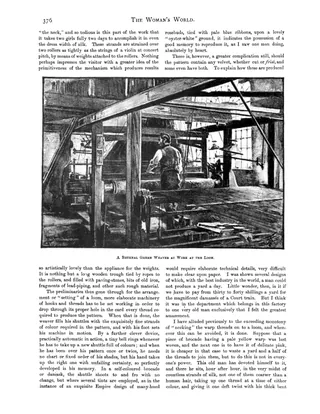
Silk-Weaving in the East-End
Article · 4 pages
A 1890 magazine article describing the surviving hand-loom silk-weaving trade of Bethnal Green and Spitalfields in London's East End. It covers the decline of the industry since the 1860 removal of duties on foreign silks, the Huguenot weaving families, and a visit to the factory of Messrs. Warner and Ram. It describes Jacquard loom preparation, including card cutting, 'necking' the warp, weighted warp rollers and joining warps, and the brocades, damasks and velvets woven there. It closes with an appeal for a technical school and for patronage of English silks.
Some Irish Industries : I.--The Poplin Weavers of Dublin
Article · 4 pages
A magazine article on the Irish poplin industry in Dublin's Coombe district, tracing it from the arrival of Huguenot silk weavers in 1693 through the decline of Irish silk after 1783. It explains that poplin has a silk warp and wool weft, and describes a visit to Dublin manufacturers (winding, Jacquard looms, punched-card patterns, dyeing, materials) and to weavers working in their own homes. It covers wages, working conditions, ecclesiastical brocades, and the trade's poor state in 1890.
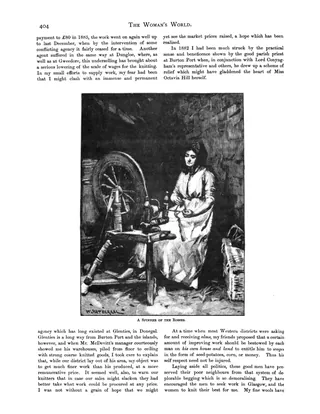
Some Irish Industries : II.--The Knitters of the Rosses
Article · 6 pages
A magazine article from The Woman's World, part of the series 'Some Irish Industries', describing the Rosses district of western Donegal and its hand-knitting trade. The author describes the landscape, poverty, customs and folklore of the islands and coast, then explains how knitting, spinning and hand-loom cloth were encouraged by Lord George Hill at Gweedore and bought by hosiery agents. She also describes her own scheme, run from a London 'stocking room' with Father Bernard at Burton Port, which supplies fine wool and pays local women for socks, gloves and jerseys. It also touches on wages, competing agencies, Donegal embroidery and sprigging, homespun cloth, plant and lichen dyeing, tuck-mill finishing, and the appeal for a pier at Kincaslough.
Tapestry-Weaving
Article · 6 pages
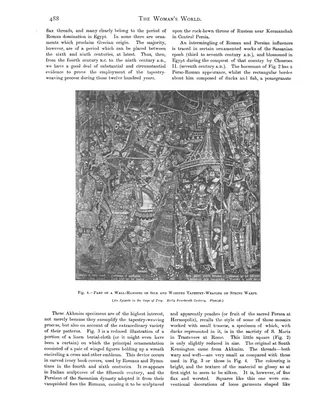
A 1888 magazine article by Alan S. Cole explaining tapestry-weaving and how it differs from embroidery and from shuttle loom-weaving. It surveys the technique from Greek and Egypto-Roman insertions (the Kouban ducks, Akhmim finds, tabulae adjunctae) through medieval and Flemish wall-hangings such as the Siege of Troy to modern Chinese silk tapestry. Illustrated with five halftone figures of historic specimens.
9 documents found