Textile Documents › Publications › Publication: Encyclopedia Britannica, 11th ed.
125 documents found
Sort: 
Abaca
Article · 1 page
A one-sentence encyclopedia entry from the 11th edition of the Encyclopedia Britannica. It defines abaca (abaka) as the native name for the plant Musa textilis, source of the fibre called Manila hemp, and refers readers to the separate Manila Hemp article.
Acacia
Article · 2 pages
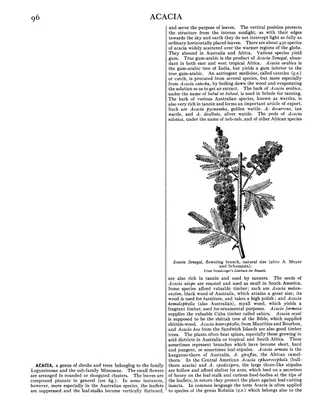
Encyclopedia article on Acacia, a genus of leguminous shrubs and trees with about 450 species in warm regions, especially Australia and Africa. It covers leaf structure, gum arabic, catechu (cutch), tannin-rich barks and pods, timber species, spines and ant associations, and the confusion with Robinia (false acacia). It includes a botanical illustration of a flowering branch of Acacia Senegal.
Agave
Article · 1 page
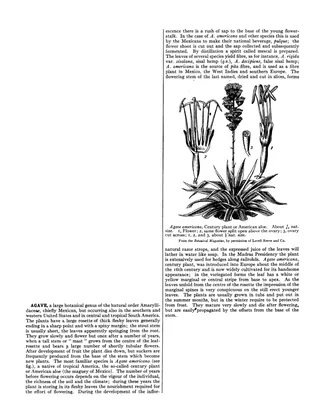
Encyclopedia article on the agave genus, a largely Mexican group of rosette-forming succulents. It describes the plant's growth and flowering habit, the uses of Agave americana (century plant, maguey) for pulque, mescal and pita fibre, and sisal hemp from related species. It includes a botanical illustration of Agave americana with flower details.
Alpaca
Article · 2 pages
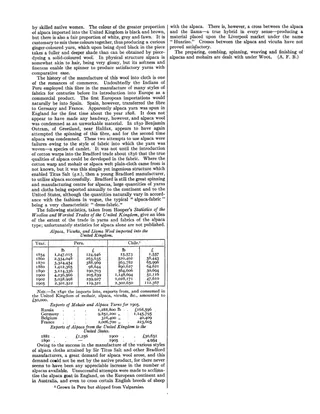
Encyclopedia article on the alpaca, both the South American domesticated animal and the fibre and fabric made from it. It covers the animal's habitat and wool colours, the history of alpaca cloth manufacture in Europe (Benjamin Outram, Titus Salt, Bradford cotton-warp fabrics), and trade statistics for imports and exports of alpaca, mohair and yarns up to 1905. It ends with notes on failed acclimatization attempts and the llama hybrid 'Huarizo'.
Arkwright, Sir Richard
Article · 2 pages
Encyclopedia article on Sir Richard Arkwright (1732-1792), English inventor of the spinning frame. It covers his early life as a barber in Bolton, the development and 1769 patent of the water-powered spinning frame, and his mills at Nottingham and Cromford with Jedediah Strutt and Samuel Need. It also covers the patent lawsuits of 1781-1785, in which his patents were cancelled, the destruction of his mill near Chorley in 1779, and his knighthood in 1786 and death in 1792.
Asbestos
Article · 2 pages
Encyclopedia article on asbestos from the 11th edition of the Encyclopaedia Britannica. It covers the etymology and ancient use of the mineral, the amphibole and serpentine (chrysotile) varieties, and the main sources in Canada, the United States, Italy, South Africa and elsewhere. It also describes how it was spun and woven into fabrics as a curiosity, its modern industrial uses, and a short list of references.
Bamboo
Article · 2 pages
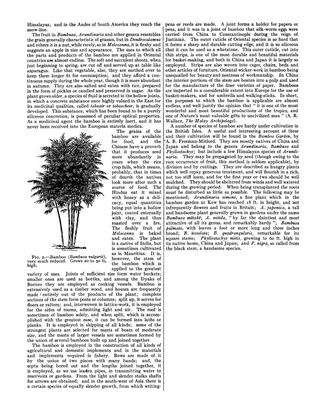
A two-page encyclopedia article on bamboo from the 11th edition of the Encyclopedia Britannica. It describes the botany of the Bambuseae grasses, their flowering habits and geographic distribution, and their many uses in Asia, including food, building, implements, basketry, wickerwork, and paper. It closes with notes on hardy species cultivated in the British Isles. Two botanical illustrations accompany the text.
Basket
Article · 3 pages
Encyclopedia Britannica (11th ed.) article on basketry, covering the history of basket-making from ancient and non-European traditions to English trade practice around 1900. It describes willow and osier grades and preparation, the few tools used, the basic strokes (slew, rand, fitch, pair, wale) and the construction of an oval basket from slath to border. It also covers other materials (cane, bamboo, palm, rush), centres of manufacture, and tables of British import values for basket-ware and willows, 1900 and 1905.
Bayeux Tapestry
Article · 4 pages
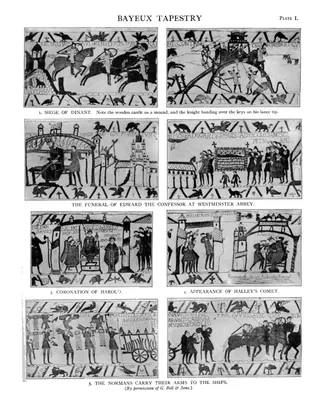
Encyclopedia Britannica (11th ed.) article describing the Bayeux Tapestry, an embroidered linen band about 231 ft long showing the Norman conquest of England in seventy-two scenes. It covers the physical description, borders, history of the object, debate over its origin and patronage by Bishop Odo, and the dating controversy, followed by a bibliography. Two plates reproduce eleven scenes, including the siege of Dinant, Harold's coronation, Halley's Comet, the ship crossing, and the cavalry attack.
Bleaching
Article · 7 pages
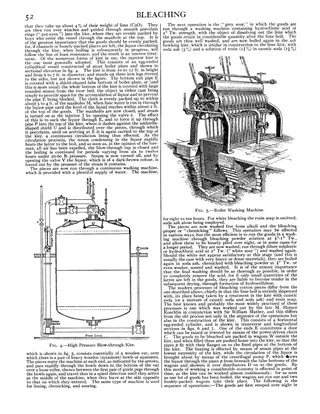
Encyclopedia article on the bleaching of textile fibres, covering the history from antiquity and the Dutch and Scottish bleachfields to the introduction of chlorine, eau de Javel and Tennant's bleaching powder. It then describes industrial practice for cotton yarn and piece goods, linen, jute and straw, including the kier boiling, souring and chemicking steps. Engraved figures show dash-wheels, singeing stoves, kiers, washing machines, the Mather kier and a horizontal drying machine.
Brocade
Article · 3 pages
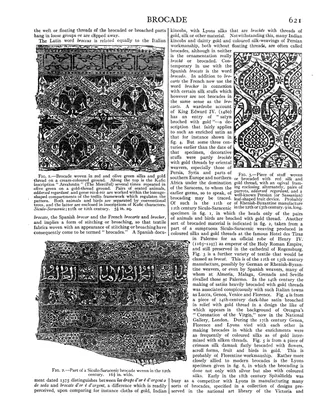
Encyclopedia Britannica (11th ed.) entry defining brocade as a decorative shuttle-woven fabric with ornament added in supplementary weft, often in coloured silks and gold or silver thread. It covers the etymology of the word, the Saracen and Siculo-Saracenic origins, Italian, French and English (Spitalfields) production from the 14th to 18th centuries, and early Chinese brocading. Six photographs of fragments illustrate the types discussed, and no weaving drafts are given.
Buckram
Article · 1 page
A one-paragraph encyclopedia entry defining buckram. It notes that the word occurs in several early European forms with unknown derivation, and that it once meant a fine linen or cotton cloth. It now means a coarse linen or cotton fabric stiffened with glue, used for clothing linings and in bookbinding. It also mentions Falstaff's "men in buckram" in Shakespeare's Henry IV.
Calender
Article · 1 page
A short encyclopedia entry defining the calender, a machine of two or more close-set, often heated rollers through which cotton, calico and other fabrics are passed to give a smooth, glazed finish. It gives the word's etymology from the Greek for cylinder and notes that the same machine is used in paper manufacture.
Calico
Article · 1 page
A short encyclopedia entry defining calico as a plain cotton cloth. It explains the name's derivation from the Indian port of Calicut and notes how usage differs between England, where it means grey or bleached plain cotton, and the United States, where it means printed cloth.
Cambric
Article · 1 page
A short encyclopedia entry on cambric, a fine linen cloth named for Cambrai, France. It covers the word's origin, an early record of use for Henry VIII's shirts, typical uses such as handkerchiefs, collars and fine underclothing, and thread counts of about 120 per inch. It also mentions embroidery cambric and batiste, and the later imitation of cambric in cotton and tow mixtures.
Camel
Article · 2 pages
Encyclopedia Britannica (11th ed.) article on the camel, covering the Arabian (dromedary) and Bactrian species. It describes the wild Bactrian camel, the animal's domestication, its use as a beast of burden, its temperament and diet, and the products obtained from it, including hair, hide, milk, meat and dung. It also notes the Biblical references to camels and the 'needle's eye' saying.
Cane
Article · 1 page
A one-page encyclopedia article on cane from the 11th edition of the Encyclopaedia Britannica. It explains that the name properly belongs to the rattan palms of the genera Calamus and Daemonorops, and describes where they grow, their climbing habit, and how they are harvested. It also covers uses such as basket-work, chair seating, rope and walking-sticks, and the trade in canes and rattans centred on Asian ports.
Canvas
Article · 1 page
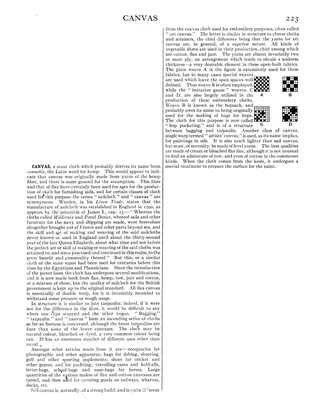
A one-page encyclopedia article on canvas, the stout cloth traditionally used for sails. It covers the likely origin of the name from Latin cannabis, the history of English sailcloth manufacture from 1590, the fibres used (flax, hemp, tow, jute, cotton) and the many uses of canvas. It also describes open-built embroidery or art canvas and artists' canvas, and illustrates plain weave, hopsack and imitation gauze weaves in four small diagrams.
Carding
Article · 1 page
A short encyclopedia article on carding, the combing of textile fibres to straighten them and remove impurities before spinning. It describes early hand cards and stock cards, then traces the development of mechanical carding through Hargreaves, Bourn, Lewis Paul, the elder Peel and Arkwright in the 18th century.
Carmine
Article · 1 page
A short encyclopedia entry defining carmine as a bright red pigment made from cochineal. It describes how it is prepared by boiling cochineal and precipitating the color with alum, cream of tartar, stannous chloride or potassium oxalate, and how light and alumina content affect its quality. It also covers adulterants, a test for purity, its chemical makeup, and its uses in artificial flowers, water-colors, cosmetics, ink and miniature painting. The text begins with the tail of the preceding entry, which mentions carmine lake.
Carpet
Article · 10 pages
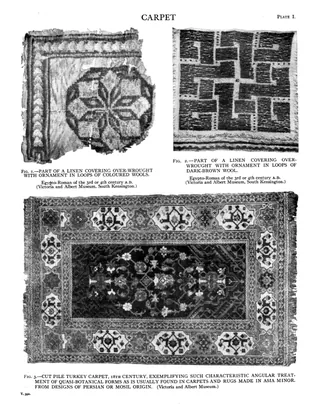
Encyclopedia Britannica (11th ed.) article on carpets covering their definition, etymology, and history from ancient Egypt, Assyria and Greece through Egypto-Roman looped textiles to later pile carpets. It describes the Oriental hand-knotted method and surveys carpet making in Persia, Turkey, India, Spain, England and France, followed by the introduction of Jacquard and steam power looms in the 19th century. Four plates illustrate Egypto-Roman loop-worked linens, Turkey, Persian, Lahore and Spanish cut pile carpets, and the Ardebil carpet; a bibliography closes the article.
Carrolling
Illustration · 1 page
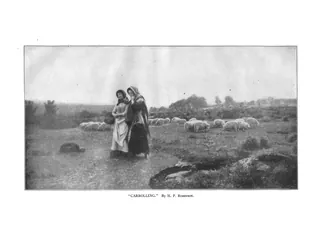
A single-page plate reproducing a black-and-white photograph titled "Carrolling" by H. P. Robinson, from the 11th edition of the Encyclopedia Britannica. It shows a rural field scene with two figures in long dresses or cloaks and a row of bundled or heaped shapes behind them. There is no textile or weaving instruction on the page, only the caption.
Cheese Cloth
Article · 1 page
A very short encyclopedia entry defining cheese cloth as an open, sieve-like cloth usually made from flax or tow yarns and used for wrapping cheese. It notes a finer version made for women's gowns and similar cloth used for upholstery linings and as a ground for embroidery.

Chintz
Article · 1 page
A very short encyclopedia entry defining chintz. It gives the word's origin from the Hindi chint, meaning spotted or variegated, and describes the original Indian stained or painted calico. It also notes the later use of the term for a highly glazed, multicolored printed calico used for bed hangings and furniture coverings.
Cloth
Article · 1 page
A short encyclopedia entry from the 11th edition of the Encyclopedia Britannica on the word 'cloth'. It covers the meaning of the term as a covering or woven material, its commercial use for woolen fabric, and its Germanic etymology. It also explains the distinction between the plurals 'cloths' and 'clothes'.
Clothier
Article · 1 page
A very short dictionary-style entry from the 11th edition of the Encyclopedia Britannica defining 'clothier' as a manufacturer of cloth or a dealer in cloth or ready-made clothing. It notes that in the United States the word once referred only to those who dressed or fulled cloth during manufacture, but now has the general sense.
Coal Tar
Article · 5 pages
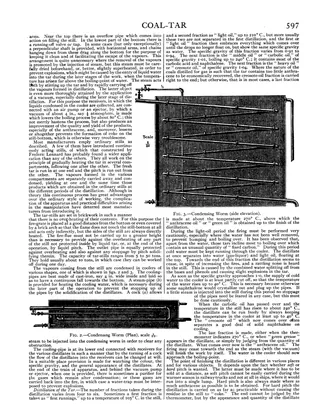
Encyclopaedia Britannica (11th ed.) article on coal-tar, covering its origin as a by-product of coal-gas and coke-oven manufacture, its composition, and its uses in the crude state (fuel, paint, roofing-felt, lamp-black). Most of the article describes fractional distillation in tar-stills and condensers, and the working up of the light, middle, creosote and anthracene oil fractions into benzene, naphthalene, carbolic acid, pyridine bases, creosote and anthracene (for alizarine). It also gives a short history of the industry (Mansfield, Hofmann, Perkin) and a bibliography. Three figures show a tar-still, a condensing worm and a benzol still.
Coccidia
Article · 6 pages
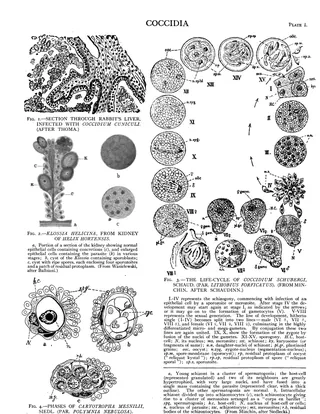
Encyclopedia Britannica (11th ed.) article on Coccidia, an order of parasitic Sporozoa that live inside the cells of vertebrates, molluscs, arthropods and annelids. It covers the history of their discovery, host-cell damage and coccidiosis, the life cycle (schizogony, gametogony, fertilization, sporogony), variations among genera, classification into four families with genera listed, and the debated Cephalopod parasites (Eucoccidium/Aggregata). Two plates of microscopic illustrations and a bibliography by H. M. Woodcock are included. It has no connection to weaving or textiles.
Cochineal
Article · 1 page
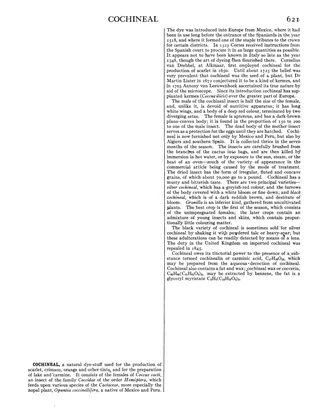
A one-page encyclopedia article on cochineal, the red dye obtained from the female Coccus cacti insect that feeds on nopal cactus. It covers the dye's introduction to Europe from Mexico, its early use in scarlet dyeing, the insect's natural history, harvesting and processing, commercial varieties, adulteration, and the chemistry of its colouring matter, carminic acid.
Coco-Nut Palm
Article · 1 page
A single page from the 11th edition of the Encyclopedia Britannica covering the coco-nut palm. It describes how the palm is cultivated, especially in Ceylon and on the Malabar and Coromandel coasts of India, and lists its many uses. These include food, toddy and arrack, timber, plaited leaves, coir fibre for rope, brushes and matting, and coco-nut oil from copra.
Coir
Article · 1 page
A very short encyclopedia entry from the 11th edition of the Encyclopedia Britannica defining coir as a rough, strong fibre obtained from the outer husk of the coconut. It gives the word's Malay origin and refers readers to the article on the coco-nut palm for further detail.
Corduroy
Article · 1 page
A short encyclopedia entry defining corduroy as a cotton fustian cloth made like a ribbed velvet, coarse and heavy for workmen's clothes, with finer kinds used for ladies' dresses. It discusses the word's supposed origin (the English coinage imitating a French corde du roi), notes the unrelated Somerset woollen duroy, and mentions the American use of the name for log roads.
Costume
Article · 26 pages
This is the Encyclopaedia Britannica (11th ed.) article "Costume," covering the history of dress from the ancient Near East and Egypt through Aegean, Greek, Etruscan and Roman dress to medieval, Tudor, Stuart, Georgian and Victorian English fashion. It also covers modern European and non-European dress, official costume, and a bibliography of costume literature. It opens with a discussion of modesty, ornament and the origins of clothing. It is illustrated with line drawings and photographic plates of sculptures, brasses, manuscripts and portraits. It has little on tapestry or weaving as such.
Cotton
Article · 26 pages
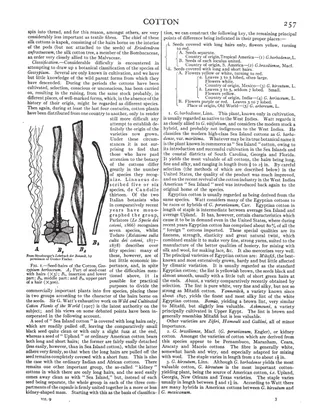
Encyclopedia Britannica 11th edition article on cotton, covering the botany and classification of Gossypium species, cultivation, ginning, cotton seed products, pests such as the boll weevil, and seed selection. It also surveys world production by country, the cotton markets and trading methods at Liverpool and Manchester (futures, options, clearing house), yarn and cloth trade, and descriptions of cotton fabrics such as jean, jeanette and Oxford. Includes statistical tables and a few diagrams.
Cotton Manufacturing
Article · 21 pages
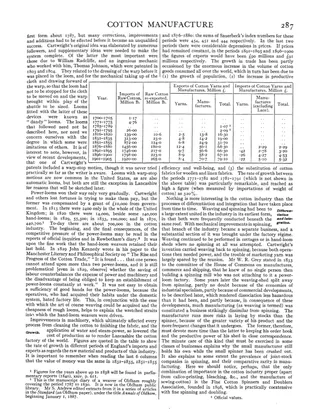
Encyclopedia Britannica (11th ed.) article on the economic and industrial history of cotton manufacture, covering its origins in Europe and England, the fustian trade of 17th-century Lancashire, and the organization of hand weaving, warping and the putting-out system. It treats the mechanical inventions (Arkwright's water-frame, the mule, Roberts's self-actor, Cartwright's power loom), the localization of spinning and weaving in Lancashire, labour and wages, and the industry's growth in the United States, Germany, Switzerland, Austria, Russia, China, Japan and elsewhere. Many statistical tables on operatives, spindles, looms and cotton consumption are included, and a bibliography closes the article.
Cotton-Spinning Machinery
Article · 9 pages
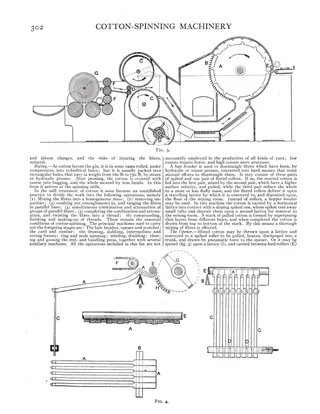
Encyclopedia Britannica (11th ed.) article on cotton-spinning machinery, covering the sequence of processes from ginning and baling through mill preparation to spinning, reeling and bundling. It describes the saw gin and Macarthy gin, bale breakers, openers and scutchers, carding engines, combing, drawing, slubbing, intermediate and roving frames, ring spinning and the self-acting mule. Historical notes on inventors such as Whitney, Arkwright, Crompton and Roberts are included. Illustrated with line diagrams of machines and two plates of photographs of a Manchester fine cotton-spinning mill.
Crape
Article · 1 page
Encyclopedia article defining crape as a gauzy, crimped silk fabric woven from hard-spun silk yarn in the gum. It distinguishes soft Canton or Oriental crape, whose waviness comes from reverse-twisted weft that relaxes when degummed, from hard crape, whose crisp texture comes from secret finishing processes. It also covers uses such as mourning dress and nuns' veils, British production centers, and imitations like cotton Victoria crape.
Crash
Article · 1 page
A short encyclopedia entry defining crash as a narrow towelling fabric, 14 to 20 inches wide. It covers the probable Russian origin of the name, the yarns used (flax, tow, boiled yarns, later cotton warp and jute weft), the varieties (grey, boiled, bleached, plain, twilled, fancy), and how the cloth is finished and made up into roller towels.
Cretonne
Article · 1 page
A short encyclopedia entry defining cretonne. It describes the cloth as originally a strong white fabric with hemp warp and linen weft, named for the Normandy village of Creton, and now a stout printed cotton cloth used like chintz. It notes that cretonne may be printed on both sides and may have a woven fancy pattern beneath the print.
Crinoline
Article · 1 page
A short encyclopedia entry defining crinoline as a stiffening fabric of horse-hair and cotton or linen thread, with the name's French and Latin origin. It notes substitute materials such as straw-like hat-shape material. It also covers the later use of the term for hoop skirt supports of whalebone and steel in the mid-19th century, and for protective netting frameworks on warships.
Crotchet
Article · 1 page
A short Encyclopedia Britannica (11th ed.) entry on the word 'crotchet'. It traces the word to the French croche, 'hook', and mentions its relation to the English 'crochet' for hook work. It then covers other senses: hook-like bristles of burrowing worms, the musical note, and a whim or fancy, as in 'crotchety'. It does not describe crochet technique.
Damask
Article · 2 pages
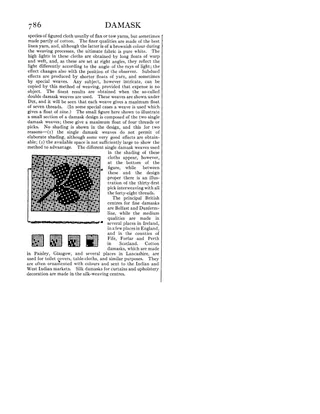
Encyclopedia Britannica (11th ed.) article on damask, covering the origin of the term in the figured silks of Damascus and its present meaning as richly patterned linen. It explains how damask figures are produced with long warp and weft floats, single and double damask weaves, and the maximum float lengths. It closes with the main British centres of manufacture (Belfast, Dunfermline, Scotland, Paisley, Lancashire) and uses of cotton and silk damasks. A small figure shows a damask design section and single damask weaves.

Denim
Article · 1 page
A very short encyclopedia entry defining denim. It explains the word as an abbreviation of the French serge de Nimes, originally a kind of serge, and says it now means a stout twilled cloth, usually cotton, made in various colours and used for overalls and similar garments.
Diaper
Article · 1 page · weaving drafts
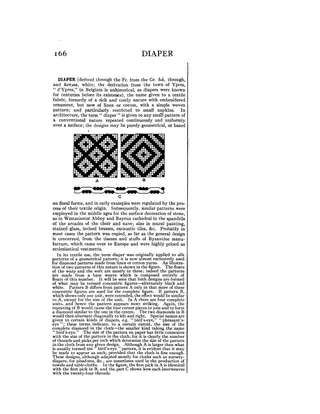
Encyclopedia Britannica (11th ed.) entry on diaper, covering the word's derivation, the fabric, and the use of diaper patterns in architecture and decoration. It then describes diaper weaving as small diamond patterns in linen or cotton built on a base weave of three-thread floats. Two diamond drawdowns (A and B) illustrate concentric black and white figures, with a strip showing the interweaving. It also covers bird's-eye and pheasant's-eye diapers and their use in nursery diapers, towels and tablecloths.
Dimity
Article · 1 page
A very short encyclopedia entry defining dimity. It gives the word's derivation from the Greek for "double thread" via Italian, and describes the cloth as a stout, usually white fabric woven with raised patterns, used for bed upholstery and curtains and sometimes printed in colours.
Draper
Article · 1 page
A short encyclopedia entry defining 'draper' as a dealer in cloth and textiles. It discusses the etymology of the word (French drap, Low Latin drappus, and the related 'drab'), and briefly covers the Drapers' Company, one of the London livery companies, chartered in 1364. It also notes the trade's combination with millinery and hosiery and a 1908 legal case on the meaning of 'drapery'.
Drill
Article · 1 page
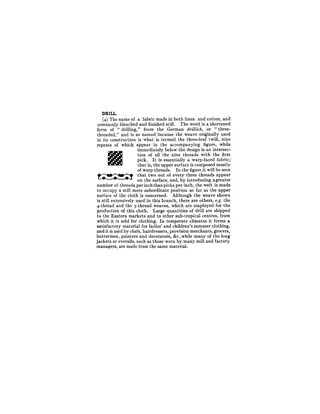
A short Encyclopedia Britannica (11th ed.) entry on drill, a linen or cotton fabric usually bleached and finished stiff. It explains the name's derivation from German drillich ('three-threaded'), describes the warp-faced three-leaf twill weave with a small figure, and mentions 4- and 5-thread variants. It also covers the fabric's markets and uses in clothing and work garments.
Duck
Article · 1 page
A short encyclopedia entry defining duck as a plain, lightweight fabric originally made from tow yarns, usually single in both warp and weft. It covers the likely etymology from Dutch doeck, the cream-colored bleaching stage called duck, and the many uses of the cloth, including tents, light sails, clothing and bags. Russian duck is noted as a fine white linen canvas.
Dyeing
Article · 12 pages
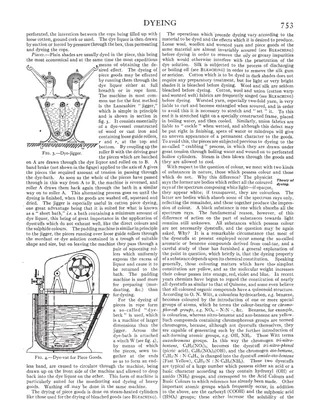
The Encyclopaedia Britannica (11th ed.) article on dyeing, covering the history of the art from prehistoric times through the coal-tar dye discoveries of the 19th century. It classifies dyestuffs by method of application (acid, direct, developed, mordant, and miscellaneous colours such as indigo, aniline black and catechu) and describes dyebath procedures for wool, silk and cotton. It also covers natural dyestuffs such as madder and the dyeing machinery for loose fibre, yarn, cops and piece goods, illustrated with a vat, a cop-dyeing machine and a jigger. It ends with a bibliography of dyeing literature.
Embossing
Article · 2 pages
A short encyclopedia entry defining embossing as the production of raised patterns on metal, leather, textiles, cardboard, paper and similar materials using engraved dies or plates. It describes plain and colour embossing, cameo embossing, screw presses, bookbinding blocking, and engraved copper cylinders in calender frames for wall-papers, textiles and felt. It also covers combined embossing and calico-printing machines, heated rollers, sheet-metal stamping and embossing on soft wood.
125 documents found