Textile Documents › Authors › Author: William Henry Holmes
5 documents found
Sort: 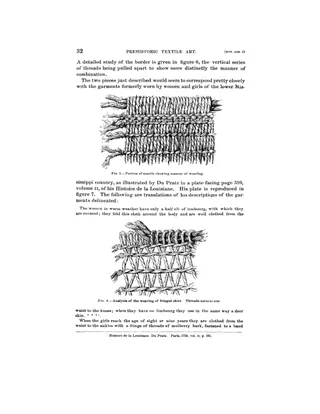
"Prehistoric Textile Art of Eastern United States" in Bureau of Ethnology, Smithsonian Institution
Monograph · 50 pages
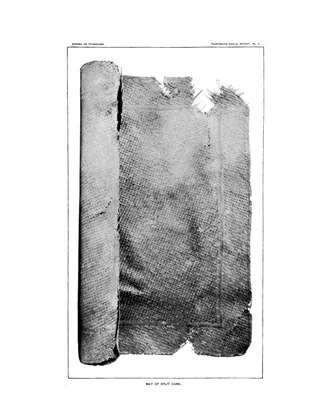
William Henry Holmes's study of prehistoric textile art in the mound region of the eastern United States, from the Thirteenth Annual Report of the Bureau of Ethnology. It surveys wattle work, basketry, matting, and pliable fabrics (cloths, nets, feather work, embroidery), drawing on early European accounts and archeological finds. Much of the evidence comes from cave and shelter burials, charred cloth from mounds, fabrics preserved by contact with copper, and fabric impressions on pottery, with discussion of twined and diagonal weaving. Nine plates and 28 figures illustrate specimens, early engravings, and restored fabric structures.
Prehistoric Textile Art of the Eastern United States
Monograph · 50 pages
William Henry Holmes's study of the textile arts of the prehistoric mound-building peoples of the eastern United States, from the Thirteenth Annual Report of the Bureau of Ethnology. It covers wattle work, basketry, matting, and pliable fabrics (cloth, nets, feather-work, embroidery), drawing on early European accounts and on archaeological remains. Surviving fabrics come from caves and shelters, charred mound deposits, contact with copper, and impressions on pottery. It is illustrated with plates and figures, including drawings that analyze twined and woven structures; it contains no weaving drafts.
Prehistoric Textile Fabrics of the United States Derived from Impressions on Pottery
Monograph · 34 pages
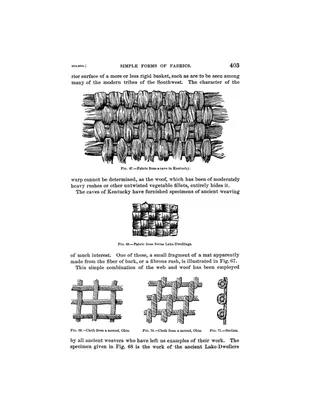
William H. Holmes's 1884 study, published in the Third Annual Report of the Bureau of Ethnology, examines textile impressions left on prehistoric pottery from the eastern and central United States. He sorts the fabrics into six groups plus miscellaneous forms: plain weave, paired and twisted warp, diagonal weaves, plaiting, knotted nets, and cord markings. Many illustrated figures show the impressions and restorations, with comparisons to Swiss Lake-Dwelling fabrics and modern Northwest Coast work. The text discusses how the fabrics may have been made, using pegs and frames, and how they were used in shaping and decorating pottery.
A Study of the Textile Art in its Relation to the Development of Form and Ornament
Monograph · 62 pages
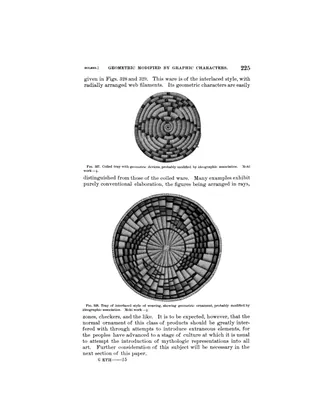
William H. Holmes's study argues that the textile arts (basketry, weaving, embroidery, netting) shaped the development of form and geometric ornament in primitive art. It covers form and color in textiles, then relief and color phenomena arising from construction techniques such as twining, coiling, interlacing and reticulated work, with supplementary features like feathers, pendants and embroidery. It closes with how geometric design was imposed on graphic figures and carried into pottery, carving, tapa stamps and architecture. It is illustrated with many figures (286-358) of Native American, Peruvian and Polynesian baskets, trays and fabrics.
Textile Art in Prehistoric Archaeology
Article · 6 pages
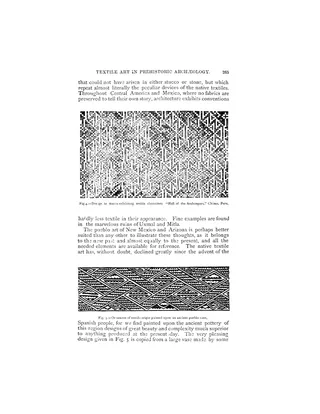
An 1886 essay by W. H. Holmes arguing that the textile art, especially basketry, strongly shaped the form and decoration of other prehistoric arts. It reviews how ancient fabrics survive (dry Peruvian sands, Egyptian balsam, copper salts, charring, Swiss lake dwellings, and impressions on pottery) and uses pueblo pottery, Peruvian stucco at Chimu, and Central American architecture as examples. Five line illustrations show a pueblo basket, a pottery cup imitating woven work, and painted or stucco designs of textile origin.
5 documents found