Textile Documents › Publications › Publication: Baldwin's Textile Designer
29 documents found
Sort: 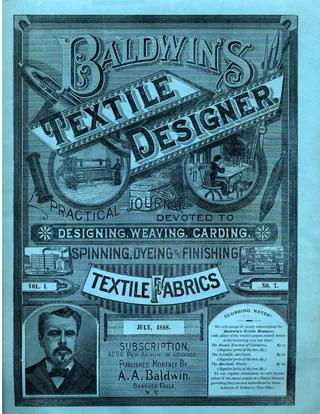
Baldwin's Textile Designer, Vol. 1, No. 7 (July 1888)
Baldwin's Textile Designer, July 1888
Periodical · 20 pages · weaving drafts
July 1888 issue (Vol. 1, No. 7) of Baldwin's Textile Designer, a monthly trade journal published by A. A. Baldwin at Brasher Falls, N.Y., covering designing, weaving, carding, spinning, dyeing and finishing. It includes articles on the finishing room (burling), hair-cloth manufacture, carding engines and their clothing, fibres such as hemp and jute, New England factory life, coloring and blending of fibres, and soaps. Weaving content includes the winners of a weave contest (weaves No. 1-88 shown as drawdowns) and the 'Latest Novelties' section with patterns 92-104 for fancy woolen and worsted suitings, giving warp and filling patterns, reed and picks, and drafts, one with 23 or 32 harnesses. The issue also has a biographical portrait of designer James Hendry, book notices, queries and replies, situation-wanted ads and advertisements for Knowles looms and E. Lehmann pattern packets.
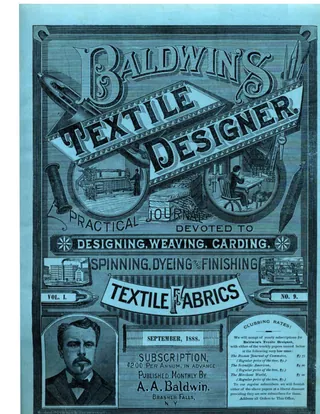
Baldwin's Textile Designer, Vol. 1, No. 9 (September 1888)
Baldwin's Textile Designer, September 1888
Periodical · 19 pages · weaving drafts
September 1888 issue (Vol. 1, No. 9) of Baldwin's Textile Designer, a monthly trade journal for woolen and worsted mill workers published by A. A. Baldwin at Brasher Falls, N.Y. It mixes essays on mill labor and overseers with technical pieces on woolen spinning, finishing, wool scouring and carbonizing, lubricants, loom picking motion, and carding engine clothing. Drafts and weaves appear in the article on composing and combining weaves and in the Latest Novelties section (Patterns 118-129 for fancy worsteds, cassimeres and diagonals, with warp patterns, picks per inch and drawing-in drafts). The issue also has reader correspondence about a design contest, a queries section, a note on the Jumbo lace machine, wants ads and advertisements for looms and pattern services.
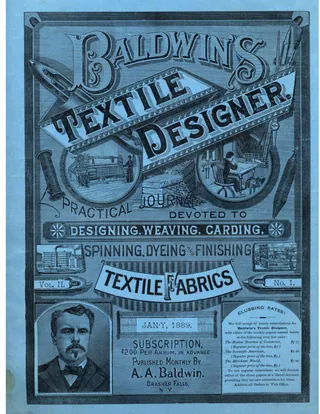
Baldwin's Textile Designer, Vol. 2, No. 1 (January 1889)
Baldwin's Textile Designer, January 1889
Periodical · 20 pages · weaving drafts
January 1889 issue (Vol. 2, No. 1) of Baldwin's Textile Designer, a monthly trade journal for woolen and cotton mill people, published by A. A. Baldwin at Brasher Falls, N.Y. It mixes mill-management essays, finishing and flocking, oil testing, wool electricity, water softening, trade news and a biographical sketch of J. M. Masson with technical content. The technical content includes a Designs department with pattern drafts and weaves (Patterns 1-11) for woolen and worsted suitings, with warp and filling color sequences, and an article on satin weaves and satin-order figure arrangements. Advertisements for textile books, looms and supplies fill the front and back pages.
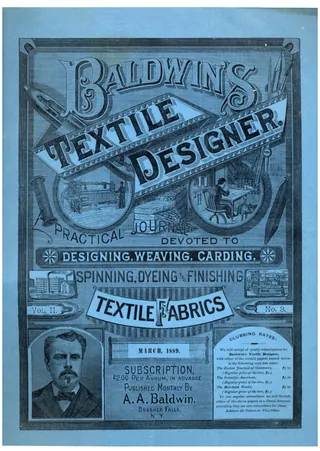
Baldwin's Textile Designer, Vol. 2, No. 3 (March 1889)
Baldwin's Textile Designer, March 1889
Periodical · 20 pages · weaving drafts
March 1889 issue (Vol. 2, No. 3) of Baldwin's Textile Designer, a monthly trade journal for woolen and worsted mill workers published by A. A. Baldwin at Brasher Falls, N.Y. It mixes technical articles on finishing, fulling, carding, loom adjustment, uneven checks and oils for machinery with editorial and reader letters on workers, wages and managers. A designs department gives numbered patterns (about Nos. 24-35) for woolen and worsted suitings, trouserings and coatings, with weave diagrams, drafts, warp and filling patterns, and a reader-submitted weaves section. Also includes a mill history of the Cocheco Woolen Manufacturing Company, queries and replies, a biographical portrait, patent notes, and advertisements.
Baldwin's Textile Designer, Vol. 2, No. 9 (September 1889)
Baldwin's Textile Designer, September 1889
Periodical · 20 pages · weaving drafts
September 1889 issue of Baldwin's Textile Designer, an American monthly trade journal for mill designers, weavers, carders, finishers and dyers. It combines articles on color effects, finishing, loom picking motions, the history of weaving, Irish linen, early US cotton manufacture and mill management with a biographical sketch of designer J. H. Pickford. The issue includes several pages of woolen and worsted fabric patterns (Nos. 91-100) with weave, draft and warp/filling pattern details, plus twill and satin drafts and pegging plans, and advertisements for books, looms and services.
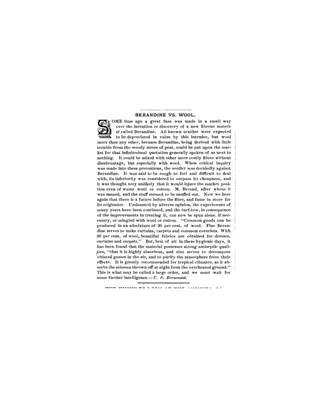
Berandine vs. Wool
Baldwin's Textile Designer, January 1889
Article · 1 page
A short 1889 article reprinted from the U. S. Economist on Berandine, a fibre made from the woody stems of peat (turf-tow) and named after its inventor, M. Berand. It recounts the early negative verdict on the fibre as rough and inferior, then reports improved processing that lets it be spun alone or blended with wool or cotton. It lists proposed uses (curtains, carpets, coverlets, dress fabrics) and claimed antiseptic and absorbent properties.
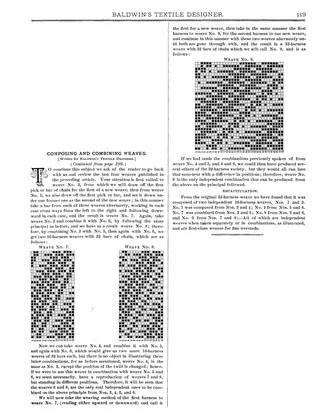
Composing and Combining Weaves
Baldwin's Textile Designer, September 1888
Article · 1 page · weaving drafts
A single-page installment from Baldwin's Textile Designer (continued from page 106) on building complex weaves by combining simpler ones. It explains how to take picks (bars of chain) alternately from weaves No. 3 and 5, and No. 3 and 6, to produce 16-harness weaves No. 7 and No. 8 with 32 bars of chain. It then combines the harnesses of Nos. 7 and 8 to make the 32-harness weave No. 9, and closes with a recapitulation of how all the weaves derive from one another. Three drawdown grids illustrate Nos. 7, 8 and 9, which the author recommends for fine worsteds.
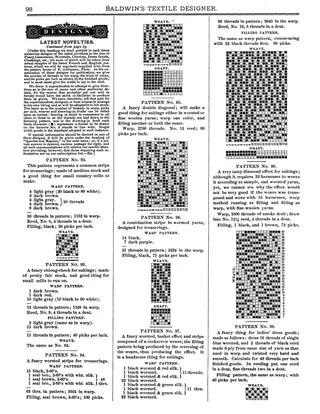
Designs
Baldwin's Textile Designer, July 1888
Article · 2 pages · weaving drafts
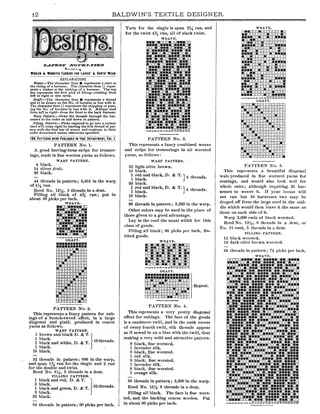
Two pages from the "Designs" feature (Latest Novelties) of Baldwin's Textile Designer, July 1888, presenting patterns 92 to 104 for fancy cassimeres, worsted suitings, trouserings and dress goods. Each pattern gives a short description, warp and filling color patterns, thread counts, reed size and picks per inch, with a weave draft (drawdown) and drawing-in draft. The patterns are taken from samples supplied by E. Lehmann of Paris, and include stripes, checks, diagonals, a corkscrew weave and a diamond effect. An introductory note explains how to read the drafts.
Designs
Baldwin's Textile Designer, January 1889
Article · 2 pages · weaving drafts
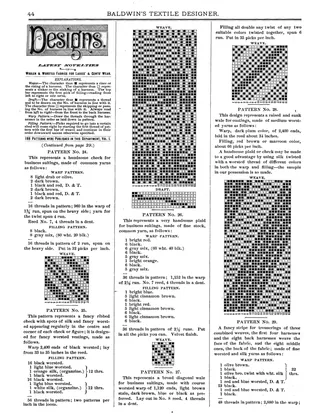
Two pages from the "Designs" department of Baldwin's Textile Designer presenting eleven patterns for woolen and worsted fabrics for ladies' and gentlemen's wear, such as trouserings, suitings, coatings and flannel. Each pattern gives a short description, warp and filling color patterns, thread counts, reed number, yarn run and picks per inch, with weave and draft grids. A brief explanation of the weave and draft notation (risers, sinkers, harness numbers) opens the feature.
Designs
Baldwin's Textile Designer, March 1889
Article · 2 pages · weaving drafts
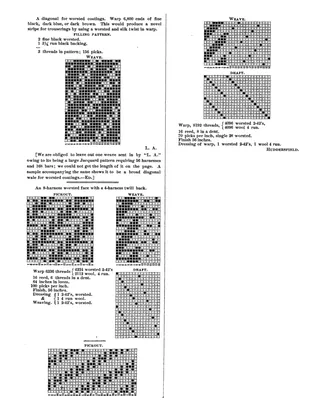
Two pages from the "Designs" department of Baldwin's Textile Designer (March 1889), presenting Patterns 24-35 for woolen and worsted fabrics for men's and women's wear. Each pattern gives a description of the cloth (checks, plaids, wales, stripes), warp and filling color sequences, thread counts, yarn run, reed number and picks per inch, together with weave diagrams and some drafts. An opening note explains how to read the weave and draft notation (risers, sinkers, harnesses).
Designs
Baldwin's Textile Designer, March 1889
Article · 2 pages · weaving drafts
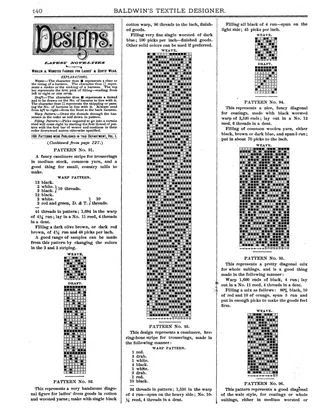
Two pages from the "Miscellaneous Weaves" feature of Baldwin's Textile Designer, with weave designs submitted by designers and weavers. They include a diagonal-through-stripe pattern with warp and filling color arrangements, reed, and pick counts, and diagonals for worsted coatings and trouserings. A final item from Huddersfield gives an 8-harness worsted face with a 4-harness twill back, with pickouts, drafts, and warp and weft specifications.
Designs
Baldwin's Textile Designer, September 1889
Article · 2 pages · weaving drafts
Two pages from the "Designs" department of Baldwin's Textile Designer, September 1889, presenting Patterns No. 91 to 100 for woolen and worsted fabrics. Each pattern gives a weave and draft grid with warp and filling color sequences, thread counts, reed numbers, yarn sizes and picks per inch. The fabrics include cassimere trouserings, diagonals, wales and a small plaid for coatings, suitings and ladies' dress goods. A short explanation of the weave and draft notation opens the feature.
Early American Contributions to Textile Finishing Machinery
Baldwin's Textile Designer, March 1889
Article · 1 page
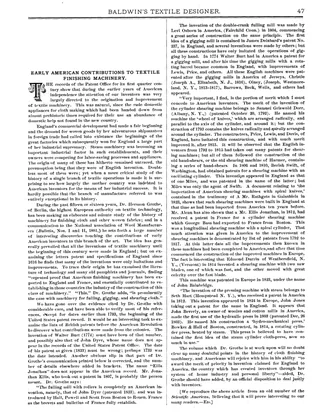
A one-page article reprinted from Scientific American on the American origins of cloth finishing machinery. It summarizes Dr. Hermann Grothe's research on American inventors' contributions to fulling mills, gigging mills, cylinder shearing machines, and steam and hydraulic cloth presses. It cites patents from about 1774 to 1817 and traces how these machines were exported to or copied in England and France.
Early Cotton Manufacture of the United States
Baldwin's Textile Designer, September 1889
Article · 2 pages
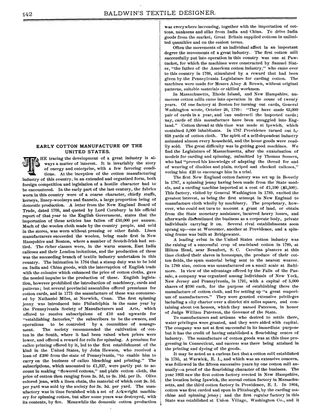
A two-page historical article tracing the growth of cotton manufacturing in the United States from the early 1700s to the 1820s. It covers colonial homespun, wool and linen cloth, early cotton cards and spinning jennies, calico printing, and the first mills at Pawtucket, Beverly, Paterson, Waltham and Lowell. It also notes the role of Samuel Slater, the move from hand-loom weaving to combined spinning and weaving mills, and the rise of roller printing.
Effects of Colors in Textile Designs
Baldwin's Textile Designer, September 1889
Article · 2 pages
A two-page article from Baldwin's Textile Designer (September 1889) on how colors interact in patterned textile fabrics. It covers primary, binary and tertiary mixed colors, complementary colors, simultaneous contrast, and how juxtaposed colors modify each other's apparent hue. It also notes how thread direction and viewing position change the look of a fabric, with practical advice for designers, dyers, printers and dealers.
History of Weaving
Baldwin's Textile Designer, September 1889
Article · 1 page
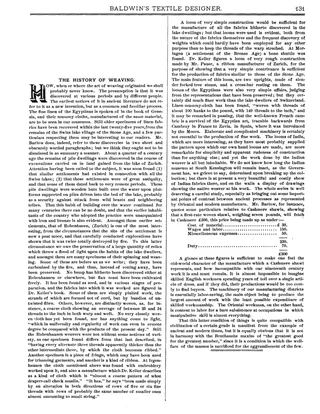
A one-page article from Baldwin's Textile Designer on the origins of weaving. It discusses linen fabrics, fringe and ribbon recovered from Swiss lake dwelling sites such as Robenhausen and Irgenhausen, drawing on Dr. Keller's reports, and the simple looms that could have produced them. It then compares Egyptian and Indian hand weaving, including the cost breakdown of a Cashmere shawl, with the labor-saving machinery of nineteenth-century manufacture.
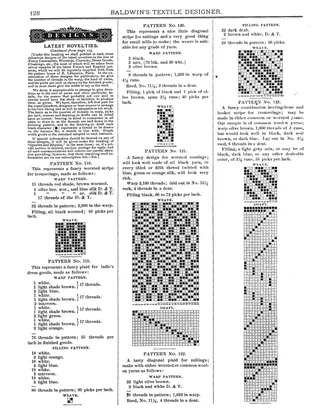
Latest Novelties
Baldwin's Textile Designer, September 1888
Article · 2 pages · weaving drafts
Two pages from the September 1888 issue of Baldwin's Textile Designer presenting Patterns 118 to 129, a series of woolen and worsted fabric designs for trouserings, suitings, coatings and dress goods. Each pattern gives the warp color arrangement, thread counts, reed number, filling and picks per inch, with a weave drawdown and, for some, a drawing-in draft. An editorial note explains that the designs come from French and English samples supplied by E. Lehmann of Paris.
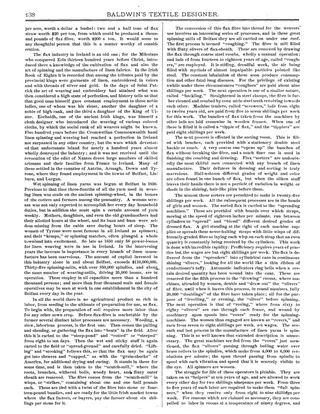
Manufacture of Linen in Ireland
Baldwin's Textile Designer, September 1889
Article · 3 pages
An article from Baldwin's Textile Designer, reprinted from the Canadian Manufacturer, on the linen industry in Ireland. It opens with US flax import figures for early 1889 and argues that North American farmers neglect flax. It then gives a history of Irish flax growing and linen weaving, from legend through the Huguenot immigration, the start of wet spinning at Belfast in 1830 and the growth of power looms. It also describes the stages of flax preparation and mill spinning (roughing, hackling, sorting, spreading, drawing, roving, spinning) with worker ages and wages, and closes on the harsh conditions of women spinners.
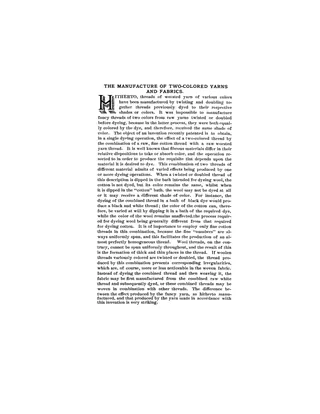
Manufacture of Two-Colored Yarns and Fabrics
Baldwin's Textile Designer, January 1889
Article · 1 page
A short 1889 trade journal article describing a recently patented method of making two-colored yarns in a single dyeing operation. A raw fine cotton thread is twisted with a raw worsted thread, and because the two fibers take dyes differently, one bath can leave the cotton white or color it differently from the wool. The article explains why fine cotton is used (uniform spinning), and notes that the fabric can be woven first and dyed afterward.
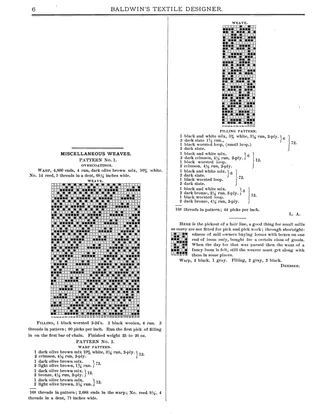
Miscellaneous Weaves
Baldwin's Textile Designer, January 1889
Article · 1 page · weaving drafts
A single page from Baldwin's Textile Designer giving woolen mill specifications for two fabrics: an overcoating (Pattern No. 1) and a fancy pattern with loop filling (Pattern No. 2). Each gives warp and filling color sequences, yarn counts, reed, ends, picks per inch and a weave draft. A short note adds a pickout for a hair-line fabric, aimed at small mills with limited loom equipment.
Miscellaneous Weaves
Baldwin's Textile Designer, March 1889
Article · 2 pages · weaving drafts
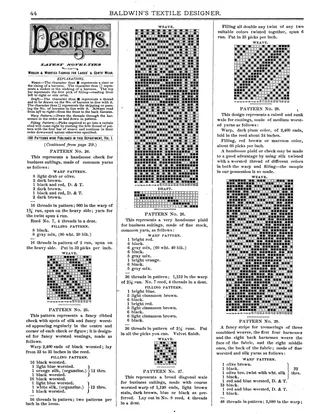
Two pages from Baldwin's Textile Designer (pp. 44-45) continuing the department "Latest Novelties in Woolen & Worsted Fabrics for Ladies' & Gents' Wear," presenting Patterns No. 24 through 35. Each pattern has a short description of the intended fabric (suitings, vestings, coatings, trouserings, dress goods), warp and filling color sequences, thread counts, yarn run sizes, reed numbers, and picks per inch, accompanied by weave and draft diagrams. An explanation of the weave and draft notation is given at the top of the first page.
Miscellaneous Weaves
Baldwin's Textile Designer, March 1889
Article · 2 pages · weaving drafts
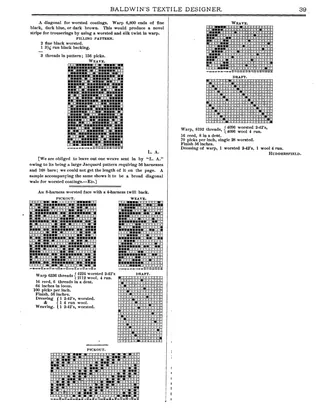
Two pages from the 'Miscellaneous Weaves' feature in Baldwin's Textile Designer, March 1889, presenting weave drawdowns and pickouts with mill-style specifications. The first is a diagonal-striped pattern with warp colour order, reed and dent details, and filling pattern. The second gives a diagonal for worsted coatings and two worsted-face and wool-back cloths with warp counts, reed, picks per inch and finish width, one signed 'L. A.' and one from Huddersfield. An editor's note explains that a large Jacquard diagonal wale pattern was omitted.
Miscellaneous Weaves
Baldwin's Textile Designer, September 1889
Article · 1 page · weaving drafts
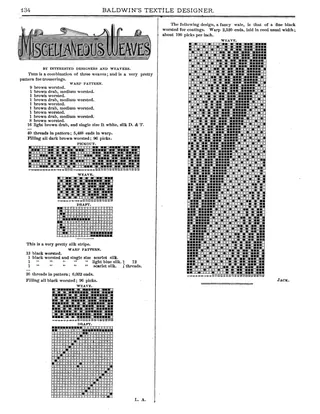
A single page from the "Miscellaneous Weaves" feature of Baldwin's Textile Designer, contributed by designers and weavers. It gives weave grids, pickouts and drafts with warp color patterns for a trouserings fabric combining three weaves, a worsted-and-silk stripe, and a fancy wale black worsted coating. Thread counts, ends in the warp and picks are listed for each.
Nature, Composition, and Treatment of Animal and Vegetable Fabrics
Baldwin's Textile Designer, September 1889
Article · 1 page
A one-page 1889 article from Baldwin's Textile Designer on the composition and treatment of animal and vegetable textile fibers, stressing that workmen should understand fiber chemistry to avoid mishaps. It covers fleece washing for wool, the importance of ripe cotton fibers for dyeing, and newer vegetable fibers such as China grass (ramie), abaca, pina, agave, jute and sunn. It closes with notes on bleaching losses in cotton, linen and hemp, and the chemical makeup of silk and wool, including sulphur content. The article is credited to Wool and Textile Fabrics.
New Patented Fabrics
Baldwin's Textile Designer, March 1889
Article · 1 page
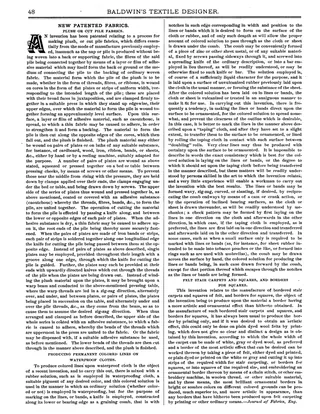
A single-page column of three patent notices from an 1889 issue of Baldwin's Textile Designer. The first describes a process for making plush or cut pile fabric by winding pile material on plates, fixing it with an adhesive such as caoutchouc, and cutting it free. The second covers a notched comb for laying permanent colored lines on rubber-coated waterproof cloth. The third covers felt stair carpets and squares with machine-embroidered borders in place of printed ones.
Satin Weaves and Some of the Uses to Which They are Applied
Baldwin's Textile Designer, January 1889
Article · 2 pages · weaving drafts
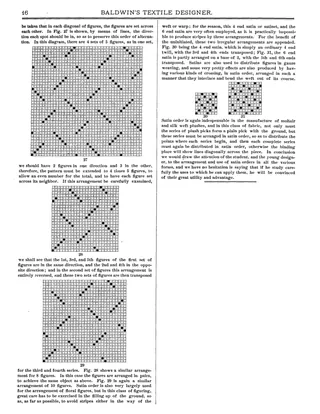
A two-page article, reprinted from the English Journal of Fabrics and continued from an earlier volume, on using satin order to arrange small geometrical and floral figures in woven cloth. It explains how spots are placed in satin order to avoid diagonal lines and 'cocked' effects, and gives diagrams for 5, 8 and 10 figure arrangements. It also describes the 4 end and 6 end irregular satins and notes satin order in gauze weaving and in mohair and silk weft plushes.
Subscription order form
Baldwin's Textile Designer, c. 1880-1889
Ephemera · 1 page
A blank one-page subscription order form for Baldwin's Textile Designer, issued by publishers Baldwin & Pickford of Brasher Falls, New York. It gives the price ($2.00 per year, or one dollar for six months), accepted payment methods, and blanks for date, length of subscription, address, remarks and amount enclosed.
Winners of Prizes Offered in the "Weave Contest"
Baldwin's Textile Designer, September 1888
Article · 1 page · weaving drafts
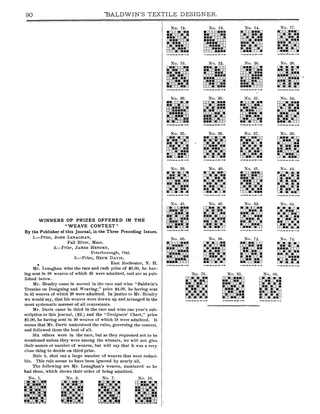
Announcement of the winners of the "Weave Contest" run in earlier issues of Baldwin's Textile Designer. It names the three prize winners (Lenaghan, Hendry and Davis), the prizes each received and how many of their submitted weaves were admitted. The page then reproduces the 35 admitted weaves submitted by the first-prize winner, John Lenaghan, as small drawdown diagrams numbered by his own sequence.
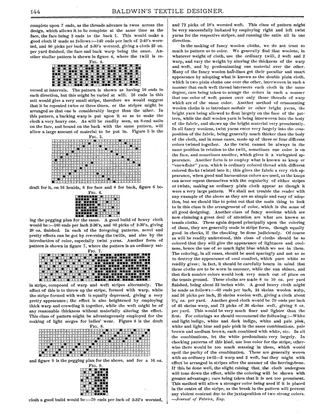
Worsteds and Woolens, Etc.
Baldwin's Textile Designer, September 1889
Article · 2 pages · weaving drafts
A two-page article from Baldwin's Textile Designer (September 1889), reprinted from the Journal of Fabrics, on designing worsted and woolen cloths for men's coatings, trouserings and suitings. It describes satin-based corkscrew or rolling twill patterns on 10, 11 and 14 ends, a backed cloth, and a heavy 16-end backed satin with draft and pegging plan, plus a satin stripe for light serges. Cloth builds are given as ends and picks per inch, yarn counts and finished weight. The last part covers fancy woolens (double plain hair-lines, mohair, twist and knop yarns) and tennis cloths, with coloring advice.
29 documents found