Textile Documents › Topic: Ecclesiastical textiles
132 documents found
Sort: 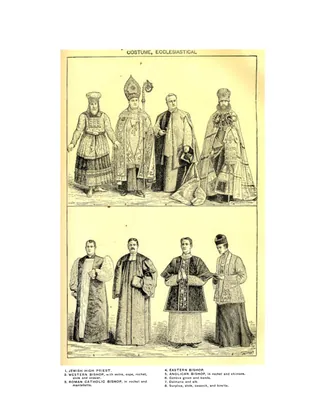
Costume, Ecclesiastical
Article · 7 pages
Encyclopedia article on the official dress of clergy, covering its development from Jewish priestly dress and the early Christian church to the present. It describes Western vestments (chasuble, stole, alb, cope, surplice, and episcopal items such as mitre and pallium), Eastern, Anglican, Protestant and monastic costume, and liturgical colors. It includes engraved plates of vestments, a bishop series, and a Jesuit in mandarin dress, and ends with a bibliography.
Design Considerations
Minnesota Weaver, December - January 1978-79
Article · 1 page
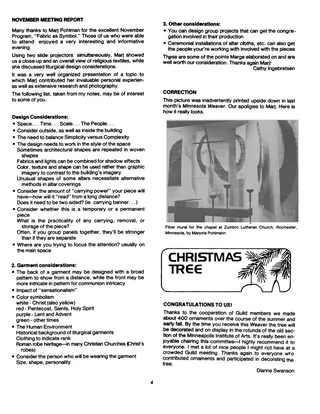
A single page from the Minnesota Weaver guild newsletter. It reports on Marj Pohlman's November program "Fabric as Symbol," with notes on designing liturgical textiles and garments, including scale, visibility, permanence, and liturgical color symbolism. It also carries a correction reprinting a photograph of her fiber mural for the chapel at Zumbro Lutheran Church, Rochester, Minnesota, and a note on about 400 ornaments the guild made for a Christmas tree at the Minneapolis Institute of Arts.
Ecclesiastical Embroidery
Magazine of Art, 1898
Article · 1 page
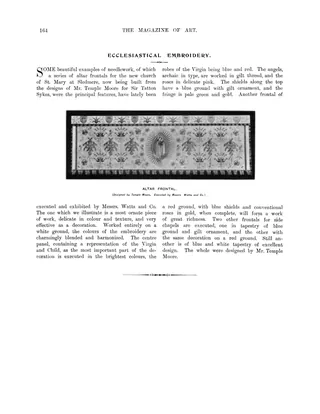
A one-page note from The Magazine of Art (1898) on altar frontals designed by Temple Moore for the new church of St. Mary at Sledmere, made for Sir Tatton Sykes and executed and exhibited by Watts and Co. It describes an illustrated frontal embroidered on a white ground with a central Virgin and Child, gilt angels, pink roses and shields, and mentions other frontals in embroidery and tapestry in red and blue schemes.
Ancient Russian Ecclesiastical Embroideries
Article · 55 pages
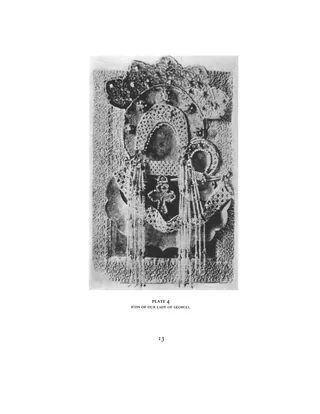
An illustrated article surveying Russian Orthodox church embroidery from the fourteenth to the seventeenth century. It covers icon veils, funeral shrouds, chalice palls, altar frontals and banners, along with the materials and techniques used: split stitch, couched gold and silver thread, silk thread, and pearls and jewels. It also covers the main workshops (Staritzky, Godunov, Stroganov), the painters who supplied designs, and individual dated pieces such as the 1399 veil of Maria of Tver. It has many plates and ends with a bibliography of mostly Russian sources.
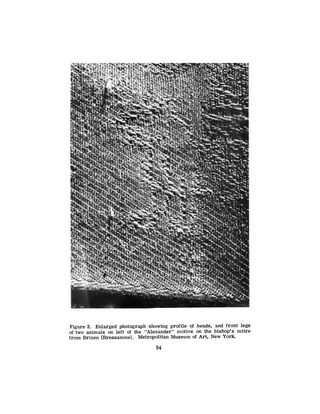
Further Notes on a Twelfth-Century Bishop's Mitre in the Metropolitan Museum of Art
Article · 22 pages
Eleanor B. Sachs examines a figure woven in purple, gold and pink threads on the gold brow band of a twelfth-century bishop's mitre in the Metropolitan Museum of Art. The figure is a frontal, orant human flanked by profile animals. She compares it with Alexander's Celestial Journey, Daniel in the lions' den, Coptic Helios/Ascension textiles, Elijah, and Scylla and Charybdis. She concludes that Alexander's Journey is the most likely reading but that the figure remains a puzzle. The article has 18 endnotes and 15 figures: photographs of the mitre and comparative sculptures, mosaics, enamels, ivories and a Coptic tapestry.
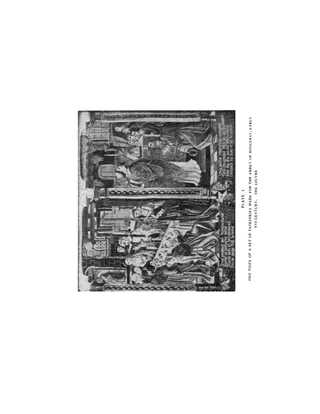
Notes on the Doctrine of Transubstantiation as Illustrated in XVI Century Art
Article · 10 pages
A 1928 Bulletin of the Needle and Bobbin Club article on how sixteenth-century European art illustrated the doctrine of Transubstantiation. It discusses the Ronceray Abbey tapestry set (Louvre and Boston), the Chalon-sur-Saône tapestry, French mystic-press stained glass, German images such as the Mill of the Host and the Weiterswiller altar, and a stump-work chasuble orphrey at Karlsruhe. Plates show Ronceray tapestry pieces, a drawing of the Karlsruhe embroidery, and a Spanish carpet.
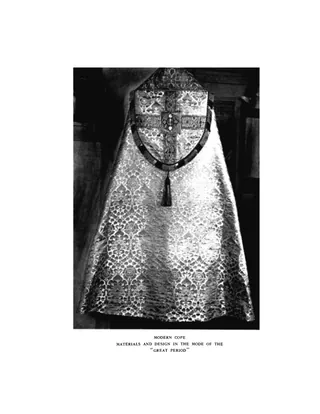
Church Embroidery
Article · 9 pages
Article by Harriet Philips Bronson on the principles and history of ecclesiastical embroidery, from early Christian work through the English "Opus Anglicum" Great Period (12th-15th centuries) and its decline, to the late nineteenth-century revival. It discusses the Ascoli and Syon copes, Spanish padded work, the qualities needed in a church designer, materials such as gold thread, damask, velvet and brocatelle, and the Roman sequence of liturgical colors. Illustrations show a medieval chasuble from South Kensington Museum, a banner for the Chapel of St. Francis of Assisi, a burse with a pelican in gold thread, and a modern cope.
Practical Weaving Suggestions, Vol. 1-70 (1970): Some Experiences in Ecclesiastical Weaving
Periodical · 6 pages · weaving drafts
Article by Mary E. Black describing the handwoven church vestments and hangings made by Mrs. Douglas (Bessie) Murray and Mrs. John (Evelyn) Longard of Halifax, Nova Scotia, after an exhibition at St. Mary's University. It discusses design sources, color choice, yarn quality and the practical demands of ecclesiastical weaving. It then gives weaving notes with warp, weft, sley, threading and treadling for a Rose Window wall hanging (12-harness overshot variation), a crackle-weave heavy fabric, and chasubles for King's College Boys' School and the Church of the Holy Spirit. Lily mercerized perle, Trinklette and metallic yarns are specified throughout.
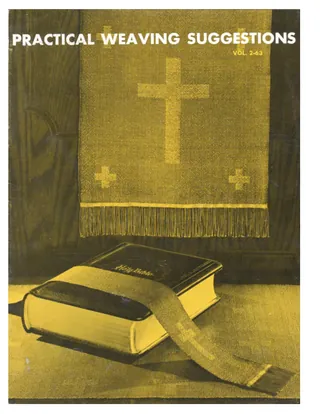
Practical Weaving Suggestions, Vol. 2-63 (1963): Ecclesiastical Weaving
Periodical · 8 pages · weaving drafts
An issue of Lily Mills' Practical Weaving Suggestions devoted to ecclesiastical weaving. Colonel John Fishback describes designing and weaving a 12-foot dossal curtain in 16-thread Summer & Winter units on a 16-harness loom for St. Mark's Episcopal Church, Venice, Florida. Lela Gordon discusses making altar, pulpit and lectern hangings, including fitting them to different churches. Drafts and materials lists follow for a 3-piece altar, pulpit and lectern set (Bergman technique), a 7-step graded cross and a 4-harness cross in crackle weave, and a graded cross in Summer and Winter, with Lily yarn numbers and a source for bullion fringe.
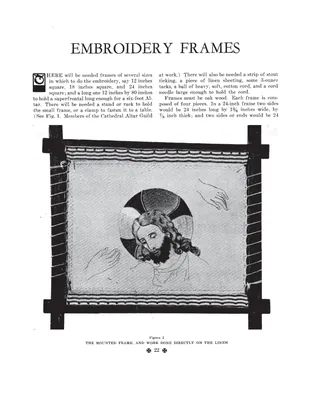
Church Embroidery and Church Vestments
Book · 125 pages
A practical manual on making church embroidery and liturgical vestments, written by the head of the Washington Cathedral Altar Guild. Part One covers liturgical colours, fabrics, embroidery frames, transferring patterns, stitches (Italian, long and short, split, couching, Damascene), altar hangings, burses, veils, stoles, altar linens, applied work and banners. Part Two covers making albs, stoles, maniples, chasubles, tunicles, dalmatics, copes, surplices and the vested altar, followed by funeral palls, church symbols, and stain removal. Illustrated with many photographs and line drawings, including garment patterns with measurements.
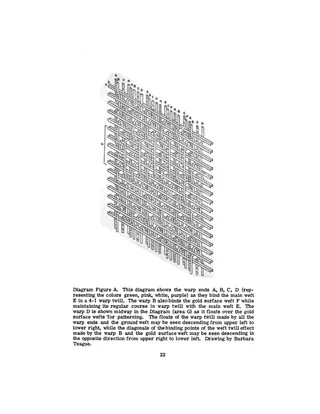
Some Notes on a Twelfth-Century Bishop's Mitre in the Metropolitan Museum of Art
Article · 51 pages · weaving drafts
Article by Eleanor B. Sachs on a twelfth-century bishop's mitre from the Convent of Neustift, Brixen, now in the Metropolitan Museum of Art. It describes the mitre's brow-band, peak bands and fanons, woven in colored silks and gold thread with a mermaid, centaurs, a lion and a figure who may be Scylla or Alexander. It explains the complex warp-twill structure with gold surface weft, with a diagram, and compares the bands to Palermo bands and Frederick II's coronation shoes and sword belt. Most of the article traces the double-tailed mermaid back to Greek, Etruscan and Roman Scylla images and medieval church carving, with extensive footnotes and many photographs.
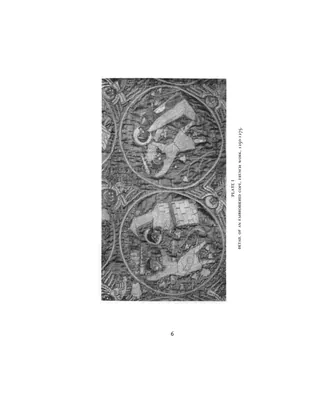
Medieval Textiles in the Cathedral of Uppsala, Sweden
Article · 27 pages
Article by Dr. Agnes Geijer, Curator of Textiles at the Statens Historiska Museum in Stockholm, surveying the medieval vestments in Uppsala Cathedral. It covers the cope of Archbishop Nils Alleson (1295), the St. Erik shroud, North Italian silk brocades, Chinese silks reused as linings, and the 15th-century needle-painted chasubles from the workshop of Albertus Pictor. The text includes a technical discussion of diasprum weaves, 2- and 3-heddle ground weaves, membrane-gold wefts, loom widths and selvages. Fourteen plates are followed by detailed plate notes with repeat widths and weave descriptions, plus footnotes citing the literature.
Shuttle-Craft Bulletin (March 1958)
Periodical · 38 pages · weaving drafts
March 1958 Portfolio Edition of the Shuttle-Craft Bulletin, issued as a monograph on handweaving for church use. It covers Fair Linens for the altar or communion table (Atwater-Bronson, Summer and Winter, damask and Brooks Bouquet approaches), a kneeling pad, altar vestments and dossal woven in silk and lurex, church paraments, copes, and a glossary of ecclesiastical terms. Contributions come from Harriet Tidball, Mary E. Black, Joyce Chown and guild members, with drafts, tie-ups, diagrams and photographs. It ends with book reviews by Boris Veren and advertisements.
Shuttle-Craft Bulletin (March 1959)
Periodical · 38 pages · weaving drafts
March 1959 Portfolio Edition of Shuttle Craft, the monthly bulletin of the Shuttle Craft Guild (Bedford, Nova Scotia), devoted to ecclesiastical weaving. It includes Evelyn Longard's article on handwoven textiles for the synagogue (tallit, Torah covers, chupa, menorah and star designs), a short piece on the forms of the cross, and Mary E. Black and Joyce Chown's experiments with woven church book markers in crackle, dukagang, twill and summer and winter, using silk, cotton and gold guimpe. A section on fringes covers uncut loop fringe, woven fringe tape and rya knotted fringe, followed by a note on rayon versus silk and advertisements and guild announcements.
The Bulletin of the Needle and Bobbin Club, Vol. 38, Nos. 1 & 2 (1954)
Periodical · 53 pages
Double issue (Vol. 38, Nos. 1 & 2, 1954) of the Bulletin of the Needle and Bobbin Club. It contains Dr. Agnes Geijer's article on the medieval textiles in the Uppsala cathedral treasury, including copes, chasubles and brocaded silks, with notes on plates covering weaves, materials and dating. It also has Florence Edler de Roover's study of the Lucca silk trade, covering production, guilds, merchants, marketing, fabric types and decline. Club notes, an obituary of founder Frances Morris, a note on an international centre for ancient textiles, and a list of officers follow.
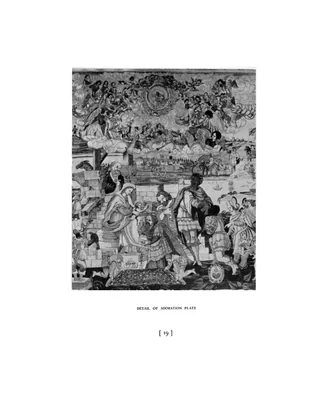
Adoration of the Magi in Embroidery
Article · 7 pages
An iconographic essay by Phyllis Ackerman on a seventeenth-century Italian embroidered altarfrontal showing the Adoration of the Magi. It describes the central scene and the many surrounding episodes (animals, travelers, Old Testament parallels, heavenly choir) and reads them as a Christian allegory of the Fall and Redemption. It also notes Oriental influences such as a Persian-style textile pattern and a Polonaise-type carpet. Illustrations include the altarfrontal, a detail of the Adoration, and a center panel of embroidered netting.
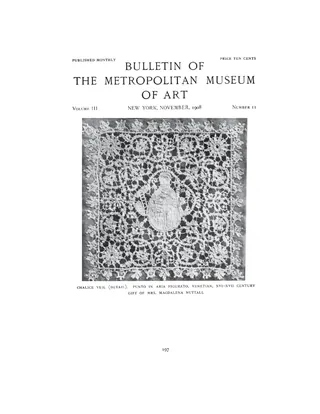
[Chalice Veil]
Article · 1 page
A single-page item from the Bulletin of the Metropolitan Museum of Art, November 1908, showing a photograph of a detail of a Venetian chalice veil. The caption identifies it as punto in aria figurato lace of the 16th to 17th century, given to the museum by Mrs. Magdalena Nuttall. The page carries the photograph and caption only, with no running text.
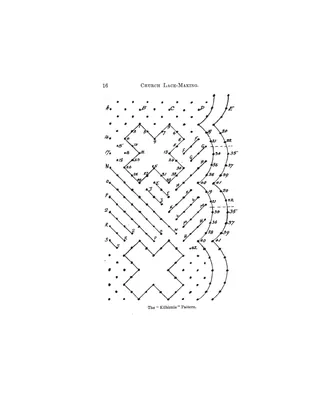
Church Lace
Book · 128 pages
A 1920 pattern book of eight pillow (bobbin) lace designs for church use, by M. E. W. Milroy. The patterns are the Katapwa, Kilbirnie, St. Patrick, Ladyland, St. Andrew, St. Cross, St. David and St. George, intended for chalice veils, a credence table cloth and fair linen cloths. Each has a materials list (bobbin counts, Knox's Falcon linen thread), a photograph, pricking diagrams and numbered step-by-step instructions in cloth stitch, double stitch, ground stitch, plaits and Honiton-style borders. The introduction gives practical advice and prices for prickings and finished lace.
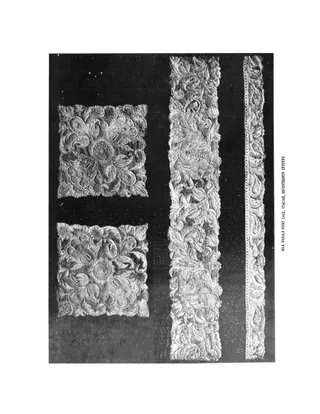
Ecclesiastical Lace Ancient and Modern: A Comparison
Article · 6 pages
Part I of an article by Mrs. F. Nevill Jackson comparing seventeenth-century church lace with nineteenth-century work. It discusses what counts as ecclesiastical lace, lace made for church use versus lay lace later given to the church, and the role of convents in lace-making. It criticizes the weak design of modern lace, using the 1887 Youghal (Co. Cork) convent set made for Pope Leo XIII as its main example. Plates show Italian and Venetian needle-point lace, including an alb and a stole, and modern Irish needle-point.
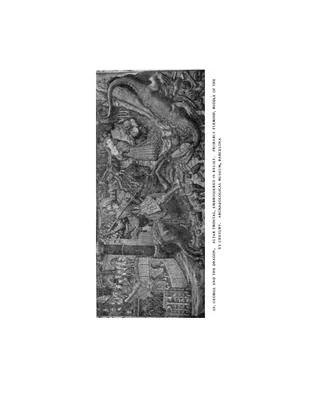
St. George and the Dragon: An Embroidery in Relief
Article · 3 pages
Short 1928 article from the Bulletin of the Needle and Bobbin Club on a fifteenth-century altar frontal in the Archaeological Museum, Barcelona, showing St. George and the Dragon worked in relief in silk, wool, silver and gold thread. It attributes the piece probably to Flemish work of the mid-1400s and discusses relief embroidery as a forerunner of seventeenth-century English stumpwork, citing related examples in the Cluny, the Louvre, Halberstadt and Neufchatel. Illustrated with a photograph of the altar frontal and a detail of an English valance in the Metropolitan Museum of Art.
Antique Embroideries
Magazine of Art, 1896-1897
Article · 3 pages
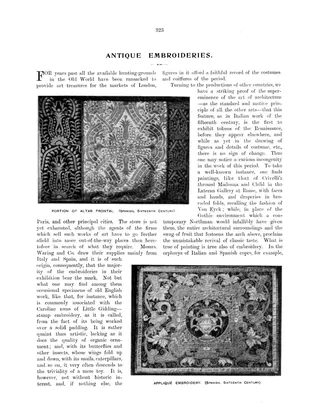
A short illustrated article from The Magazine of Art reviewing an exhibition of antique Italian and Spanish ecclesiastical embroideries at Messrs. Waring and Co. It discusses the shift from Gothic to Renaissance style in orphreys, altar frontals and vestments, notes Oriental influence, and mentions English stump embroidery. It closes with a survey of stitches such as raised gold, couching, feather, chain and tent stitch, laid work and appliqué.
Church Embroidery
Book · 222 pages
Anastasia Dolby's 1867 handbook on ecclesiastical needlework, with practical instruction on designing and working embroidery for the church. It opens with a history of English church embroidery (Opus Anglicanum), then describes eight altar designs with colour schemes and working dimensions, followed by super-frontals, monograms, powderings, pulpit and desk hangings, sermon-cases, alms-bags, dish-mats, book-markers and church linen. Later chapters cover appliqué, embroidery frames and hand care, gold work (couching, bullion, passing, pearl-purl), long-stitch and French knots, and suitable fabrics and liturgical colours. Illustrated with line-drawn plates and photographed stitch samples; an index and publisher's advertisements follow.
Irish Papal Jubilee lace
Article · 2 pages
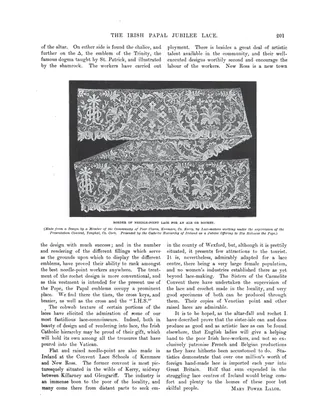
A short 1888 magazine article describing the set of Irish needle-point lace presented by the Irish Catholic bishops to Pope Leo XIII for his priestly Jubilee. It covers the design competition among Irish art schools, the winning Kenmare design, and the making of the altar-fall and rochet lace by workers at the Presentation Convent, Youghal. It also notes the lace schools at Kenmare and New Ross and urges English buyers to support Irish lace. Two photographic illustrations show a cuff and a border of the needle-point lace.
Newly Discovered Epitaphios Designed by Christopher Zefarovic
Article · 23 pages
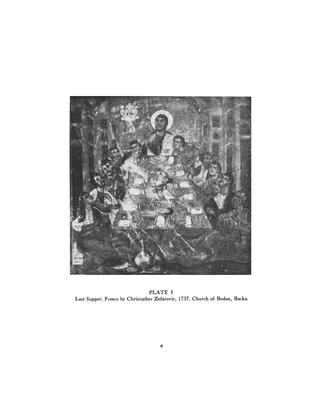
An article attributing a previously unrecorded epitaphios (Orthodox Good Friday funeral shroud), embroidered in Vienna around 1780, to the designs of the Serbian artist Christopher Zefarovic (d. 1753). It reviews his career as fresco painter, engraver and embroidery designer, compares his three accepted epitaphioi (Budapest, Olympiotice, Bucharest) with earlier Byzantine and Serbo-Byzantine examples by Despoineta and Kasymbouri, and analyzes iconography, inscriptions and stitching (silk, couched metal thread, long-and-short stitch). Fourteen plates illustrate the epitaphioi, a curtain, an antimension, and related works, and footnotes cite the scholarship.
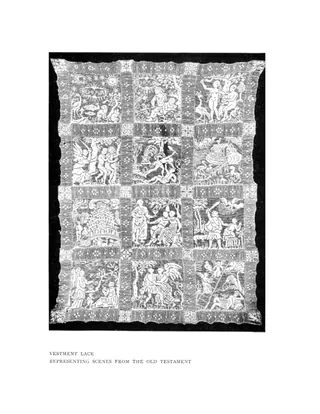
[Vestment] Lace
The Connoisseur, 1903
Article · 2 pages
A short note from The Connoisseur on a piece of lacis (darned netting) made of twelve squares that once formed part of an altar cloth or vestment. It explains how the square-mesh net ground was made and the pattern darned onto it, and traces the word réseau to the old term rézil or rezeuil. A halftone plate shows the panel, a grid of framed scenes from the Old Testament with decorative borders.
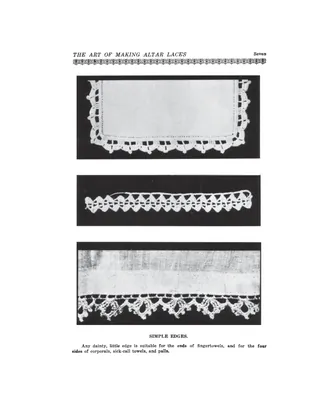
The Art of Making Altar Laces
Order of Saint Veronica, c. 1921
Monograph · 32 pages
A booklet of crochet and tatting instructions for lace trimmings on Catholic altar linens, issued by the Order of Saint Veronica (Our Sunday Visitor, Huntington, Indiana). It opens with a foreword and a letter explaining the society's mission, then covers cutting and folding altar linens, simple edges, stole collars, sick-call towels, tatted edgings, crocheted cinctures, and Irish crochet. Larger projects follow, including filet and mesh altar cloth laces (Cross and Heart, I.H.S., Diamond Frontal, Grape Design), pineapple and wheel laces, medallions, and a cut-work altar cloth. Written row-by-row directions accompany photographs of the finished pieces, and the booklet ends with a poem, 'Weaving for the Master'.

Textiles from the Excavations in the Orléans Cathedral
Article · 18 pages
Article describing the 1937-38 excavations beneath Orléans Cathedral, which uncovered remains of earlier churches, mosaic pavements and three bishops' tombs. The author concentrates on the silk textiles from the tombs: a bishop's hose (caligae) and sandals, a twill-woven chasuble with griffin, lion and eagle motifs, and a possible alb with a lozenge pattern and decorative border. Also covers the crozier, chalice and enamel glove medallions found with them. Illustrated with plates of the site, mosaics, metalwork, textile fragments and pattern reconstructions.
The Bulletin of the Needle and Bobbin Club, Vol. 31, Nos. 1 & 2 (1947)
Periodical · 82 pages
Combined Volume 31, Nos. 1 & 2 (1947) of the Bulletin of the Needle and Bobbin Club. The bulk is Eugenia Tolmachoff's illustrated survey of Russian church embroidery from the 14th to 17th centuries, covering icon veils, shrouds, altar frontals and palls from the Staritzky, Godunov and Stroganov workshops, with notes on gold thread, pearls, jewels and stitches. Vivi Sylwan's article (translated by R. J. Charleston) examines a late-Antique Egyptian tapestry medallion with gold thread and the history of gold thread in textiles. Junius Bird describes a pre-Spanish Peruvian ikat shawl from the Viru Valley. Club notes and a list of officers close the issue.
Shuttle-Craft Bulletin (April 1958)
Periodical · 40 pages · weaving drafts
April 1958 Portfolio Edition of the Shuttle Craft Bulletin (Vol. XXXV, No. 4), published by the Shuttle Craft Guild in Bedford, Nova Scotia. It opens with Harriet Tidball's essay defending traditional weaving terminology (including her proposed name "Atwater Lace" for the Bronson weave), then gives an Atwater-based Summer and Winter recipe for church weaving. The main feature is Mary E. Black's beginner study "Experimenting is Fun", which works through seven experiments on one hybrid four-harness texture draft, varying weft threads, sett, and threading changes. It closes with Cliff Hotchkiss on weaving for the church (Summer and Winter altar hangings, reversible seasonal colors, 8-harness drafts) and the Loom-Side Market advertisements.
The Bulletin of the Needle and Bobbin Club, Vol. 52, Nos. 1 & 2 (1969)
Periodical · 51 pages
Double issue (Vol. 52, Nos. 1 & 2) of the Bulletin of the Needle and Bobbin Club, 1969. It contains Luba Gurdus's study of a newly discovered epitaphios (embroidered Orthodox funeral cloth) attributed to the Serbian artist Christopher Zefarovic, with comparison to epitaphioi by Despoineta and Theodosia Kasymbouri. Margaret T. J. Rowe examines textile fragments from the tomb of an unknown bishop at Saint Denis, including knitted silk gloves and tablet-woven silver-gilt bands. Marguerite Dubuisson's French-language article surveys medieval knitting (bonneterie) through surviving socks, gloves, mittens and cushion covers. The issue ends with a book note on William Justema's The Pleasures of Pattern, club notes, an obituary section and a list of officers.
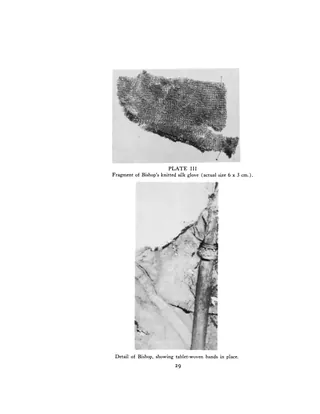
Fragments from the Tomb of an Unknown Bishop in Saint Denis, Paris
Article · 8 pages
Margaret Rowe describes thirteenth-century textile fragments from an unmarked bishop's burial found during Sumner Crosby's excavations at the Abbey Church of Saint Denis, now mounted in plastic at the Yale University Art Gallery. She covers the circumstances of the find, the fiber and dye analysis (silk, madder-dyed red, silver-gilt thread on silk core), the plastic embedding conservation, and the vestments. She gives particular attention to a knitted silk glove and to tablet-woven trim bands, with measured descriptions of the mounted band fragments. The article is illustrated with plates of the burial, fragments, glove and bands.
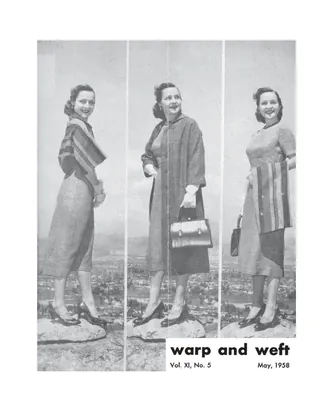
Warp & Weft, Vol. 11, No. 5 (May 1958)
May 1958
Periodical · 9 pages · weaving drafts
May 1958 issue of Warp and Weft, a monthly handweaving bulletin from Robin & Russ Handweavers of Santa Barbara. It features the cover garment by Marie Walling (a silk rose-path cape, dress and coat shown at the Southern California Handweavers Conference), an article on weaving ecclesiastical fair linens in Atwater lace, and a Summer and Winter sample with threading profile, tie-up, treadling, materials and cost per yard. Also included are a review of Berta Frey's Designing and Drafting for Handweavers, classified ads for yarns and equipment, and loom advertisements.
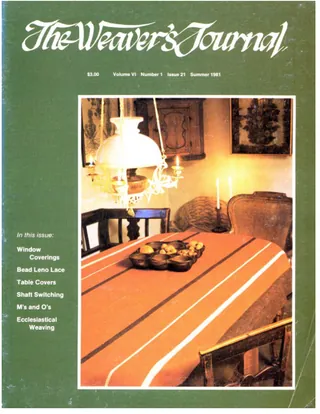
Weaver's Journal, Vol. VI, No. 1 Issue 21 (Summer 1981)
Weaver's Journal, Summer 1981
Periodical · 59 pages · weaving drafts
Summer 1981 issue of The Weaver's Journal, focused on home furnishings and ecclesiastical weaving. It includes project instructions for three tablecloths (a 3/1 twill cottolin cloth, an overshot and pick-up leno set, and a mock-leno cloth), plus several insulating window coverings such as Roman shades, shutters and tapestry window panels, some in mock leno and doup leno. Technical articles cover shaft-switching on 3-end drafts, satin with long-eyed heddles, multiple-shaft M's and O's with two foundation shafts, and figured bead leno lace. The ecclesiastical section covers vestments, a talis, hangings, stoles and chasubles. Other items are felting, a computer loom program, product and book reviews, contest winners, ads and an index.
Costume in All Ages
Article · 2 pages
A short introductory essay from Godey's Lady's Book (1860) distinguishing costume from fashion and tracing the history of dress from biblical times through Egypt, Greece and Rome to the classical revival in early nineteenth-century Europe. It touches on dress laws, Chinese foot binding, the biblical priestly robes, and the influence of Franklin's plain dress in Paris. It closes by promising further notes on the costumes of different periods.
Embroidery
Article · 2 pages
An encyclopedia article surveying embroidery from prehistoric skin decoration through the early twentieth century. It traces the history by region (Near East, Greece, Rome, Byzantium, Italy, Spain, Germany, the Netherlands, France, England, and the Orient), citing notable surviving pieces such as the Syon cope. It closes with a short account of tools and principal stitches (cross, tent, chain, buttonhole, satin, couching, appliqué) and a bibliography.
Embroidery
Rees's Cyclopedia, 1819
Article · 1 page
An encyclopedia entry on embroidery from Rees's Cyclopedia. It defines embroidery as enriching cloth, stuff, or muslin with needlework figures in gold or silver thread, and discusses the word's etymology, its attribution to the Phrygians, and its use in church vestments, standards, and similar items. It also lists kinds of embroidery (both-sided, guimped, raised on the stamp, low and plain) and cites a British statute (22 Geo. II) banning imports of foreign embroidery and gold or silver brocade.
A Search for Old Lace in Venice
Catholic World, March 1876
Article · 4 pages
A travel essay from the Catholic World in which the author, visiting Venice in early spring, follows an elderly lace-seller to her rooms to look at antique Venetian lace. Much of the text is about travel in Venice and Vicenza and about the seller herself. The lace discussion covers collars, cuffs, and flounces from albs and cottas, the thick, close texture of old Venetian point, its historic price, and the poorer quality of modern Venetian lace compared with the old and with Honiton and Irish lace.

Towel
Article · 1 page
A short encyclopedia entry defining the towel as a cloth for drying the hands, face or body. It names the main towelling fabrics, huckaback and Turkish towelling, and notes finer linen and damask towellings. It also covers the ecclesiastical use of the term for altar cloths, and traces the word's etymology from Old French and Low Latin back to Teutonic roots meaning 'to wash'.
The Art of Tatting
Book · 127 pages
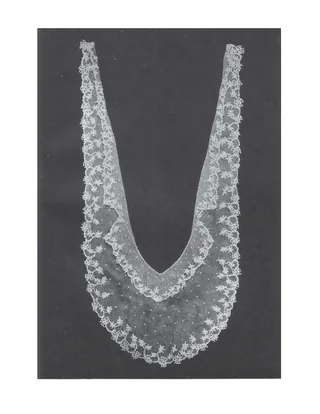
A 1910 book on tatting by Katharin L. Hoare, with an introduction by Carmen Sylva (H.M. the Queen of Roumania). The text covers the history of tatting, the shuttle, and basic single- and two-shuttle technique, with diagrams of the stitch and hand positions. Most of the book is a series of collotype plates of tatted work, chiefly by the Queen of Roumania, with her own descriptions. Items include altar veils, a coverlet, an iconostasis curtain, dress trimmings, collars, bags, handkerchiefs and church work. A final section shows miscellaneous examples, including historic shuttles in the Wallace Collection.
Arts and Industries of To-Day
Art Journal, 1897
Article · 2 pages
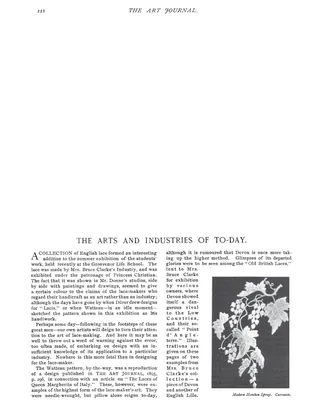
A short 1897 Art Journal column on contemporary arts and crafts in England. It reports on an exhibition of English pillow lace made by Mrs. Bruce Clarke's Industry (Honiton, Devon, and Bucks Point), an antependium and other embroidered church work in Harris flax and silk cloth, and the new Della Robbia ware fountain at the Savoy Hotel. Illustrated with photographs of lace, the antependium and the fountain.
Costume
Article · 1 page · French
A one-page encyclopedia entry on "Costume" from the Nouveau Larousse Illustré, written in French. It defines the term, then surveys dress from the ancient Orient, Greece, the Etruscans, Rome and Gaul through the Middle Ages and modern France. It also covers ecclesiastical and liturgical vestments, military uniforms, official dress, theatrical costume and the fine-arts sense of the word, and ends with a bibliography of French costume histories.
Dramatic History of a Well-Known Collection
Article · 9 pages
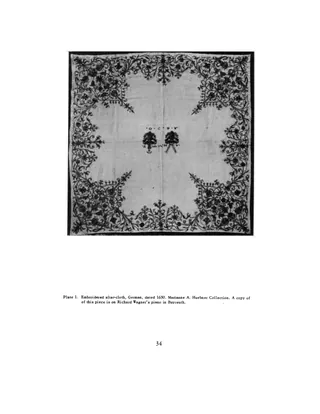
Text of a lecture given by Marianne A. Huebner to the Needle and Bobbin Club in December 1961, recounting the history of her collection of antique textiles. It begins with her aunt's Frankfurt firm R. Riesser, which served royal, church and wealthy clients and built a collection of antique textiles, including Coptic pieces from the Bock collection. It then follows the collection through two World Wars, inflation, Nazi rule, Huebner's emigration to the U.S. in 1939, and the wartime concealment of the collection in eastern Germany. Her recovery of the collection in New York in 1960 is described. The article has one plate of a German embroidered altar-cloth dated 1630.
Embroidery section from Historic Ornament: Treatise on Decorative Art and Architectural Ornament
Monograph · 8 pages
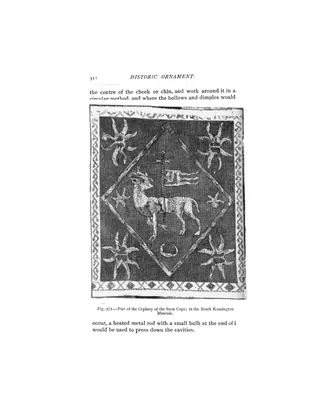
An excerpt on embroidery from James Ward's Historic Ornament (1897), covering pages 319-325 of the Textile Fabrics chapter. It traces embroidery from Egypt, Assyria, Persia and Phrygia through Greece and Anglo-Saxon and Norman England, including Opus Anglicum and the Bayeux Tapestry. It describes stitch types (feather, chain, crewel, satin, darning), gold and silver thread, and cut work or appliqué. Illustrations show a Norman archer from the Bayeux Tapestry, the Syon Cope orphrey, a Persian gold and silver embroidered velvet carpet, and the state gloves of Louis XIII.
Mediaeval Embroidery from the Collection of Mrs. Murray Crane
Article · 6 pages
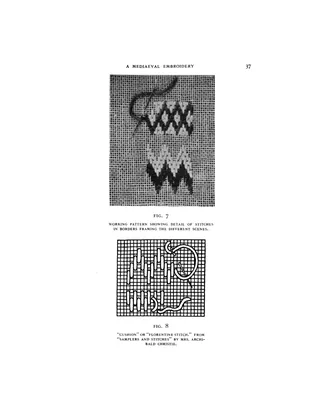
An article from the Bulletin of the Needle and Bobbin Club describing a large fourteenth-century German embroidered altar hanging in the collection of Mrs. Murray Crane, formerly owned by the Prince of Sigmaringen. The hanging has twelve square panels pairing New Testament scenes with Old Testament antetypes, between borders bearing heraldic arms. It is worked in counted canvas stitch, mainly cushion or Florentine stitch, in lustrous silk. The article discusses the stitchery and costumes, with working pattern charts of the geometric garment and border motifs and a diagram of the stitch. A final page shows a wedding embroidery from Janina.
The Bulletin of the Needle and Bobbin Club, Vol. 19, No. 2 (1935)
Periodical · 26 pages
Issue of the Needle and Bobbin Club Bulletin containing two articles. Margaret Harrington Daniels's "Embroidery and Botany" traces how Pierre Vallet, embroiderer to the French king, and the botanist Jean Robin produced the flower pattern book Le Jardin du Roy (Paris, 1608), and links it to French parterre gardens and the origins of the Jardin des Plantes. Phyllis Ackerman's "An Adoration of the Magi in Embroidery" interprets the iconography of a late Renaissance embroidered panel. Club Notes report a lecture on Javanese batik and an exhibit of the Anna Blakesley Bliss lace collection, followed by lists of officers and directors.
Embroidery
Article · 10 pages
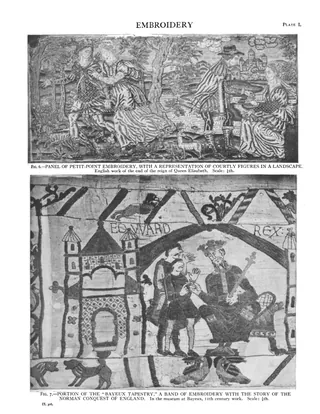
Reprint of the Encyclopaedia Britannica (11th ed.) article on embroidery, with six plates. It surveys the history of decorative needlework from ancient Egypt, Persia and Greece through medieval and later European work (France, the Netherlands, Italy, Spain, Germany, Scandinavia), and also covers the Near East, India, China, Japan, Persia, Turkestan and North Africa. The article closes with a bibliography of older works on embroidery. The plates show English, German, Italian, Chinese, Icelandic, Cretan, Persian and Sicilian pieces, including the Bayeux Tapestry, the Syon Cope and a Sicilian Tristan quilt.
Loomcraft
Periodical · 10 pages · weaving drafts
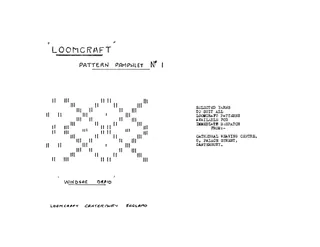
Five Loomcraft pattern pamphlets (Nos. 1-4 and 6) from the Cathedral Weaving Centre in Canterbury, England. Each gives a four-shaft pattern with sett, yarns, threading draft and lift sequences with pedal numbers and repeat counts. The patterns are the Windsor Braid, Golden Cross and St Andrews Braid (narrow braids for ecclesiastical work and book markers), a block-design cushion cover and Petals linen guest towels.
Point Compté, Lace Netting
Article · 3 pages
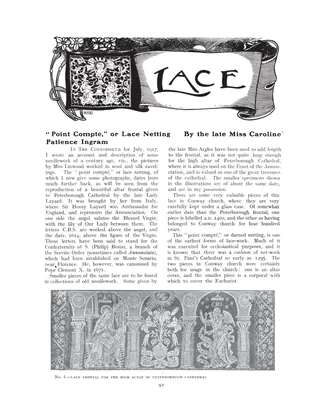
A short illustrated article on "point compté," or darned netting lace, one of the earliest forms of lace-work. It describes a 1614 Italian altar frontal of the Annunciation given to Peterborough Cathedral, pieces at Conway church, and historical references to netting at St. Paul's (1295) and Exeter (1327). It also mentions a piece attributed to Mary Queen of Scots, and ends with an obituary note on the author, a church embroiderer. Five photographs show the frontal and smaller examples.
Shuttle-Craft Bulletin (April 1959)
Periodical · 39 pages · weaving drafts
April 1959 Portfolio Edition of Shuttle Craft, the monthly bulletin of the Shuttle Craft Guild (Bedford, Nova Scotia). The issue centers on weaving with plant materials. Rita Bretscher describes using grasses, cattails and Indian grass as warp and weft, with warp planning, sleying, tied continuous wefts and drafts for screens and place mats. Other items: a spot-weave (warp pattern) wall hanging woven with pine needles by Lenora Broadhead Pratt; Mary E. Black on cere-cloths and other altar cloths and on a group project of kneeling-bench covers; church colors; a book review column by Boris Veren; and advertisements. It also has a Loom Language section and a note on the portfolio samples.
The Bulletin of the Needle and Bobbin Club, Vol. 24, Nos. 1 & 2 (1940)
Periodical · 68 pages
Combined issue (Vol. 24, Nos. 1 & 2, 1940) of the Bulletin of the Needle and Bobbin Club, devoted mainly to an English translation of N. Sobolev's 1912 study of hand-block printed textiles in Russia, translated by Eugenia Tolmachoff. It traces Eastern, Byzantine and Western (French, woodcut, gingerbread-mold) influences on printed fabric designs used for vestments, kerchiefs, curtains, book bindings and tents, with many halftone illustrations from Moscow and Brooklyn Museum collections. It also includes excerpts from V. Klein on cotton fabrics (mitkal, kutnia, zenden, kindiak), a glossary-style appendix of Russian textile terms, a bibliography, and the Club's notes for 1940-1941.
132 documents found