Textile Documents › Publications › Publication: Scott, Greenwood & Son
9 documents found
Sort: 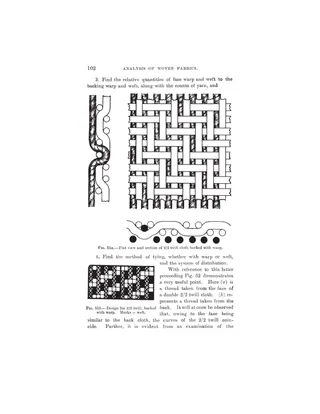
Analysis of Woven Fabrics
Book · 341 pages · weaving drafts
A 1914 technical treatise on analysing woven cloth, written by two Yorkshire textile teachers. It covers raw fibres and yarn qualities, yarn count and cloth weight calculations, setts, weave analysis, drafts and pegging plans, and the effects of dyeing and finishing on wool, union and cotton cloths. It explains how to work back from a small finished sample to loom particulars, with worked examples (worsted costume cloth, mohair lustre, double cloth, corduroy, colour-and-weave cloths), quick methods, fibre analysis, costing and wage lists. It ends with a glossary of fabric terms, an appendix of weaving price lists and a publisher's catalogue.
Carpets and Rugs
Book · 441 pages · weaving drafts
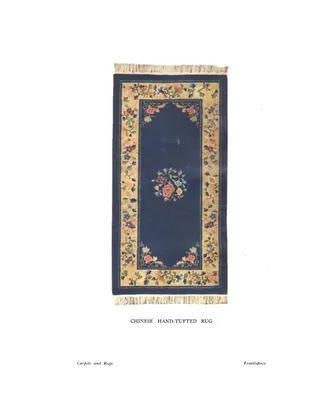
A 1924 technical treatise on the structure, design and manufacture of carpets and rugs, by Professor Roberts Beaumont and published posthumously. It opens with the history of pile and tapestry weaving and Eastern hand-tufted carpets, then covers felt carpeting, Kidderminster, Scotch and Ingrain carpets, union patternwork, Brussels and tapestry carpets, Wilton and cut-pile carpets, and chenille and machine-tufted Axminsters. A final chapter treats pile structure and quality. It includes many weave drafts and point-paper design diagrams, loom settings, yarn counts, colouring schemes, tables, and halftone plates, with an appendix on Chinese and Japanese hand-tufted carpets.
Chemical Technology of Textile Fibres
Book · 345 pages
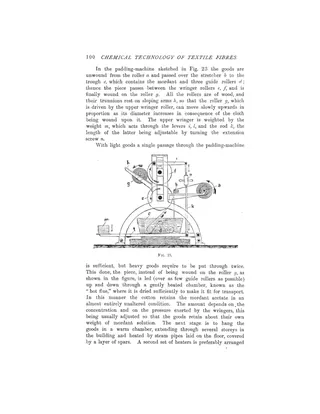
A 1902 English translation (by Chas. Salter) of Georg von Georgievics's textbook on the chemical technology of textile fibres. It covers the origin and structure of vegetable, animal and other fibres, then washing, bleaching and carbonising, mordants, dyeing, printing and dressing/finishing. Dyeing is the main chapter, with sections on each dye class and on dyeing machinery; there are 47 illustrations, mostly microscopic fibre drawings and machine diagrams. The book has an index and publisher's advertisements at the end, and contains no weaving drafts.
Church Lace
Book · 128 pages
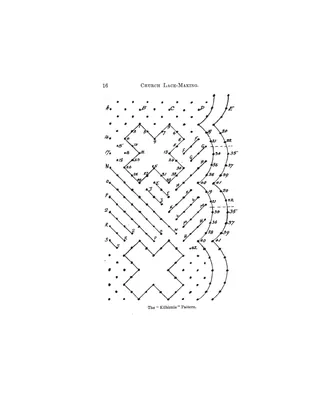
A 1920 pattern book of eight pillow (bobbin) lace designs for church use, by M. E. W. Milroy. The patterns are the Katapwa, Kilbirnie, St. Patrick, Ladyland, St. Andrew, St. Cross, St. David and St. George, intended for chalice veils, a credence table cloth and fair linen cloths. Each has a materials list (bobbin counts, Knox's Falcon linen thread), a photograph, pricking diagrams and numbered step-by-step instructions in cloth stitch, double stitch, ground stitch, plaits and Honiton-style borders. The introduction gives practical advice and prices for prickings and finished lace.
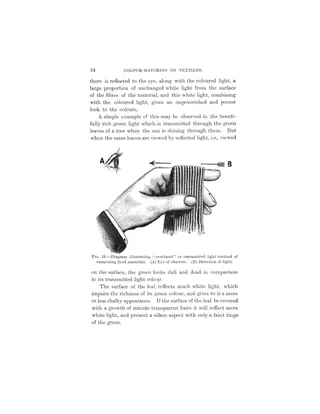
Colour-Matching on Textiles
Book · 175 pages
A 1901 manual by David Paterson for dyers, calico printers and textile colour chemists on matching dyed colours on textiles. It covers colour perception and the structure of the eye, the qualities of daylight, simultaneous contrast, reflected versus transmitted-light examination, and the effects of fibre lustre, transparency and dyestuff optics such as fluorescence. Later chapters treat colour-blindness, tinted films as matching aids, silk trimmings, artificial illuminants (electric arc, magnesium, acetylene, Welsbach, gas), and absorption spectra explaining why shades that match in daylight differ in gaslight. It has a coloured frontispiece, diagrams, photographs, an index, and publisher's advertisements at the back.
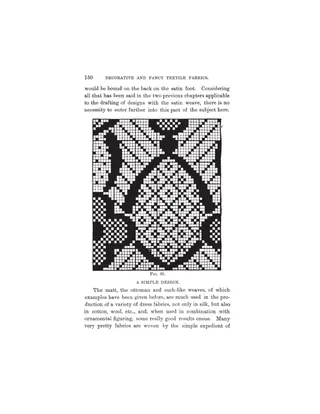
Decorative and Fancy Textile Fabrics
Book · 243 pages · weaving drafts
A 1898 English trade manual on designing and weaving decorative power-loom textiles, with illustrated chapters on pattern construction (drop, diaper, border and centre patterns) and ruled-paper (point paper) work. It describes the Jacquard machine and the manufacture of Brussels, Wilton, tapestry, ingrain and Axminster carpets, damasks and tapestry fabrics, scarf silks, ribbons, handkerchiefs, dress goods, mantle cloths, figured plush and bed quilts. Many chapters include weave drafts and loom illustrations, and the last chapter covers calico printing. The book ends with a publisher's catalogue of technical books.
The Finishing of Textile Fabrics
Book · 278 pages · weaving drafts
A 1909 technical treatise by Roberts Beaumont of the University of Leeds on the finishing of woollen, worsted and union cloths after weaving. It covers scouring, milling (fulling) and felting theory, raising with teazles and card wire, cutting, pressing, and lustring, with descriptions of finishing machinery by makers such as Kilburn, Bailey and Tomlinson. Much of the work examines how yarn structure, fibre type and weave structure (plain, twills, sateens, backed and double cloths) affect shrinkage and raising, illustrated with photographs, micrographs, tables, weave plans and healding drafts. It ends with finishing routines for specific cloths and an index.
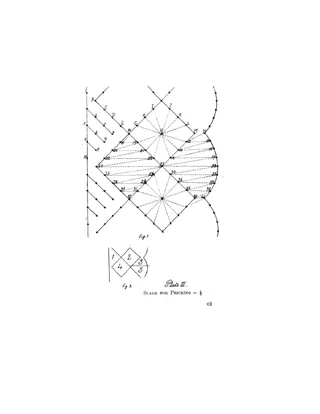
Home Lace-Making: A Handbook for Teachers and Pupils
Book · 57 pages
A 1909 handbook for teaching bobbin lace-making (Torchon) to children and other pupils, by M. E. W. Milroy. It opens with a preface and hints for the teacher on materials and costs, making prickings with a hektograph, and running a class. Six progressive patterns follow, each with a step-by-step numbered stitch sequence by pairs of bobbins and pin holes, plus pricking diagrams (Plates I-VII) and photographs of the six finished laces.
Standard Cloths: Structure and Manufacture
Book · 357 pages · weaving drafts
A 1916 technical treatise by Roberts Beaumont on the structure, analysis and manufacture of standard woollen and worsted cloths, including Government, military and naval fabrics. It opens with microscopic study of fabric structure and defects, then covers fabric quality, Cheviot and Saxony contrasts, and standard specifications and tests. Later chapters cover weave types, light fabrics and flannels, medium and heavy suitings, worsteds, double and compound cloths, overcoatings, Army and Navy cloths, tartans and felt manufacture. It gives many worked examples with yarn counts, reed and pick settings, finishing routines and weights per yard, with photographs, weave plans and colour schemes. It ends with an index and trade advertisements.
9 documents found