Textile Documents › Publications › Publication: Rees's Cyclopedia
93 documents found
Sort: 
Abaca
Rees's Cyclopedia, 1819
Article · 1 page
A very short encyclopedia entry on abaca, described as a flax- or hemp-like fiber gathered in the Manila (Philippine) Islands. It says the plant is sown yearly, then steeped in water and beaten like hemp. Two kinds are named: white abaca for fine linen and grey abaca for cordage only.
Agave
Rees's Cyclopedia, 1819
Article · 2 pages
An encyclopedia article on the botanical genus Agave (American aloe) from Rees's Cyclopaedia. It gives the botanical characters, describes seven species, and notes the history of their introduction to Europe and England. It also covers uses of the leaf juice as soap and the leaf fibres for thread, rope and cloth, including a process for extracting thread at Loule, Portugal, and ends with cultivation advice and a comparison with Aloe.
Amianthus
Rees's Cyclopedia, 1819
Article · 2 pages
Encyclopedia article on amianthus (mountain flax), a fibrous, incombustible mineral related to asbestos. It covers physical characteristics, localities, behavior under heat and acids, and chemical analyses by Bergman. It also gives the history of spinning and weaving the fibers into fireproof cloth, used for Roman funeral shrouds, along with Mahudel's method for preparing the cloth, incombustible paper, and lamp wicks.
Asbestus
Rees's Cyclopedia, 1819
Article · 1 page
A short encyclopedia entry on asbestus (asbestos) from Rees's Cyclopedia, treated as a mineral in chemistry and mineralogy. It describes colour, crystal forms, fracture, lustre, specific gravity, behaviour with acids and under the blowpipe, and competing chemical analyses by Bergman and Weigleb. It notes that asbestus occurs in serpentine rock and that the more flexible varieties were used to make incombustible cloth, as with amianthus.
Batiste
Rees's Cyclopedia, 1819
Article · 1 page
A short encyclopedia entry from Rees's Cyclopedia defining batiste as a fine white linen cloth made in Flanders and Picardy. It describes three grades, from very thin to a thicker 'Holland batiste', and lists common uses such as neckcloths, headcloths and surplices.
Bays
Rees's Cyclopedia, 1819
Article · 1 page
A short encyclopedia entry defining bays as a coarse, open woollen fabric with a long nap, woven on a two-treadle loom like flannel. It covers the centers of manufacture (Colchester and Bocking in Essex, and Lisle and Tournay in Flanders), the introduction of the trade to England by Flemish refugees under Elizabeth I, and the decline of exports as French makers imitated it. It also gives the uses and standard widths and lengths of bays.
Black
Rees's Cyclopedia, 1771
Article · 2 pages
An encyclopedia article on the color black from Rees's Cyclopedia. It covers black dyeing of cloth and hats with galls and iron vitriol (copperas), the woad and indigo ground used on broadcloth, and Jesuit's or coal black. It also gives an Elizabethan statute on maddering black and notes on logwood, silver and lead blacks, and pigment blacks (earth, German or Frankfort, hartshorn and ivory black).
Blanket
Rees's Cyclopedia, 1819
Article · 1 page
A short encyclopedia entry on blankets as a commercial product, taken from Rees's Cyclopedia. It describes blankets as light, loosely woven woolen bedding and says their manufacture centered on Witney in Oxfordshire. It gives two explanations for the quality of Witney blankets: the river Windrush water used for scouring, or a local loose spinning method. It also lists the wool grades used for blankets of different widths, measured in quarters.
Bleaching
Rees's Cyclopedia, 1819
Article · 18 pages
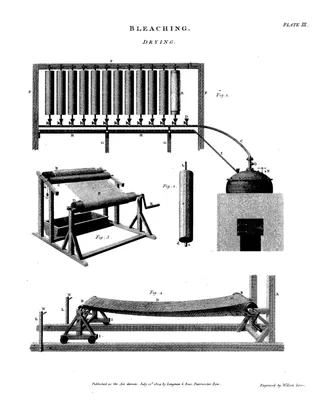
Encyclopedia article on bleaching of linen and cotton from Rees's Cyclopedia, by Edward Hussey Delaval. It explains the theory of bleaching and describes the vessels and processes used: steeping, boiling, bucking with alkaline leys, souring, washing, and bleaching with oxygenated muriatic acid (chlorine) and lime preparations. It also covers testing the strength of alkalies and acids, clearing printed goods, and the history of improvements by Berthollet, Tennant and others. Illustrated with engraved plates of bucking, washing, drying and bleaching apparatus.
Broach
Rees's Cyclopedia, 1819
Article · 1 page
A short dictionary entry on the word 'broach' from Rees's Cyclopedia. It defines the term as an awl or bodkin, a steel tool for opening holes in metal, a stick for winding thread or yarn, and, in the North of England, a wooden knitting needle for coarse work. It also refers readers to the Tapestry entry for the broach used in tapestry weaving.
Brocade
Rees's Cyclopedia, 1819
Article · 2 pages
An encyclopedia entry on brocade from Rees's Cyclopedia (1819). It defines brocade as cloth of gold, silver or silk enriched with flowers and figures, and describes how gilt wire is spun onto silk thread, including Milanese, Nuremberg and Chinese gilt-paper variants. It also covers the Venetian damasquete and Vaucanson's heated-roll machine at Lyons for extending the gilding, then gives advice on cleaning rich brocades with spirit of wine. A short note on the brocade-shell in conchology closes the entry.

Brocatell
Rees's Cyclopedia, 1819
Article · 1 page
A very short encyclopedia entry defining brocatell (French brocadel) as an ordinary fabric of cotton or coarse silk made in imitation of brocade. It notes that the cloth was used mainly for tapestry and other furnishings, and that the Venetian product was the most esteemed.
Brown
Rees's Cyclopedia, 1771
Article · 1 page
A short encyclopedia entry on the color brown from Rees's Cyclopedia. It lists the shades dyers distinguish (sad brown, London brown, clove brown, purple brown, walnut-tree brown) and names brown pigments such as bistre, brown ochre, Cologne earth, umber and brown pink. It also describes Spanish brown, a dull red earth pigment used by house-painters and colourmen and dug in parts of England.
Buckram
Rees's Cyclopedia, 1819
Article · 1 page
A very short encyclopedia entry defining buckram as a thick linen or hempen cloth stiffened with gum or glue. It describes its use as lining to give garments shape and as wrapping to protect cloth and other goods from soiling and fading. It also notes how buckram was sold wholesale, in small pieces about four ells long.
Cable
Rees's Cyclopedia, 1819
Article · 1 page
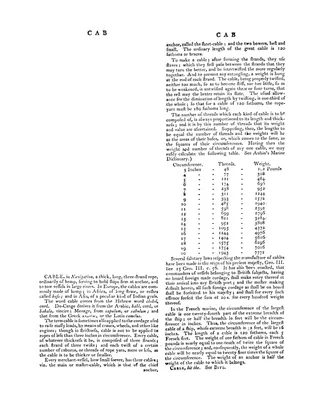
A one-page encyclopedia entry on ship's cables from Rees's Cyclopedia. It describes how a cable is made from strands, twisted with staves and weighted against tangling, and notes the one-third shortening in length from twisting. It also gives a table relating circumference to number of threads and weight, British legislation on cordage, French marine proportions, and the etymology of the word. Weaving is not covered.
Calender
Rees's Cyclopedia, 1819
Article · 1 page
A short encyclopedia entry on the calender, a machine used in textile manufacture to press stuffs, silks, calicoes and linens so they become smooth, even and glossy, and to water or wave tabbies and mohairs. It covers the word's derivation, the construction of the machine with its wooden rollers and heavily weighted movable upper plank, the royal calender at Paris made for Colbert, and horse-driven versions. It also mentions calendering worsteds and linen cloths.
Callicoe
Rees's Cyclopedia, 1819
Article · 1 page
A short encyclopedia entry defining callicoe (calico) as a cotton cloth originally imported from Calicut on the Malabar coast of India. It notes that the term now generally applies to English-made cotton cloths of varying fineness, first manufactured at Blackburn in Lancashire, and mentions the spinning, weaving, bleaching and dyeing work involved. It refers readers to the article on Cotton Manufactures.
Camblet
Rees's Cyclopedia, 1819
Article · 1 page
A short encyclopedia entry defining camblet (chamblet), a fabric made of wool, silk, or hair, especially goat or camel hair. It covers the true oriental camblet from Angora goat hair, the etymology from camelotum and camelinum, and the European centers of manufacture (Brussels, England, France, Holland, Flanders). It also describes figured, water, and waved camblets and the finishing processes of hot-pressing and calendering.
Cane
Rees's Cyclopedia, 1819
Article · 1 page
A single page from Rees's Cyclopedia (1819) with the end of one entry and the entry for rattan canes. It describes rattan canes from China, Japan and Sumatra, which are split for cane chairs and twisted into cordage and cables. It then describes the large canes of Guayaquil in South America, used in building and as rafters, flooring and poles, and the water found in their tubes.
Canvas
Rees's Cyclopedia, 1819
Article · 1 page
A short encyclopedia entry on canvas from Rees's Cyclopedia. It defines canvas as a coarse, openly and regularly woven linen or hempen cloth used for tapestry work grounds and painting. It lists commercial varieties (Dutch, Barras, Hessian, packing, spruce, working canvas) and notes the preparation of painters' canvas and the use of the name for sail cloth.
Carding
Rees's Cyclopedia, 1819
Article · 1 page
A very short encyclopedia entry defining carding as the preparation of wool, cotton, hair, or flax by passing it between the iron teeth of two cards to comb, disentangle, and align the fibres for spinning. It also notes that wool is oiled before carding, giving proportions of oil by weight for weft wool versus warp wool, and cross-references the entries on Cards and Cloth.
Cloth
Rees's Cyclopedia, 1819
Article · 3 pages
An encyclopedia article on woollen cloth from Rees's Cyclopedia. It defines cloth, lists the qualities of good superfine cloth, and describes the Wiltshire manufacture step by step: scouring, dyeing, scribbling, carding, slubbing, spinning, warping, sizing, weaving broad-cloth with two weavers, fulling, burling, dressing with teazels and shears, and pressing. It closes with a long summary of English statutes on cloth measurement, sealing, export, stretching, and the regulation of clothiers and weavers.
Cochineal
Rees's Cyclopedia, 1819
Article · 5 pages
Encyclopedia article on cochineal from Rees's Cyclopedia (1819). It covers the insect, its cultivation in Mexico and elsewhere, grades and trade, and the history of its use as a dye, including the discovery of tin mordants for scarlet. It describes chemical reactions of cochineal with acids, salts and mordants on wool, silk and cotton, practical dyeing and calico-printing advice, and recipes for carmine and red lake.
Coir
Rees's Cyclopedia, 1819
Article · 1 page
A short encyclopedia entry defining coir, the strong fibre prepared from coconut husks and widely used in the East Indies for cables and cordage. It summarizes the experiments Dr. William Roxburgh of Calcutta sent to the Society of Arts, London, in 1801 and 1806, comparing the strength of hemp and about twenty other vegetable fibres when white, tanned and tarred, fresh and after maceration in water.
Colour
Rees's Cyclopedia, c. 1802-1820
Article · 11 pages
An encyclopedia article on colour and colour-making in calico printing, from Rees's Cyclopedia. It sorts printers' colours into three classes: dyed colours raised on mordants, chemical colours with mordant mixed into the colouring matter, and colours held in solution by an acid or alkali. It gives recipes and chemical theory for iron and alumina mordants (iron liquor, red liquor), chemical black, berry-yellow, greens and tin solutions for scarlets. The final page appears to carry a separate passage on colour changes from chemical mixtures.
Cotton Manufacture
Rees's Cyclopedia, 1819
Article · 33 pages
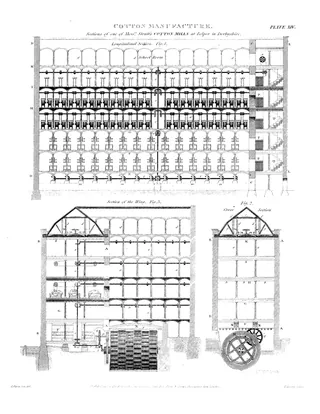
Article on cotton from Rees's Cyclopedia covering the cotton plant, its commercial varieties (North American, South American, West Indian, East Indian), prices, import statistics and duties, and the history of the cotton manufacture in Britain. It describes the processes of carding, roving, spinning (jenny, water frame, throstle, mule), warp sizing and dressing, weaving and the first attempts at power looms, plus employment and wage figures for England and Scotland. About 13 engraved plates illustrate calico printing, batting, devilling, carding, drawing, roving, spinning, reeling, doubling and twisting machines, and Strutt's mill at Belper.
Crape
Rees's Cyclopedia, 1819
Article · 1 page
A short encyclopedia entry defining crape as a light, transparent, gauze-like silk fabric made from raw silk that is gummed and twisted on the mill, and used chiefly for mourning. It explains the difference between crisped (double) and smooth (single) crape, how the crisping results from heavier twisting of the warp, and mentions its origin in Bologna, manufacture at Lyons, and a historical reference to St. Bathilda's crape of gold and silver.
Damask
Rees's Cyclopedia, 1819
Article · 2 pages
A short encyclopedia entry on damask from Rees's Cyclopedia, defining it as a twill-based figured fabric with large patterns. It covers the possible Damascus origin of the name, the early silk damask of France and Italy, its probable introduction to Britain by Dutch and Flemish weavers, and its later decline in silk. It notes that British production had shifted to linen and cotton table linen centered on Dunfermline, and that the weaving uses five or eight leaves of front mounting plus a draw loom harness. It refers readers to the entries Design and Draw-book for the process.
Design in the Weaving Manufactures
Rees's Cyclopedia, 1819
Article · 3 pages · weaving drafts
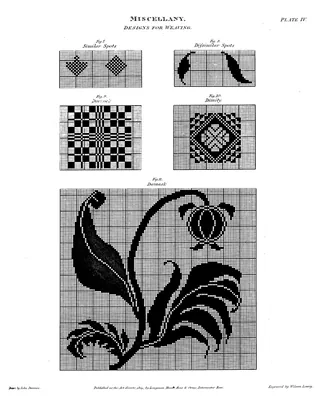
An encyclopedia article on 'design' in woven manufactures, explaining how ornamental patterns are drawn on ruled design paper and translated to the loom. It covers how squares represent warp and weft threads, how oblique and curved lines are approximated, and includes a table of angles of obliquity for 1 to 9 squares of warp and weft. A worked example calculates the size of a damask flower on cloth versus on paper. The last page is Plate IV, 'Designs for Weaving', showing grid designs for similar spots, dissimilar spots, dornock, dimity and damask.
Diaper
Rees's Cyclopedia, 1819
Article · 2 pages
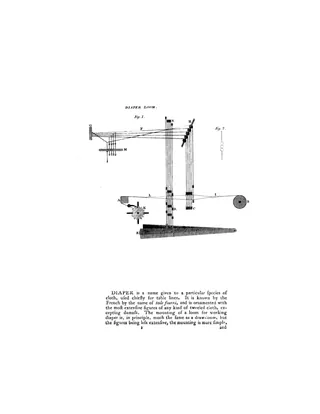
An encyclopedia article on diaper, a twill-based cloth used chiefly for table linen, and on the loom mounting used to weave it. It explains how diaper uses broken five-leaf twill with reversed floats to form figures, and how a back harness operated by the weaver's hand supplements the front treadle mounting. It describes the parts of the diaper loom shown in an engraved figure (breast beam, cloth beam, treadles, back harness, cords and pulleys, and the iron or copper eyes called mails).
Dimity
Rees's Cyclopedia, 1819
Article · 1 page
A short encyclopedia entry defining dimity as a stout cotton cloth, originally imported from India and by then widely made in Britain, especially Lancashire. It distinguishes dimity from fustian: dimity is ornamented in the loom with stripes or figures and usually bleached white, while fustian is a plain twilled cloth usually dyed after weaving. It notes that striped dimities are cheaper because they need simpler loom mounting, and refers readers to the article Draught and Cording for mounting plans.
Dornock
Rees's Cyclopedia, 1819
Article · 1 page
Encyclopedia entry defining dornock as a stout figured linen, chiefly woven in northern Scotland for table cloths. It describes the simple check or square patterns made by reversing warp and weft floats, and the use of three-, four- and five-leaf twills. It also notes that customer weavers wove much of it from home-spun yarn, a trade then in decline. It refers to plates for the design-paper representation and loom mounting, but these are not part of the scan.
Draught and Cording
Rees's Cyclopedia, 1819
Article · 5 pages · weaving drafts
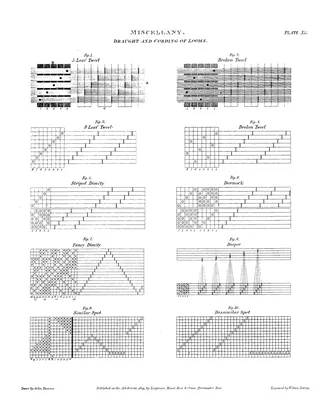
An encyclopedia article from Rees's Cyclopedia explaining draught (the order of drawing warp threads through heddles) and cording (tying leaves to treddles) for looms. It describes how plans are drawn and read, then works through ten figures: five- and eight-leaf tweel and broken tweel, striped dimity, dornock, fancy dimity, diaper mounting, and similar and dissimilar spots. The last page is Plate XII, with the draught and cording diagrams for these figures.
Draw-Loom
Rees's Cyclopedia, 1819
Article · 3 pages
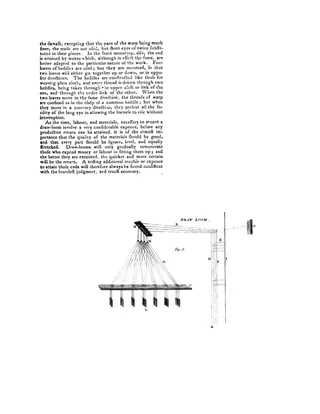
An encyclopedia article on the draw-loom from Rees's Cyclopedia, describing how the harness (mails, weights, pulleys, tail cords, simples and lashes) is built and mounted, and how a pattern is read on from design paper by two operators. It also covers the 'patent' draw-loom introduced at Dunfermline that lets one weaver work alone, and the draw-loom as used for carpets and for spot weaving. A Fig. 3 engraving labels the parts of the loom.
Dyeing
Rees's Cyclopedia, 1819
Article · 9 pages
Excerpt from Rees's Cyclopedia (1819) giving a historical account of the art of dyeing, from its obscure origins through antiquity, the Middle Ages, and early modern Europe. It covers the legends and uses of Tyrian purple, dye materials known to the Greeks and Romans (alum, alkanet, madder, woad, indigo), the discovery of archil and kermes scarlet, the Gobelin family, and the development of dyeing theory in France, including Berthollet's work. A short closing section lists the various trades that use dyeing or coloring, such as bleaching, staining wood and leather, and marbling paper.
Embroidery
Rees's Cyclopedia, 1819
Article · 1 page
An encyclopedia entry on embroidery from Rees's Cyclopedia. It defines embroidery as enriching cloth, stuff, or muslin with needlework figures in gold or silver thread, and discusses the word's etymology, its attribution to the Phrygians, and its use in church vestments, standards, and similar items. It also lists kinds of embroidery (both-sided, guimped, raised on the stamp, low and plain) and cites a British statute (22 Geo. II) banning imports of foreign embroidery and gold or silver brocade.
Felt
Rees's Cyclopedia, 1819
Article · 1 page
A short encyclopedia entry defining felt as a stuff of wool, or wool and hair, that is neither spun nor woven but made by fulling with lees and size and shaping on a block with fire and water. It names the usual fibers (beaver, camel and coney hair, lamb's and sheep's wool) and notes that felt is used chiefly for hats. It describes the felt for a hat as formed into a funnel-shaped piece before being shaped, and refers readers to the entry HAT.
Felting
Rees's Cyclopedia, 1819
Article · 1 page
A single-page encyclopedia entry on felting from Rees's Cyclopedia. It describes how hatters turn fur, hair and wool into cloth without spinning or weaving, by bowing the fibers apart, layering them, and working them with moisture and pressure so they twist together. It explains why wool's naturally crooked fibers felt readily, while straight hairs such as beaver and rabbit must be prepared first, and it refers readers to the entries on Fulling and Hat.
Flax
Rees's Cyclopedia, 1819
Article · 8 pages
Encyclopedia article on flax from Rees's Cyclopedia (1819), covering the plant mainly from an agricultural standpoint. It discusses soil, seed quantity, sowing time, after-culture and weeding, pulling, rippling the seed, and water-retting, plus rents and profits in Scotland and England. Later pages describe the parts of a flax-breaking (brake) machine with lettered references, and a section on other vegetable fibres used like hemp and flax.
Fuller
Rees's Cyclopedia, 1819
Article · 1 page
A short encyclopedia entry on the fuller, the workman who fulls, mills or scours woollen cloths, rateens, serges and other stuffs to make them thicker, more compact and durable. It gives the Latin origin of the word (fullo) and notes that Roman fullers washed, scoured and finished cloth under formal laws, with references to Pliny and Ulpian. It cross-refers to the entry on Fulling.
Fulling
Rees's Cyclopedia, 1819
Article · 4 pages
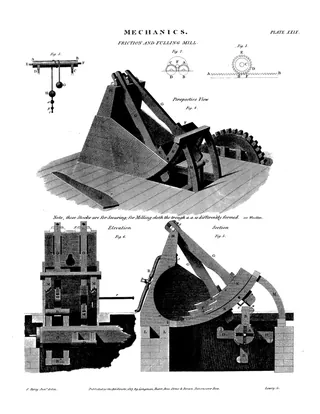
Encyclopedia article on fulling (milling) of cloth, from Rees's Cyclopedia. It covers the history of the art, the construction and operation of the water- or steam-driven fulling mill with its stocks, beaters, lifters and trough, and Colmet's method of fulling woollen cloth with soap. It also treats the fulling of stockings and caps, and the fulling of hat felt with wine lees versus sulphuric acid. A plate of the friction and fulling mill is included.
Furs
Rees's Cyclopedia, c. 1802-1820
Article · 14 pages
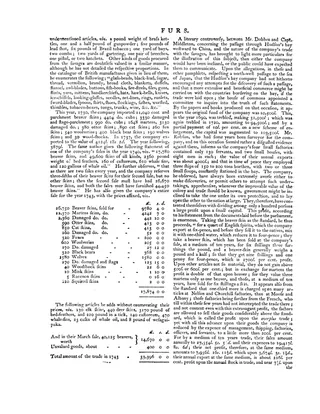
An encyclopedia article on furs from Rees's Cyclopedia, covering the qualities and relative values of furs from beaver, fox, ermine, sable, sea-otter and other animals, and how climate and season affect them. It then traces the history of the fur trade, from Russia and Siberia to the Hudson's Bay Company, the French in Canada, the British conquest of Canada, and the North-west Company and the Mackenzie expeditions. It includes tables of imports, sales and prices from the 18th and early 19th centuries, and the barter trade with the Indians.
Fustian
Rees's Cyclopedia, 1819
Article · 4 pages · weaving drafts
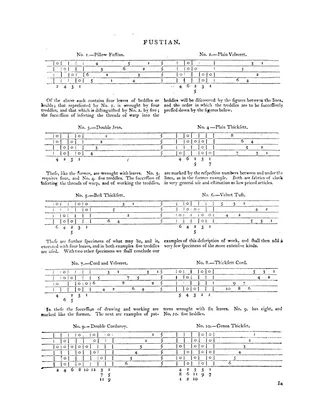
Encyclopedia article on fustian from Rees's Cyclopedia (vol. XV). It defines fustian as a coarse, thick, twilled cotton cloth, gives the word's etymology, and describes the Lancashire and Yorkshire manufacture. Eighteen draft diagrams give threading and treadling for fustians, velverets, thickset, corduroys, Genoa and plain velveteens, and velvets, on four to eight leaves of heddles. Closing remarks discuss terminology across cotton, wool and silk cloths and the cutting of pile after weaving.
Fustic
Rees's Cyclopedia, 1819
Article · 1 page
A single page from Rees's Cyclopedia on fustic, a yellow dyestuff. It describes old fustic (Morus tinctoria) and young fustic (Rhus cotinus, Venice sumach), covering colour, durability, mordants, and uses in compound colours such as greens, drabs and olives. The entry begins on this page and breaks off partway through the description of the tree.
Goat
Rees's Cyclopedia, 1819
Article · 1 page
A one-page excerpt from Rees's Cyclopedia (1819) on the goat in rural economy, with a cross-reference to the zoological entry under Capra. It covers where goats suit a farm, their milk, cheese, kids, suet, horns and skins, and the use of goat hair for durable ropes and some stuff. It also gives points for choosing and keeping goats, including breeding season and shelter.
Gobelins
Rees's Cyclopedia, 1819
Article · 1 page
A one-page encyclopedia entry on the Gobelins, the Paris manufactory for tapestry and furnishings for the French crown. It recounts the founding by the dyers Giles and John Gobelins, the 1667 establishment as the Hotel Royal des Gobelins under Louis XIV and Colbert, and the regulations governing it. It also mentions notable tapestry series designed by Le Brun.
Gossypium (Cotton)
Rees's Cyclopedia, 1819
Article · 2 pages
An encyclopedia entry on Gossypium, the cotton plant, from Rees's Cyclopedia. It gives the etymology of the name, the botanical generic and essential characters, and the Linnaean species (G. herbaceum, G. barbadense, G. arboreum, G. hirsutum, G. religiosum), with notes on their native regions and distinguishing features. It closes with remarks on further species described by Cavanilles and Willdenow. The entry is botanical, not about spinning or weaving.
Hat
Rees's Cyclopedia, 1819
Article · 3 pages
Excerpt from Rees's Cyclopedia (1819) on hats. It describes how beaver felt hats were made: preparing the fur, bowing, basoning, fulling, blocking, dyeing, stiffening and finishing. It also summarizes British laws on hat retailing, duties and exports, and notes briefly that women's hats were made from various materials and that the hat was a symbol of the cardinalate.
Hemp
Rees's Cyclopedia, 1819
Article · 4 pages
An encyclopedia article on hemp from Rees's Cyclopedia (vol. XVII), covering the plant's cultivation and preparation as a fibre crop. It treats soil, seed, sowing, pulling, seed harvesting, dew-retting and water-retting (including Bralle's soap-steeping method and Rainbeard's pit), then breaking, scutching, beetling and heckling. It closes with yields, prices, bounties, the case for expanding British hemp growing, and a note on ancient knowledge of hemp.
Hykes
Rees's Cyclopedia, 1819
Article · 1 page
A short encyclopedia entry defining the hyke, a blanket-like garment used in Barbary (North Africa). It says the women weave hykes without a shuttle, passing each weft thread by hand. It describes the size, use as daytime dress and night bedding, and cites Dr. Shaw's comparison to the ancient peplus or toga.
93 documents found