Textile Documents › Publications › Publication: Nouveau Larousse Illustré
52 documents found
Sort: 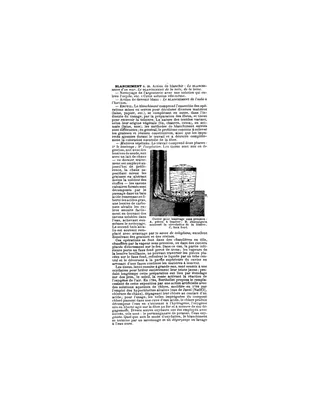
Blanchiment [Bleaching]
Article · 1 page · French
A one-page French dictionary entry on bleaching (blanchiment) from the Nouveau Larousse Illustré. It gives the general definitions, then an encyclopedic section on bleaching textiles. For plant fibers (linen, hemp, cotton) it covers lye or lime scouring followed by oxidation, including Berthollet's 1784 chlorine bleaching and the later hypochlorites, in place of meadow bleaching. An engraving shows a cuvier (vat) for pressureless lye bleaching.
Bobine [Bobbin]
Article · 1 page · French
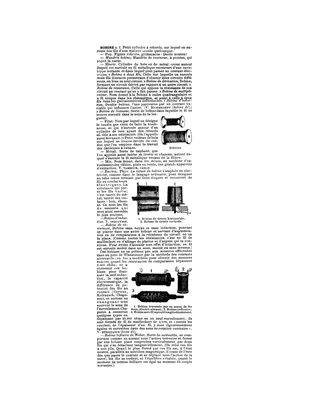
A single dictionary entry on 'bobine' (bobbin, spool, coil) from the Nouveau Larousse Illustré. It defines the term as a small flanged cylinder for winding textile threads, then lists specialized senses in electricity, spinning (the roll made by the boudineuse and ribbon-carder bobbins), wire drawing and mining. Most of the text is an encyclopedic note on electrical coils (resistance, induction, Weber's bifilar coil), with small figures of wooden bobbins and coil diagrams.
Brocart [Brocade]
Article · 1 page · French
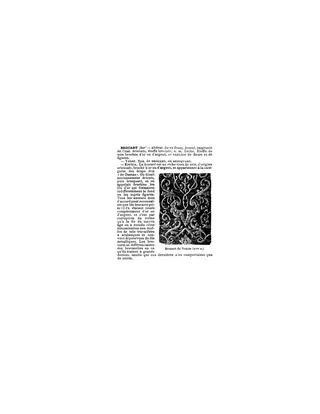
A one-page French dictionary entry on brocade (brocart) from the Nouveau Larousse Illustré. It gives the word's etymology and defines brocade as a silk fabric brocaded with gold or silver, and it also notes the hunting-term sense. The encyclopedic note covers the Oriental origin, the early all-gold and silver weaving, and how the term later broadened to figured silks. It also distinguishes brocade (large patterns) from brocatelle (small patterns). An illustration shows a 16th-century Venetian brocade.
Broderie [Embroidery]
Article · 3 pages · French
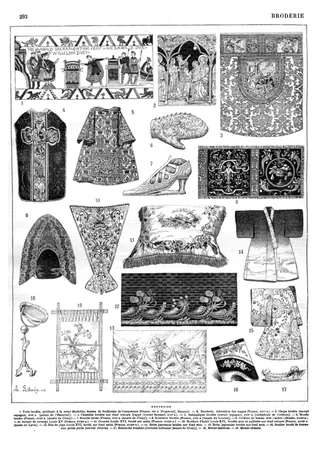
A French encyclopedia entry on embroidery (broderie) from the Nouveau Larousse Illustré. It gives definitions and figurative senses, then describes embroidery frames (métier and tambour), the main categories (white, colored/metallic, and canvas embroidery) with their stitch types, and a historical survey from antiquity and Byzantium through the 18th century and the rise of machine embroidery. A plate illustrates historical examples such as the Bayeux panel, copes, chasubles, shoes, and Asian garments, along with frame types.
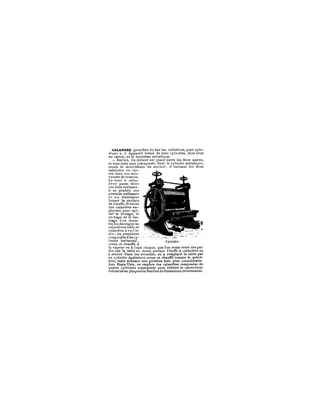
Calandre [Calender]
Article · 1 page · French
A one-page French encyclopedia entry on the calender (calandre), a machine of three cylinders, two of pasteboard and one of metal, used to press, smooth and lustre fabrics. It explains how the cloth passes between the rollers, and distinguishes table calenders from cylinder calenders, which are heated with steam or hot water. It also notes American four-roller calenders used to roll vulcanized rubber into sheets. An engraving shows a hand-operated calender with three rollers.
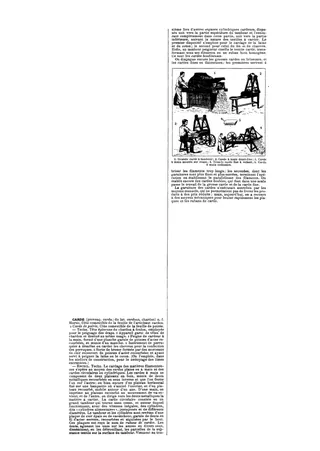
Carde [Card]
Article · 1 page · French
A one-page dictionary entry on "carde" from the Nouveau Larousse Illustré. It defines the word in its horticultural and technical senses (artichoke cardoon rib, teasel head, hand cards, wig-maker's tool). The encyclopedic section describes hand cards and circular (drum) carding machines, their cylinders and card clothing, and the differences between breaker and finisher cards for wool, cotton, flax and hemp. Five engraved illustrations show drum and hand carding machines.
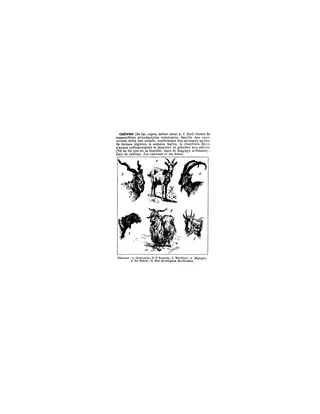
Chèvre [Goat]
Article · 1 page · French
A single-page French encyclopedia entry on the goat (chèvre) from the Nouveau Larousse Illustré. It gives a short zoological definition of the genus and a plate of six engravings showing the ordinary goat, Angora, Markhor, Ægagre (wild goat), Nubian goat, and Rocky Mountain goat. The page has no textile or weaving content beyond the illustration of the Angora goat, a mohair source.
Costume
Article · 1 page · French
A one-page encyclopedia entry on "Costume" from the Nouveau Larousse Illustré, written in French. It defines the term, then surveys dress from the ancient Orient, Greece, the Etruscans, Rome and Gaul through the Middle Ages and modern France. It also covers ecclesiastical and liturgical vestments, military uniforms, official dress, theatrical costume and the fine-arts sense of the word, and ends with a bibliography of French costume histories.
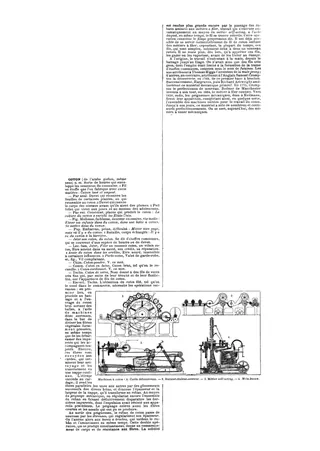
Coton [Cotton]
Article · 1 page · French
A one-page French dictionary entry on cotton (coton) from the Nouveau Larousse Illustré. It gives definitions and idioms, then an encyclopedic section on industrial cotton spinning: opening and beating, carding, drawing, combing, roving, spinning on the self-acting mule, and finishing before weaving. It also briefly traces the history of spinning machinery (Higgs, Crompton, Hargreaves, Arkwright, Bodmer, Heilmann). Four engraved illustrations show a carding machine, a batting/opening machine, a self-acting mule and a mule-jenny.
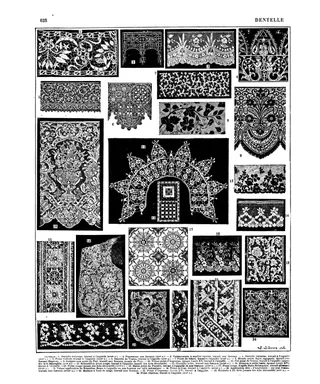
Dentelle [Lace]
Article · 3 pages · French
Encyclopedia entry on lace (dentelle) from the Nouveau Larousse Illustré, in French. It defines lace and its figurative uses, then describes needle lace (Alençon, Argentan, Brussels, England) and bobbin lace (Valenciennes, Malines, Chantilly, blonde), the tools of bobbin lacemaking, machine-made imitation lace, and the history of lace from the 15th to the early 20th century. A full plate shows 24 captioned lace samples, and a further page illustrates a lace pillow, a bobbin winding stand, and Metsu's painting The Lacemaker.
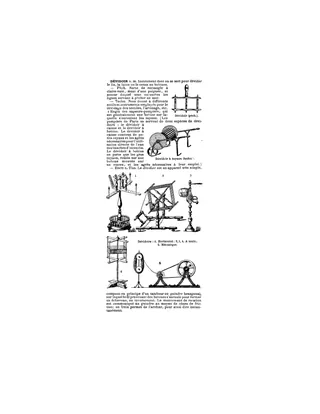
Dévidior [Reeler]
Article · 1 page · French
A one-page French dictionary entry for "dévidoir" (reel or winder) from the Nouveau Larousse Illustré. It defines the textile instrument for winding flax, wool or cotton, then the fishing-line and fire-hose senses. An encyclopedic note describes the textile reel as a hexagonal drum (guindre) that forms skeins, driven by friction cones with a brake. Engravings show a fishing reel, a hose reel and five numbered dévidoirs, including horizontal, hand-operated and mechanical types.
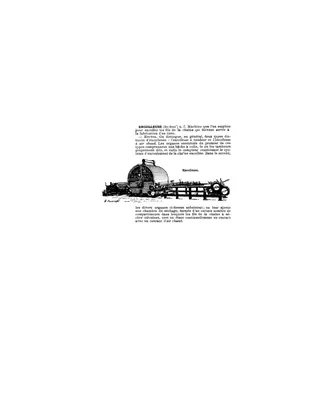
Encolleuse [Sizing Machine]
Article · 1 page · French
A short French encyclopedia entry defining the encolleuse, a machine used to size warp threads before weaving. It distinguishes the drum sizing machine from the hot-air sizing machine, describing the size bath, drums, and beam winding system, plus the drying chamber added in the hot-air type. An engraving shows the machine with its drum dryer, size bath, and roller frame.
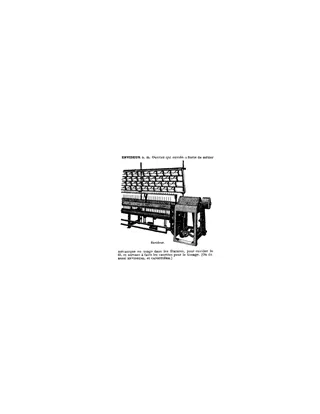
Envideur [Bobbin Winder]
Article · 1 page · French
A short dictionary entry from the Nouveau Larousse Illustré defining 'envideur', either a worker who winds thread onto bobbins or a mechanical machine used in spinning mills to wind yarn and make the bobbins (canettes) used for weaving. The entry notes the alternate names envideuse and canettière. A line illustration shows the machine, with a rack of spindles at the top, a long horizontal frame with rollers and drive mechanism, and a wheeled base.
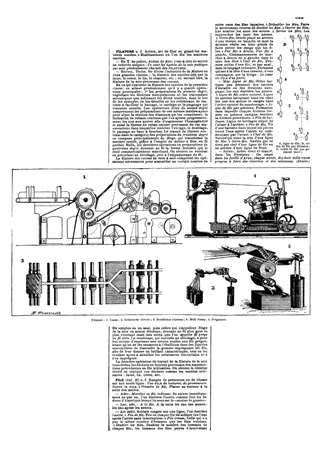
Filature [Spinning Mill]
Article · 1 page · French
A single page from the Nouveau Larousse Illustré (1904) containing the dictionary entry for 'filature' (spinning, spinning mill), with an encyclopedic account of industrial spinning. It describes the four stages of preparing and spinning wool, cotton, linen and hemp, and the separate process for silk from cocoons (reeling, throwing, spinning waste silk). It also includes the adjacent entry 'file' (row, line), mostly military and naval usage, and an illustration of spinning machinery.
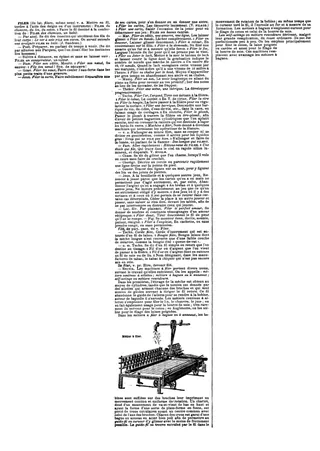
Filer [Spin]
Article · 1 page · French
A one-page dictionary entry on the French verb "filer" from the Nouveau Larousse Illustré. It lists the verb's many senses, from spinning fibers into thread to figurative, nautical, musical, gaming and technical uses. The encyclopedic section describes three types of spinning machines: continuous flyer frames, ring frames, and self-acting mules. An engraving of a spinning machine (métier à filer) accompanies the entry.
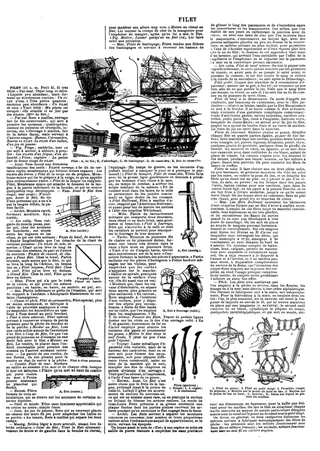
Filet [Net]
Article · 1 page · French
A page from the Nouveau Larousse Illustré (1904) containing part of the dictionary entry 'Filet', covering its many senses. The portions most relevant to textiles are the nautical entries on netting (bastingage nets, Bullivant steel torpedo nets) and the fishing entry describing hand netting with a netting shuttle (navette) and a mesh gauge stick, with knots tied on the thumb or under the little finger. It also briefly distinguishes French (two-thread) and English (single-thread) machines for making fishing nets. The rest of the page covers unrelated senses: horse bridle, architectural flashing, and culinary preparations of beef, venison and sole.
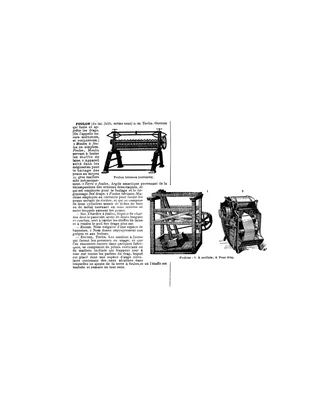
Foulon [Fuller]
Article · 1 page · French
A one-page dictionary entry on the foulon (fuller) from the Nouveau Larousse Illustré. It defines the term as the worker who fulls and finishes cloth, the fulling mill, fuller's earth, and the bristle fulling machine used in leather dressing, and gives botanical and entomological senses. The technical note describes mallet and pestle fulling mills that beat woollen cloth in alkaline water with fuller's earth. Two engravings show a bristle fulling machine and mallet and cloth fulling machines.
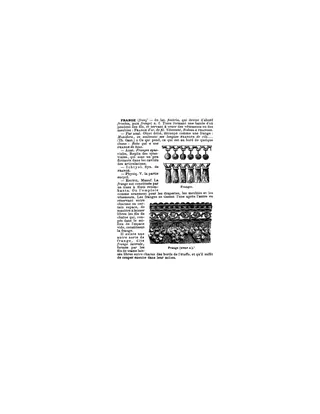
Frange [Fringe]
Article · 1 page · French
A one-page French dictionary entry on the fringe (frange) from the Nouveau Larousse Illustré. It gives the etymology and definitions, including figurative, anatomical and ichthyological senses, then an encyclopedic note on how fringes are woven. Fringes are woven one after another with spaces left between them so that the warp threads, cut in the middle of each space, form the fringe; a side fringe is made from weft threads left free at the fabric edges. Illustrations show sample fringes, including an 18th-century example.
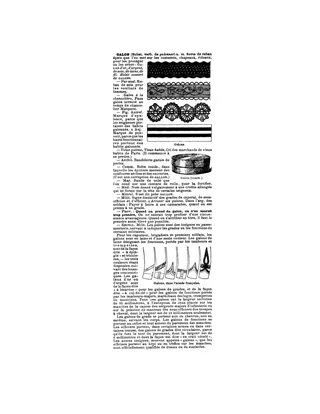
Galon [Braid]
Article · 1 page · French
A dictionary entry on "galon" from the Nouveau Larousse Illustré, defining it as a thick braid or ribbon used to trim or protect costumes, hats and curtains, in gold, silver, silk, wool or thread. It lists secondary senses (architecture, commerce, nautical, medical, measurement, proverbs) and gives an encyclopedic account of military galons, the braided rank and function insignia of the French army, including their types, widths and placement. Illustrations show braid samples and military galons.
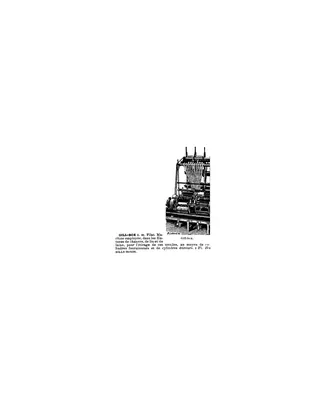
Gill Box
Article · 1 page · French
A short French dictionary entry from the Nouveau Larousse Illustré defining the gill-box (filature term), a machine used in hemp, flax and wool spinning mills to draw out fibers using feeding rollers and drawing rollers. It is accompanied by an engraved illustration of the machine, credited to H. Leblond.
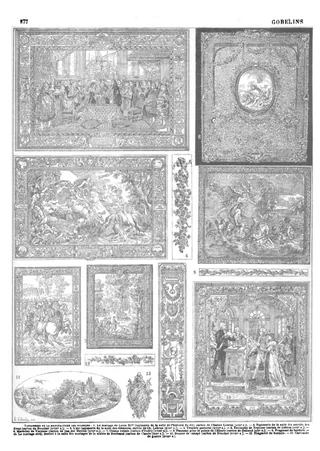
Gobelins
Article · 2 pages · French
A short French encyclopedia entry on the Manufacture des Gobelins, the famous Paris tapestry and dyeing establishment. The text begins with the origins of the Gobelin family, dyers from Reims who settled in the faubourg Saint-Marceau along the Bièvre in the 15th century. A full-page plate shows numbered examples of Gobelins tapestries from the 17th to 19th centuries, with a caption naming the cartoon designers (Lebrun, Boucher, Oudry, van der Meulen, Galland, Claude).
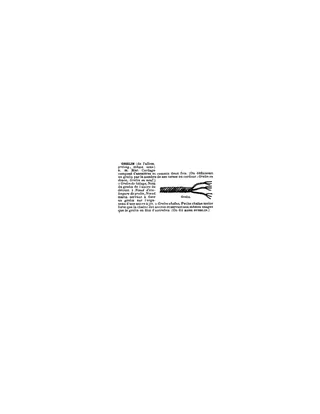
Grelin [Hawser]
Article · 1 page · French
A short French dictionary entry on the grelin (hawser), a nautical cordage made of cable-laid strands (aussières) twisted twice. It explains that grelins were classed by the number of strands, as in nine- or twelve-strand hawsers. It also lists related terms: grelin de halage, the knot for fastening a hawser to an anchor ring, and the grelin-chaîne. A line drawing shows a hawser with its strands splayed at one end.
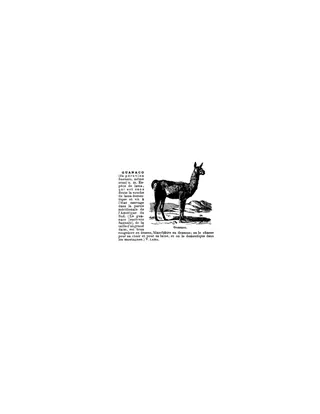
Guanaco
Article · 1 page · French
A short French dictionary entry on the guanaco, a wild South American camelid regarded as the likely ancestor of the domestic llama. It gives the etymology (Peruvian huanaco), the Latin name Auchenia huanaco, a description of size and coloring, and notes that it is hunted for meat and wool. A line drawing of a guanaco accompanies the entry, which cross-refers to the entry for Lama.
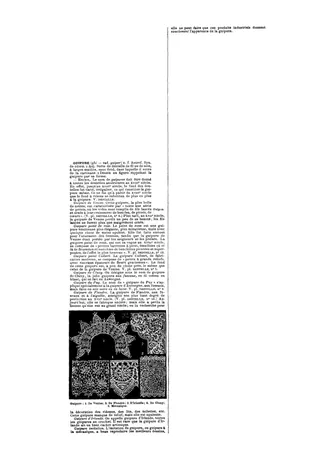
Guipure
Article · 1 page · French
A one-page French encyclopedia entry on guipure from the Nouveau Larousse Illustré. It defines guipure as a wide-meshed lace without a net ground, made with thread or silk and cartisane, and surveys the main types: Venice, point de rose, Colbert, Cluny, Le Puy, Flanders, Ireland (crochet) and machine-made imitation. A plate shows five numbered guipure samples.
Impression [Printing]
Article · 1 page · French
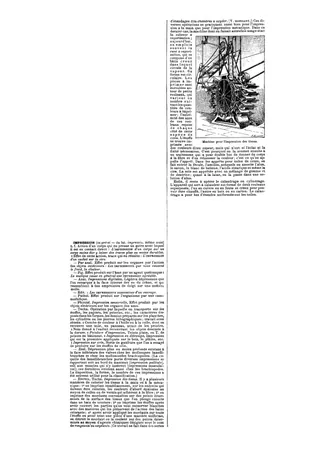
A page from the Nouveau Larousse Illustré (1904) on the entry 'Impression', with emphasis on the printing of textiles. It describes steaming vats (cuve à vaporisation), finishing (apprêt) for cotton, silk and wool, and calendering. It also outlines four methods of coloring fabrics: direct printing, mordant printing followed by dyeing, resist printing, and discharge printing. An engraving shows a machine for printing fabrics.
Jacquard
Article · 1 page · French
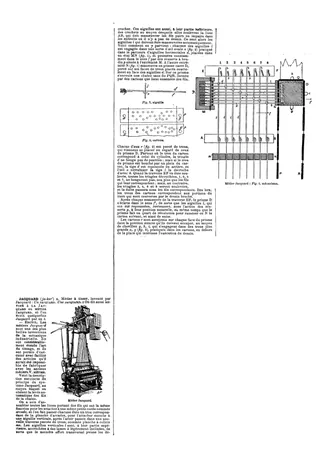
A one-page French encyclopedia entry on the Jacquard loom from the Nouveau Larousse Illustré. It gives the definition and spelling variants, then explains how the Jacquard mechanism automatically lifts warp threads using vertical needles, horizontal needles, a rotating prism and a chain of punched cards. The page includes an illustration of the loom with detail figures of the mechanism, a needle and the cards.
Laine [Wool]
Article · 1 page · French
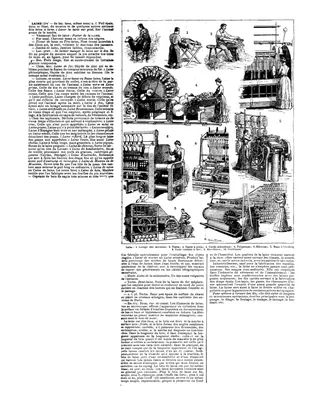
A one-page French encyclopedia entry on wool (laine) from the Nouveau Larousse Illustré. It gives the definition and figurative, botanical, chemical and trade senses, with many commercial wool grades and related materials (artificial wool, wood wool, mineral wool). The encyclopedic section covers fibre structure, staple types, qualities and uses. A plate of ten engravings shows wool processing from washing and shearing to carding, combing, drawing and spinning.
Lama [Llama]
Article · 1 page · French
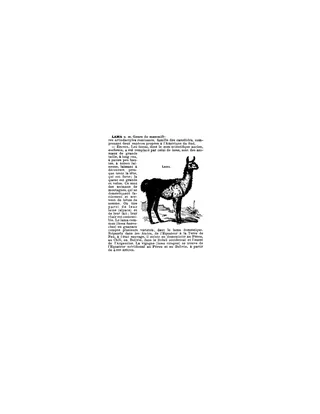
A one-page French encyclopedia entry on the llama from the Nouveau Larousse Illustré, with an engraving of a llama in a rocky landscape. It describes the genus as South American camelids, notes their use as pack animals and for wool (alpaca), milk and meat, and mentions the guanaco (common llama) and the vicuña with their ranges in the Andes.
Lice [Warp]
Article · 1 page · French
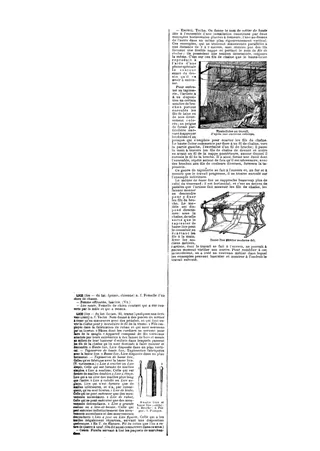
A one-page encyclopedia entry on the French word "lice" from the Nouveau Larousse Illustré. It describes the haute-lice (vertical) tapestry loom and the basse-lice (horizontal, pedal-operated) loom, the tools used (broche, peigne, poinçon), and how the weaver works from the back of the tapestry. It also lists the technical meanings of lice as a heddle, with its types, and as thread or cord in other trades. Illustrations show a haute-lice weaver, a modern basse-lice loom, and the tools.
Lin [Flax]
Article · 1 page · French
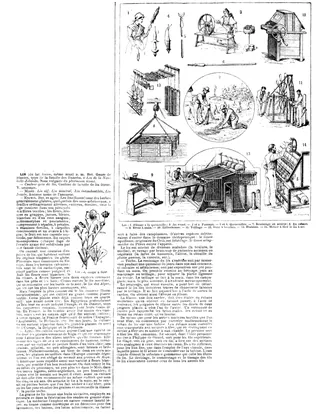
A French encyclopedia entry on flax (lin) from the Nouveau Larousse Illustré. It covers the botany of the genus Linum, the history of flax cultivation from Egypt and Gaul to the Middle Ages, and cultivation practices, seed varieties, uses of linseed and pests. A technical section describes retting, breaking, scutching, hackling, carding and spinning, including dry and hot-water spinning frames. An engraved plate with 14 numbered figures shows distaffs, spindles, spinning wheel, retting, breaking, scutching and flax spinning machinery.
Malines [Mechlin]
Article · 1 page · French
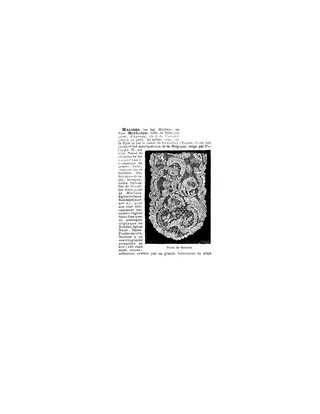
A short French encyclopedia entry on Malines (Mechelen), Belgium, giving its location, population, archbishopric, trade, churches, and history as a cloth-making center. It notes the town's specialty of point de Malines lace and includes a photograph of a piece of white bobbin lace with floral and scrolling motifs.
Mule-Jenny
Article · 1 page · French
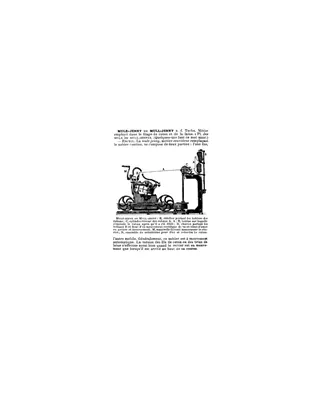
A short French encyclopedia entry on the mule-jenny, a spinning machine used for cotton and wool. It explains that the machine has a fixed part and a movable carriage, usually works automatically, and twists the yarn both while moving and at the end of its travel. An engraved illustration with a lettered key labels the creel, drawing cylinder, rovings, bobbins, carriage, crank and spinning mechanism.
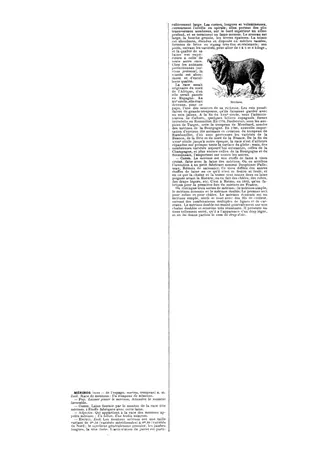
Mérinos [Merino]
Article · 1 page · French
A one-page dictionary entry on the merino from the Nouveau Larousse Illustré, with an engraving of a merino sheep. It describes the breed's physical features and fleece, its supposed North African origin and its development in Spain, and its introduction into France (Roussillon, Montbard, Rambouillet). It also covers merino cloth, a twilled all-worsted wool fabric first made at Reims in 1803, and its three kinds: simple, Scottish (checked or striped) and double.
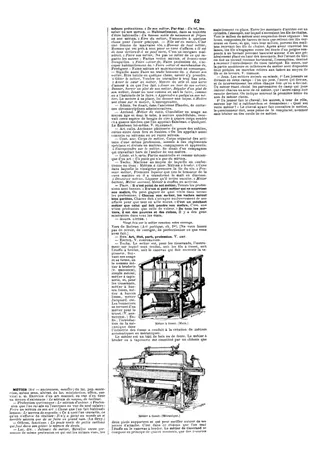
Métier [Loom]
Article · 1 page · French
A single-page dictionary entry on the word "métier" from the Nouveau Larousse Illustré. It covers general meanings (trade, profession), idioms, proverbs and historical senses. The encyclopedic section describes the loom: embroidery and tapestry frames, the weaver's loom with warp beam, heddles (lames), reed, beater, cloth beam and treadles, and the low-warp, high-warp and Jacquard types. Two engravings show a hand-operated frame loom with a seated weaver and a mechanical loom.
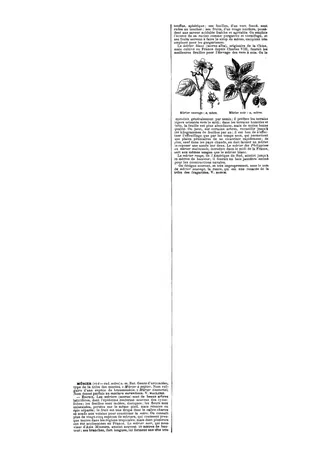
Mûrier [Mulberry]
Article · 1 page · French
A one-page French encyclopedia entry on the mulberry (mûrier) from the Nouveau Larousse Illustré. It gives the botanical definition of the genus Morus and describes the black mulberry, the white mulberry, whose leaves are the best food for silkworms, the Philippine and red mulberries, and the wrongly named 'wild mulberry' (bramble). It includes illustrations of the wild and black mulberry branches and fruits.
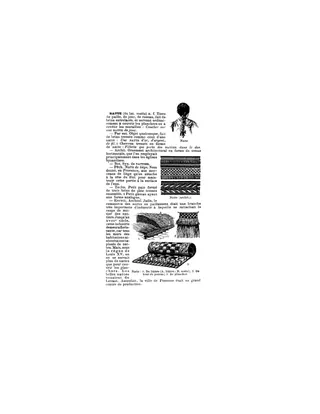
Natte [Mat]
Article · 1 page · French
A single-page French dictionary entry on the 'natte' (mat) from the Nouveau Larousse Illustré. It defines the word as a woven or plaited fabric of straw, rush or reed used to cover floors or walls, and gives extended senses including braided hair, the architectural plait ornament of Byzantine churches, and a braided loaf. The encyclopedic note covers the historical trade of mat-makers (natiers), the use of mats on walls until the 18th century, and Pontoise as a production centre. Illustrations show a braided-hair bust, an architectural plait band, and three kinds of mat.
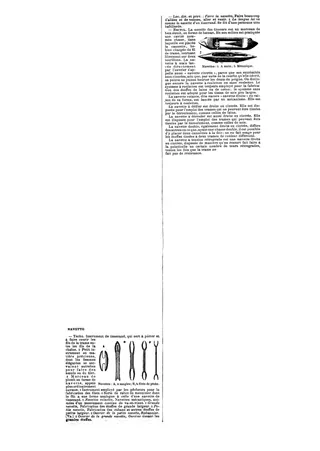
Navette [Shuttle]
Article · 1 page · French
A French encyclopedia entry on the word 'navette' (shuttle) from the Nouveau Larousse Illustré. It defines the weaver's shuttle for carrying weft through the warp, along with other senses: a lacemaking or netting tool, a lead piece called saumon, a fisherman's netting shuttle, and a carpenter's plane. The encyclopedic section describes shuttle construction and types: hand or curved, flying or mechanical, rolling and non-rolling, unwinding, double, and reverse-tension shuttles. Engraved figures show hand and mechanical shuttles and sangle and fishing-net shuttles.
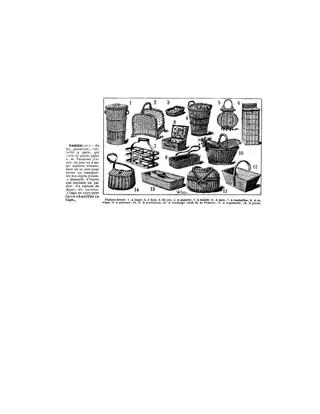
Panier [Basket]
Article · 1 page · French
A one-page dictionary entry on the panier (basket) from the Nouveau Larousse Illustré. It gives the word's Latin origin and defines it as a vessel of wicker, rush or other plaited material for carrying or storing things. An engraved plate shows fourteen numbered basket types, including baskets for linen, wood, salad, bread, bottles, needlework, provisions, grape harvest, silverware and fishing.
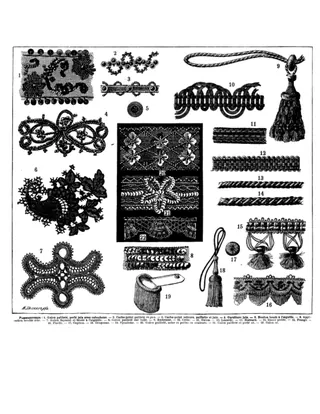
Passementerie [Lace]
Article · 2 pages · French
A two-page French encyclopedia entry on passementerie (decorative trimmings) from the Nouveau Larousse Illustré. The text defines the craft, divides it into trimmings for women's clothing, furnishings, military dress and carriages, and sketches its history from ancient Egypt and the Orient to its peak under Louis XIV. It also covers the tools and looms used, the materials (silk, cotton, wool, metallic thread, jet, beads), and the French production centers. A plate shows 22 numbered samples, including braids, galloons, fringes, cords, tassels, buttons and beaded jet trims.
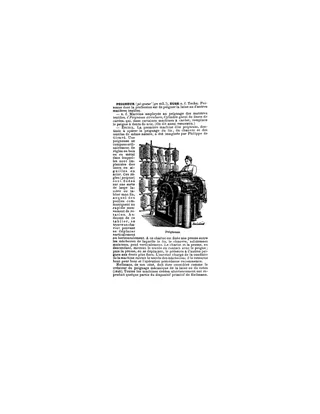
Peigneur [Comber]
Article · 1 page · French
A one-page French encyclopedia entry defining 'peigneur/peigneuse' as both a worker who combs wool or other textile fibres and the machine used for combing. It describes the construction of the flax and hemp combing machine (steel-toothed combs on an endless apron, with a clamp carriage), credits Philippe de Girard with the first such machine and Heilmann with mechanical combing of wool and cotton (1845). An engraving shows a woman operating the machine.
Ramie
Article · 1 page · French
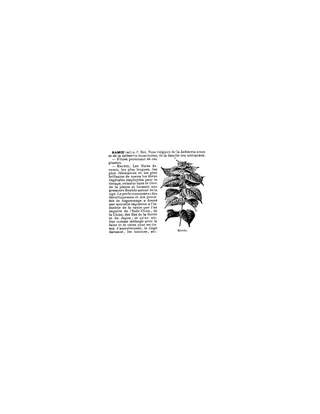
A one-page encyclopedia entry on ramie from the Nouveau Larousse Illustré, with a botanical illustration of the plant. It identifies ramie as Boehmeria nivea and Boehmeria tenacissima of the nettle family. It describes the fibers as the longest, strongest and most lustrous of the vegetable weaving fibers, found in the bast. It also notes improvements in decorticating and degumming, imports from Indochina, China, the Sunda Islands and Japan, and use blended with wool and cotton for furnishing fabrics, damask linen and batiste.
Soie [Silk]
Article · 2 pages · French
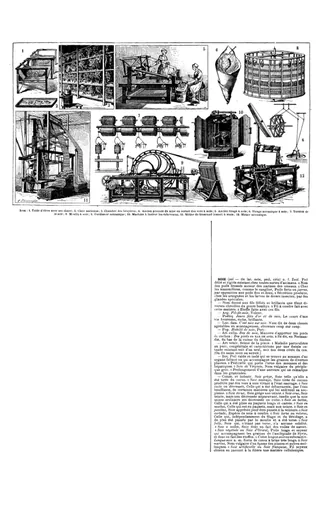
A two-page dictionary entry on "soie" from the Nouveau Larousse Illustré, covering its many senses: bristles and hairs, the silkworm's filament, commercial silk grades, artificial silk, spider silk, and the tang of a blade. The main section describes silk production, from rearing silkworms and reeling cocons to throwing (moulinage), degumming, warping and weaving by hand (the Lyon canut) or on power looms. Illustrations show twelve stages of silk production and diagrams of taffeta, five-shaft satin and twill (serge) structures.
Tapisserie [Tapestry]
Article · 2 pages · French
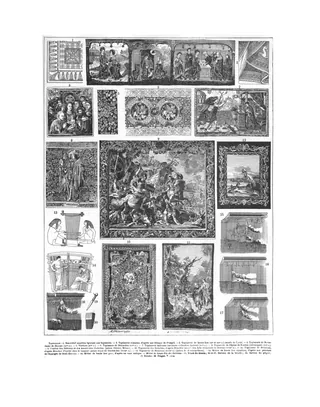
Dictionary entry on 'tapisserie' from the Nouveau Larousse Illustré, in French. It gives the word's senses and idioms, then a history of tapestry from antiquity through the medieval, Flemish, Italian, English and French manufactures (Gobelins, Beauvais, Aubusson, Savonnerie), with a list of famous hangings by century. A technical section distinguishes high-warp, low-warp and needlepoint tapestry and names the main canvas stitches. A plate illustrates ancient to 18th-century tapestries, ancient looms and the Gobelins high-warp loom tools.
Teinture [Dyeing]
Article · 2 pages · French
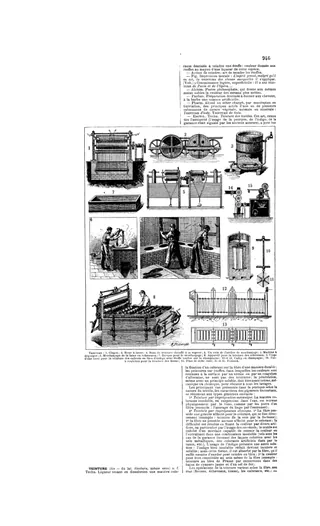
Two-page encyclopedia entry on 'Teinture' from the Nouveau Larousse Illustré. It defines dyeing and explains the main principles: mechanical impregnation, chemical impregnation with or without mordants, and indigo vat dyeing. It describes the processes for loose fibre, skeins and cloth, and lists mineral, natural and synthetic dyestuffs. A plate of numbered engravings shows dyeing equipment such as vats, washing wheels, mordanting workshops, stretching frames and a padder. Short sections cover the figurative, alchemical, perfumery (hair dye) and pharmaceutical (tincture) senses of the word.
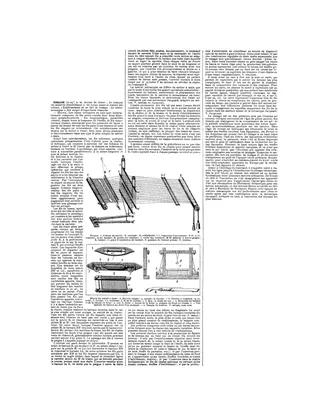
Tissage [Weaving]
Article · 1 page · French
Encyclopedia entry on weaving (tissage) from the Nouveau Larousse Illustré, in French. It explains warp and weft, the preparatory operations (winding, warping, sizing, pirn winding), and the working of the simple hand loom with heddles, pedals, batten and shuttle, then outlines mechanical looms and the Jacquard mechanism. It also classifies weaves (plain, twill, satin, compound and fancy weaves, pile fabrics), describes the preparation of designs on point paper, and gives a short history of weaving. An engraving shows a loom diagram with labeled parts and details of shuttles, reed, batten and tensioner.
Tissu [Fabric]
Article · 1 page · French
A French encyclopedia entry on "tissu" (fabric) from the Nouveau Larousse Illustré. It gives the general and figurative meanings of the word, then a technical survey of fabrics classified by fiber (wool, goat hair, silk, linen, hemp, jute, cotton, velvet, knitted and mesh fabrics). It also covers waterproof, fireproof and pharmaceutical fabrics, and ends with a short section on histological and pathological tissue.
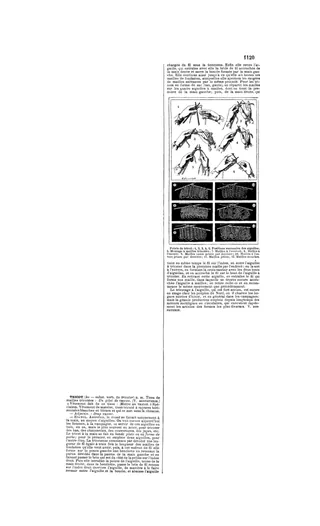
Tricot [Knitting]
Article · 1 page · French
A one-page French encyclopedia entry on 'tricot' (knitting) from the Nouveau Larousse Illustré. It defines the word and explains hand knitting with two needles for flat pieces and four or five for seamless items such as stockings and gloves, covering casting on and forming stitches. An illustrated plate shows successive needle positions, cast-on and basic stitches (knit, purl, twisted, yarn-over, speckled). It notes that hand knitting persists in northern countries and rural areas while industry uses straight or circular knitting machines, and refers readers to the entry on bonneterie.
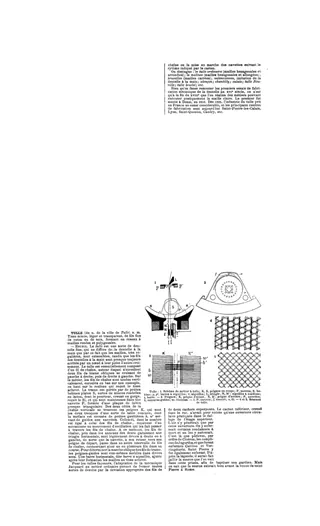
Tulle [Netting]
Article · 1 page · French
A one-page encyclopedia entry on tulle from the Nouveau Larousse Illustré. It defines tulle as a light, transparent net of fine cotton or silk and explains how it differs from handmade lace. It describes the tulle machine (bobbins, carriages, combs, needle bars, Jacquard adaptation for patterned tulle), lists varieties, and gives a brief history of mechanical production in France. A figure shows a schematic of the tulle machine and two net mesh structures.
Velours [Velvet]
Article · 1 page · French
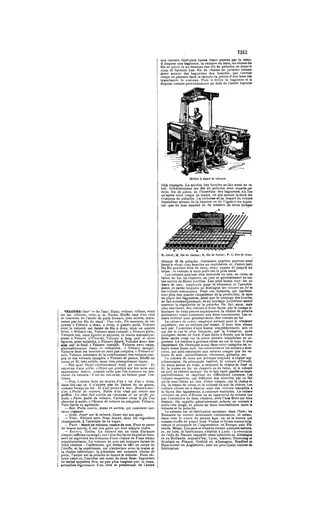
A one-page French encyclopedia entry on velvet (velours) from the Nouveau Larousse Illustré. It gives the definition and idiomatic uses, then a technical account of weaving velvet with two warps and cutting rods (fers), with an engraving of a velvet loom and a diagram of the process. It also covers silk, cotton and wool velvets, the main varieties, and a short history of velvet manufacture and its centers.
Ver a Soie [Silk Worm]
Article · 1 page · French
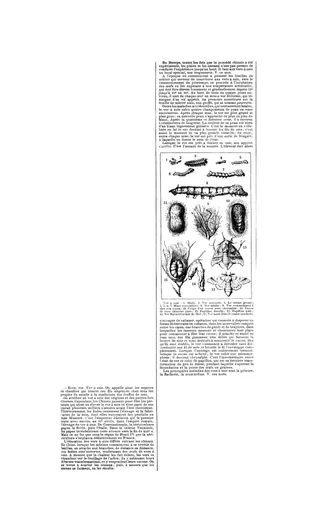
A French encyclopedia entry on the silkworm from the Nouveau Larousse Illustré, with a plate of its life stages. The text covers the rearing cycle: incubation of eggs, the four molts, the spinning of the cocoon and the metamorphosis into chrysalis and moth. It also gives a brief history of sericulture from China through India, Byzantium under Justinian, Italy and France under Henri IV, and describes the Chinese method of raising worms on the trees. The main silkworm diseases (pébrine, flacherie, muscardine) are named.
52 documents found