Textile Documents › Authors › Author: Leavenworth E. Elliott
6 documents found
Sort: 
The Adaptation of Light for Color Workers
Article · 5 pages
A 1929 article from The Melliand on how lighting affects color perception and discrimination in textile factories. It covers the effect of illumination intensity on different hues, eye fatigue and reflex action, variation in daylight, individual differences in color vision, and the use of mercury, incandescent, and mixed lighting for color matching. Examples are drawn from hosiery, woolen and worsted weaving, carpets, and patterned knitting.
Avoidance of Color Troubles Caused by Electric Light, Part 1
Article · 6 pages
Part 1 of an article on avoiding color problems under electric light in industry, concentrating on the fundamentals of color theory. It argues that color vision matters for only a small share of workers, chiefly in textiles, and then explains color as a mental sensation, a property of light and a property of surfaces. Topics include elementary colors, chroma, brightness, saturation, tints, shades, hues, wave lengths, reflection, fluorescence, and the difference between mixing pigments and mixing lights. Three spectrum figures are included, and the article is continued in a later part.
Avoidance of Color Troubles Caused by Electric Light, Part 2
Article · 7 pages
Second part of a series on how electric lighting distorts color in textile work. It covers the physiological basis of color vision, a classification of hues (warm, cold, browns, grays), and how incandescent and mercury light change the appearance of surfaces compared with daylight, with a figure comparing spectra. It then distinguishes colorists (designers, dyers) from workmen who only need to avoid mistaking colors, and recommends educating workers, using numbers or symbols for identification, and choosing distinguishable color series for fugitive silk dyeing under different lights.
Light for the Colorist, addendum
Article · 1 page
A short addendum by E. Leavenworth Elliott to his October 1931 article on lighting for colorists. He clarifies that although blue glass is easy to make, producing glass of an exact shade and density that raises an electric lamp's color temperature without color distortion requires combining two or three coloring agents, with a high rejection rate and therefore higher prices. He warns colorists against so-called daylight lamps that use cobalt blue glass of insufficient density.
Light for the Colorist, Part 1
Article · 6 pages
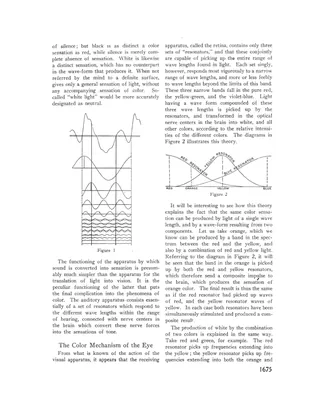
An article from The Melliand introducing the physics of light and color for technical colorists and artists, as the start of a series on lighting for the colorist. It draws analogies between sound and light (pitch/color, loudness/brightness, timbre/wave form), describes the three-resonator theory of color vision in the retina, and explains how spectrophotometers analyze color by wave length and brightness. It closes with color temperature, comparing noon sunlight (about 5000°C) with the Mazda C tungsten lamp and sky conditions, and the need for a standard light for color work.
Light for the Colorist, Part 2
Article · 2 pages
An article on artificial and natural light as it affects color matching and color work in the textile industry. It reviews color temperature scales for common light sources, the standard of 5,300°K noon sunlight for white light and 2,800°K for ordinary electric light, and why blue glass filters can whiten electric light only by absorbing at least 80% of it. It warns against exaggerated claims by makers of 'daylight' lamps, explains the difference between lenses and curved glass placques, and discusses the differing lighting needs of the technical colorist and the artist.
6 documents found