Textile Documents › Publications › Publication: Domestic Encyclopedia
22 documents found
Sort: 
Dyeing
Domestic Encyclopedia, 1821
Article · 12 pages
An encyclopedia article on the art of dyeing from an early 19th-century English-language reference work. It explains the chemistry of dyeing, the role of mordants, and the primary colours, then gives vat and bath procedures for blue (woad and indigo), red (scarlet, crimson, madder), yellow, fawn (walnut bark and root), and black. Later pages give general recipes for wool and silk and describe a method of fixing alumina mordants with an oily alkaline solution to dye cotton and linen a fast red.
Dyers' Green Weed
Domestic Encyclopedia, 1821
Article · 1 page
A short encyclopedia entry on dyers' greenweed (Genista tinctoria), also called woodwaxen or dyer's broom. It describes the plant's habitat and flowering season and its use as a yellow dye, preferred for dyeing wood green. It also mentions the yellow lake pigment made for painters and the plant's medicinal uses as a purgative and diuretic.
Dyers' Weed
Domestic Encyclopedia, 1821
Article · 2 pages
An encyclopedia entry on dyers'-weed (weld, Reseda luteola), describing the plant, its habitat, and its use as the fastest and brightest yellow dye for wool, cotton, mohair, silk and linen. It gives M. Gadd's mordanting and dyeing proportions using alum, cream of tartar, bran and potash, and a second process, from Tilloch's Philosophical Magazine, for making a yellow water-colour pigment from weld seeds with whiting and alum.
Filament
Domestic Encyclopedia, 1821
Article · 1 page
A short encyclopedia entry defining 'filament' in natural history as a fibre or fine thread found in flesh, nerves, skin, plants and roots. It describes how putrefaction or alkaline lye isolates the tough filaments, and notes the use of vegetable filaments in manufacturing: hemp, flax and cotton cloths in Britain, bark cloth and cordage in Madagascar, nettle fibre in France, hop stalk cloth in Sweden, and bark cloth in Otaheite (Tahiti).
Flannel
Domestic Encyclopedia, 1821
Article · 1 page
A one-page encyclopedia entry on flannel, defined as a light, porous woollen stuff woven on a loom with two treddles, similar to baize. Most of the text is a health argument for wearing flannel next to the skin, covering who benefits (older people, those with gout, rheumatism or colds) and who should avoid it (those prone to profuse perspiration or skin eruptions). It gives almost no technical weaving detail beyond the opening definition.
Flax
Domestic Encyclopedia, 1821
Article · 3 pages
An encyclopedia article on flax (Linum usitatissimum) from the Domestic Encyclopedia. It describes the plant, its use for linen, and the steps from sowing and pulling through water retting, grass retting, drying, rippling off the seed and scutching. It also covers linseed oil and oil-cake, and quotes Mr. Deane's New England Farmer on soil, manure, seed quantity, weeding and timing of harvest.
Fulling
Domestic Encyclopedia, 1821
Article · 1 page
A one-page encyclopedia entry defining fulling (also called milling) as the cleansing, scouring and pressing of cloth, stuffs and stockings to make them firmer. It describes the water-powered fulling mill, the use of urine, fuller's earth and soap, and how the felting of wool fibres shrinks and thickens the cloth. It also covers the different handling of stockings and caps, which are fulled by foot, by hand or with toothed wooden racks.
Gauze
Domestic Encyclopedia, 1821
Article · 1 page
A very short encyclopedia entry defining gauze as a thin, transparent fabric woven of silk or thread. It notes that the gauze loom resembles an ordinary loom with some added parts, and mentions figured gauzes and gauzes with gold and silver flowers, chiefly imported from China.
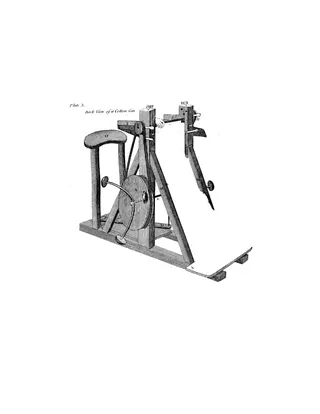
Gin
Domestic Encyclopedia, 1821
Article · 2 pages
A short encyclopedia entry on the cotton gin, describing an improved foot-operated roller gin used in South Carolina. The text explains each lettered part of the machine: treadle and crank, weighted flywheels, iron rollers turned in opposite directions by a strap, adjustable screws, a movable feed table and a seed trough. It claims a daily output of sixty-five pounds of cotton. An engraved plate shows the back view of the machine.
Hemp
Domestic Encyclopedia, 1821
Article · 2 pages
An encyclopedia article on common hemp (Cannabis sativa) as grown and processed in early nineteenth-century Britain. It covers sowing, harvesting, retting (water and dew), reeding, breaking, beating, heckling, and spinning, with the yarn reel measures and the use of hemp for cordage, sailcloth and cloth. It also notes secondary uses (oil, fuel, pest deterrent), substitute fibre plants, and hemp's importance to maritime trade, with import figures for 1788.
Indigo
Domestic Encyclopedia, 1821
Article · 1 page
A single page from the Domestic Encyclopedia (1821) with the entry on indigo. It describes how indigo is made from the leaves and branches of the indigo shrub: steeping and fermenting the slips in vats, beating the liquor with perforated wooden buckets to precipitate the coloring matter, draining, filtering, and drying. It also gives signs of good indigo and a short recipe for a blue color made by dissolving powdered indigo in oil of vitriol.
Lace
Domestic Encyclopedia, 1821
Article · 1 page
A short encyclopedia entry defining lace as a fabric of gold, silver, silk or thread worked on a cushion with spindles. It names lace types by place or method, including Point, Brussels or Flanders lace and English blond or bone-lace from Buckinghamshire. It also gives practical advice on restoring tarnished gold or silver lace with warmed spirit of wine and on recovering the metal from old lace by boiling in soap-ley.
Linen
Domestic Encyclopedia, 1821
Article · 1 page
A short encyclopedia entry on linen, a cloth made chiefly of hemp and flax. It briefly covers spinning flax yarn by hand, recommending a mucilage in place of saliva or water to wet the threads, then weaving on the loom much like wool and bleaching. It refers readers to other articles in the encyclopedia for details on fiber processing, cloth and bleaching.
Loom
Domestic Encyclopedia, 1821
Article · 1 page
A short encyclopedia entry defining the loom as a machine that combines distinct threads into one piece. It notes that looms vary with the material and method of weaving, then briefly describes Samuel Sholl's improved silk loom, which won a silver medal from the Society for the Encouragement of Arts in 1790. It lists the loom's claimed advantages (more light, adjustable length, portability, lower cost) and refers readers to the Society's Transactions, vol. 8.

Mohair
Domestic Encyclopedia, 1821
Article · 1 page
A one-sentence encyclopedia entry defining mohair as the hair of a goat found near Angora in Turkey. It notes that the inhabitants of Angora were all employed in making camblets (camlets) from this hair.
Mordants
Domestic Encyclopedia, 1821
Article · 1 page
A short encyclopedia entry defining mordants in dyeing as substances that prepare fabrics to take up coloring matter. It lists common mordants of the period, including alum (sulphat of alumine), cream of tartar, tin solutions, gallic acid, copper sulphate, verdigris, arsenic and zinc sulphate. It also gives an early 19th-century chemical explanation of how mordants act on the stuffs and on the pigment.
Mulberry Tree
Domestic Encyclopedia, 1821
Article · 2 pages
A two-page encyclopedia entry on the mulberry tree (Morus) from the Domestic Encyclopedia. It covers propagation by layers and cuttings, soil and site, uses of the fruit, juice, bark and wood, and the white mulberry (Morus alba) as food for silkworms. It notes raw silk production in Prussia and German states and the tree's cultivation in the United States, especially Connecticut.
Silk
Domestic Encyclopedia, 1821
Article · 1 page
A very short encyclopedia entry defining silk as the thread produced by the silkworm (Bombyx). It outlines the early history of silk in Europe, noting its origin in China and the introduction of silkworm rearing and silk working to the western world in A.D. 555. Two monks are said to have brought the secret from the Indies, after which manufactories were set up at Athens, Thebes, and Corinth.
Silk Worm
Domestic Encyclopedia, 1821
Article · 1 page
A single encyclopedia page on the silkworm (Bombyx), describing its life cycle from egg to caterpillar, cocoon-spinning over about ten days, and transformation into a moth. It also explains how cocoons are sold and reeled, with several cocoon filaments joined in warm water to make one thread, and notes that the continuous thread is computed at about six English miles long.
Teasel
Domestic Encyclopedia, 1821
Article · 1 page
A short encyclopedia entry on teasel (Dipsacus), especially fuller's teasel, covering its cultivation from seed, soil, spacing, timing of sowing, flowering and harvest of the heads. It also notes the use of the hooked heads by clothiers, mounted on a wheel, to raise the nap on woollen cloth.
Velvet
Domestic Encyclopedia, 1821
Article · 1 page
A short encyclopedia entry defining velvet as a silk fabric with a close, short, soft shag. It explains the etymology of the word and how the pile is made from warp threads raised over a channelled ruler or needle and cut with a steel tool. It names France and Italy as the best centers of velvet manufacture.
Wool
Domestic Encyclopedia, 1821
Article · 3 pages
An early nineteenth-century encyclopedia article on wool. It describes the fleece and its grades, the best British sheep breeds and attempts to improve British wool, and how wool is cleaned (bouking in a heated urine and water bath), carded and spun. It also covers spinning of warp (chain) and weft (filling) yarns, the Holland-style spinning wheel, and a short outline of finishing steps in British woollen manufacture.
22 documents found