Textile Documents › Publications › Publication: Workers of the Nation: An Industrial Encyclopedia of the Occupations of the American People
26 documents found
Sort: 
Clothing Manufacture
Article · 2 pages
A two-page encyclopedia article on the American ready-made clothing industry as of the early 1900s. It traces the industry's growth from Civil War demand for uniforms and the sewing machine, through the 1876 shift to the task system, and describes the division of labor among designers, cutters, tailors, and specialized garment makers. It also gives workforce statistics (women, men, children), the number of establishments, and the leading manufacturing centers (New York, Chicago).
Cordage and Twine Industries
Article · 2 pages
A short encyclopedia article on the American cordage and twine industries in the early 1900s. It describes the failed attempts at consolidation (National Cordage Company, United States Cordage Company), the scale of rope and binder-twine production, and the principal fibres, manila and sisal. It gives statistics on output and spindles, and emphasizes binder twine for agriculture, including the large Chicago twine mill.
Cotton Crop
Article · 1 page
A one-page article on the cotton crop of the United States in the early 1900s. It describes the cotton belt, acreage, yield, and the leading producing states, with a note on sea island cotton. It also covers production costs per pound, the state of Southern agriculture and harvesting labor, and the waste of cotton left in the fields.
Cotton Manufacture and Allied Industries
Article · 10 pages
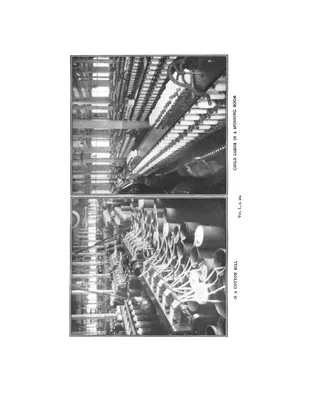
A chapter from the 1906 industrial encyclopedia Workers of the Nation, surveying the American cotton industry around 1900. It covers the business of cotton mills in New England and the South, the Northrup automatic loom and other mill machinery, skilled operatives and child labor, cotton ginning and baling systems, and cotton seed products. It is economic and social history of factory production, not hand weaving.
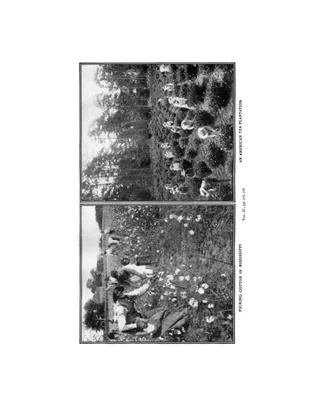
Cotton Picker
Article · 2 pages
A short early-twentieth-century encyclopedia article describing how cotton is picked by hand in the American South. It covers the work of men, women and children in the fields, pay rates per hundred pounds, daily picking averages, the hemp picking sack and basket, and the repeated pickings of a field. A page of photographs shows cotton picking in Mississippi and an American tea plantation.
Cotton Planter
Article · 2 pages
A short 1906 encyclopedia article describing the cotton planter's occupation in the American South. It covers the economics of the picking season, cotton prices and profits, and the labor arrangements between planters and workers (share contracts, daily wages, pay schedules, plantation commissaries). The text is written from a period viewpoint and uses racially prejudiced language and stereotypes about Black workers.
[Flax Cultivation]
Article · 1 page
A short passage on the state of flax cultivation in the United States around 1906. It reports that flax growing had nearly ceased in the Eastern States, and gives national figures for farms, acreage and yield. It also breaks down acreage by region, with the North Central States, especially Minnesota and the Dakotas, dominating production.
Flax, Hemp, and Jute Products
Article · 1 page
A short encyclopedia entry giving an overview of the American flax, hemp and jute industries circa 1906. It groups the industries by product (cordage and twine, jute and jute goods, linen goods and linen thread) and gives statistics on total product value, capital, and number of workers employed.
Foreign Wool
Article · 1 page
A one-page encyclopedia article on the importation of foreign wool into the United States in the 19th century, with figures from 1824 to 1900. It covers changes in import volume tied to tariff legislation, the leading source countries for each wool class in 1890 and 1900, and the use of imported wool in manufacturing, including carpet wools.
Foreigners in the Clothing Trade
Article · 3 pages
A short 1906 encyclopedia article on how immigration shaped the American clothing trade, especially tailoring and garment manufacture in New York and Chicago. It covers the division of labor in ready-made work, the roles of Russian Jewish, Italian, Polish, Scandinavian and other workers, tenement home-finishing, wages, and labor organization. The characterizations of nationalities reflect the attitudes and stereotypes of the period.
Goat Raising
Article · 1 page
A one-page encyclopedia entry from 1906 on the American Angora goat industry. It covers the origin of the breed from Angora, Turkey, the main producing states, uses of the goats for brush clearing, mohair for cloth and plush upholstery, and meat, and cautions on husbandry. It also mentions goat shows, breeding prices, and a 1901 importation from Turkey.
Hats and Caps
Article · 3 pages
A three-page encyclopedia article on the hat and cap industry in the United States around 1906. It surveys materials (rabbit and hare fur, wool, cloth, straw) and centers such as Danbury, Connecticut, then describes step by step how fur felt hats are made by machine and how silk hats are built from shellacked cambric covered with silk plush.
Hosiery and Knit Goods
Article · 2 pages
A short encyclopedia article on the American hosiery and knit goods industry circa 1906. It compares the speed of hand knitting with machine knitting and gives the size and location of the industry. It then describes how socks and stockings are machine-knitted, using a cuff machine, a Jacquard-controlled cylinder machine and a transfer cup. It ends with the preparation of lisle cotton yarn by combing, gassing and chemical treatment, and with dyeing and pressing.
Linen Manufacture
Article · 2 pages
A short encyclopedia article from 1906 on the state of the linen industry in the United States. It explains that American mills rely on imported flax fibre because domestic flax is grown for seed rather than fibre, and that about eighteen establishments employ fewer than 4,000 workers. It discusses the markets for linen carpet yarns, shoe thread, towelling and table linen, the effect of the 1897 tariff changes, and Department of Agriculture efforts to revive fibre flax cultivation.
Linen Thread
Article · 2 pages
A short encyclopedia article on the American linen thread industry in the early 1900s. It describes the dominance of the American Thread Company, the import of Irish-spun tow yarn and flax, and quotes the company president's testimony to the Industrial Commission on wages, hours, housing at Holyoke, Massachusetts, and attitudes toward profit-sharing and labor conditions.

Manufacture of Dyestuffs
Article · 2 pages
A short encyclopedia entry on the American dyestuff industry around 1906. It distinguishes organic and inorganic dyes, noting the growth of artificial indigo, anilin, alizarin and other coal-tar colors alongside continued use of vegetable dyes. It gives statistics on imports of logwood, indigo, madder and cudbear, and on U.S. establishments, workers, output value and raw materials consumed, including logwood, fustic, cutch, yellow oak bark and iron liquor.
Manufacture of Sewing Machines
Article · 3 pages
A three-page encyclopedia article from 1906 on the sewing machine industry in the United States. It covers where sewing machines are used in industry and the home, the lock stitch and chain stitch machines, materials and manufacturing processes, patents, electric motors, and exports. A final section on development describes Isaac M. Singer's 1851 improvements and names the main manufacturing cities.
Mechanical Methods of Handling Cotton
Article · 1 page
A short 1906 encyclopedia article on mechanical handling of cotton, from harvesting through ginning and baling. It describes the Mason Cotton Picker and an unsuccessful experiment with trained monkeys as pickers near Natchez, Mississippi. It also covers ginning, Eli Whitney, and the roller compress's round bale versus the square bale, with savings in space, freight, insurance and fire risk.
Negro Labor in the Cotton Fields
Article · 1 page
A short 1906 encyclopedia article on African American labor in the Southern cotton fields, written from the viewpoint of planters. It discusses the migration of Black workers to Southern cities, planters' worries about finding field labor, attempts to substitute Italian immigrants, and the wages and work habits of field hands. It is a period source that contains racist stereotyping and says nothing about textile production or weaving.
Sheep Raising
Article · 1 page
A short 1906 encyclopedia article on sheep raising in the United States. It estimates the national flock, names the leading sheep-producing states (mainly the Western mountain states), and describes the range "bands" grazed in government reserves. It also discusses the shift in Eastern and Midwestern states from fine-wool Merino flocks toward English mutton breeds. It has no weaving content.
Silk Manufacture
Article · 5 pages
A chapter from a 1906 industrial encyclopedia describing the American silk industry at the start of the twentieth century. It covers production and trade statistics, the dominance of Paterson, N.J., mill machinery and the labor force, the steps in making silk ribbon (throwing, dyeing, winding, doubling), Jacquard looms, Szczepanik's photographic design-to-card process, and velvet and plush manufacture.
"Sweating," Home and Factory System
Article · 3 pages
An early twentieth-century encyclopedia article describing the "sweating" or task system in the American ready-made clothing trade, in which work was contracted and subcontracted to small shops and home workers. It covers the task system's wage structure (operator, baster, finisher, presser, buttonhole maker), the growth of unreasonable daily tasks, and the role of immigrant labor in New York. It contrasts this with the subdivided factory ("Boston") system and the home system, which it says were replacing sweatshops.
Textile Industries and Trades
Article · 7 pages
A chapter from a 1906 industrial encyclopedia surveying the American textile industries. It covers cotton, wool, silk, linen, hosiery and carpet manufacture, with comparative statistics against the United Kingdom, and describes dyeing and finishing, including methods for producing multi-colored cloth through differential dyeing and mordanting. It also reviews textile schools in Pennsylvania, Massachusetts and the South, and labor conditions in the textile trades, including wages, machinery such as the Northrop loom and ring spindle, immigration, child labor and working hours.
Wool and Carpet Manufactures
Article · 8 pages
Chapter XXVII of an early twentieth-century industrial encyclopedia, surveying the American wool manufacturing industry around 1900. It covers woollen goods, worsted goods, felt goods and yarns, with census statistics on mills, employees, looms, spindles and output, plus tariff effects and comparison with English practice. The final sections describe the carpet industry and carpet weaving, explaining how Wilton, Brussels, tapestry, velvet, Axminster, moquette and ingrain carpets are constructed.
Wool Supply
Article · 1 page
A one-page encyclopedia article on the United States wool supply around 1900. It gives figures for domestic and imported wool consumed in manufacture, the rise in new wool and shoddy use since 1890, and year-to-year variation in domestic wool production. It also notes the growth of the angora goat (mohair) industry shown by the census.
Wool Trade
Article · 1 page
A one-page article from a 1906 industrial encyclopedia describing how American wool growers sell their clips. It covers sales to buying agents, local dealers and eastern houses, typical agent commissions, and the rise of the wool exchange in Montana, then the largest wool-producing state.
26 documents found