Textile Documents › Publications › Publication: Journal of The Textile Institute
8 documents found
Sort: 
Analyses of Fabrics of Foreign Origin Collected and Exhibited by the Board of Trade
Article · 38 pages · weaving drafts
A paper presented at the 1915 annual meeting of the Textile Institute reporting a technical analysis of several hundred German and Austrian fabrics collected by the Board of Trade. Fabrics are described by number, with yarn counts, ends and picks per inch, twist direction, fibre content, dyes and finishing, selling prices, and weave, many with weave diagrams (Figs. 1-42). Groups include blankets, shawls, dressing-gown fabrics, flannelettes, printed furnishing fabrics, crepes, fancy yarn fabrics, men's suitings, and table linen, followed by concluding remarks and discussion.
Decortication of Fibrous Plants, with Special Reference to the Belgian Flax Industry
Article · 34 pages
A paper by H. R. Carter of Belfast, read to the Textile Institute and printed in its Journal in November 1913, on separating (decorticating) fibre from flax, hemp, jute, ramie and the leaf fibres such as sisal, Manila and New Zealand flax. It covers retting methods (pool, river-crate, vat and dew retting), the scutching of flax, and the Belgian flax industry along the Lys. A large part describes decorticating, stripping, washing and scutching machines, many shown in photographs and line drawings, with yields, speeds and power requirements. The paper ends with a list of exhibited fibre samples and the recorded discussion.
Designing and Colouring of Scotch Tweeds
Article · 15 pages · weaving drafts
A paper by Thomas Welsh of Hawick, read at a Textile Institute congress in 1912, on how Scotch tweeds are designed, colored and sold. It covers the history of the tweed trade, the making of trial ranges of 25 to 30 designs in graded colors, end-and-end patterns, and the construction of reversible double cloths with a centre tying warp (with sections and an 8-shaft weaving draft). It also discusses wool types such as Cheviot and Saxony, the cost of pattern ranges, and design trends, and it ends with a recorded discussion among manufacturers and teachers.
Frame v. Mule Spinning in the Woollen and Worsted Industries
Article · 14 pages
A 1912 paper by Prof. Aldred F. Barker comparing frame (ring) spinning with mule spinning of woollen yarns, with a brief note on worsted drafting. It explains the principles of woollen mule spinning (spindle draft, drafting twist, the old piecening carder versus the modern condenser) and describes Platt Bros.' patent woollen ring spinning frame with its twister tube. It gives cost, space and power comparisons and strength and elongation tests of yarns and cloths from three blends, with photomicrographs and drafting-roller diagrams, and ends with the discussion by Institute members.
Problem of the Cotton Supply
Article · 17 pages
A paper by Ernest H. Taylor of Manchester, read to the Textile Institute, on the dependence of the Lancashire cotton industry on American raw cotton and the price swings caused by speculators. It presents figures on cotton consumption, Liverpool prices and spindle growth, and reviews the work of the British Cotton Growing Association. Taylor proposes a Government-guaranteed capital of about five million pounds to expand cotton growing within the British Empire (India, Nigeria, the Soudan, East Africa). The second half records the discussion by Institute members, who debate Government aid, the role of speculators and the prospects of Empire-grown cotton, followed by Taylor's reply.
Some Notes on Textile Machinery Displayed at Ghent Exhibition
Article · 16 pages
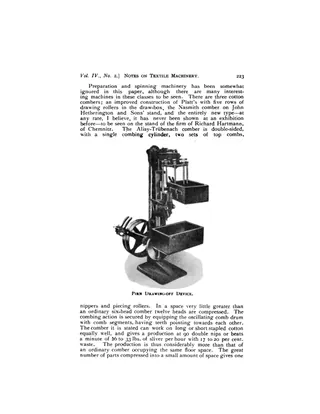
A 1913 paper by Frank Nasmith reviewing new textile machinery shown at the Ghent International Exhibition, concentrating on German pirn winding machines (Schlafhorst, Müller, Schroers) and their effect on loom productivity and the shortage of weaving-shed labour. It also covers weft replenishing attachments for looms, cop spindling and tube drawing-off devices from Richard Hartmann, the Alisy-Trübenach cotton comber, and a centrifugal flyer dry spinning frame for flax and jute from Fairbairn Lawson Combe Barbour. The paper is followed by a discussion among Textile Institute members on winding speeds, automatic looms, weaver wages, and British versus foreign machine makers.
Textile Colour Theories
Article · 15 pages · weaving drafts
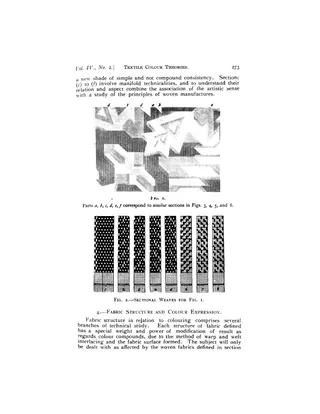
A 1913 paper by Professor Roberts Beaumont on the theory of colour in woven textiles. It argues that colour effect depends on technical factors as well as hue: fibre quality, yarn construction, fibre blending, fabric structure, weave (intertexture) and finishing. It outlines six groups of colour theories, then examines fibre qualities and fabric structure in more detail. Examples are a silk fabric with several weave sections and worsted/silk twill and weft-cord fabrics, illustrated with micro-photographs and a sectional weave diagram. It closes with brief notes on mathematical colour-and-weave effects and colour standardisation.
Weaving of Single Warps: Botany and Crossbred
Article · 12 pages
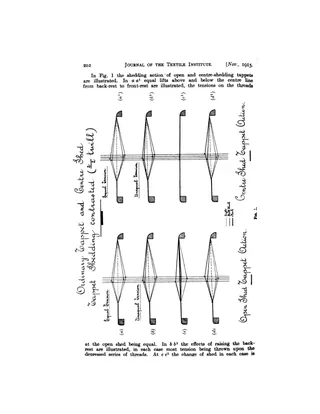
Paper by Professor A. F. Barker of Leeds University, read at the Textile Institute's Autumnal Congress in 1915, on weaving delicate single warps of botany and crossbred wool with centre-shed tappet motions rather than open-shed tappets. It argues that centre-shed tappets reduce warp tension, thread breakage, heald wear and power consumption, and it explains cam design for 2/2 and 3/3 twill tappets, with diagrams, tachograph speed records and tables of power use and mending costs. The paper also covers Continental competition in twill and serge fabrics, and it ends with the discussion that followed.
8 documents found