Textile Documents › Publications › Publication: London Encyclopaedia
11 documents found
Sort: 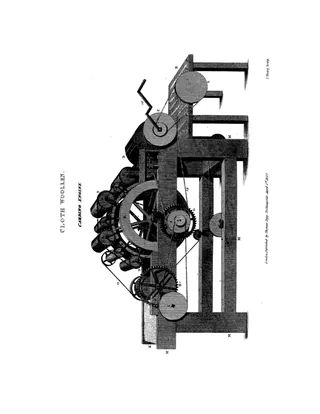
Cloth, Woollen
London Encyclopaedia, 1829
Article · 16 pages
An encyclopedia article on woollen cloth manufacture from a London encyclopaedia of 1829. It opens with the etymology of 'cloth' and literary quotations, then sets out the qualities of good woollen cloth. It describes wool preparation (scouring, oiling, the wool-mill or devil, scribbling and carding), spinning on the jenny, fulling or milling, and finishing by gigging, shearing and cropping. Engraved plates show a carding engine, spinning jenny, gig machine and cloth-shearing machinery, and the article ends with legal notes on wool export restrictions.
Cotton
London Encyclopaedia, 1829
Article · 16 pages
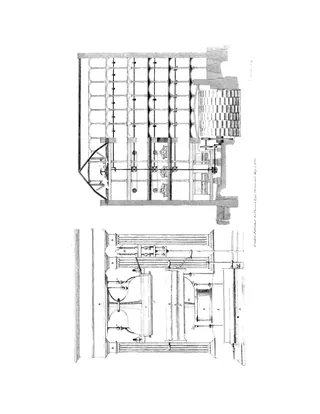
A 16-page encyclopaedia article on cotton, covering its botany, history, growing regions and trade, and the mechanical processes of cotton manufacture. It describes roller and saw gins, pickers and batting machines, carding engines, drawing and roving frames, mule spinning, reeling, warping, bleaching and stoving, and hydrostatic presses for calico printing. It also surveys the cotton industries of England, France and Switzerland, the muslin trade, and includes import statistics tables and engraved plates of machinery.
Dyeing
London Encyclopaedia, 1829
Article · 49 pages
Encyclopedia article on dyeing from a London encyclopaedia of 1829, with epigraph quotations on the word 'dye' followed by a theoretical part and a practical part. The theory covers the history of dyeing (Egyptians, Phoenicians and Tyrian purple), the nature of coloring particles, mordants, and the chemistry of Berthollet, Bancroft, Hellot and Macquer. The practical sections give numbered paragraphs of recipes for dyeing wool, silk, cotton and linen: black, blue (woad and indigo vats), red, scarlet, crimson, yellow, orange, green, violet and brown. It also covers scouring, dye-house layout and boilers, Turkey red, and ends with an index.
Flax
London Encyclopaedia, 1829
Article · 8 pages
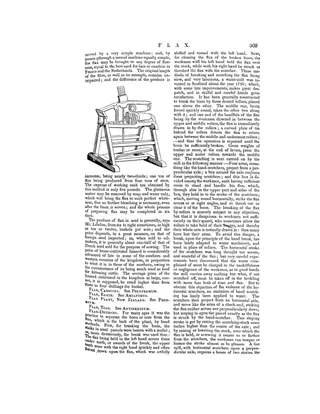
An 1829 encyclopedia article on flax (Linum usitatissimum) covering the word's etymology, literary quotations, and the plant's cultivation. It discusses soils, sowing times, weeding, and pulling, then the watering (retting) of flax in canals, grassing, and lifting. Later pages describe breaking and scutching by hand, foot and water-mill machines, and the start of heckling. One engraving shows a flax-breaking machine.
Gossypium
London Encyclopaedia, 1829
Article · 2 pages
A two-page encyclopedia entry on Gossypium, the cotton genus, giving its botanical classification and describing the species G. arboreum, G. Barbadense, G. herbaceum and G. hirsutum. It covers how cotton shrubs are cultivated (soil, exposure, planting, pruning, weeding, harvest timing) and how the seeds are separated from the fibre with a foot-driven roller cotton gin. It cross-refers to the entry COTTON.
Linen
London Encyclopaedia, 1829
Article · 18 pages
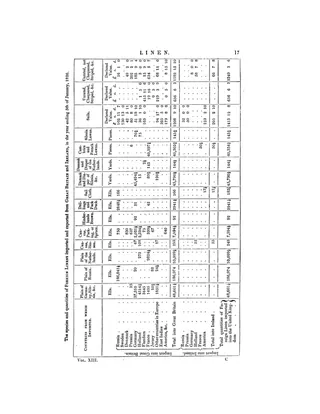
An encyclopaedia article on linen from the London Encyclopaedia, covering the spinning of flax and hemp from the spindle and distaff through the one-thread wheel and flyer wheel to the 1806 Clarke and Bugby patent for a multi-spindle hand-worked spinning machine. It also treats bleaching chemicals (barilla, pearl-ash, weed ashes, with Kirwan's analyses), starch-based washing colors, laundry apparatus, and the history and regulation of the linen trade in Ireland and Britain, including stamping and excise rules. A plate of linen machinery and statistical tables of linen imports and exports for 1826 are included.
Madder
London Encyclopaedia, 1829
Article · 2 pages
An encyclopedia article on madder, the dye from the root of Rubia tinctorum. It covers choosing and evaluating the root, then mordants and methods for dyeing wool, silk and cotton, including iron and tin variations that give browns and cinnamon shades. It ends with the full nine-step Papillon process for Turkey or Adrianople red on cotton, as released after the Scottish manufacturers' premium.
Sheep
London Encyclopaedia, 1829
Article · 9 pages
Encyclopedia entry on sheep from an early nineteenth-century London encyclopaedia (pp. 158-166). It opens with etymology and literary quotations for sheep-related words, then covers the uses of sheep, British and Irish breeds including the Leicestershire breed of Bakewell, feeding on turnips, Spanish migratory flocks and their management, the rot and flukes, anointing against scab, and advice on buying sheep. Wool is mentioned only in passing as part of breed and fleece quality.
Silk
London Encyclopaedia, 1829
Article · 15 pages
An encyclopedia article on silk, opening with a dictionary-style etymology and literary quotations (Spenser, Shakespeare, Milton, Dryden). The main text summarizes Mr. Stephenson's practical observations, published by the Society for the Promotion of Arts and Manufactures, on raising silk in Britain on the French model. It covers cultivating the white mulberry, hatching and rearing silkworms, cocoon spinning and selection, killing the chrysalis, and reeling the silk from cocoons in a heated basin. It ends by referring readers to WEAVING for later manufacturing processes.
Weaving
London Encyclopaedia, 1829
Article · 6 pages
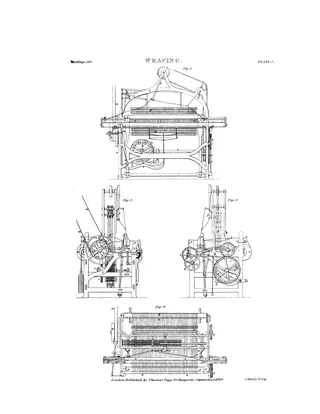
An 1829 encyclopaedia article on weaving that opens with a dictionary-style definition of the verb 'weave' and literary quotations. It then describes Mr. Roberts of Manchester's patented improvements to the power loom, including a tappet mechanism for six-shaft twill looms, a cylinder-and-needle device for figured weaving (an alternative to the draw boy), and cloth take-up and warp let-off regulation. It also covers multi-shuttle arrangements for ribbon looms. Two engraved plates show the loom mechanisms.
Wool
London Encyclopaedia, 1829
Article · 1 page
A single page from an early nineteenth-century encyclopaedia entry on wool. It covers the etymology and dictionary senses of wool and related words, with literary quotations (Shakespeare, Dryden, Pope, Swift), and compares wool to hair in growth and shedding. It also describes how fleece is sorted by body part in France, England, and Spain, and names wool regions valued in antiquity.
11 documents found