Textile Documents › Publications › Publication: Encyclopedia Britannica, 1st ed.
60 documents found
Sort: 
Asbestos
Article · 1 page
A short encyclopedia entry describing asbestos as a native stone that splits into fine, silky threads one to ten inches long and survives fire, which only whitens it. It notes that cloth and paper have been made from it, reports Royal Society trials in which asbestos cloth lost a dram of weight in the fire, and repeats Pliny's account of napkins cleaned by burning. It names localities in Asia and Europe, including Anglesey in Wales and Aberdeenshire in Scotland.
Basket
Article · 1 page
A very short dictionary-style entry on 'basket' from the first edition of the Encyclopedia Britannica. It defines a basket as a machine made of interwoven twigs for holding fruit, earth and similar goods, and notes that the word also denotes an uncertain quantity, giving examples such as a basket of medlars (two bushels) and of asafoetida (20 to 50 pounds).
Bays
Article · 1 page
A short encyclopedia entry defining bays as an open woollen stuff with a long nap, sometimes frizzed. It describes manufacture on a two-treadle loom like flannel, chiefly at Colchester and Bocking in Essex, and notes export to Spain, Portugal and Italy. It also covers uses (clothing for monks and nuns, linings, backing for mirrors, case linings) and standard dimensions.

Beer
Article · 1 page
A very short dictionary-style entry from the first edition of the Encyclopedia Britannica defining 'beer' as a weaver's term. It describes a beer as nineteen warp ends running together the full length of the cloth. The entry gives only this definition, with no drafts or further explanation.
Black
Article · 1 page
A short encyclopedia entry on the color black as used by dyers, painters and other trades. It gives the dyer's recipe for black on high-priced woollen cloth (woad and indigo base, boiled with alum, tartar or wine-lees ashes, maddered, then blacked with galls, copperas and sumach), and a simpler method for cheaper stuffs. It also describes other blacks: German or Frankfort black, ivory, bone, hart's-horn, Spanish (burnt cork), lamp and earth blacks, ink, and currier's black for leather.
Blanket
Article · 1 page
A short encyclopedia entry defining a blanket as a bed coverlet, usually of white wool woven in a loom and crossed like serges. It describes finishing by fulling and napping with a fuller's thistle, notes blankets made from animal hair, and gives British duties on French blankets and French import duties.
Bleaching
Article · 12 pages
An eighteenth-century encyclopedia article on bleaching linen cloth and thread, as practiced by Scottish bleachers. It describes the sequence of steeping, bucking and boiling in alkaline lyes, alternate watering and drying on the field, souring with buttermilk, bran or vitriol, soap washing, and starching and bluing. It then discusses the theory behind each stage, citing experiments by Dr Home on wax bleaching, lyes, acids and lime, and closes with a method of bleaching safely with lime.
Blue
Article · 1 page
A very short encyclopedia entry on blue as a dyers' color, treated as one of the simple or mother-colours used to compose other colors. It names woad, indigo, and a pastel from Normandy as the sources of blue, and notes that some dyers deepen the shade by adding Brasil and other woods.
Botany: List of Dying Plants
Article · 2 pages
Two pages from the article on Botany in the first edition of the Encyclopedia Britannica, listing plants used in dyeing, arranged by color (yellow, red, purple, blue, violet, green, black). Each entry gives the Latin name, common English name, habitat, the plant part used, and the color obtained. The section closes with a short remark on the usefulness of botany to food, medicine, agriculture and the arts.
Brocade
Article · 1 page
A short encyclopedia entry defining brocade as a stuff of gold, silver, or silk enriched with flowers, foliage, and other ornaments. It explains that the term once meant cloth woven entirely of gold or silver thread in warp and weft, then extended to fabrics with silk used to raise and finish metal-thread figures. By the time of writing, any figured stuff, even plain silk satins, taffetas, or lustrings, was called brocade.

Brocatel
Article · 1 page
A very short encyclopedia entry defining brocatel (or brocadel) as a coarse kind of brocade used chiefly for tapestry. It gives only a one-line definition, with no technical detail on structure or materials.
Brown
Article · 1 page
A short encyclopedia entry defining the colour brown as used by dyers and painters, a dusky reddish colour with several named shades such as Spanish-brown, sad-brown, tawney-brown, London brown and clove-brown. Most of the text covers Spanish-brown, an earth pigment used by painters as a priming colour for timber, for shading vermillion and for dark picture grounds. It notes that burning the pigment improves it for most uses. It ends with a cross-reference to the article on dyeing.

Bucking
Article · 1 page
A one-sentence encyclopedia entry from the first edition of the Encyclopedia Britannica defining bucking as the first operation in whitening linen yarn or cloth. It gives no procedural detail beyond this definition.
Buckram
Article · 1 page
A short encyclopedia entry defining buckram as a coarse, gummed, calendered and dyed cloth made of hemp, used to stiffen garment linings and women's gowns and as wrapping for goods. It notes that buckram was often made from old sheets and sails, how it was sold wholesale, and the import duties and drawbacks on Carrick, East-country, French and German buckrams.
Cable
Article · 1 page
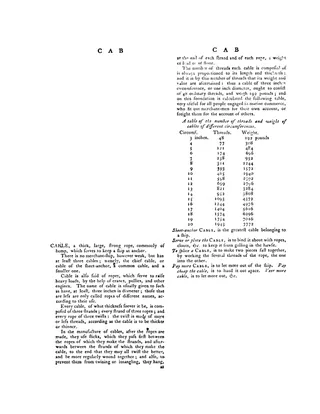
A one-page excerpt from the 1771 first edition of the Encyclopedia Britannica defining 'cable' as a thick hemp rope used to hold a ship at anchor or to raise loads with cranes and pulleys. It explains how cables are built from three strands, each of three ropes, each of three twists, and describes the use of sticks in twisting. It includes a table of thread counts and weights for cables of 3 to 20 inches circumference, plus nautical terms such as sheet-anchor cable, serving, splicing, and paying out cable.
Calender
Article · 1 page
A short encyclopedia entry defining the calender, a machine used in textile manufacture to press woollen and silk fabrics and linens so they become smooth, even and glossy, or to give them a watered or waved finish as seen in mohairs and tabbies. It describes the machine as two hard wooden rollers set between two heavy boards, the upper one pressed down by a screw and loaded with stones.
Callico
Article · 1 page
A short encyclopedia entry defining calico as a cotton cloth made chiefly in the East Indies. It describes painted and undyed varieties, including pieces with gold and silver stripes and decorative end tissues. It notes that the East India Company imported and re-exported the cloth, and that printed or stained Indian calicoes were prohibited in Britain by statute 7 Geo. I, cap. vii because of distress to domestic manufacturers.
Camblet
Article · 1 page
A short encyclopedia entry defining camblet (camlet) as a plain fabric woven on a two-treadle loom, like linens and flannels. It lists the fiber combinations used (goat's hair, hair and silk, all wool, wool and thread), the finishing and decorative variants (dyed in thread or in the piece, mixed, striped, watered, figured), and the uses for garments, bed curtains and household furnishings.
Canvas
Article · 1 page
A short encyclopedia entry defining canvas as an unbleached cloth of hemp or flax. It describes three kinds: a fine, open, regularly squared canvas used as a ground for needle tapestry with gold, silver, silk or wool threads; a coarse, somewhat open cloth used to cover women's stays and stiffen men's clothes; and a very coarse hemp cloth used for towels, domestic purposes and ship sails.
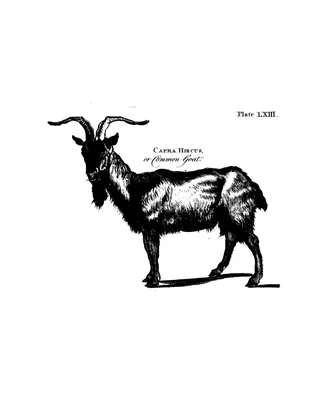
Capra (Goat)
Article · 3 pages
A three-page excerpt from the 1771 first edition of the Encyclopedia Britannica on the genus Capra (goats). It covers goat temperament, breeding, and the uses of goat products such as milk, cheese, flesh, tallow, hair and hides. It then lists species including the ibex, chamois, bezoar goat and antelope. It includes an engraved plate of the common goat (Plate LXIII).
Carmine
Article · 1 page
A short encyclopedia entry defining carmine as a beautiful purplish-red powder used by miniature painters, though rarely because of its price. It describes the main method of extracting it from cochineal with water infused with chouan and antour, and notes variants using rocou or brazil-wood, fernambouc and leaf-gold steeped in white-wine vinegar.
Cloth
Article · 2 pages
An 18th-century encyclopedia article on woolen cloth manufacture. It lists twelve marks of good cloth, then describes the process step by step: scouring, oiling and carding the wool, spinning, sizing the warp, weaving on the loom, fulling, raising the nap with teasels, shearing, dyeing, tentering and pressing. It ends by noting that mixed cloths, whose wools are dyed before spinning, are made in much the same way.
Coccinella
Article · 3 pages
An 18th-century encyclopedia article on the coccinella genus of insects, focusing on Coccinella cacti, the source of cochineal dye. It describes the nopal plant on which the insects are bred, how the plant is cultivated, the insect's life cycle and hazards, and the Indian methods of killing the insects by hot water, oven heat or sun. It ends with the regions of New Spain and Peru where cochineal is produced, with Oaxaca as the chief center of trade.
Colour
Article · 1 page
A short encyclopedia entry on colour in the art of dyeing, from the first edition of the Encyclopedia Britannica. It lists five simple or primary colours (blue, yellow, brown, red, black) from which dyers form other colours, and names compound shades such as amaranth, violet, pansy, columbine or dove-colour, and purple-crimson. It notes that all colours made with cochineal are called crimson.

Comb
Article · 1 page
A very short encyclopedia entry on the comb as an instrument for cleaning, untangling, and dressing flax, wool, hair, and similar fibers. It also notes that combs for wool were prohibited from being imported into Britain.
Cotton
Article · 1 page
A single page from the first edition of the Encyclopedia Britannica (1771) on cotton as a commodity. It describes cotton wool and cotton thread, the grades and places of origin (Cyprus, Smyrna, Bengal, Coromandel, Damascus, Jerusalem, the Antilles), and the sorts of goods made from it. It also covers how bags are packed in the Antilles and the import and drawback duties on cotton wool and yarn.

Crape
Article · 1 page
A one-sentence encyclopedia entry defining crape as a commercial fabric made like gauze from raw silk that is gummed and twisted on the mill. It gives no details of weave structure, finishing, or uses.
Dyeing
Article · 4 pages
Four-page article on dyeing from the first edition of the Encyclopedia Britannica (1771). It defines the art, lists the materials used (mordants, salts, liquors, metals, colourants), and gives general observations on how dyestuffs behave. It then describes dye procedures and colour recipes for wool, silk and thread, including blacks, scarlets, blues, greens and yellows, with notes on how dyes add weight to silk.
Felt
Article · 1 page
A very short encyclopedia entry defining felt as a stuff that gets its consistence from fulling with lees and size, without spinning or weaving. It notes that felt is made of wool alone or of wool and hair. It also gives the import duty and export drawback for French-made felts used for cloaks.

Flannel
Article · 1 page
A very brief dictionary entry on flannel from the first edition of the Encyclopedia Britannica. It defines flannel as a loose sort of woollen stuff, not crossed (not twilled), woven on a loom like bays.
Flax
Article · 8 pages
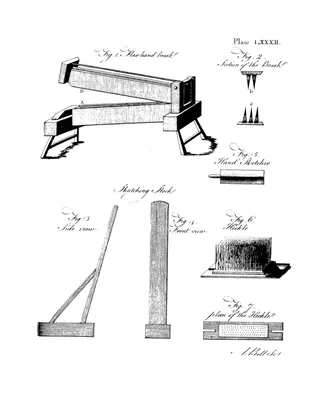
Eighteenth-century encyclopedia article on flax from the first edition of the Encyclopedia Britannica. It gives the Scottish Trustees' recommended practice for growing flax: soil choice, linseed selection, sowing, weeding, pulling, rippling, watering (retting) in canals, grassing and storage. It includes a cost and profit estimate for a Scots acre and a separate method for growing fine flax for cambric and lawn. The closing FLAX-DRESSING section describes breaking, scutching and heckling by hand tools, water-mills and foot machines, illustrated by an engraved plate of the tools.
Fuller
Article · 1 page
A very brief encyclopedia entry defining a fuller as a workman in woollen manufactories who mills or scours cloths, serges, and other stuffs to make them thicker, more compact, and more durable. It refers readers to the article CLOTH for further information.
Fulling
Article · 1 page
A brief encyclopedia entry defining fulling as the scouring and pressing of cloth, stuffs and stockings to cleanse, thicken and strengthen them, done by water mill. It notes the use of fuller's earth and soap, and describes hand, foot and machine fulling of stockings and caps with various ingredients such as urine and chalk-softened water.
Fustian
Article · 1 page
A short encyclopedia entry defining fustian as a cotton cloth that looks as if ribbed or whaled on one side. It explains that true fustians are made wholly of cotton yarn in both warp and weft, though many have a flax or hemp warp, and notes that they come in wide, narrow, fine and coarse kinds, with or without shag or nap.
Fustick
Article · 1 page
A very short encyclopedia entry on fustick (also spelled fustock), a yellow dyewood from the Caribbean islands used for dyeing yellow. It also notes that the wood paid no import duty.
Hats
Article · 1 page
An 18th-century encyclopedia entry on hats. It describes the making of felt hats from beaver fur and other animal hair: bowing, felting, fulling, blocking, singeing, dyeing, stiffening and finishing. It briefly notes the hat trade in England and the plaiting of women's hats from chip, straw or cane, and the weaving of hats from horse-hair and silk.
Hemp
Article · 1 page
A short encyclopedia entry on the cultivation and preparation of hemp, presented as a set of differences from the raising and dressing of flax. It covers soil and manure, sowing, the male and female plants, pulling, seed saving, watering (retting) and dressing, including skutching in water lint-mills. It refers readers to the articles Cannabis and Flax.
Indigo
Article · 2 pages
A short encyclopedia entry on indigo from the first edition of the Encyclopedia Britannica. It cross-references the botanical genus Indigofera, then describes how indigo blue is made from the leaves of the anil plant by steeping, churning with olive oil, settling and drying. It also gives advice on judging quality, compares East Indian (Serquisse) with West Indian (Guatimala, St Domingo, Jamaica) types, and lists uses for dyers, laundresses, painters and confectioners.

Mohair
Article · 1 page
A one-sentence encyclopedia entry defining mohair as the hair of a goat found around Angora in Turkey. It notes that the inhabitants of the city were all employed in making camblets from this hair. Useful as an example of eighteenth-century commercial description of the fiber.
Muslin
Article · 1 page
A very short encyclopedia entry defining muslin as a fine cotton cloth with a downy nap on its surface. It notes that several kinds were imported from the East Indies, especially Bengal, and names varieties such as doreas, betelles, mulmuls and tanjeebs.
Ovis (Sheep)
Article · 2 pages
A two-page encyclopedia entry on the genus Ovis from the first edition of the Encyclopedia Britannica. It describes the domestic sheep (Aries): temperament, breeding, gestation, lambing, castration, ageing by teeth and horns, housing and pasture. It also briefly notes the Guinea sheep and the Cretan sheep. Wool and clothing are mentioned only in passing.
Ovis (Sheep)
Article · 2 pages
A short encyclopedia entry on the genus Ovis from the first edition of the Encyclopedia Britannica. It gives the zoological characters of the genus and describes the domestic sheep (Aries): temperament, breeding, gestation, lambing, castration, age as shown by teeth and horns, and pasturing in Britain and southern Europe. It also briefly notes the Guinea sheep and the Cretan sheep. Wool and weaving are not treated beyond a mention of wool quality in breeding ewes.
Plush
Article · 1 page
A very short encyclopedia entry defining plush as a fabric with a velvet-like nap or shag on one side. It describes the usual construction: a single woolen weft thread with a double warp, one of twisted wool and the other of goat or camel hair. It also notes that some plushes are made wholly of worsted or wholly of hair.
Red
Article · 1 page
A very short encyclopedia entry on the color red in dyeing, describing it as one of the five simple or mother colors. It lists the six kinds or casts of red some dyers distinguish and reduces them to three, according to the principal dyestuffs: kermes, cochineal, and madder.
Reel and Reeling
Article · 1 page
A very short encyclopedia entry defining 'reel' as a machine used for reeling, and 'reeling' as winding thread, silk, cotton or similar fibers into a skein or onto a bottom to prevent tangling. It also notes that reeling is used to fill or empty bobbins and quills for manufacturing various stuffs. The entry only states that reels and methods vary, without describing specific designs.
Reseda
Article · 1 page
A very short encyclopedia entry on Reseda, a plant genus, giving its botanical classification and floral characteristics. It notes 11 species, two native to Britain: the lutea (base-rocket) and the luteola (wild woad or dyer's weed). The entry has no dyeing instructions, though dyer's weed is a source of yellow dye.
Rope and Rope Yarn
Article · 1 page
A very short encyclopedia entry defining rope as hemp, hair or similar fiber spun into thick yarn and twisted together from several strands on a wheel. It notes that a small rope is called a cord and a very thick one a cable. A second entry defines rope-yarn, the untwisted yarn of a rope used by sailors, usually made from junk, to make sinnet and mats.
Sattin and Sattinet
Article · 1 page
Two brief dictionary-style entries from the first edition of the Encyclopedia Britannica. Satin is defined as a glossy silk fabric whose very fine warp stands out to cover the coarser weft, and sattinet as a light, thin, usually striped satin used chiefly for ladies' summer nightgowns.
Serge
Article · 1 page
A very short encyclopedia entry defining serge as a woolen stuff made on a loom. It notes that serges were named for their quality or place of manufacture, and singles out London serge as the most valued abroad, with a manufacture of it begun in France.
Silk
Article · 3 pages
An 18th-century encyclopedia article on silk from the first edition of the Encyclopedia Britannica. It describes the silkworm and its silk-producing vessels, the spinning of the cocoon, and the selection and handling of cocoons. It also covers how to judge silk quality and weight (Piedmont organzine, Lyons aunes and portees), and the preparation steps of reeling, spinning, milling, bleaching and dyeing, including floretta from waste cocoons.
60 documents found