Textile Documents › Publications › Publication: Chambers's Encyclopedia
44 documents found
Sort: 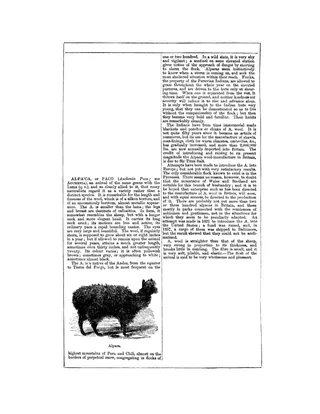
Alpaca
Chambers's Encyclopedia, 1881
Article · 1 page
A one-page encyclopedia entry on the alpaca (Auchenia paco), a South American camelid related to the llama. It describes the animal's appearance, habitat in the Andes, and behavior, and the length, color and silky quality of its wool. It also covers the use of the wool by Peruvian Indians, its commercial importation into Britain and manufacture there (credited to Sir Titus Salt), and attempts to introduce the animal to Europe and the United States.
Arkwright, Sir Richard
Chambers's Encyclopedia, 1881
Article · 2 pages
Two pages from Chambers's Encyclopedia (1881) covering the later career of Sir Richard Arkwright, inventor of the cotton spinning-frame. It describes the roller spinning machine, his partnership with Jedidiah Strutt, his mills at Nottingham and Cromford, and his patent disputes and lawsuits. It also covers hostility from rival manufacturers and workers, his knighthood and high-sheriff appointment, and his death in 1792.
Bamboo
Chambers's Encyclopedia, 1881
Article · 1 page
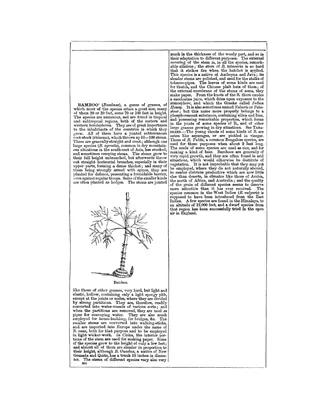
A one-page encyclopedia entry on bamboo (Bambusa), a genus of tropical and subtropical grasses. It describes the plant's growth habit, rhizome and jointed stems, and the many species and their sizes. It also lists uses: building, water pipes, walking sticks, wickerwork, paper, plaited hats, thatch, food and the exudate tabasheer. A line drawing of a bamboo plant accompanies the text.
Basket
Chambers's Encyclopedia, 1881
Article · 1 page
A short encyclopedia entry on baskets from Chambers's Encyclopedia. It covers the word's Welsh origin, early use of baskets (Israelites, ancient Britons), materials, willow cultivation and profits in Britain, the trade in handmade baskets, basket-making in blind asylums, and imports from the continent. It gives no technical instruction on construction.
Bleaching
Chambers's Encyclopedia, 1881
Article · 3 pages
An encyclopedia article on the bleaching of textiles. It traces the history from open-air grass bleaching (bucking, crofting, souring) through Berthollet's 1785 discovery of chlorine and the use of chloride of lime. It then describes the stages of industrial bleaching of cotton and linen (singeing, scouring, bucking in a kier, souring, chemicking, finishing), and the separate sulphur-based bleaching of wool and silk. It closes with a brief mention of bleaching paper rags, palm-oil and straw.
Calendering
Chambers's Encyclopedia, 1881
Article · 1 page
A one-page encyclopedia article on calendering, the finishing of linen, cotton and other fabrics by pressing them between heavy cylinders. It describes the construction of the calender, with paper and iron rollers, steam or heated centre roller and heavy weighting. It also covers starching, watering and glazing effects, the history of the machine, and the scale of the industry in Manchester, Glasgow and Dundee.
Calico Printing
Chambers's Encyclopedia, 1881
Article · 3 pages
An encyclopedia article on calico-printing, the production of coloured patterns on cotton and other cloth. It outlines the history of the art from Calicut in India to Europe, then the preparation of cloth by singeing, bleaching and calendering. It describes the six styles of applying colour: madder, padding, topical, resist or reserve, discharge, and China blue, with the mordants, thickeners, dyes and chemicals used in each.
Carding of Cotton
Chambers's Encyclopedia, 1881
Article · 1 page
A short encyclopedia entry describing the carding of cotton, in which the fibres are disentangled and laid parallel. It explains the wire-toothed card mounted on cylinders, the transfer of the cotton between cylinders, and its removal as a fleece by the doffer and doffing-knife. The fleece is then condensed through a funnel into a sliver ready for drawing or doubling, with a cross-reference to Spinning.
Carpets
Chambers's Encyclopedia, 1881
Article · 2 pages
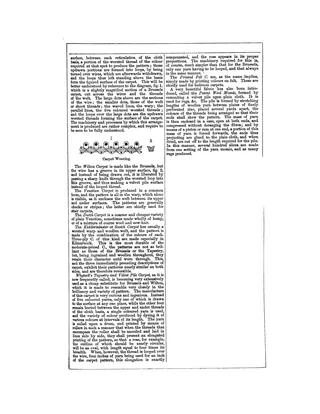
An encyclopedia article from Chambers's Encyclopedia describing the main kinds of woven and printed carpets in use in the 1880s. It covers Turkey, Axminster, Brussels, Wilton, Venetian, Dutch, Kidderminster/Scotch, Whytock's Tapestry and Velvet Pile, printed felt and Patent Wool Mosaic carpets, with notes on materials and manufacture. A diagram of magnified cross-sections shows Brussels and Wilton construction with wires, weft, warp and looped worsted.
Cashmere Goat
Chambers's Encyclopedia, 1881
Article · 1 page
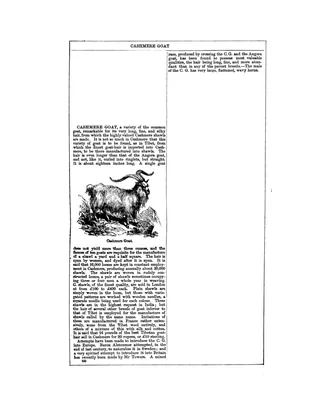
A one-page encyclopedia entry on the Cashmere goat, a long-haired variety of the common goat whose fine hair, mostly from Tibet, is made into Cashmere shawls. It describes the fleece length and yield, the spinning and dyeing of the hair by women, and the weaving of plain and patterned shawls (the patterned ones worked with wooden needles, one per colour). It also covers shawl prices, French imitations, and attempts to introduce the goat into Sweden and Britain. Includes an engraved illustration of the goat.
Cotton
Chambers's Encyclopedia, 1881
Article · 10 pages
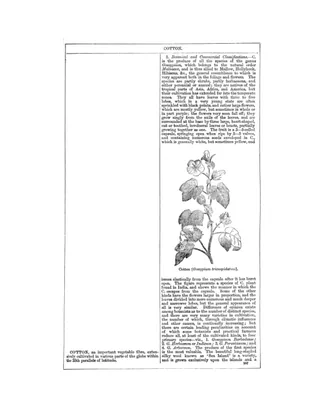
An encyclopedia article on cotton from Chambers's Encyclopedia. It covers the botany and commercial classes of the Gossypium species, cultivation, and the history of the cotton trade in the United States, India, Brazil, Egypt and Europe. It also covers the British cotton manufacture, including the inventions of Wyatt, Arkwright, Hargreaves, Crompton and Cartwright, as well as the effects of the American Civil War and the cotton famine. It includes a botanical illustration and statistical tables of imports, consumption, exports and prices.
Crochet
Chambers's Encyclopedia, 1881
Article · 1 page
A short encyclopedia entry defining crochet as a system of looping with a hook. It explains the basic method of making a chain and working plain crochet, how twisting the thread and skipping loops produce varied and open patterns, and how work can be made in the round. It also compares crochet with knitting and mentions the materials and items it is used for.
Damask
Chambers's Encyclopedia, 1881
Article · 2 pages
A two-page encyclopedia article defining damask as figured fabric woven with non-geometric patterns, and tracing its name to Damascus. It describes the Jacquard machine's role and the main centers of manufacture in Europe and Britain, especially Dunfermline. It distinguishes full harness, single (common) and double damask by the number of threads lifted per needle and the shaft ground (five-shaft, eight-leaf twill), then gives cost and industry statistics for Dunfermline from 1836 to 1877.
Dye-Stuffs
Chambers's Encyclopedia, 1881
Article · 3 pages
Encyclopedia article on dye-stuffs from Chambers's Encyclopedia (1881). It lists the principal natural dyes of animal and vegetable origin, such as cochineal, kermes, lac, madder, indigo, logwood, fustic, weld, woad and quercitron, with the colours each yields. It then covers the newer coal-tar (aniline) colours, including mauve, magenta, roseine, violine and picric acid, with their chemical preparation. It ends with methods of applying them to silk, wool and cotton, and in calico printing.
Dyeing
Chambers's Encyclopedia, 1881
Article · 3 pages
Encyclopedia article on dyeing from Chambers's Encyclopedia. It gives a brief history from Tyrian purple and the Egyptians, Greeks and Romans to Highland Scottish domestic dyeing with lichens, heather and alder bark. It explains indigo vat preparation for wool and cotton, mordants and preparation of goods, then lists numbered recipes for dyeing cotton, wool and silk in many colours, and closes with mixed fabrics.
Embroidery
Chambers's Encyclopedia, 1881
Article · 2 pages
An encyclopedia article from 1881 giving a general overview of embroidery as an art. It covers its antiquity and use among peoples from the Chinese, Persians, Turks and Hindus to the Laplander and Red Indian, and the unusual materials used in Oriental work. It also describes hand-embroidery methods, including frames, Berlin work, pricked patterns and muslin embroidery, and explains how Heilmann's multi-needle embroidery machine works with a pantograph.
Fashion
Chambers's Encyclopedia, 1881
Article · 4 pages
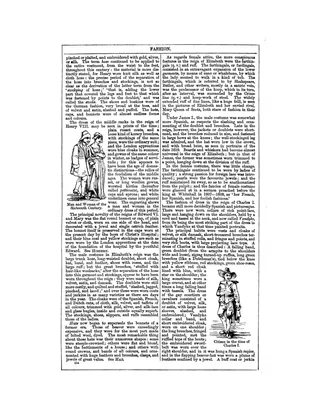
Encyclopedia article surveying the history of fashion in Western Europe, chiefly England, from Roman and Anglo-Saxon dress to the 1870s. It covers men's and women's clothing by reign, including the Norman period, Tudor and Stuart styles, 18th-century wigs, hoops and cocked hats, and the post-1790 shift to pantaloons, trousers and frock-coats. Engravings illustrate costume of the 15th, 16th and 17th centuries and a gentleman of 1750. It ends with remarks on the moral view of fashion, quoting Hazlitt, and a reference to Mrs Stone's Chronicles of Fashion.
Felt, Felting
Chambers's Encyclopedia, 1881
Article · 2 pages
A two-page encyclopedia article explaining felt as a fabric formed without weaving, through the interlocking of barbed hair and wool fibres under moisture, pressure and beating. It recounts the St Clement hatters' legend, describes beaver-hat felting by hand and machine felting of waste wool, and lists uses such as carpeting, drugget, padding, saddles, boiler sheathing and asphalted roofing felt.
Fibre
Chambers's Encyclopedia, 1881
Article · 2 pages
An encyclopedia article on textile fibres. It surveys the mineral, animal and vegetable materials used for cordage and cloth, covering wool and hair, silk and byssus, and bast, fruit and leaf fibres, and how they are extracted. It ends with a classified list of fibrous plants arranged by botanical order, split into exogenous and endogenous plants.
Flax
Chambers's Encyclopedia, 1881
Article · 2 pages
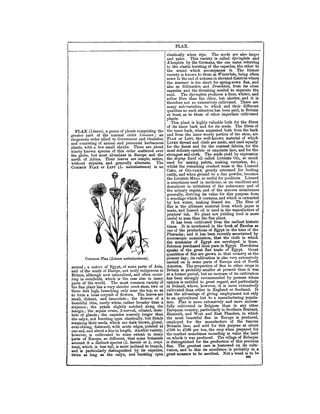
An encyclopedia article on flax (genus Linum) from Chambers's Encyclopedia, covering the botany of the common flax plant (Linum usitatissimum) and its varieties. It describes the uses of the fibre for linen and lace and of the seed for linseed oil and cake. It also covers the history of cultivation from ancient Egypt, the main growing regions (Belgium, the Baltic, Britain, Ireland, India), sowing and pulling practices, and purging flax (Linum catharticum). A botanical illustration of the plant is included.
Flax-Dressing
Chambers's Encyclopedia, 1881
Article · 2 pages
An encyclopedia article describing the stages of preparing flax fibre after harvest: pulling, rippling, retting (water, dew, and mixed methods), the Schenk and Watt artificial retting processes, breaking, and scutching by hand, machine, and revolving brushes. It ends by referring readers to the article on linen manufacture for later processes.
Flax. New Zealand
Chambers's Encyclopedia, 1881
Article · 1 page
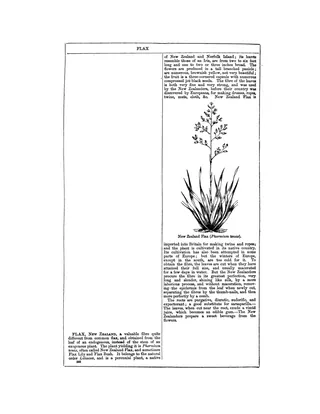
A one-page encyclopedia entry on New Zealand flax (Phormium tenax), a leaf fibre plant unlike common flax. It describes the plant's botany, its native range in New Zealand and Norfolk Island, and the Maori use of the fibre for clothing, rope, twine, mats and cloth. It also covers import into Britain, attempts at cultivation in Europe, methods of extracting the fibre, and minor medicinal and food uses. Includes a botanical engraving of the plant.
Goat
Chambers's Encyclopedia, 1881
Article · 2 pages
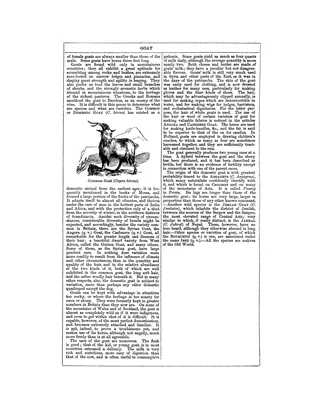
Encyclopedia article on the goat (genus Capra) from Chambers's Encyclopedia. It describes how goats differ from sheep, their wild habitats, domestic breeds (including the Angora, Cashmere and Syrian goats noted for long fine hair), and their uses for milk, meat, leather, horn and hair. It also covers the wild species thought to be the ancestor of the domestic goat. It includes an engraving of the common goat.
Goat, Rocky Mountain
Chambers's Encyclopedia, 1881
Article · 1 page
A short encyclopedia entry on the Rocky Mountain goat (Antilope lanigera), describing its range in the Rocky Mountains of North America, its sheep-like size and white fleece, and its musky flesh. It notes the suggestion that the fleece might be used for finer manufactures and that the animal might be introduced into the Scottish Highlands.
Hair
Chambers's Encyclopedia, 1881
Article · 3 pages
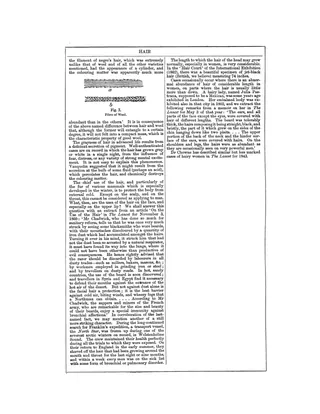
A three-page encyclopedia article on hair from Chambers's Encyclopedia (1881). It describes hair structure (shaft, bulb, follicle, cortex and medulla), pigment and colour, physical properties such as strength, elasticity and hygroscopy, and differences between races. It also compares hair with wool, noting that wool has a serrated surface and felts while hair does not, and closes with the functions of facial hair, graying, and cases of extreme length or abnormal hairiness. Three figures show a hair bulb section, a hair surface, and wool fibre.
Hair Manufactures
Chambers's Encyclopedia, 1881
Article · 3 pages
An encyclopedia article on manufactures made from animal and human hair. It covers weaving horse-hair cloth (dyeing with logwood and copperas, the two-person loom, hair used as weft), crinoline, and sacking and carpets from other hairs. It also covers felting, stuffing hair, sorting hair and making brushes and artists' pencils, and ornamental hair-work, wigs and the hair trade in Britain and France.
Hemp
Chambers's Encyclopedia, 1881
Article · 2 pages
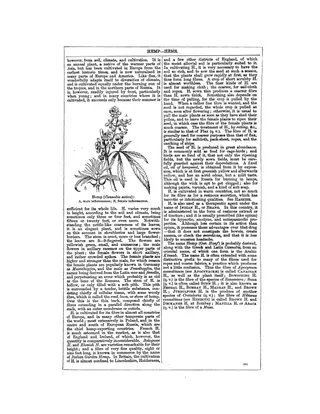
An encyclopedia article on hemp (Cannabis sativa) from Chambers's Encyclopedia. It describes the plant's botany, its cultivation for fibre in Europe and elsewhere, and the effect of sowing and pulling time on fibre quality. It also covers uses of the fibre for cloth, sailcloth and rope, the seed and its oil, the narcotic and medicinal uses (hashish, bhang), and the many other fibres called 'hemp' (Manilla, Sunn, Bowstring, Canadian). It includes a botanical illustration of male and female flowers.
Indigo
Chambers's Encyclopedia, 1881
Article · 3 pages
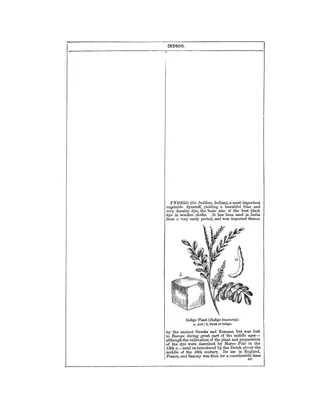
Encyclopedia article on indigo, covering the history of the dye, the plants that yield it, and its cultivation and manufacture in India. It also describes commercial varieties and trade figures, the dyer's method of preparing and using indigo in the vat, Chinese green indigo (Lo-kao), and the chemistry of indigo blue and indigo white.
Lace
Chambers's Encyclopedia, 1881
Article · 3 pages
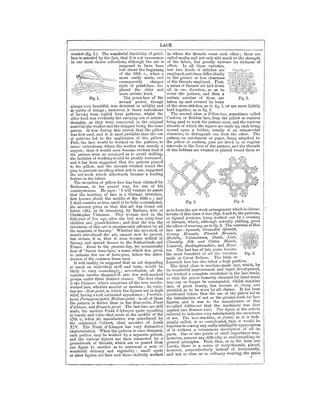
Encyclopedia article on lace covering its definition, history and classification. It describes the origins of point-lace in 14th-15th century convents and the later use of the pillow, and discusses the claim that Barbara Uttmann invented pillow-lace in Saxony. Lace is sorted into three classes: needle-made guipure/point lace, pillow (bobbin) lace and machine-made lace. The article explains how the bobbin-net machine works, outlines its Nottingham inventors, and ends with gold and silver lace. Illustrated with line figures of stitches and bobbin-lace structures.
Linen and Linen Manufacture
Chambers's Encyclopedia, 1881
Article · 1 page
A one-page encyclopedia article on linen and its manufacture, from Chambers's Encyclopedia. It surveys the main centers of linen production (France, the Netherlands, Ireland, Scotland) and lists the principal linen fabrics, including lawn, cambric, damask, diaper, sheeting, huckaback, crash and tick. It closes with a short history of linen from ancient Egypt onward, noting its durability and its recovery after the rise of cotton.
Loom
Chambers's Encyclopedia, 1881
Article · 3 pages
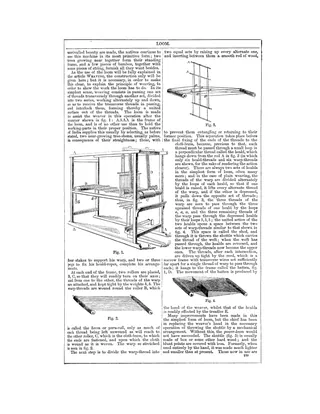
An encyclopedia article describing the loom as the machine for weaving, with a short note on its history from ancient hand looms to Cartwright's power loom of 1787. It explains the principle of plain weaving and the parts of a simple hand loom: frame, warp beam and cloth beam, healds, shed, reed and batten, treadles. It also covers the shuttle and shuttle races and shows a power loom. Six figures illustrate the frame, warp, healds, shed, shuttle and power loom.
Madder
Chambers's Encyclopedia, 1881
Article · 2 pages
Encyclopedia article on madder (Rubia tinctorum), the plant whose roots yield a major red dye. It covers the species and where they grow, cultivation, harvesting, drying and grinding of the roots, and the trade qualities of Dutch, French, Turkish, Indian and Russian madder. It also gives the history of madder in dyeing from Pliny and Dioscorides, the chemistry of its colouring matters (alizarine, purpurine, Schunck's research, artificial alizarine), and its use for Turkey-red on cotton and for purples, lilacs and pinks, with British import figures for 1875.
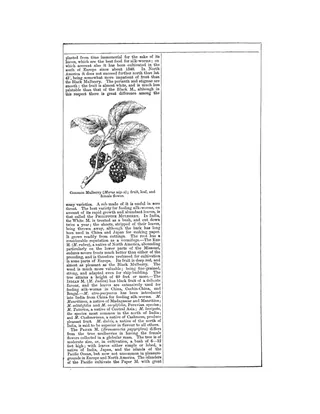
Mulberry
Chambers's Encyclopedia, 1881
Article · 2 pages
A two-page encyclopedia entry on the mulberry genus (Morus), describing the black, white, red and Indian mulberries and other species, their native regions, cultivation, fruit and wood. It stresses the white mulberry and related species as food for silk-worms in China, India and southern Europe. It also begins a note on the paper mulberry (Broussonetia papyrifera), whose bark is used for paper and, in the Pacific, for cloth. The page with a botanical illustration shows the common mulberry's fruit, leaf and female flower.
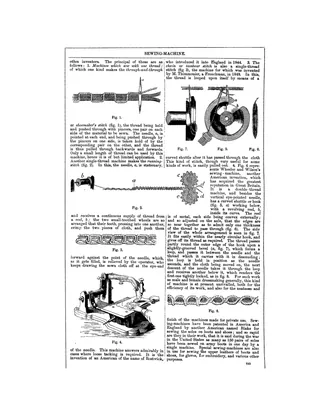
Sewing-Machine
Chambers's Encyclopedia, 1881
Article · 2 pages
An encyclopedia article on the sewing machine from Chambers's Encyclopedia. It recounts Elias Howe's invention and patent history, then describes the main machine types: single-thread through-and-through, running-stitch and chain/tambour machines, and the double-thread Wheeler and Wilson lock-stitch machine. Eight figures illustrate the stitches and mechanisms. It closes with notes on specialized machines for boot soles, gloves and embroidery.
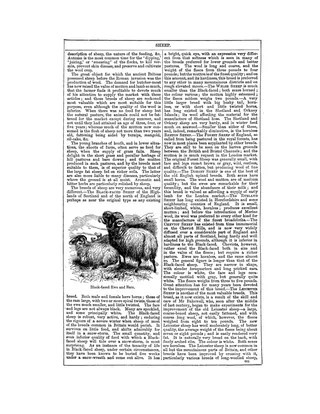
Sheep
Chambers's Encyclopedia, 1881
Article · 4 pages
An encyclopedia article on sheep (genus Ovis) from Chambers's Encyclopedia. It covers the characteristics of sheep compared with goats, wild species such as the Rocky Mountain sheep and Aoudad, and the habits, breeding cycle and shearing season of the domestic sheep. It then surveys many breeds, including Black-faced, Cheviot, Leicester, Cotswold, South Down, Shetland, fat-tailed and Astrakhan, with notes on fleece weight and wool quality. Two engravings illustrate a Rocky Mountain sheep and a Black-faced ewe and ram.
Shoddy
Chambers's Encyclopedia, 1881
Article · 1 page
A short encyclopedia entry defining shoddy as wool recovered from woven fabrics and rags and reduced to fibre for respinning. It distinguishes shoddy (from worsted rags) from mungo (from woollen rags), describes tearing the rags in a willey, and notes the Yorkshire origin of the term. It also mentions the shift from using shoddy to adulterate cloth to making light cloths for mild climates.
Silk and Silkworm
Chambers's Encyclopedia, 1881
Article · 5 pages
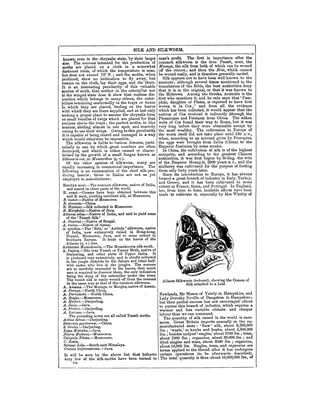
An encyclopedia article on silk and the silkworm from Chambers's Encyclopedia. It covers the natural history of Bombyx mori, the life cycle, mulberry feeding, and a list of other silk-producing moths such as tusseh, moonga and eria. It also describes the history of silk in China, Greece, Rome and Europe, rearing methods, cocoon sorting, reeling, and throwing (winding, cleaning, twisting, doubling) into singles, tram and organzine. It closes with the use of waste silk and the centers of British silk manufacture and dyeing.
Silk-Cotton
Chambers's Encyclopedia, 1881
Article · 1 page
Encyclopedia article on silk-cotton, the silky seed fibre from Bombax and related tropical trees of Asia, Africa and America. It explains that the fibre is too short, smooth and elastic for cotton machinery, though it has been spun and woven on a small scale in India and New Spain, and is mainly used as stuffing for pillows and mattresses. It also describes the main silk-cotton trees (Bombax ceiba, Bombax malabaricum) and mentions Brazilian vegetable silk from Chorisia species.
Spinning
Chambers's Encyclopedia, 1881
Article · 3 pages
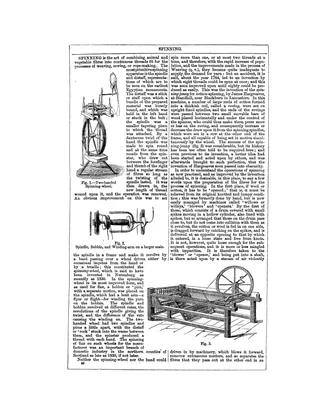
An encyclopedia article on spinning, tracing the craft from the hand spindle and distaff through the spinning-wheel to the mechanized spinning of the Industrial Revolution. It describes the Hargreaves jenny, Arkwright's throstle, and Crompton's mule. It also covers the preparation of fibre by opening, lapping and carding, and the yarn counts reached in the 1880s. Illustrated with line figures of a two-handed wheel, spindle and bobbin, the jenny, and carding machinery.
Weaving
Chambers's Encyclopedia, 1881
Article · 1 page
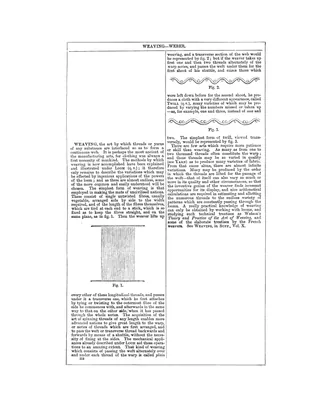
A short encyclopedia entry defining weaving as the interlacing of threads or yarns into a continuous web. It describes the simplest mat weaving of untwisted fibres tied to sticks, then plain weave and the basic twill, illustrated by three small diagrams (a warp setup and cross-sections of plain weave and simple twill). It notes the skill needed, warps of one to two thousand threads, and refers readers to Watson's treatise and related entries on Loom, Twill and Yarn.
Weaving
Chambers's Encyclopedia, 1881
Article · 1 page
A single page from Chambers's Encyclopedia (1881) on weaving, dealing with the introduction of convex weaving by machinery in 1867. It describes a patent convex power loom built for the Convex Weaving Company in New York under M. Opper, used mainly for woven ladies' stays (corsets). The article compares output with the hand-loom (about four pair of stays a day versus 40) and notes the use of the Jacquard to restrict the weft to part of the warp width when weaving gores.
Whitney, Eli
Chambers's Encyclopedia, 1881
Article · 1 page
A short encyclopedia biography of Eli Whitney (1765-1825), the American inventor of the cotton gin. It covers his Yale education, his time in Georgia, the invention of the gin to separate cotton from seed, the patent lawsuits that consumed his profits, and his later success manufacturing firearms with interchangeable parts at Whitneyville, Connecticut.
Wool
Chambers's Encyclopedia, 1881
Article · 3 pages
An encyclopedia article on wool as a textile raw material, from Chambers's Encyclopedia (1881). It explains the structure of the wool fibre (waviness, surface scales, felting), the difference between combing and carding wools, and the long-wool and short-wool British sheep breeds. It also surveys wool production in Australia, the Cape, India, Europe and South America, and includes a table of British wool imports by country from 1810 to 1874, plus notes on mohair, alpaca, Cashmere wool and sheepskin rugs.
Woollen and Worsted Manufactures
Chambers's Encyclopedia, 1881
Article · 5 pages
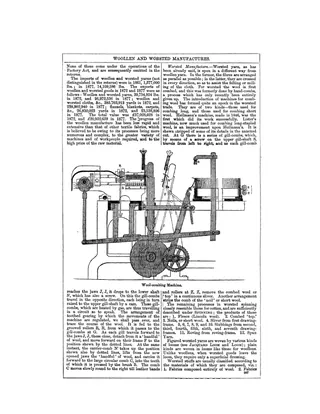
Encyclopedia article on the woollen and worsted industries, from the medieval history of English wool manufacture through the 1870s. It describes the stages of making woollen cloth (sorting, scouring, willying, carding, spinning, fulling, teasing, shearing, dyeing) and the different processes for worsted, including wool-combing machines (Heilmann, Lister). It lists cloth types and fabric classes by fibre content, discusses shoddy and cotton warps, and gives regional centres and 1875 factory, operative, import and export statistics for the United Kingdom.
44 documents found