Textile Documents › Authors › Author: Thomas Woodhouse
12 documents found
Sort: 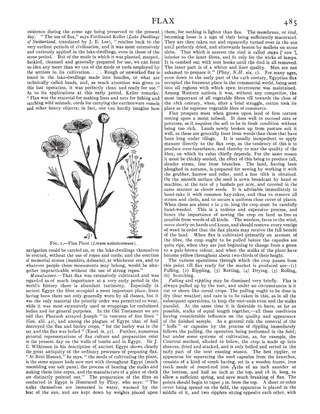
Flax
Article · 6 pages
Encyclopedia Britannica (11th ed.) article on flax, covering the botany of Linum usitatissimum, its ancient history and use in Egypt and the Swiss lake-dwellings, and cultivation. It describes the steps from pulling and rippling through retting (water, dew, warm-water, steam and chemical methods) to scutching, with notes on Courtrai flax. The article closes with trade information: acreage by country in 1905, Russian flax grades and base marks, price tables 1897-1906, and imports to the United Kingdom and Irish acreage.
Jacquards and Harnesses: Card-Cutting, Lacing and Repeating Mechanism
Book · 477 pages · weaving drafts
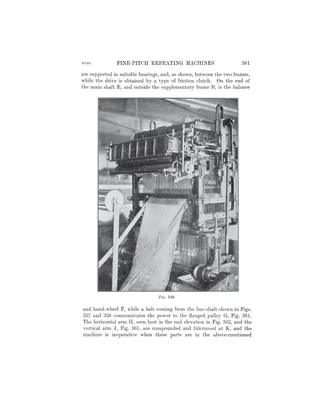
A technical treatise on Jacquard machines and their accessories, covering harness ties (straight-through, repeating, centre and mixed ties), the preparation of Jacquard cards, and the machines that cut, lace, stitch and repeat them. It covers hand and power card-cutting, reading boards, hand and mechanical lacing, peg- and lace-hole machines, and ordinary-, medium- and fine-pitch repeating machines. It is heavily illustrated with mechanical line drawings and photographs, plus some design and harness diagrams and a few weave-strip drafts. The volume also has a subject index and period advertisements from Jacquard and loom makers.
Jute
Article · 4 pages
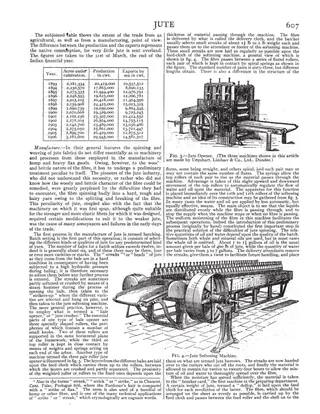
Encyclopedia article on jute, the vegetable fibre from Corchorus capsularis and C. olitorius. It covers the history of the name and trade, cultivation in Bengal, traditional hand-loom gunny weaving in India, and the growth of the Dundee and Calcutta mills, with tables of looms, spindles, acreage, production and exports. The second half describes mechanical manufacture: batching, softening, carding, drawing, roving and spinning, plus yarn counts and uses. Illustrations show seed capsules and the opener, softening machine and batching gear.
Jute and Linen Weaving
Book · 310 pages · weaving drafts
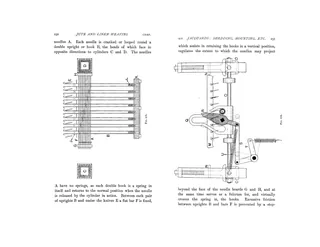
A technical textbook on power-loom weaving of jute and linen, in its second edition (1914), by two Scottish technical-college instructors. It covers yarn counts, reeling and bundling, warp and weft winding, warping, beaming and sizing (including sizing chemicals), drawing-in and reeding, and the loom motions: shedding by tappet, dobby and jacquard, picking, beating up, let-off, take-up, box motions, auxiliary motions, terry towel motions, automatic weft supply and selvages. It is heavily illustrated with mechanical drawings of machinery by makers such as Lupton and Place and Anderston Foundry, and includes calculations for pinions and shotting plus a few pegging and draft diagrams.
Linen
Article · 4 pages
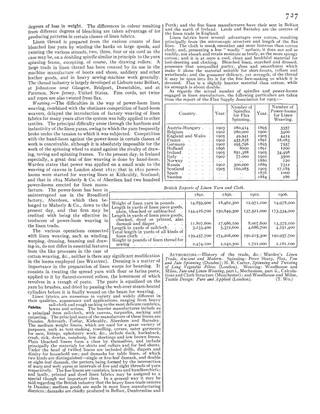
Encyclopedia article on linen and the linen industry from the 1911 Encyclopaedia Britannica. It covers the history of the trade and its decline under cotton, hand and machine flax spinning, hackling, preparing, wet and dry spinning, yarn counts and measures, bleaching, thread, power-loom weaving, and types of linen fabric. It closes with tables of spindles and power-looms by country and of British linen exports, plus a short bibliography.
Ramie
Article · 2 pages
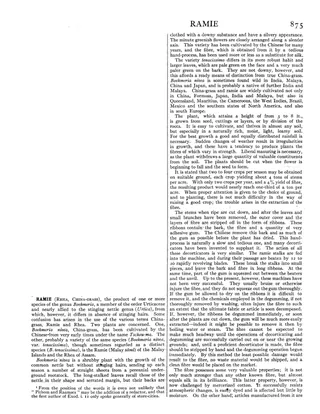
Encyclopedia article on ramie (rhea, China-grass), a bast fibre from Boehmeria species. It covers botany, varieties, cultivation and geographic range, hand and machine decortication, degumming, and the problems of spinning a fibre of variable length. It also notes the fibre's properties (strong, lustrous, but brittle and hairy) and its uses, such as gas mantles, paper, ropes, nets and fabrics.
Rope and Rope Making
Article · 10 pages
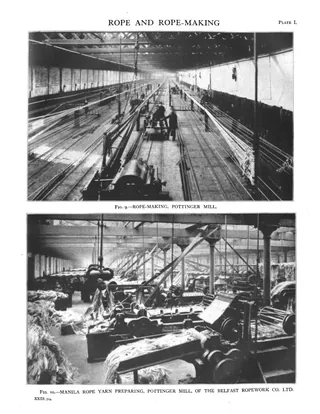
Encyclopedia Britannica (11th ed.) article on rope and rope-making. It covers the fibres used (hemp, manila, sisal, jute, cotton), the construction of strands, hawser-laid and cable-laid ropes, hand spinning and laying in the rope-walk, and factory machinery (hackling, drawing frames, automatic spinners, house machines). It also treats cotton driving ropes for power transmission, wire rope construction and strength tables, aerial ropeways, and electrical cables. Illustrated with line figures and four plates of rope-works and machinery.
Textile Design
Book · 263 pages · weaving drafts
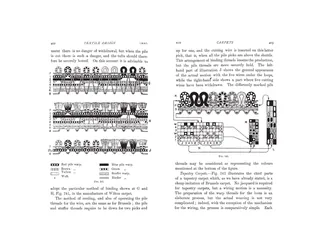
A comprehensive 1912 textbook on the technical design of woven textiles by two Scottish technical-college instructors. It works through plain, twill and sateen weaves, mock lenos, huckabacks, honeycombs, crêpes, spots, dice and diamond designs, damasks and jacquard mounting. It goes on to compound, backed and double cloths, three-ply and multi-ply fabrics, pile fabrics (velvets, plushes, carpets, terry), Bedford cords and piqués, gauze, leno, lappet and swivel fabrics, and silk picture weaving. The book is heavily illustrated with drawdowns, drafts and weaving plans, plus harness and card-cutting calculations for dobby and jacquard looms. Originally serialized in the Textile Manufacturer, it was aimed at jute and linen weaving and extended to general industrial textile design.
Textile Machine Drawing
Book · 128 pages
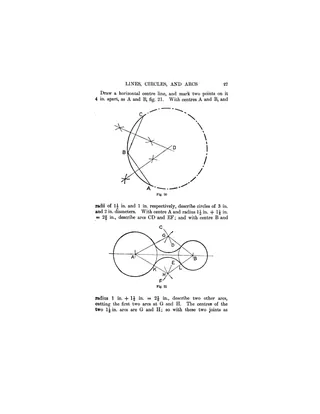
An elementary manual teaching mechanical drawing to textile students, written by a Dundee Technical College weaving instructor and a textile-engineering chief draughtsman. It moves from pencils, paper and instruments through line exercises, plane geometry, orthographic projection, bolts, screws and keys, sketching of details, scale drawing and small assemblies. Worked exercises use real textile machine parts such as loom levers, treadle levers, roving frame slides, faller reception levers, a breaker card worker roller and a picking-cone stud. It has many dimensioned figures and contains no weaving drafts.
Textile Mathematics, Part 1
Book · 63 pages
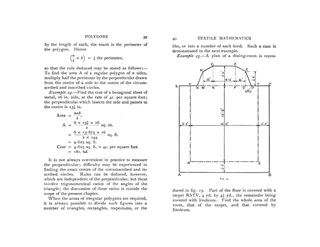
An elementary mathematics textbook for textile students, Part I of two, written by a Dundee weaving instructor and a textile-engineering draughtsman. It covers algebraic signs, brackets and symbolic notation, then the mensuration of rectangles, triangles, quadrilaterals, polygons, circles, arcs and sectors, gear wheels, rectangular solids, specific gravity, prisms, cylinders, pyramids, cones and spheres. Worked examples draw on textile practice such as yarn counts, loom speed, take-up rollers, cloth costs, bobbins and sizing machines. A chapter-by-chapter set of exercises with answers closes the book.
Textile Mathematics, Part 2
Book · 64 pages
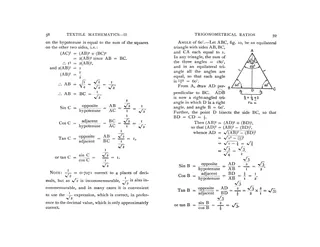
A 1921 textbook of mathematics for textile students, Part II of a two-part work by Thomas Woodhouse and Alexander Brand. It covers ratio, proportion and variation, averages, percentages, loss and regain (moisture conditioning), mixtures and costs, indices and logarithms, trigonometrical ratios, and yarn counts for cotton, linen, jute, woollen and worsted systems. Worked examples use mill problems such as pulley speeds, dressing mixtures, yarn blends and twist contraction. The book ends with exercises with answers, a section of useful data (gear formulae, weights and measures, mensuration rules) and logarithm and trigonometric tables.
Yarn Counts and Calculations
Book · 124 pages
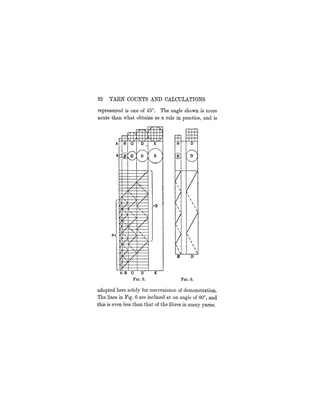
A 1921 technical manual on yarn counts and the arithmetic of yarn calculation, written by a Dundee Technical College textile instructor. It explains twenty-two systems of counting raw silk, spun silk, artificial silk, cotton, woollen, worsted, linen, hemp and jute yarns, and shows how to convert counts between fixed-weight and fixed-length systems, with conversion tables. Later chapters cover the resulting count of multiple-ply and twisted yarns with and without shrinkage, the pricing of twisted yarns and fibre mixtures, turns per inch, and the angle of twist, mostly through worked formulas and examples. It includes an index and has no weaving drafts.
12 documents found