Textile Documents › Topic: Felt and felting
102 documents found
Sort: 
Asbestos Felt
Article · 1 page
A short dictionary entry describing F. A. Gooch's method of making a felt from anhydrous asbestos for use as a filtering material. The asbestos is scraped to a fine down, boiled in hydrochloric acid, washed by decantation, and deposited with a Bunsen pump onto a perforated platinum crucible or fine platinum gauze. It is a laboratory technique, not a textile one.
Felt
Manufacturer and Builder, 1869
Article · 1 page
A short 1869 magazine item on the legendary and early history of felt and felt hats. It recounts the story of St. Clement discovering felting with wool in his sandals, his role as patron saint of hatters, and the introduction of felt hats in Paris and their later manufacture in England.
Felt
Article · 1 page
A one-page article on the history and contemporary use of felt in fiber arts. It traces felt from legend and early skin clothing through Roman accounts and the felt hat industry to its adoption by textile artists such as Robert Morris. It also notes related techniques, the Art Protis needle process and handmade paper pressing. The page includes an advertisement for the Yarnery in St. Paul.
Felt
Encyclopaedia Perthensis, 1803
Article · 1 page
A short encyclopedia entry defining felt as a stuff made by fulling wool, or wool and hair, with lees and size, without spinning or weaving. It notes the import duty and export drawback on French-made felts used for cloaks, and adds a dictionary-style definition of the verb 'to felt' with a quotation from Hale.
Felt
Article · 1 page
A very short encyclopedia entry defining felt as a stuff that gets its consistence from fulling with lees and size, without spinning or weaving. It notes that felt is made of wool alone or of wool and hair. It also gives the import duty and export drawback for French-made felts used for cloaks.
Felt
Article · 2 pages
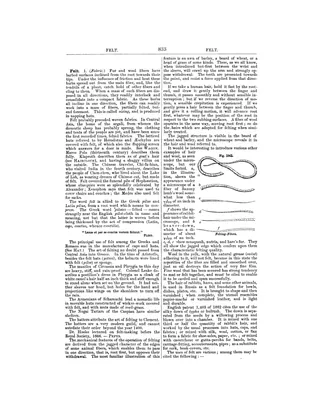
Two-page dictionary entry on felt from Knight's American Mechanical Dictionary. It explains how the barbed surfaces of wool and fur fibers interlock under friction and heat, and traces felt use from Central Asia, Greece and Rome to modern hatting. It also covers microscope views of felting fibers, unusual felting materials such as typha down, and a list of uses from clothing and tents to piano hammers and steam-packing.
Felt
Rees's Cyclopedia, 1819
Article · 1 page
A short encyclopedia entry defining felt as a stuff of wool, or wool and hair, that is neither spun nor woven but made by fulling with lees and size and shaping on a block with fire and water. It names the usual fibers (beaver, camel and coney hair, lamb's and sheep's wool) and notes that felt is used chiefly for hats. It describes the felt for a hat as formed into a funnel-shaped piece before being shaped, and refers readers to the entry HAT.
Filz [Felt]
Article · 1 page · German
A short German encyclopedia entry defining felt as a structure of tangled animal hairs, chiefly sheep's wool, hare and rabbit fur, whose fibers are bonded by bowing, felting and fulling rather than weaving. It lists uses such as hats, steam cylinder coverings, damping in musical instruments and shoes. It also notes the papermaking sense of the term: a coarse, loosely woven, lightly fulled woolen cloth placed between sheets of paper when they are removed from the mold.
Felt
Article · 2 pages
Two-page encyclopedia article on felt as a fabric made without weaving. It covers the origin of felt making, the scaly structure of wool and hair that causes fibres to interlock, the first mechanical felting process (J. R. Williams, c. 1820), and the uses of felt, including hats, floor coverings, piano hammers, and roofing and lining felts. It ends with a bibliographic pointer to Murphy's The Textile Industries and 1909 U.S. census statistics on felt manufacture.
Felt, Felting
Chambers's Encyclopedia, 1881
Article · 2 pages
A two-page encyclopedia article explaining felt as a fabric formed without weaving, through the interlocking of barbed hair and wool fibres under moisture, pressure and beating. It recounts the St Clement hatters' legend, describes beaver-hat felting by hand and machine felting of waste wool, and lists uses such as carpeting, drugget, padding, saddles, boiler sheathing and asphalted roofing felt.
Felting
Rees's Cyclopedia, 1819
Article · 1 page
A single-page encyclopedia entry on felting from Rees's Cyclopedia. It describes how hatters turn fur, hair and wool into cloth without spinning or weaving, by bowing the fibers apart, layering them, and working them with moisture and pressure so they twist together. It explains why wool's naturally crooked fibers felt readily, while straight hairs such as beaver and rabbit must be prepared first, and it refers readers to the entries on Fulling and Hat.
Felting Machine
Article · 2 pages
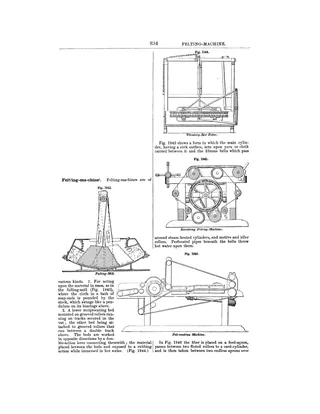
A short dictionary entry on felting machines from Knight's American Mechanical Dictionary. It describes several types, including the fulling-mill, a vibratory-bed felter with reciprocating beds in a hot-water vat, a revolving felting machine with a cork-surfaced cylinder and steam-heated belts, and a felt-making machine that cards fiber and consolidates it under reciprocating platens. Engraved figures 1943 to 1946 illustrate each machine.
Filzfabrikation [Felt Manufacture]
Article · 2 pages · German
An encyclopedia article on felt manufacture from Brockhaus' Konversations-Lexicon. It explains how animal hairs mat together under moisture, heat, and pressure, and describes hand and machine production of felt hats: preparing fur and wool, forming and fulling the hat bodies, shearing, stiffening with shellac, and finishing. It ends with German import and export figures for felt goods and hats in 1900.
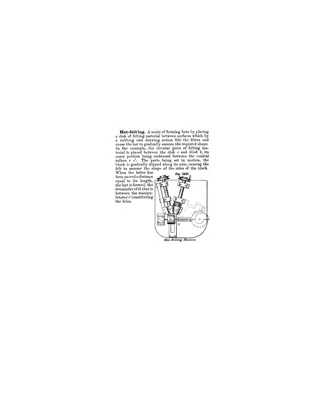
Hat-Felting
Article · 1 page
A short dictionary entry describing hat-felting, a mechanical method of forming hats by working a disk of felting material between a disk, a block and conical rollers. The rubbing and drawing action felts the fibers while the block slides along its axis, shaping the crown and leaving the brim. Illustrated with a line drawing of the machine (Fig. 2430).
Felt
Article · 1 page
A one-page encyclopedia entry defining felt as a stuff of wool, fur, or hair whose fibers are entangled and interlocked. It covers the ancient history of felt, the legend of St. Clement, how waste wool is felted by machine with heat, moisture, and beating, and its uses for carpets, hats, garments, boiler covering, and roofing. It also briefly describes making hat felt from fur such as nutria, raccoon, beaver, and rabbit.
Felt
Zell's Encyclopedia, 1876
Article · 1 page
A one-page encyclopedia entry on felt, giving its etymology and describing how it is made by carding, then combining and compressing fibres of wool or fur with heat, moisture and pressure. It lists uses including hats, printed and embossed table-cloths and carpets, roofing felt, boiler covering and ship sheathing linings, and closes with legendary accounts of its invention by St. Clement and by the Saracens.
Felt
Article · 2 pages
Encyclopedia article from the 11th edition of the Britannica describing felt as a fabric formed by matting wool, fur and hair fibers. It distinguishes woven (thread-structure) felts from true fibre felts, reviews the early history of felt in Asia and the ancient world, and outlines manufacture: mixing, willowing, scribbling, carding, ironing, fulling. It also covers hat felts and impregnated felts such as asphalted roofing felt and iron-felt, with British manufacturers named.
Pacific Bark-Cloth
Article · 19 pages
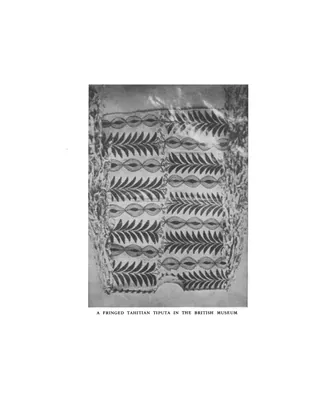
An article by Gertrude Whiting on the making, decoration and use of Pacific bark-cloth (kapa, tapa, siapo), drawing on accounts by Joseph Banks, Reinhold Forster, William Ellis, James Cook, William T. Brigham and others. It covers the trees used, stripping, soaking and beating, patching and pasting, dyeing and stamping with bamboo blocks, lace kapa, perfuming and waterproofing, sewing, and a glossary of Hawaiian, Samoan, Tahitian and Fijian terms. Comparisons are made to bark-cloth in Africa, Borneo and Malaya. Illustrations show kapa specimens from the Bishop Museum and British Museum, bamboo stamping sticks, and Hawaiian warriors with kapa beards.
Hat-Maker's Battery
Article · 1 page
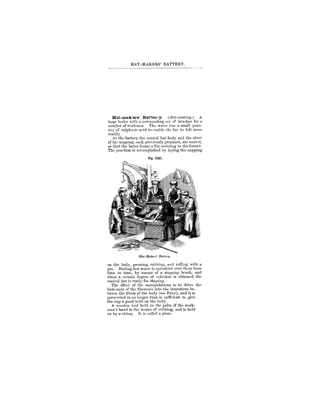
A one-page dictionary entry on the hat-makers' battery, a large boiler surrounded by workbenches where fur napping is joined to a conical felt hat body. It explains the use of slightly acidulated hot water, the pressing, rubbing and rolling that felt the fur onto the body, and the wooden 'glove' used for rubbing. An engraving (Fig. 2435) shows workmen around the boiler with a hoist.
A Utility Bag
Article · 2 pages
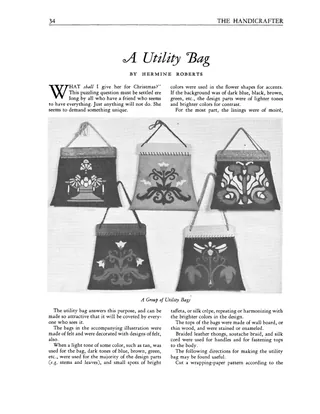
A 1931 magazine article giving instructions for making a decorative utility bag from felt, trimmed with applied felt cut-out designs. It covers color choices, linings, wood or wall board tops, and handles of braided leather, soutache braid or silk cord. Step-by-step directions refer to diagrams with pattern dimensions, a symmetric design panel, and a drilled wooden top strip. A supplier's advertisement for bag frames and linings follows.
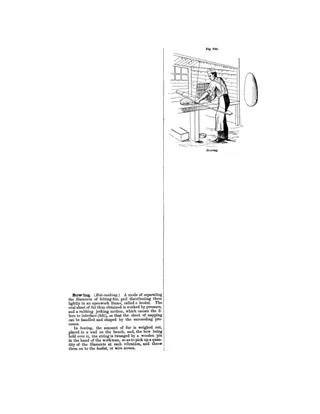
Bowing
Article · 1 page
A short dictionary entry on bowing, the hat-making process of separating felting-fur fibers with a vibrating bowstring and depositing them on a basket or wire screen. The resulting sheet of fur is then worked by pressure and rubbing so the fibers felt together. An engraving (Fig. 544) shows a workman at a bench with a suspended bow over a wad of fur.
Brim Stretcher
Article · 1 page
A short dictionary entry describing the brim stretcher, a machine that stretches the brims of felt hats out from the edge of the rough cone-shaped hat body. It explains the treadle-operated spindle, the spreading ribs worked by a hand lever, the crank-driven vibrating ribs and the working sequence. It also notes that such machines had largely replaced the old hand method of blocking soft wool and fur hats.
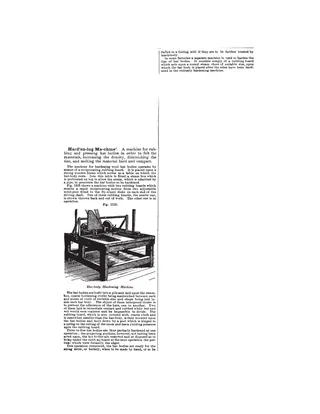
Hardening Machine
Article · 1 page
A one-page dictionary entry on the hardening machine used in hat making to felt and compact hat bodies by rubbing and pressing them with steam. It describes the wooden table with a perforated steam box, reciprocating rubbing boards driven by wrist-pins on flywheel disks, and the spring-loaded pressure post. It also explains how hat bodies are piled with separating cloths, partially hardened, and repositioned, and mentions a separate tip-hardening machine. A line drawing of the machine is included.
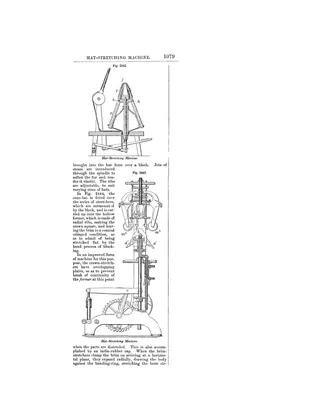
Hat-Stretching Machine
Article · 2 pages
A two-page dictionary entry describing machines that stretch felt hat-cones into shape before blocking. It explains radially arranged hinged arms, stretcher levers, ribs and rollers that crimp or stretch the body, and the use of steam through the spindle to soften fur. Illustrated with figures 2441 to 2443 showing sections and elevations of the apparatus.
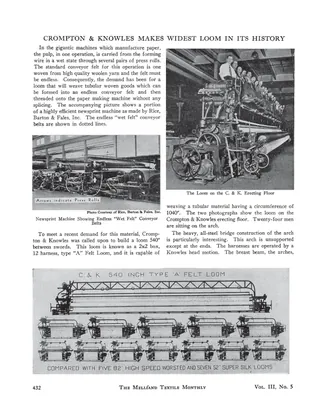
Crompton & Knowles Makes Widest Loom in its History
The Melliand, August 1931
Article · 2 pages
A short trade article from 1931 describing a very large felt loom built by Crompton & Knowles for weaving tubular, endless woolen conveyor felts used on paper-making machines. It gives the loom's specifications (540-inch reed space between swords, 12 harnesses, 2x2 box, Knowles head motion, two motors, 30 picks per minute, about 20 tons) and compares its floor space with that of smaller worsted and silk looms. Illustrated with photographs of a newsprint machine and the loom on the erecting floor.
Fulling
Domestic Encyclopedia, 1821
Article · 1 page
A one-page encyclopedia entry defining fulling (also called milling) as the cleansing, scouring and pressing of cloth, stuffs and stockings to make them firmer. It describes the water-powered fulling mill, the use of urine, fuller's earth and soap, and how the felting of wool fibres shrinks and thickens the cloth. It also covers the different handling of stockings and caps, which are fulled by foot, by hand or with toothed wooden racks.
Hat
Article · 2 pages
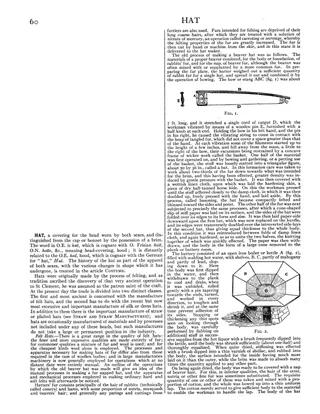
Two-page encyclopedia article on hats from the 11th edition of the Encyclopaedia Britannica. It describes the manufacture of felt hats, covering the old hand process for beaver hats (fur preparation, bowing, basoning, battery, napping) and later machine forming of fur and wool bodies. It also briefly covers the making of silk hats. Two figures show the hatter's bow and the battery kettle.
Hat-body Sizing Machine
Article · 1 page
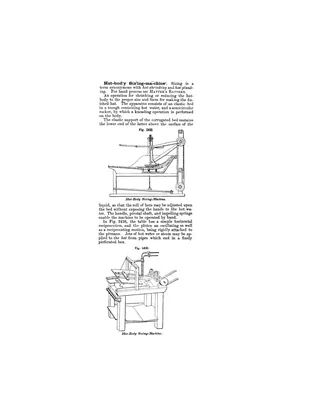
A short dictionary entry from Knight's American Mechanical Dictionary describing machines for sizing (shrinking or planking) felt hat-bodies to the proper size and form. It explains a trough machine with a corrugated elastic bed and semicircular rocker that kneads the body in hot water, and a table-type machine with reciprocating table and oscillating platen, with jets of hot water or steam. Two line drawings (Figs. 2425 and 2426) illustrate the machines.
Hat-fulling Machine
Article · 1 page
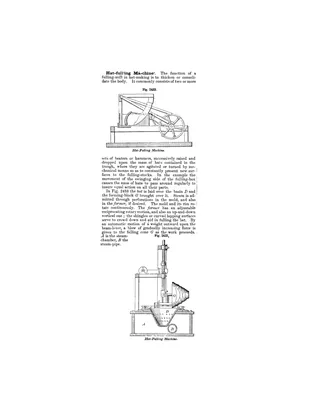
A short dictionary entry describing machines used to full (thicken and consolidate) felt hat bodies. It explains how a fulling mill uses beaters or hammers on hats in a trough, and how a steam-heated machine presses the bat with a forming block. Two line drawings (Figs. 2432 and 2433) illustrate the machines.
Hat-Hardening Machine
Article · 1 page
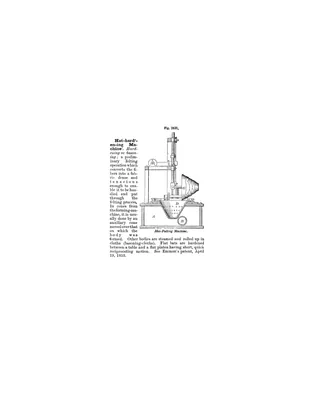
A short dictionary entry from Knight's American Mechanical Dictionary describing the hat-hardening (basoning) machine, a preliminary felting step that makes fiber bodies dense enough to handle before full felting. It explains how cone bodies are hardened with an auxiliary cone, how other bodies are steamed and rolled in basoning cloths, and how flat bats are hardened between a table and a reciprocating platen. A cross-section drawing (Fig. 2433) of a hat-fulling machine is included, and Emmon's 1853 patent is cited.
Hat-Pouncing Machine
Article · 1 page
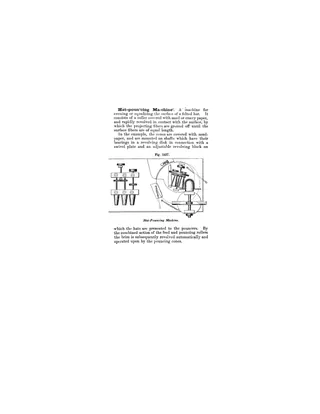
A short dictionary entry describing the hat-pouncing machine, which evens the surface of a felted hat by grinding off projecting fibers with sand- or emery-paper-covered rollers. The illustrated example uses sandpaper-covered cones on shafts in a revolving disk, with a swivel plate and an adjustable revolving block that holds the hat. A line drawing (Fig. 2437) shows the machine.
Hats
Article · 1 page
An 18th-century encyclopedia entry on hats. It describes the making of felt hats from beaver fur and other animal hair: bowing, felting, fulling, blocking, singeing, dyeing, stiffening and finishing. It briefly notes the hat trade in England and the plaiting of women's hats from chip, straw or cane, and the weaving of hats from horse-hair and silk.
Hats and Caps
Article · 3 pages
A three-page encyclopedia article on the hat and cap industry in the United States around 1906. It surveys materials (rabbit and hare fur, wool, cloth, straw) and centers such as Danbury, Connecticut, then describes step by step how fur felt hats are made by machine and how silk hats are built from shellacked cambric covered with silk plush.
Minnesota Weavers Guild Calendar (October-November 1983)
Minnesota Weavers Guild Calendar, October-November 1983
Periodical · 5 pages
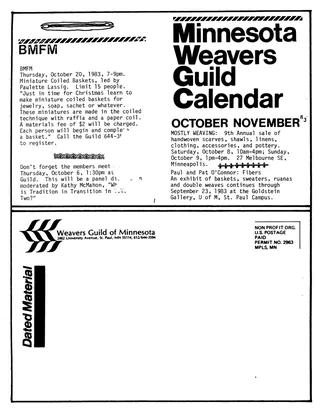
October-November 1983 issue of the Weavers Guild of Minnesota's calendar newsletter. It has a co-president's message, board minutes from July 1983, an announcement of a feltmaking workshop with Rowen Schussheim, committee news (Harrisville Yarns feature), and bulletin board ads for looms. The last page is a calendar of classes, workshops, member meetings and the November Fiber Fair, with instructors and fees.
Tufted-Fabric Machine
Article · 1 page
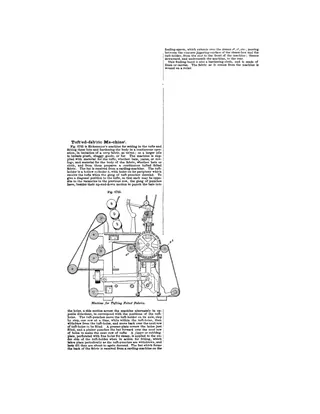
A one-page dictionary entry from Knight's American Mechanical Dictionary describing Eickemeyer's tufted-fabric machine (Fig. 6765). The machine sets tufts of bat, yarn or roving into a felted body in a continuous operation, imitating terry, velvet, plush, shaggy goods or fur. The text explains the tuft-holder cylinder, reciprocating tuft-punches, presser-plate, steam jigger and feeding/hardening band, and is accompanied by a side-elevation diagram.
Hat
Rees's Cyclopedia, 1819
Article · 3 pages
Excerpt from Rees's Cyclopedia (1819) on hats. It describes how beaver felt hats were made: preparing the fur, bowing, basoning, fulling, blocking, dyeing, stiffening and finishing. It also summarizes British laws on hat retailing, duties and exports, and notes briefly that women's hats were made from various materials and that the hat was a symbol of the cardinalate.
Hat
Article · 3 pages
Encyclopedia article on the hat covering its history from ancient Greek and Roman head coverings through medieval, Tudor, Stuart and nineteenth-century styles. It also describes hat manufacture, with an account of the early American hat trade and detailed processes for fur felt, wool felt, silk and straw hats. It closes with 1909 and 1913 US production values and two references for further reading.
Hat Making
Article · 2 pages
An encyclopedia entry on the manufacture of felt hats, focused on the United States. It contrasts the older hand methods (bowing fur or wool into bats, felting on the battery, blocking and finishing) with the machinery that replaced them: forming, hardening, fulling, finishing lathes, stretching, blocking, shaping and pouncing machines. It names inventors and companies, distinguishes wool-hat from fur-hat production, and ends with cross-references to other dictionary entries and to Scientific American articles.
Hat-Making Machinery
Article · 12 pages
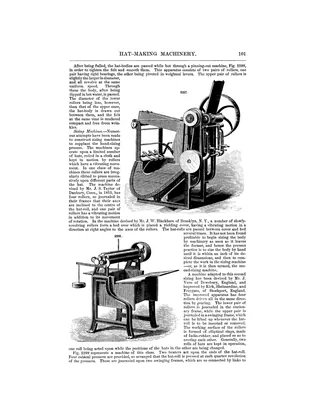
An 1889 encyclopedia article describing the machinery used in 19th-century American felt hat manufacture, covering both fur hats and wool hats. It follows the process from fur preparation and blowing, forming, hardening, sizing, fulling and stiffening through stretching, blocking, pouncing, ironing and finishing. Machines are illustrated with numbered engravings (Figs. 2295-2316), many credited to R. Eickemeyer of Yonkers, N.Y.
Hats
Article · 4 pages
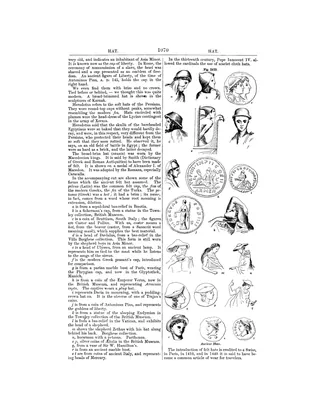
Encyclopedia entry on hats from Knight's American Mechanical Dictionary, covering the history of hats from antiquity (Greek, Persian, Roman forms, the Phrygian cap, the petasus) through the introduction of felt hats in medieval Europe. It describes hand and machine methods of making felt and fur hat bodies, including bowing, basoning, planking, the Wells perforated cone, and the finishing of silk plush hats. It also lists the parts of a hat, kinds of hats, and the preparation and plaiting of Panama straw, with illustrations of ancient hats, a hat diagram and a hat-blocking machine.
The Bulletin of the Needle and Bobbin Club, Vol. 40, Nos. 1 & 2 (1956)
Periodical · 50 pages
A double issue of the Bulletin of the Needle and Bobbin Club devoted to a single article by John F. Haskins on the Pazyrik kurgans (frozen tombs) of the Siberian Altai. It covers the excavations by Griaznov and Rudenko, the dating and the identity of the people buried there (Scythians, Massagetae, Ta Yueh-chih), and the preserved textiles of Kurgan Five. These include felt wall hangings with appliqu\u00e9s, felt saddle covers, linen and wool tapestries, Chinese silk with chain-stitch embroidery, and the pile carpet called the world's oldest. The issue has plates and line drawings, endnotes with Russian and Western references, club notes and a list of officers.
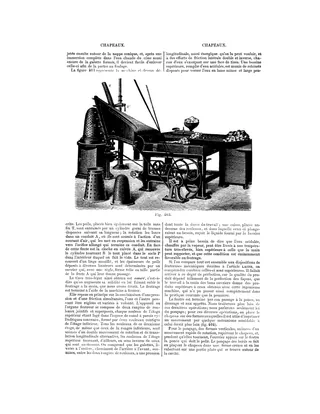
Chapeaux [Hats]
Article · 7 pages · French
A French encyclopedia article on hat manufacture, covering felt hats in the most detail: fur and wool selection, secretage with mercury solutions, bowing with the arcon, basting, fulling, dyeing and finishing. It also describes an American machine that forms the felt body by air suction, mechanical felting machines, silk hats, collapsible (Gibus) hats, straw hats (Tuscan straw, Swiss and English production, Ludy's hydraulic finishing machine) and Panama hats. Illustrated with engravings of the fulling shop, bowing tool, felting machines and hat-finishing apparatus.
Hats and Their Manufacture
Article · 8 pages
An 1872 article on the history and manufacture of hats in the United States, from colonial protection and English restrictions on American hat exports through the post-Revolution trade. It describes hand felting (bowing) of fur and wool, silk plush hats, and straw, grass and palm-leaf hats and bonnets, including early women inventors such as Betsy Metcalf and Sophia Woodhouse. It also covers the introduction of felting machinery (Wells patent, 1846), census figures for hat production, and a closing argument that the tariff has damaged the export trade.
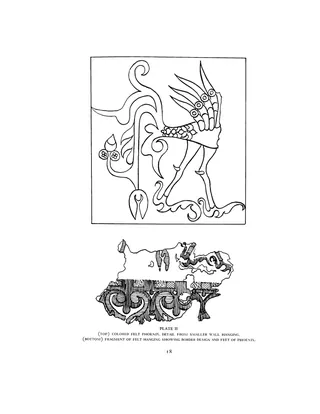
Pazyrik, the valley of the Frozen Tombs
Article · 46 pages
An article by John F. Haskins, based on a 1955 lecture to the Needle and Bobbin Club, on the Pazyryk (spelled Pazyrik) burial mounds of the Siberian Altai and their frozen contents. It covers the Griaznov and Rudenko excavations, the debate over whether the builders were Scythians or Massagetae (Ta Yüeh-chih), and the dating of the finds. The main focus is Kurgan Five and its textiles: felt wall hangings and saddle covers with appliqué, linen and wool tapestries, imported Chinese silk with chain-stitch embroidery, and a knotted-pile woolen rug with elk, griffon and horseman borders. Plates and line drawings illustrate the textiles, and endnotes cite Russian, Chinese and classical sources.
Of Fiber - Fabric Finishes
Article · 1 page
A one-page article for handweavers on finishing fabric after it comes off the loom. It explains why greige goods need further work and describes three home finishing processes: shrinking (wet-finishing), fulling of wool by heat, detergent and pressure, and napping or gigging to raise the surface fibers. It ends with advice to test each method on a sample and to choose a finish according to how the fabric will be cared for.
Planking Machine
Article · 1 page
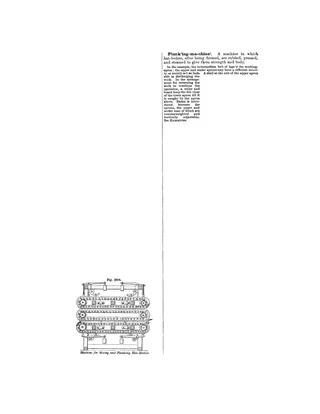
A short dictionary entry from Knight's American Mechanical Dictionary describing the planking machine, used in hat making to rub, press and steam formed hat-bodies so they gain strength and body. The text explains the arrangement of stacked aprons of lags, steam introduction and the return of the work, with an illustration (Fig. 3304) of a machine for sizing and planking hat-bodies.
Blocking Machine
Article · 2 pages
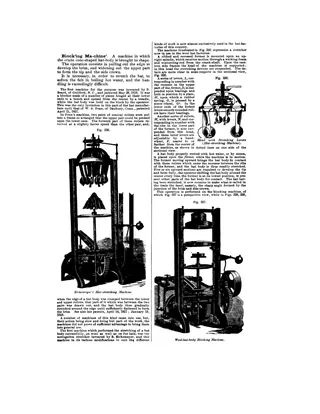
A dictionary entry from Knight's New Mechanical Dictionary on hat blocking machines, which shape the felt hat body into brim and crown. It traces the history from D. Beard's 1816 patent through W. A. Fenn's 1857 roller machine to R. Eickemeyer's corrugation stretcher, then describes how the stretching and banding (blocking) machines work. Illustrated with figures of the stretcher, its head with levers, and three positions of the banding machine.
Hat-napping Machine
Article · 1 page
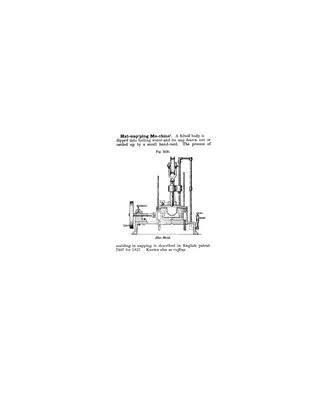
A short dictionary entry on the hat-napping machine, reproduced from Knight's American Mechanical Dictionary. It explains that a felted hat body is dipped in boiling water and its nap raised with a small hand-card, a process also called ruffing, and cites an 1837 English patent. A line drawing (Fig. 2436) shows a hat mold on a base with a lever press, hand crank wheel and water valve.
[Hats]
Article · 2 pages
Two pages of dictionary entries on hat-making terms and machinery, excerpted from Knight's American Mechanical Dictionary. Entries define hat blocks, hat-bodies, brushing, planking, stiffening and perforating machines, hat-measuring devices, ventilators, napping, and tools like the rounding-gage. A short entry describes preparing Tuscan straw for straw hats, and another defines sennit (plaited straw).
Notes on the Needlework of South Eastern Europe
Article · 9 pages
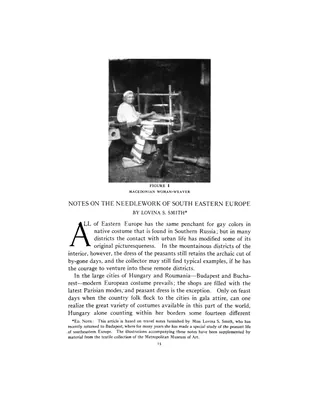
A 1922 article based on travel notes by Lovina S. Smith describing peasant costume and needlework in Hungary, Roumania, Macedonia, Croatia, Slovakia and Bosnia. It covers Magyar felt Szúr coats with cloth appliqué, wedding coats, aprons, Roumanian embroidered blouses and skirts, and the outdoor tree loom. Illustrated with photographs of costumes and museum specimens from the Metropolitan Museum of Art, including a Macedonian woman weaver at her loom.
102 documents found