Textile Documents › Authors › Author: Gertrude Whiting
11 documents found
Sort: 
German Val and "Val de Dieppe"
Article · 2 pages
A short 1917 article distinguishing hand-made "German Val" from true French or Belgian Valenciennes lace, and describing "Val de Dieppe." It explains the differences in ground (four-thread braided versus two-thread twisted), the "roue" outline, and the terminology of "real," "true," "imitation" and machine copies. It describes three sample edges (Bohemian, Swiss, Italian) shown in an illustration, and the three-thread tulle ground of Dieppe Val.
Guild of the Needle and Bobbin Crafts
Article · 3 pages
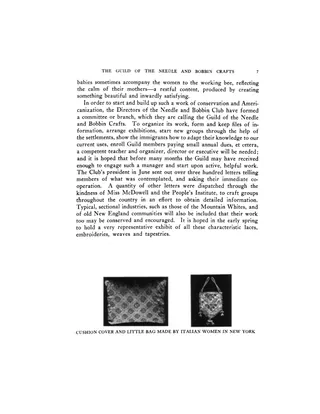
A short article from the Bulletin of the Needle and Bobbin Club announcing the formation of the Guild of the Needle and Bobbin Crafts, a committee of the club. The Guild aims to enlist immigrant women in New York, especially Italian and Ukrainian women, to practice and sell the embroidery, lace and weaving they learned in their native lands, as a form of cultural conservation and Americanization. The text quotes a People's Institute pamphlet on immigrant arts and describes plans for a director, file of information, settlement groups and an exhibition. One photograph shows a cushion cover and little bag made by Italian women in New York.
A Lace Guide for Makers and Collectors
Book · 411 pages
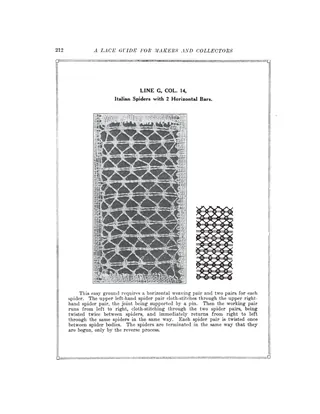
A 1920 guide to bobbin lace by Gertrude Whiting, founder of the Needle and Bobbin Club, written for lace makers and collectors. It has introductory and advice chapters, a five-language lace nomenclature (English, French, Italian, Spanish, German), and detailed rules for making 145 bobbin lace grounds and fillings. These are arranged by line and column of the author's sampler (Torchon, Valenciennes, Devonshire, Flemish, Italian spiders, Buratto/filet, and her own 'Trude' grounds), each with a halftone photograph and a pricking or stitch diagram. The second half is a very large bibliography of lace and needlework literature, followed by an index of the grounds and a description of the accompanying sampler held at the Metropolitan Museum of Art.
Netted Feather Robes
Article · 8 pages
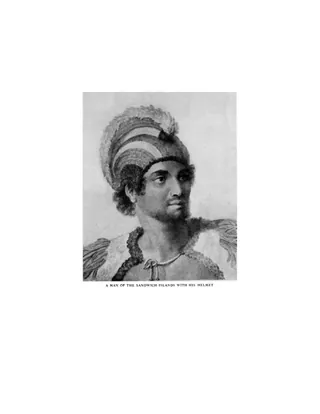
An article on the netted feather cloaks, capes and helmets of Hawaii, made by tying tufts of small feathers to a filet mesh of olona fibre. It describes how the birds were caught, the feather types and colors used, the designs, and the famous royal pieces such as Kamehameha's mamo cloak. It also covers collections in the Bishop Museum and elsewhere, and briefly mentions feather fabrics from Brazil and China. Illustrations show a Hawaiian man in a helmet, King Kaumualii's helmet and King Kamehameha in his cloak.
Notes on Navajo Weaving
Article · 2 pages
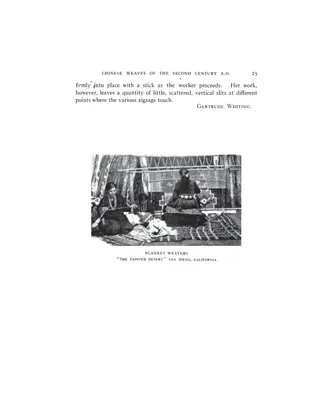
A short note comparing how weft colors are handled in ordinary weaving, in Gobelins tapestry, and in Navajo weaving. The author explains that a Navajo weaver fills in areas of color with whatever length of yarn she has, producing irregular zigzag boundaries and small scattered vertical slits, and beats the work down with a stick. A photograph shows two blanket weavers at a loom, captioned as from "The Painted Desert," San Diego, California.
Pacific Bark-Cloth
Article · 19 pages
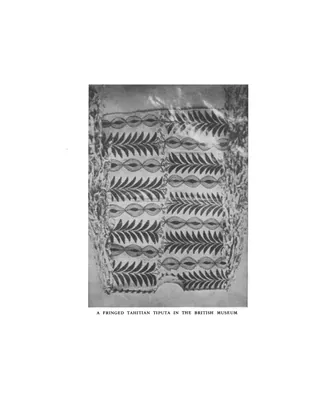
An article by Gertrude Whiting on the making, decoration and use of Pacific bark-cloth (kapa, tapa, siapo), drawing on accounts by Joseph Banks, Reinhold Forster, William Ellis, James Cook, William T. Brigham and others. It covers the trees used, stripping, soaking and beating, patching and pasting, dyeing and stamping with bamboo blocks, lace kapa, perfuming and waterproofing, sewing, and a glossary of Hawaiian, Samoan, Tahitian and Fijian terms. Comparisons are made to bark-cloth in Africa, Borneo and Malaya. Illustrations show kapa specimens from the Bishop Museum and British Museum, bamboo stamping sticks, and Hawaiian warriors with kapa beards.
A Peep into Sericulture
Article · 4 pages
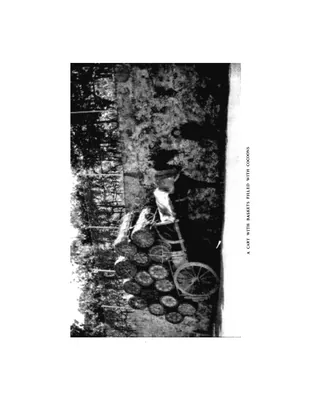
A short article by Gertrude Whiting recounting what she observed of silk production in Italy: raising silkworms on mulberry leaves, cocoon spinning, buying and weighing cocoons, killing the pupae, and reeling filaments from hot-water-softened cocoons. It also mentions Tussah silk from Manchuria, silkworm breeding experiments at Nanking, and cottage weaving of silk Roman blankets that were brushed to a shaggy surface. A photograph shows a cart loaded with baskets of cocoons, and the last page carries a 1554 dedicatory sonnet by Matthio Pagan from a Venetian pattern book as a filler.
Richelieu Collection of Samples
Article · 13 pages
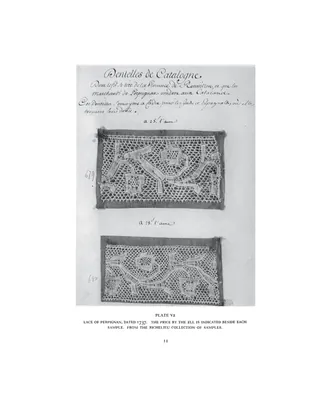
Article by Gertrude Whiting describing the Richelieu collection of textile samples (1732-1737) in the Bibliothèque Nationale, Paris, seven volumes of annotated samples of silks, cottons, linens, woolens, ribbons, gauzes and laces. It is illustrated with plates of ribbons, royal table linen of 1736, woven materials, gauzes, and Perpignan lace of 1737 with price notes. It includes a free translation of part of Richelieu's preface on the lace industry of Havre, covering prices, export to the Americas, and women's bobbin-lace wages.
Silkworm, and its Culture in Hawaii
Article · 4 pages
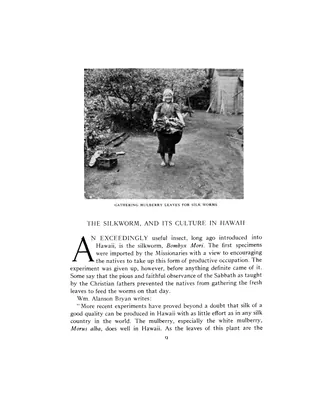
A short illustrated article on sericulture in Hawaii. It recounts how missionaries introduced the silkworm (Bombyx mori) to encourage native silk production, quotes William Alanson Bryan on the life cycle and the suitability of white mulberry, and describes the later crossing of American and Chinese worms. It ends with the decline of the industry after the 1840 drought and pest infestations. Photographs show mulberry leaf gathering, silkworms feeding, moths and eggs, and moths in a cultivator's tray.
Swiss Lace Patterns
Article · 14 pages
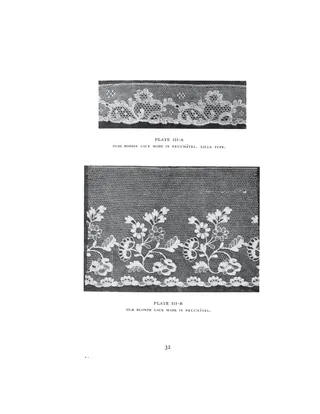
An illustrated article on the history of lace-making in Switzerland, drawn from material collected by Gertrude Whiting. It covers the c. 1561 Zurich pattern book Nüw Modelbuch, the Neuchâtel and Jura bobbin lace industry, its peak in the late 18th century and its collapse after 1817. It also describes the Société Neuchâteloise d'Emulation's prize attempts, a large album of over 2,000 lace patterns found at Couvet, and later revival efforts. A translated account of domestic lace-making life in the Jura covers pillows with bollets, pricked patterns and the lacemaker's lamp. Plates show pattern book pages, Neuchâtel laces, signed pattern drawings, a lace pillow, a lamp and a Swiss lacemaker's house.
The Tercentenary of Colbert: The Great Patron of the French Lace and Textile Industries—1619-1919
Article · 5 pages
A biographical article marking the 300th anniversary of Jean Baptiste Colbert's birth, Louis XIV's finance minister. It covers his financial reforms, public works, tariffs and state regulation of industry, then turns to the Royal Manufactories he founded. The lace section describes how Venetian and Flemish lace-makers were brought to France, the centres at Alençon and Argentan, the central depot in Paris, and the creation of Point de France, with its monopoly from 1665 to 1675.
11 documents found