Textile Documents › Publications › Publication: Dictionnaire des Arts et Manufactures et de L'Agriculture
19 documents found
Sort: 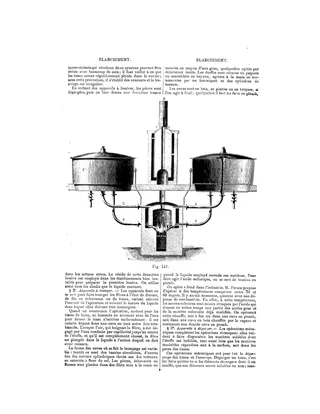
Blanchiment [Bleaching]
Article · 22 pages · French
A French encyclopedia article on the bleaching of textile fibers and fabrics (cotton, linen, hemp, wool and silk). It explains the theory of removing natural and added impurities, then describes the apparatus used for lye boiling, steeping, rinsing, washing and wringing, with engraved figures of vats, boilers, washing wheels, squeezing rollers and sizing and drying machines. It also covers chlorine and chloride-of-lime bleaching, souring and sulfurous acid treatments, finishing, and the specific practice for linen and hemp, wool (scouring and sulfuring) and silk (degumming and sulfuring).
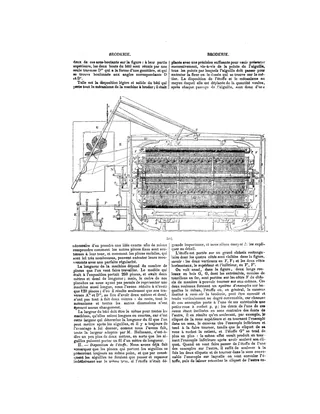
Broderie [Embroidery]
Article · 10 pages · French
A French encyclopedia article on embroidery (broderie) from a dictionary of arts, manufactures and agriculture. It opens with a historical survey of embroidery and tapestry in antiquity, citing the Bible, Homer, Pliny and Ovid, then covers canvas embroidery (tapestry stitches such as petit point, gros point and chain stitch) and its materials and patterns. The article describes hand embroidery frames (screw and slat types) with proposed improvements, and ends with a long technical description of a Heilmann-type embroidery machine with pantograph, grippers and needles.
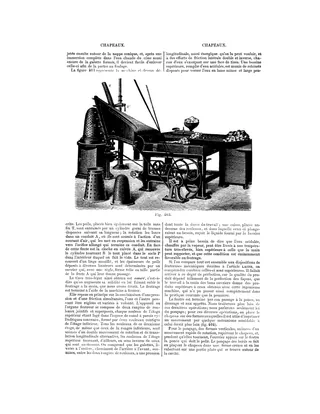
Chapeaux [Hats]
Article · 7 pages · French
A French encyclopedia article on hat manufacture, covering felt hats in the most detail: fur and wool selection, secretage with mercury solutions, bowing with the arcon, basting, fulling, dyeing and finishing. It also describes an American machine that forms the felt body by air suction, mechanical felting machines, silk hats, collapsible (Gibus) hats, straw hats (Tuscan straw, Swiss and English production, Ludy's hydraulic finishing machine) and Panama hats. Illustrated with engravings of the fulling shop, bowing tool, felting machines and hat-finishing apparatus.
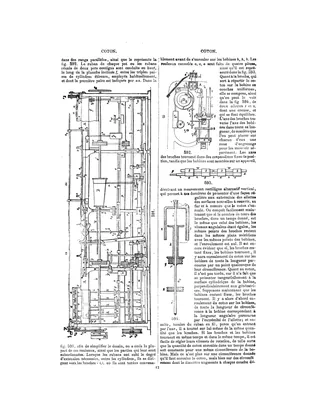
Coton [Cotton]
Article · 22 pages · French
A French encyclopedia article on cotton and cotton spinning from a dictionary of arts, manufactures and agriculture. It covers the botany and cultivation of the cotton plant, harvesting, ginning (roller gin and saw gin), and the history of spinning machinery (Jenny, throstle, mule-jenny, self-acting). It then describes the preparation and spinning sequence: opening and cleaning, batting, carding, drawing, roving frames, continuous and mule spinning, with many engraved machine figures. It ends with a short section on cotonisation, the attempt to make cotton-like fibre from hemp and flax.
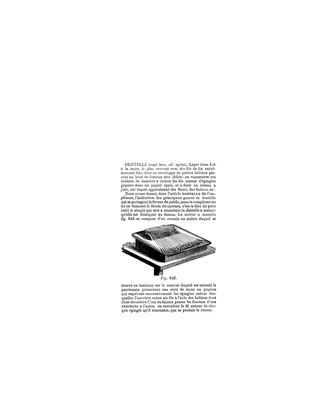
Dentelle [Lace]
Article · 2 pages · French
A two-page French encyclopedia entry on lace (dentelle). It briefly defines bobbin lace and describes the lace pillow (carreau) with its drum and pricked parchment, shown in an engraving (Fig. 646), then notes needle lace. Most of the text covers machine-made lace: the tulle machine, the Pusher vertical tulle loom with Jacquard control, the machine-made guipure for furnishings from 1850, the net ground (fond filet) of 1872, copies of Venetian point and Cluny guipures, and colored and embroidered finishing.
Fil D'Or et D'Argent [Gold and Silver Thread]
Article · 2 pages · French
French encyclopedia article on gold and silver thread, covering drawn precious-metal wire and silk threads wrapped with thin flattened gilt or silver strip. It describes the use of these threads in passementerie for military epaulettes, belts and braids, and the shift from pure silver or gilt copper cores to mixed silver-over-copper wire. It then reports M. Hélouis's improvement of 'mi-fin' by using nickel silver (maillechort) wire, and his coloring of metal strips with galvanic lead-peroxide deposits following Nobili and Becquerel. It also mentions the effect of foreign competition on Lyon manufacture.
Fil de Laine Floche [Floche Wool Yarn]
Article · 2 pages · French
A two-page encyclopedia entry on "fil de laine floche," a soft, loosely twisted worsted yarn made from long combed wool for needlepoint tapestry and fine knitwear. It traces the history of the yarn in France (from the older fil d'Estain to the first French production in the 1820s-1830s) and compares French merino-cross yarns with those of Berlin. It also advises on choosing fleeces and preparing combed wool (washing, steaming, pressing, light beating) before spinning.
Fil Retors [Plied Thread]
Article · 2 pages · French
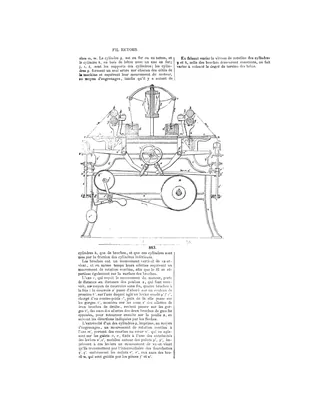
A short 19th-century French encyclopedia entry describing a machine for twisting several strands of cotton, wool or linen into a single plied thread for sewing, netting and similar uses. It explains the parts shown in a transverse section (figure 883): bobbins, glass guide rods, water troughs for wetting the thread, drawing cylinders, spindles with flyers, belt drives and heart-shaped cams. It also notes how varying the cylinder speed against constant spindle speed changes the degree of twist.
Filets [Nets]
Article · 2 pages · French
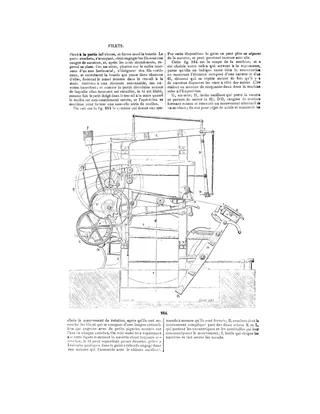
A short French encyclopedia article on nets (filets), explaining how fishing nets are made by hand with a mould and shuttle, with each mesh held by a knot. It then describes the mechanical net-making machine of the French engineer Pecqueur, shown at the 1849 Exposition and awarded a prize by the Société d'encouragement. The text explains how hooks, shuttles and eccentrics form the loops and knots, and a cross-section figure (fig. 884) has labeled parts.
Impression sur étoffes [Printing on Cloth]
Article · 52 pages · French
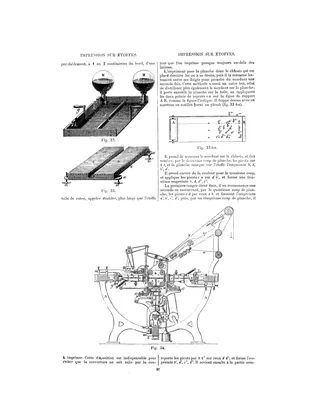
A long French encyclopedia article on printing textiles, from the Dictionnaire des Arts et Manufactures et de l'Agriculture. It opens with a history of cloth printing from antiquity through the 18th-century French and English calico industries. It then covers the chemistry of thickeners, albumin fixatives, mordants, madder dyeing, Turkey (Adrianople) red, indigo and other colours, with recipes. The later chapters describe printing methods (hand block, Perrotine, roller machines) and auxiliary apparatus such as steaming, drying, padding and silk degumming equipment, illustrated with many engraved figures.
Indigo
Article · 4 pages · French
A French encyclopedia article on indigo covering the source plants, extraction by fermentation, commercial types, quality testing and chemical properties. It gives instructions for setting up a cold indigo vat with potash, iron sulfate and lime, then a long section on reducing indigo with sodium hydrosulfite (Schutzenberger and de Lalande's process). It covers hydrosulfite preparation with zinc, vat dyeing of wool and cotton, and printing with reduced indigo (gummed blue) on textiles.
Jute
Article · 3 pages · French
A French encyclopedia article on jute, the fibre from Corchorus plants used in India for gunny sacks and coarse cloth. It covers the European jute trade and the spinning industry in Britain and France, including the batching treatment with oil and water, the long-fibre combing process and the carding process, and the machines used in each. It also discusses blending jute with hemp, flax, cotton, wool or silk, yarn numbering, the difficulties of dyeing and bleaching jute, and its poor durability when washed. It is signed Trignot (de Pont-Remy).
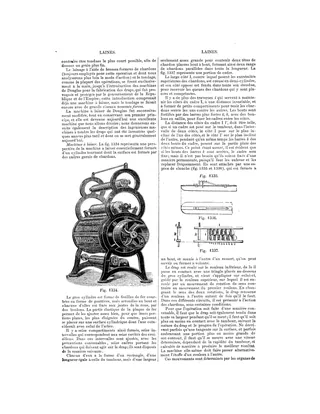
Laines [Woolens]
Article · 32 pages · French
A long French encyclopedia article on the manufacture of woolen fabrics, from the properties and classification of wool to the finished cloth. It covers the wool fibre and its felting ability, the main wool-producing countries, and the French centers of manufacture (Elbeuf, Sedan, Reims, Louviers, Aubusson and others). It then describes combing, carding, spinning, fulling, teasing with teasels, shearing, pressing and finishing, and felt making, with many engraved illustrations of the machinery used at each stage.
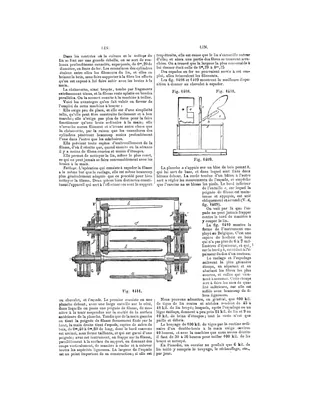
Lin [Flax]
Article · 20 pages · French
A 20-page French encyclopedia article on flax (lin) and, in part, hemp, from a dictionary of arts, manufactures and agriculture. It covers the history of flax use from antiquity (citing Pliny) and Philippe de Girard's invention of mechanical flax spinning, then its spread through Leeds, Belfast, Belgium and northern France. It also describes flax cultivation and grades, retting, breaking, scutching, combing, drawing, roving and dry and hot-water spinning, with many engraved machine figures. It ends with tables of power requirements and daily output per 100 spindles.
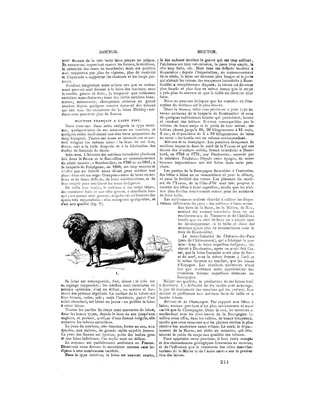
Mouton [Sheep]
Article · 17 pages · French
A French encyclopedia article on the sheep (mouton) from the Dictionnaire des Arts et Manufactures et de L'Agriculture. It surveys French sheep breeds (Flemish, Vendean, Breton, Provençal, Poitevin, Berrichon, Beauceron and others), grouping them by wool type: coarse, common and fine merino. It discusses merino and crossbred (métis) wool and its use in cloth, how to select breeding animals, and the improvement of native flocks by crossing with Dishley, Southdown and merino rams. Two pages carry engravings of sheep.
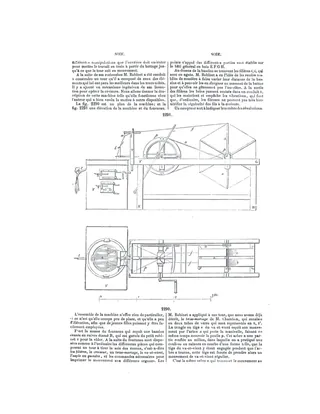
Soie [Silk]
Article · 32 pages · French
A 32-page French encyclopedia article on silk (soie) from a late-19th-century dictionary of arts, manufactures and agriculture. It covers the silk fibre and cocoon structure, mulberry cultivation, silkworm rearing and rearing-house design (d'Arcet's magnanerie), and silkworm diseases (pébrine and flacherie as studied by Pasteur). It then treats silk reeling machines (Vaucanson, Bourcier, Robinet, Locatelli), throwing or moulinage into poil, trame and organsin, reeling of skeins, and silk conditioning (drying) establishments. Illustrated with numbered engravings of machinery and apparatus (figs. 2279-2314).
Soie Artificielle [Artificial Silk]
Article · 1 page · French
A one-page French encyclopedia entry on artificial silk, as shown at the 1889 Exposition. It describes Count de Chardonnet's process: nitrating cotton or soft-wood pulp, spinning the collodion through capillary glass tubes, then denitrating the threads with dilute nitric acid to remove their explosive properties. It also gives the density, breaking load, elasticity, diameter range and dyeing of the resulting fiber.
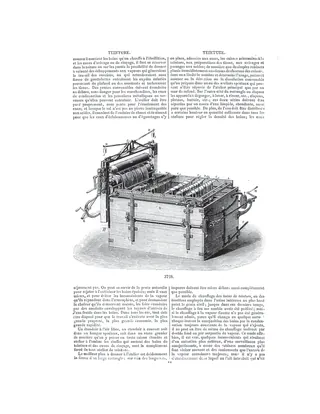
Teinture [Dyeing]
Article · 128 pages · French
A long French encyclopedia article on dyeing (teinture) from a dictionary of arts, manufactures and agriculture. It defines dyeing, surveys the textile fibers (cotton, linen, wool, silk) and the industries around them, and discusses theories of dye fixation, mordants, and the nature, origin and preparation of natural and synthetic coloring matters (madder, orchil, indigo, Chinese green, weld, fustic, aniline dyes and others). Later sections cover dyeing practice and machinery, with engraved figures of extraction apparatus, dyeing vats and wringing machines, and end with the relation of dyeing to printing (resists, discharges) and the analysis of dyed and printed colors.
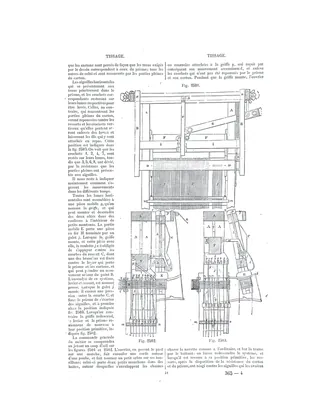
Tissage [Weaving]
Article · 40 pages · French · weaving drafts
A long French encyclopedia article on weaving (Tissage) from a dictionary of arts, manufactures and agriculture. It covers the history of weaving, general principles of warp and weft, a classification of fabrics into classes and genres, and the preparation of yarns (bobbin winding, warping, sizing, wetting of weft). It then treats heddles and weave structures (plain, twill, satin, velvet pile), squared-paper design drafting (mise en carte), hand and power looms, and the Jacquard mechanism with punched cards and shawl looms. It ends with velvet weaving, a table of thread counts for 33 cotton fabrics, and high-warp and low-warp tapestry weaving at the Gobelins. Many engraved figures numbered 2438-2506 illustrate looms and fabric structure.
19 documents found