Textile Documents › Publications › Publication: Great Industries of the United States
18 documents found
Sort: 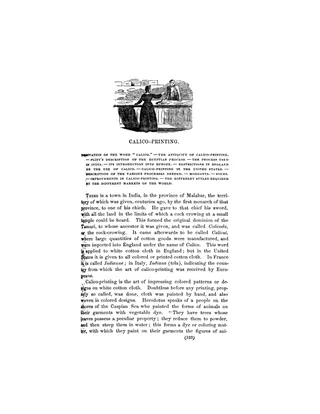
Calico Printing
Article · 10 pages
An 1872 article on calico printing from Great Industries of the United States. It traces the word 'calico' and the early history of printed and painted cloth in Egypt, India and Europe, including English restrictions on printed calico and the industry in the United States. It then describes the process: singeing, bleaching, mordants and thickeners, block, Perrotine and cylinder printing, dunging, and the madder, padding, resist, discharge and China-blue styles. Illustrated with an engraving of a shop scene and a factory building.
Card Clothing
Article · 5 pages
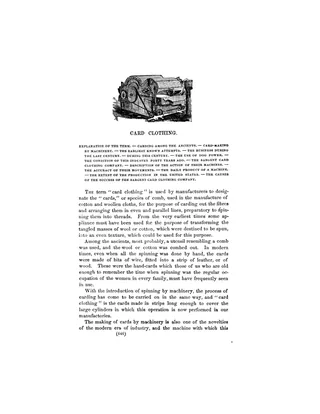
A 1872 article on card clothing, the wire-toothed leather strips used to cover carding cylinders in cotton and wool mills. It traces card-making from hand-cards to machine production in the United States, with early inventors such as Nathaniel Niles, Oliver Evans, Crittenden and Amos Whittemore, and the early use of dog power in Worcester County, Massachusetts. The second half describes the Sargent Card Clothing Company of Worcester, how its tooth-setting machines work, and its daily output compared with the national total.
Carpets
Article · 6 pages
A general historical essay on carpets from the 1872 series Great Industries of the United States. It traces carpets from their origins in the East, through Egypt, Persia, Greece and Rome, to their late arrival in Europe, with notes on tapestry (the Bayeux tapestry, Mortlake, Beauvais). The final pages cover carpet use and manufacture in the United States, from rag carpets and William Peter Sprague's 1791 Philadelphia factory to Erastus B. Bigelow's power looms of the 1840s, and conclude with remarks on other floor coverings and changing fashions.
Cordage
Article · 4 pages
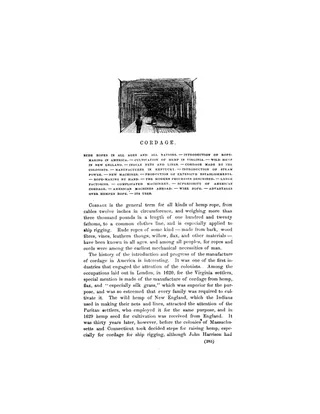
An encyclopedic article on the cordage industry from the 1872 series Great Industries of the United States. It traces rope-making in America from colonial hemp cultivation and the early rope-walks of Boston, Philadelphia, and Kentucky through the adoption of steam power and new spinning machines. It describes the old hand-spinning process on the rope-walk and the modern factory sequence of scutching, lapping, drawing, spinning, tarring, and twisting strands into rope. It closes with American cordage exports and a short note on wire rope.
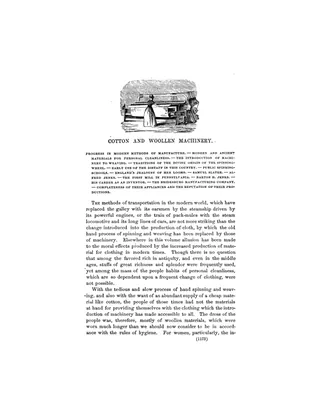
Cotton and Woollen Machinery
Article · 6 pages
A 1872 article from a US industrial survey tracing the shift from hand spinning and weaving to machine production, with emphasis on cotton and woollen machinery in America. It covers the spindle, distaff and spinning-wheel, Hargreaves, Arkwright and Crompton, English restrictions on exporting machinery, and colonial spinning-schools in Boston. It then profiles Samuel Slater, Alfred Jenks and Barton H. Jenks, and their Bridesburg Manufacturing Company near Philadelphia, describing Jenks's spindle and bobbin improvements.
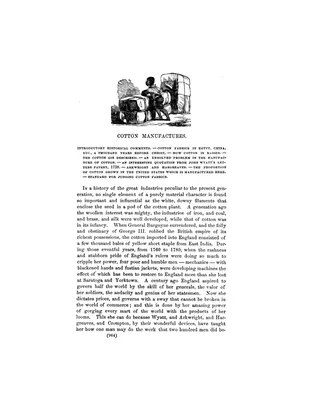
Cotton Manufactures
Article · 7 pages
A 1872 article from a multi-volume work on American industries giving a historical overview of cotton manufacture. It covers ancient cotton cloth in Egypt, India and China, how cotton is grown and ginned, and the inventions of Wyatt, Arkwright, Hargreaves, Crompton, Roberts and Whitney that mechanized spinning and weaving. It closes with the share of the U.S. crop manufactured domestically, thread count as a measure of fabric quality, and a comparison of American and English mills.
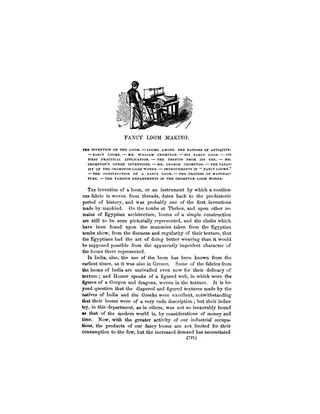
Fancy Loom Making
Article · 7 pages
A 19th-century trade article on the history and manufacture of fancy looms, centered on William and George Crompton and the Crompton Loom Works in Worcester, Massachusetts. It opens with a brief history of the loom, then covers Crompton's patented fancy loom, its first use at the Middlesex Mills in Lawrence, and later patents and improvements. It also describes the foundry and machine shops where the looms were built, and explains how the harness mechanism, pattern chain and drop-shuttle boxes distinguish a fancy loom from a plain cam loom.
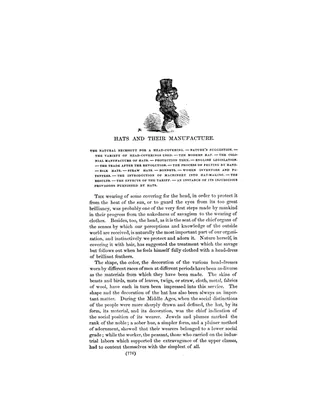
Hats and Their Manufacture
Article · 8 pages
An 1872 article on the history and manufacture of hats in the United States, from colonial protection and English restrictions on American hat exports through the post-Revolution trade. It describes hand felting (bowing) of fur and wool, silk plush hats, and straw, grass and palm-leaf hats and bonnets, including early women inventors such as Betsy Metcalf and Sophia Woodhouse. It also covers the introduction of felting machinery (Wells patent, 1846), census figures for hat production, and a closing argument that the tariff has damaged the export trade.
Knitting Machines
Article · 8 pages
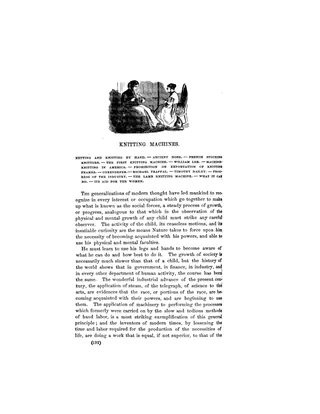
A chapter from an 1872 American industrial survey tracing the history of knitting from early netting and hand-knitted hose through William Lee's 1589 stocking frame and its spread to England and America. It covers colonial hand-knitting by women, export restrictions on frames, early American machine knitters and the move from home to factory production. It ends with a promotional description of the Isaac W. Lamb hand knitting machine and the Lamb company works at Chicopee Falls, Massachusetts.
Linen Collar and Cuff Manufacture
Article · 10 pages
An 1872 article on the industrial manufacture of linen collars and cuffs, using the Troy, New York firm of George B. Cluett, Brother & Co. as its example. It follows a collar from the design of a new style and the making of wooden patterns in graded neck sizes through cutting, the sewing-machine room, the eleven-step laundry process, inspection and packing by the dozen. It also covers the firm's stock policy, its relations with its 500 to 800 workers and a brief account of how men's and women's goods differ. It includes an engraving of the Cluett factory and has no weaving content.
Narrow Textile Fabrics
Article · 10 pages
A chapter from an 1872 survey of American industry describing narrow woven goods through a tour of the Philadelphia firm William H. Horstmann & Sons. It gives a brief biography of founder William H. Horstmann, a German-born silk weaver who came to Philadelphia in 1815 and introduced braiding machines and the Jacquard loom. It then walks through the departments: material and spooling rooms, power-loom and coach-lace rooms, braiding machines, tassel room, sword department, and the wholesale sales departments for trimmings, embroidery wools, flags, military, regalia and theatrical goods. Illustrations include the factory building and a chapter header of ribbons.
Sewing Machines
Article · 9 pages
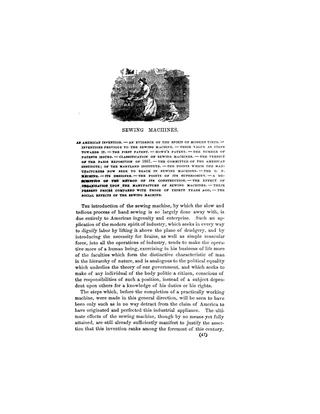
A chapter from an 1872 survey of American industry on the history and manufacture of sewing machines. It traces early patents from Weisenthal (1755) through Thimonier, Greenough and Elias Howe (1846), classifies machines by stitch type (lock-stitch, double chain-stitch, single-thread chain-stitch) and reports prize verdicts from the Paris Exposition of 1867 and American and Maryland Institute committees. Much of the text promotes the Weed Sewing Machine Company of Hartford and its G. F. "General Favorite" machine, and it closes on falling prices, factory organization and the social effects of the machine. It includes engravings, among them a view of the Weed factory.
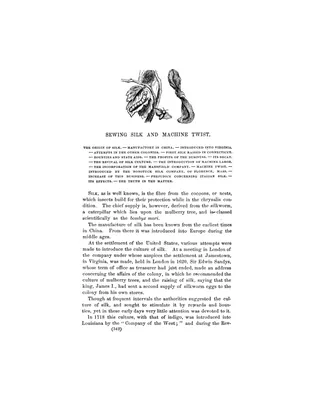
Sewing Silk and Machine Twist
Article · 5 pages
An 1872 article on the history of sewing silk and machine twist in the United States. It traces silk culture from China and the early American colonies (Virginia, Georgia, Carolina, Connecticut) through bounties, decline, and revival. It then covers the Mansfield Silk Company and the Nonotuck Silk Company's introduction of machine twist in 1852 for sewing machines. It closes with a note on the prejudice favoring Italian silk and includes a Nonotuck Silk Co. advertisement.
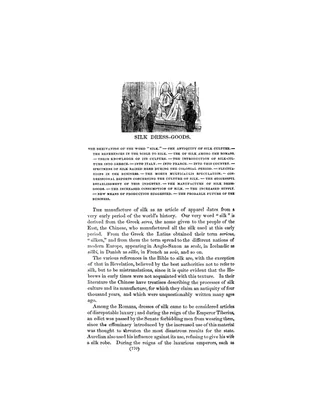
Silk Dress Goods
Article · 6 pages
A 1872 survey article on silk dress goods, tracing the word "silk" and the history of silk culture from China through Rome, Byzantium, Greece, Italy and France to the American colonies. It covers colonial silk-raising, the 1830s Morus multicaulis mulberry speculation, congressional reports on silk culture, and the later growth of American silk manufacture, naming Cheney Brothers of Manchester, Connecticut. It closes with remarks on rising consumption, silkworm disease, alternative silk sources such as wild silkworms and spiders, and the future of the industry.
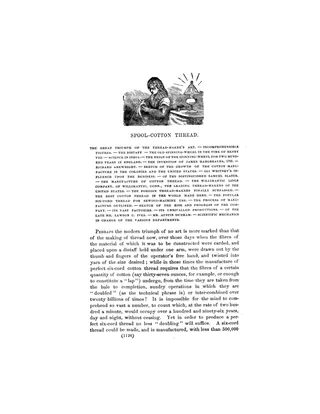
Spool-Cotton Thread
Article · 11 pages
An 1872 article on the making of spool-cotton thread. It first traces the history of spinning from the distaff and spinning-wheel through Hargreaves, Arkwright, Crompton, Whitney and Samuel Slater, and the growth of the American cotton industry. It then describes in detail the machine processes at the Willimantic Linen Company of Willimantic, Connecticut: picking, carding, combing, roving, spinning, twisting, doubling, finishing, spooling and ticketing. It closes with the company's history, its mills, dye-house and staff, and its six-cord sewing-machine thread.
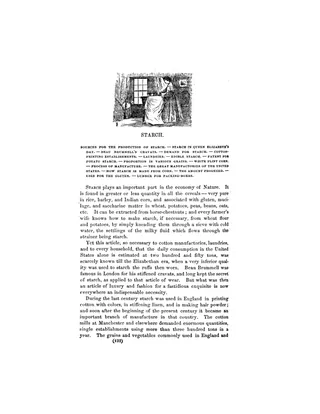
Starch
Article · 3 pages
An 1872 article on starch manufacture from the book Great Industries of the United States. It covers sources of starch (wheat, potatoes, rice, corn, horse-chestnuts), its early use for ruffs and cravats and in cotton printing and laundering, and the starch content of various grains. It describes the processes for making starch from wheat, rice and white flint corn, and the large corn-starch factories at Oswego, N.Y., and Glen Cove, L.I.
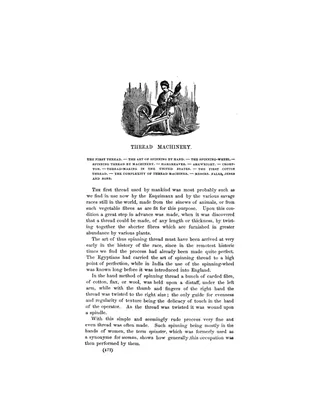
Thread Machinery
Article · 3 pages
A short 1872 article tracing the history of thread making from prehistoric hand spinning with distaff and spindle through the spinning wheel to machine spinning. It covers Hargreaves's spinning jenny, Arkwright's roller spinning and Crompton's mule, then turns to thread spinning in the United States, including the first cotton sewing thread at Pawtucket in 1794. It ends with a description of Fales, Jenks & Sons of Pawtucket, Rhode Island, makers of thread machinery.
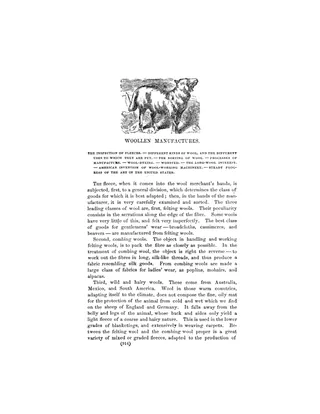
Woollen Manufactures
Article · 6 pages
A six-page 1872 article on the American woolen industry from the book Great Industries of the United States. It describes the three main classes of wool (felting, combing, and wild or hairy), fleece sorting, dyeing, carding, spinning, weaving, fulling, teazling, and shearing for broadcloth, and the shorter processes for flannels, blankets, and tweeds. It also covers worsted manufacture and the long-wool interest, and credits Erastus Bigelow's patents for looms, especially the Brussels carpet loom.
18 documents found