Textile Documents › Topic: Rope and cordage
119 documents found
Sort: 
Enormous Rope
Manufacturer and Builder, 1869
Article · 1 page
A short 1869 magazine article reprinting a Birmingham Daily Post report on an enormous wire and hemp rope made by John and Edwin Wright at Universe Works, Birmingham. The rope is about 11,000 yards long, 5.25 inches in circumference and over sixty tons, built of six strands of ten charcoal-iron wires around a hemp centre. It closes by comparing it with a 5,900-foot iron wire rope made by Roebling of Trenton, N.J., for planes on the Lehigh and Susquehanna Railroad.
Grelin [Hawser]
Article · 1 page · French
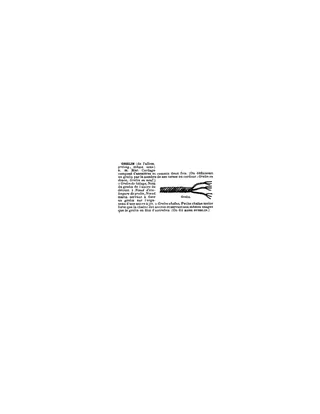
A short French dictionary entry on the grelin (hawser), a nautical cordage made of cable-laid strands (aussières) twisted twice. It explains that grelins were classed by the number of strands, as in nine- or twelve-strand hawsers. It also lists related terms: grelin de halage, the knot for fastening a hawser to an anchor ring, and the grelin-chaîne. A line drawing shows a hawser with its strands splayed at one end.
Specification of the Patent granted to Mr. James Mitchell for a Method of Manufacturing Cables, Hawsers, or Shroud-Laid Ropes, and Other Cordages, on a Scientific Principle
Article · 8 pages
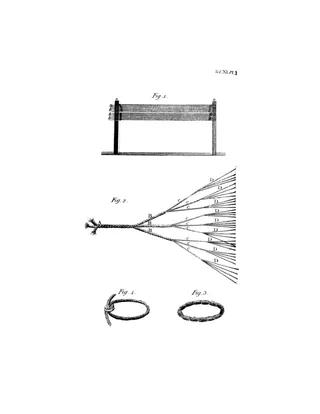
Text of James Mitchell's 1792 English patent for making cables, hawsers and shroud-laid ropes by subdividing the cylindrical twists into many smaller 'selvagee' twists so that all yarns bear load more evenly. It explains the flaw Mitchell saw in conventional rope construction, the procedure for turning and uniting the subdivided twists, and the resulting strand counts for cable-laid and hawser-laid cordage. A plate with four figures illustrates the parallel-stretched twists, the finished cable, and marled and hand selvagees.
Advertisement in Rea's Far Eastern Manual
Ephemera · 1 page
A one-page advertisement for the Hongkong Rope Manufacturing Co., Ltd., makers of pure Manila hemp rope, established 1883. It advertises ropes, cables and hawsers from 1/2 to 15 inches in circumference, with driving ropes for mills and bull ropes and drilling cables for oil wells as specialties. It notes supply to the British Navy on the China Station and to steamship lines, and shows the company's 'Phoenix Chop' trademark emblem.

Aluminum with Textiles fabrics, Cord, Rope, etc.
Manufacturer and Builder, 1884
Article · 1 page
A short notice in The Manufacturer and Builder describing an invention by W. Darlow of Plaistow, London. It covers weaving or intertwining aluminum threads, alone or combined with the usual materials, in cloth, lace, rope, cord and similar goods. It is a single brief paragraph with no technical detail or drawings.
Asbestos Rope
Manufacturer and Builder, 1884
Article · 1 page
A short 1884 note from The Manufacturer and Builder on the prospects of making rope from asbestos in England. It gives the rope's strength relative to hemp (about one-fourth), the breaking strength and weight of a 1¼-inch rope, and its proposed uses in theaters, fire brigades and building escapes. It states the rope is made like ordinary rope from Italian asbestos thread.
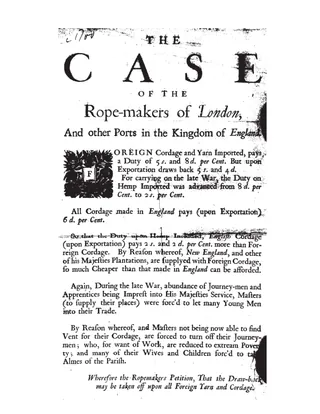
Broadside
Ephemera · 1 page
A single-sheet English broadside, c. 1700-1709, setting out the grievances of London and other English port rope-makers. It explains that imported foreign cordage and yarn pay lower net duties than English-made cordage, so the colonies buy foreign rope, and that wartime impressment and extra apprentices have left journeymen without work. The rope-makers petition for the drawback to be abolished on foreign yarn and cordage.
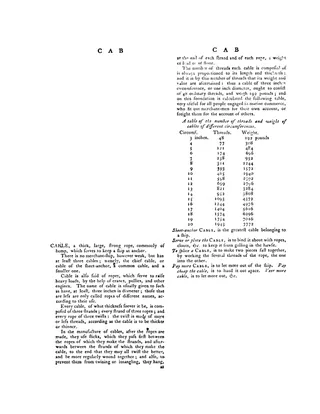
Cable
Article · 1 page
A one-page excerpt from the 1771 first edition of the Encyclopedia Britannica defining 'cable' as a thick hemp rope used to hold a ship at anchor or to raise loads with cranes and pulleys. It explains how cables are built from three strands, each of three ropes, each of three twists, and describes the use of sticks in twisting. It includes a table of thread counts and weights for cables of 3 to 20 inches circumference, plus nautical terms such as sheet-anchor cable, serving, splicing, and paying out cable.
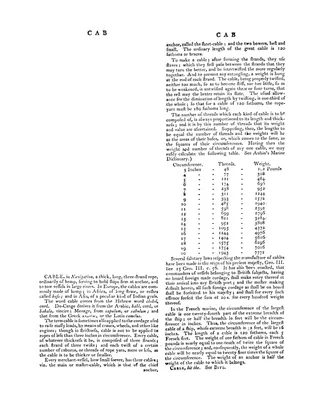
Cable
Rees's Cyclopedia, 1819
Article · 1 page
A one-page encyclopedia entry on ship's cables from Rees's Cyclopedia. It describes how a cable is made from strands, twisted with staves and weighted against tangling, and notes the one-third shortening in length from twisting. It also gives a table relating circumference to number of threads and weight, British legislation on cordage, French marine proportions, and the etymology of the word. Weaving is not covered.
Cordage
Zell's Encyclopedia, 1876
Article · 1 page
A short encyclopedia entry defining cordage as the general term for cords, ropes and cables, especially those used in ship rigging. It distinguishes cord, rope and cable by size, lists the materials they can be made from, and notes the loss in length of hemp fibres when twisted. It also mentions wire ropes and the replacement of hempen cables by iron chains.
Rope
Oxford Encyclopedia, 1826
Article · 6 pages
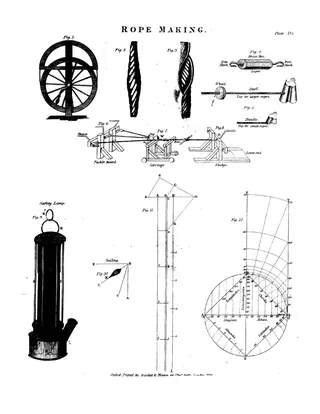
An encyclopedia article on rope and rope making from an early 19th-century Oxford encyclopedia. It covers the physics of rope rigidity (experiments by Amontons, Desaguliers, Coulomb), fibre sources such as hemp, the principles of spinning yarns, and the laying of strands into rope on a rope-walk with the tackle-board, sledge, top and woolders. It ends with tarring and Du Hamel's strength tests of white versus tarred cordage. One plate (Plate 135, Rope Making) illustrates the tools and machinery.
Rope
Rees's Cyclopedia, 1819
Article · 3 pages
An encyclopedia article on rope from Rees's Cyclopedia (1819). It defines rope, strand, hawser-laid and cable-laid construction, and gives Desaguliers' experimental tables on the resistance of ropes bent round rollers, plus tables of rope length per hundredweight and cable weights by circumference. It also lists the named ropes used in ship rigging, the thread counts of cable-laid and hawser-laid rope, and the making of twice-laid cordage from old rigging.
Rope
Zell's Encyclopedia, 1876
Article · 1 page
A short encyclopedia entry defining rope as a large twisted cord of hemp, made of yarns twisted into strands and three strands twisted into a rope. It covers white versus tarred rope, sizing and coil lengths, a rule of thumb for breaking strength, and the effect of sudden strain. It also notes other materials such as coir, Manila and wire.
Specification of Mr. Belfour's Patent for Making Ropes and Cordage
Article · 35 pages
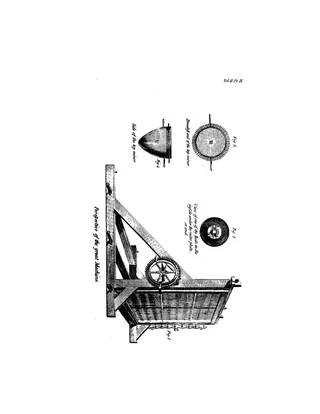
Patent specification, dated March 16, 1793, from John Daniel Belfour of Elsinore, Denmark, for a machine that makes ropes and cordage. Each rope yarn is wound on its own spring-controlled reel mounted on spindles in a large frame, so every yarn stays tight and bears an equal share of the strain when the strand is twisted. The text describes the great frame, reels, grate-work, driving wheel, a separating machine, the "top minor" (a conical guide), and nippers, with dimensions for a 22-inch cable. Three engraved plates (IX-XI) show the machines.
Specification of the Patent Granted to John Curr for a Method of Forming and Making a Flat Rope
Article · 7 pages
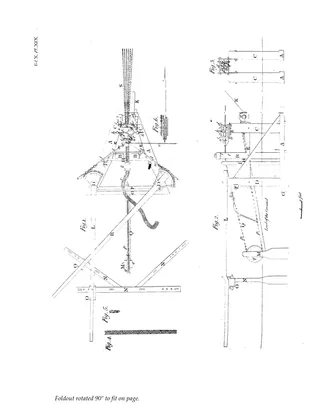
Text of the 1798 patent granted to John Curr of Sheffield for making a flat rope by sewing, stitching, or lapping two or more small ropes side by side with thread, small rope, or wire. It was intended for hoisting coal, minerals, and water out of mines. The specification describes a lever-operated machine with piercing needles and squeezing rollers, and a hand method of lapping. A foldout plate (Figs. 1-6) shows the machinery.
Stake-Head
Article · 1 page
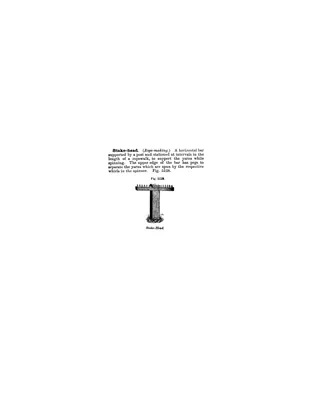
A short dictionary entry from Knight's American Mechanical Dictionary defining the stake-head, a rope-making fixture. It is a horizontal bar on a post, placed at intervals along a ropewalk to support yarns during spinning, with pegs on the upper edge to keep the yarns separate. A line drawing (Fig. 5528) accompanies the definition.
Tackle Board
Article · 1 page
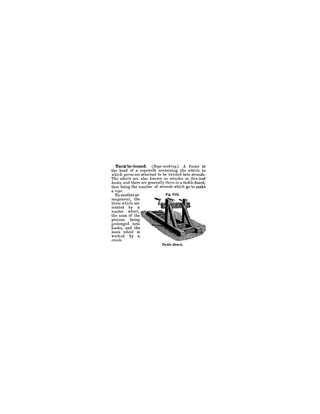
A short dictionary entry defining the tackle-board used in rope-making, a frame at the head of a ropewalk holding the whirls (hooks) to which yarns are attached to be twisted into strands. It notes that three whirls are usual, matching the three strands of a rope, and describes an arrangement in which a crank-driven master wheel turns the three pinions. Includes a line illustration labeled Fig. 6161.
A Test for Manilla Rope
Manufacturer and Builder, 1885
Article · 1 page
A short 1885 magazine article describing a simple fire test for detecting sisal mixed into manilla rope. Frost Brothers of Shadwell, England, burned balls of loose fiber from pure manilla, pure sisal, and a 50/50 blend, and compared the ash colors: dull grayish-black for manilla, whitish-gray for sisal, and grizzled black and white for the mixture. It is aimed at merchants and ship owners who want to check rope quality.
Top
Article · 1 page
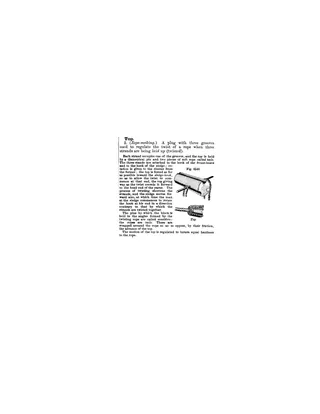
A short dictionary entry from Knight's American Mechanical Dictionary defining the rope-making 'top', a grooved wooden plug used to regulate the twist when three strands are laid up into a rope. It describes how each strand sits in a groove, how the top is held by a pin and tails, and how it moves between the breast-board and sledge hooks. A line drawing (Fig. 6548) shows the top with the strands and with a twisted rope.
Twisting Machine
Article · 1 page
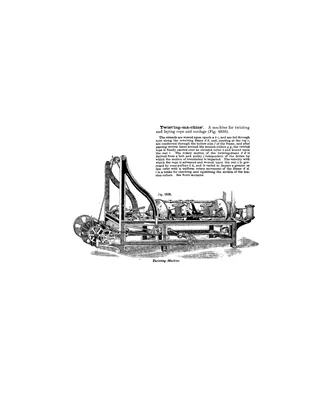
A short dictionary entry describing a machine for twisting and laying rope and cordage, illustrated with an engraving (Fig. 6838). It explains how strands are drawn from spools through a revolving frame and hollow axis, passed around tension-rollers, and wound onto a reel. Cone-pulleys vary the twist, and a brake equalizes the motion of the tension-rollers.
Cordage Industry
The Americana, 1903
Article · 4 pages
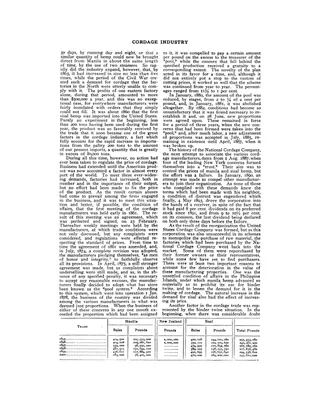
An encyclopedia-style article on the history of the American cordage (rope-making) industry. It traces rope-walks from John Harrison's first walk in Boston in 1642 through the shift to factory production after 1830, the major cordage firms, and later centers in the Midwest. It also covers price-fixing agreements, the "pool system," the National Cordage Company trust and its 1893 failure, the binder twine trade, and a table of manila, New Zealand and sisal fiber imports for 1895-1900.
Rope
Article · 3 pages
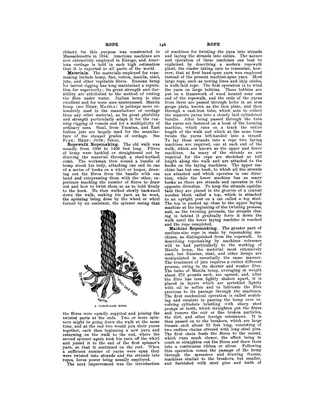
An encyclopedia article on rope and cordage from the New International Encyclopedia (1922). It covers the early history of ropemaking, materials (hemp, manila, sisal, jute, flax, cotton), traditional ropewalk spinning and laying, and the later machine processes of scutching, drawing, spinning, forming and laying. It also covers special ropes such as well-drilling cables and tarred rope, and gives a table of rope strength by material, with references to Kent and Flather.
Rope and Rope Yarn
Article · 1 page
A very short encyclopedia entry defining rope as hemp, hair or similar fiber spun into thick yarn and twisted together from several strands on a wheel. It notes that a small rope is called a cord and a very thick one a cable. A second entry defines rope-yarn, the untwisted yarn of a rope used by sailors, usually made from junk, to make sinnet and mats.
Rope Making
Manufacturer and Builder, 1873
Article · 2 pages
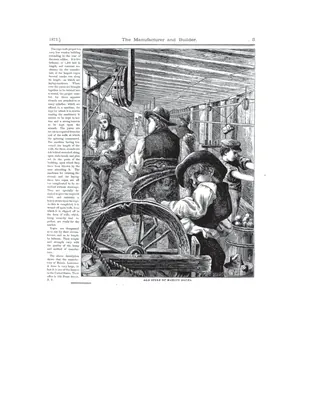
A short 1889-catalogued magazine article on rope making from The Manufacturer and Builder. It describes the traditional hand method in a rope-walk, where spinners twist hemp yarns while walking backward from a wheel, then tarring and laying into rope. It then describes the machinery-based Lawrence and Sons rope works in Brooklyn, N.Y., which processed manila, sisal and jute into yarn, strands and rope. An engraving shows workers in a long rope-walk.
[Rope-making terms from Knight's American Mechanical Dictionary]
Article · 1 page
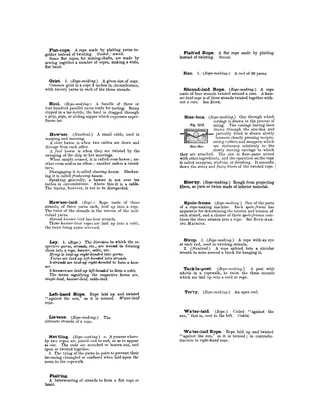
A one-page set of dictionary entries on rope and rope-making terms from Knight's American Mechanical Dictionary. Entries define terms such as flat rope, grist, haul, hawser, hawser-laid, lay, plaiting, shroud-laid rope, size-box, spole-frame and water-laid rope. It covers rope construction (yarns, strands, cable-laying direction) and ropewalk equipment, with a small engraving of a size-box.
Specification of the Patent Granted to Mr. William Chapman for a Method of Laying, Twisting, or Making Ropes and Cordage
Article · 48 pages
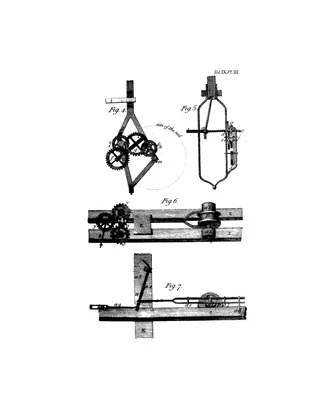
Specification of William Chapman's 1798 patent for machinery that lays, twists and coils ropes and cordage in a single operation, replacing the traditional rope-walk with sledge and top. It describes strand-shafts, rope-shafts, laying-blocks, press-blocks, holding-rollers, twisting-sheaves and coiling reels or stages, for both shroud-laid and cable-laid ropes and for twine. It also covers a method of tarring and winding yarns separately. Four engraved plates of machinery (Figs. 1-13) accompany the text.
Twine
Rees's Cyclopedia, 1819
Article · 1 page
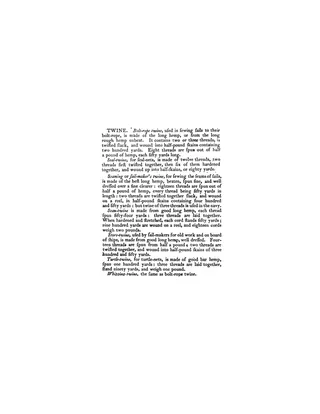
A short encyclopedia entry on twine from Rees's Cyclopedia, describing the kinds of hemp twine used in sailmaking and netting. It gives the number of threads, spinning lengths, twist, and skein lengths and weights for bolt-rope, seal, seaming, seam, store, turtle, and whipping twine.
Cordage
The Americana, 1903
Article · 3 pages
An encyclopedia article from The Americana (1903) describing the cordage industry. It covers the fibres used for rope (manila, sisal, hemp, jute), their preparation, and how they are drawn, spun into yarn and tarred. It then explains how yarn is formed into strands and laid into rope and cables by machine and on the ropewalk.
Cordage and Twine Industries
Article · 2 pages
A short encyclopedia article on the American cordage and twine industries in the early 1900s. It describes the failed attempts at consolidation (National Cordage Company, United States Cordage Company), the scale of rope and binder-twine production, and the principal fibres, manila and sisal. It gives statistics on output and spindles, and emphasizes binder twine for agriculture, including the large Chicago twine mill.
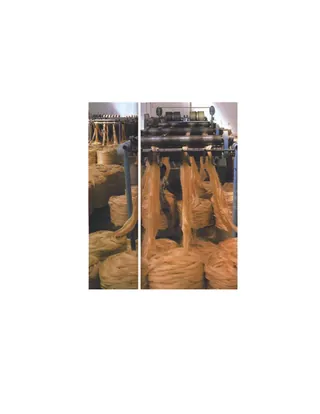
Inside the Sisal Cord Plant in the Tanga Region
China Pictorial, 1976
Illustration · 1 page
A single page of two photographs from China Pictorial, 1976 no. 3, showing the interior of a sisal cord plant in the Tanga Region of Tanzania. The images show rows of machinery for spinning or twisting rope, with coils of golden sisal fibre stacked below and fibre strands running through the equipment. There is no readable text on the page.
Rope
Article · 3 pages
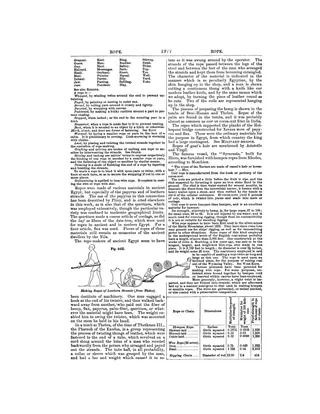
An encyclopedia entry on rope from Knight's American Mechanical Dictionary (1876). It defines rope and its constructions (cable-laid, hawser-laid, shroud-laid), lists rope names by purpose, and explains terms such as whipping, serving, worming and splicing. It also covers rope-making in ancient Egypt, with an illustration from Thebes, plus coir and wire rope, strength tables for rope and chain, and a glossary of nautical ropes.
Rope Machine
Article · 3 pages
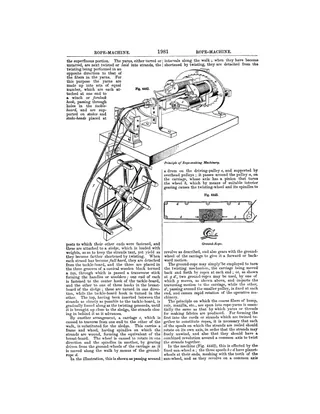
Encyclopedia entry on the rope-machine from Knight's American Mechanical Dictionary (1876). It outlines the history of rope-making from Pliny's mention of hemp through British and American patents, including Huddart's machines at Chatham and Treadwell's in 1834. It then describes hand spinning of yarn on the ropewalk, tarring, and laying strands with the tackle-board, sledge, and top. It also covers mechanical carriages with twisting wheels and spindles, planetary (sun-and-planet) gearing, Blackie's machine, a small-rope machine, and a preparing machine for hemp and manilla slivers. Illustrated with Figs. 4442-4446.
Rope Making
English Encyclopedia, 1867
Article · 5 pages
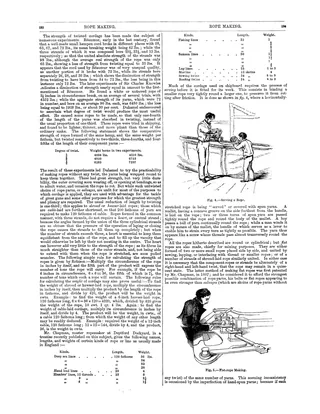
A five-page encyclopedia article on rope making, covering the structure of rope (fibres, yarns, strands, rope, cablet) and why twist gives cohesion. It describes hand spinning of rope-yarns in the ropewalk, tarring, warping, laying with the top, cable-laid and plaited ropes, serving, and flat ropes. It also covers machine-making (Huddart, Lang, Sherman), strength experiments by Réaumur, Knowles and Duhamel, tar preservatives, hemp and alternative fibres, and wire rope with comparison tables. Five engraved figures illustrate the processes.
Rope-Making Machinery
Article · 8 pages
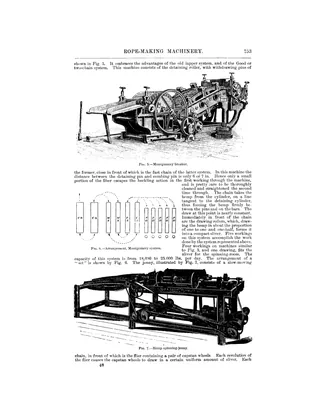
An 1889 encyclopedia article on the machinery used to make hemp and wire rope. It describes chain-type hemp preparation machines (drawing, breaker, spreader, Montgomery system), spinning jennies, strand-forming and rope-laying machines, and the rope-walk process. It also covers tarring and its effect on strength, rope tests, Lang lay and locked-coil wire rope, and wire-stranding and rope-closing machines. Illustrated with engravings and diagrams.
Cordage
Article · 4 pages
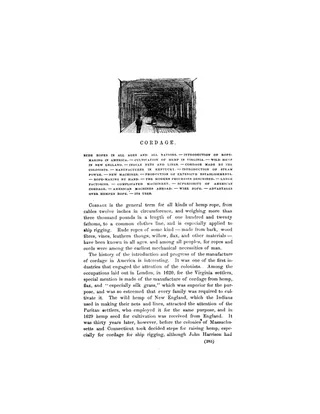
An encyclopedic article on the cordage industry from the 1872 series Great Industries of the United States. It traces rope-making in America from colonial hemp cultivation and the early rope-walks of Boston, Philadelphia, and Kentucky through the adoption of steam power and new spinning machines. It describes the old hand-spinning process on the rope-walk and the modern factory sequence of scutching, lapping, drawing, spinning, tarring, and twisting strands into rope. It closes with American cordage exports and a short note on wire rope.
[Gourock Ropework Co, Lts., Chile]
Enciclopedia Comercial, 1922
Illustration · 1 page · Spanish
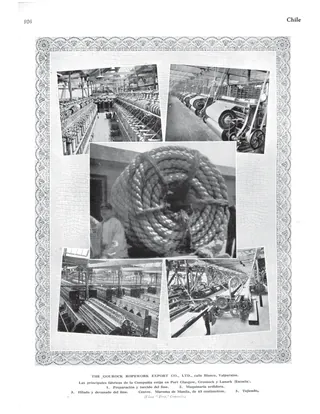
A single page from the 1922 Enciclopedia Comercial (page 926, Chile section) advertising The Gourock Ropework Export Co., Ltd., of calle Blanco, Valparaiso. It shows a collage of five photographs of the company's factories and machinery, with Spanish captions covering flax preparation and twisting, warping machinery, flax spinning and winding, a 43 cm Manila rope, and weaving. The company's main works were at Port Glasgow, Greenock and Lanark in Scotland.
[Gourock Ropework Co, Lts., Peru]
Enciclopedia Comercial, 1922
Illustration · 1 page · Spanish
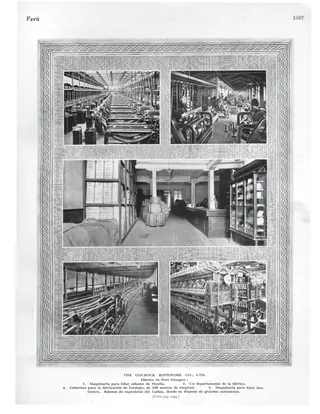
A single page of photographs from a commercial encyclopedia showing the Port Glasgow factory of the Gourock Ropework Co., Ltd. Views include machinery for spinning Manila hemp, a factory department, a 330-metre ropewalk shed, flax spinning machinery, and the company's showrooms at Callao, Peru. Captions are in Spanish and refer readers to page 1095.
Rope and Rope Making
Article · 10 pages
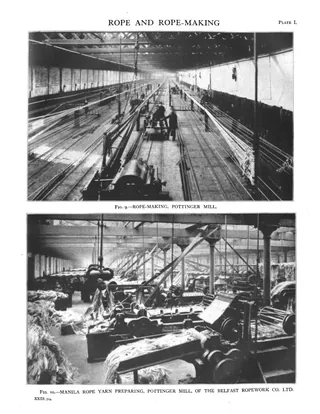
Encyclopedia Britannica (11th ed.) article on rope and rope-making. It covers the fibres used (hemp, manila, sisal, jute, cotton), the construction of strands, hawser-laid and cable-laid ropes, hand spinning and laying in the rope-walk, and factory machinery (hackling, drawing frames, automatic spinners, house machines). It also treats cotton driving ropes for power transmission, wire rope construction and strength tables, aerial ropeways, and electrical cables. Illustrated with line figures and four plates of rope-works and machinery.
Rope-Making
Rees's Cyclopedia, 1819
Article · 19 pages
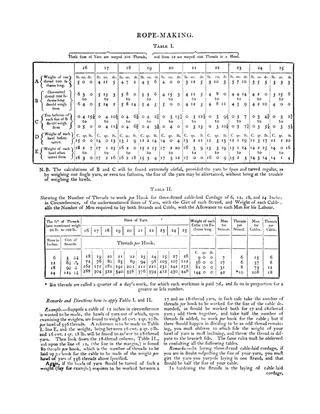
Article on rope-making from Rees's Cyclopaedia (vol. XXX), describing the manufacture of hemp cordage in a rope-walk. It covers spinning, warping, tarring and laying of yarn, strands, cables and hawsers, with rules on shrinkage, hardening and press weights. About half the pages are numbered tables giving threads per hook, yarn lengths, shrinking proportions, weights, labour costs, tapered ropes, bolt-rope and Navy contract cordage. It ends with notes on patent rope machinery (Chapman, Huddart) and short dictionary entries on rope and rope-yarn.
Cord Knotting or Macrame
U.S. Army, 1980
Monograph · 8 pages
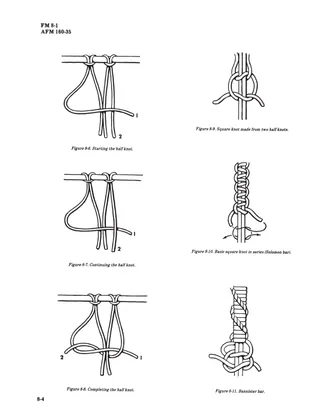
Chapter 8 of a U.S. Army/Air Force manual (FM 8-1 / AFM 160-35) giving instructions in cord knotting, or macrame, as used in occupational therapy. It covers making and using a wooden knotting frame and waist hooks, suitable cords, cutting and starting cords, the half knot, square knot, Solomon and Bannister bars, half hitches and diagonal patterns, splicing, and finishing a belt. Line drawings illustrate the frame, hooks and each knot.
Netting
Monograph · 14 pages
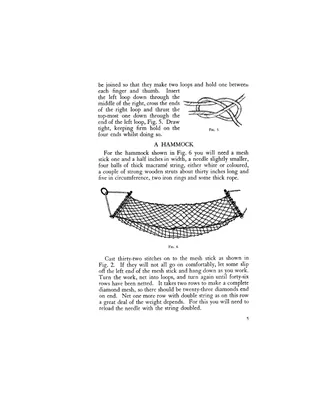
Dryad Leaflet No. 92 is an instructional booklet on hand netting with a mesh stick and needle. It covers tools, string choice, casting on, plain diamond mesh, and joining with the weaver's knot. Projects include a hammock, square- and diamond-mesh ping-pong nets, a striped string shopping bag on rings, rabbit or purse nets, and a wool scarf. Each is illustrated with numbered line drawings.
Plaited Eight-Strand Gasket
Engineering Weekly, June 25, 1869
Article · 1 page
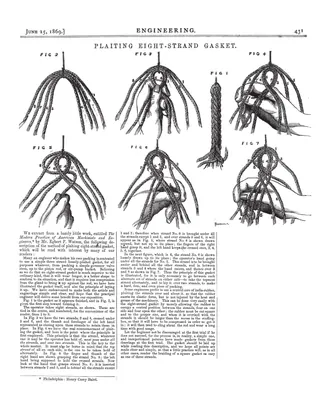
A one-page 1869 article from the journal Engineering that reproduces Egbert P. Watson's instructions for plaiting an eight-strand square gasket, used as packing for engine stuffing-boxes. Seven engraved figures show the hands and numbered strands at each stage. The text states the rule that each strand passes under all the others and over two, and it suggests an optional india-rubber core.
Abaca (Manila Hemp): The Fiber Monopoly of the Philippine Islands
Article · 12 pages
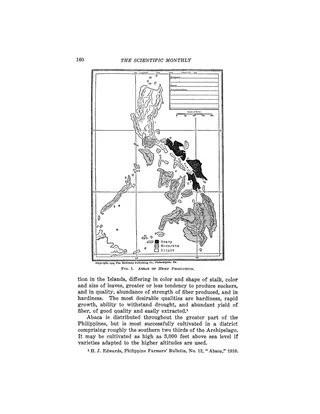
A 1920 Scientific Monthly article on abaca (Manila hemp), the leaf-sheath fiber of Musa textilis, and its role as a Philippine monopoly. It covers the plant's cultivation, soil and climate needs, harvesting, hand stripping of the fiber, the 1914 fiber grading law, uses (rope, paper, hat braid, local goods), and export statistics for 1899-1917. Shorter sections treat maguey, sisal, and minor fiber plants such as kapok, ramie, pina and buri raffia. It includes a map of hemp-producing areas and a table of hemp exports.
Manila Hemp
Hawaiian Forester and Agriculturalist, July 1904
Article · 1 page
A short editorial note from the July 1904 Hawaiian Forester and Agriculturist introducing the second in a series of articles by Leopold Blackman on developing a fibre industry in Hawaii. It discusses abaca (Manila hemp, Musa textilis), its strength as a cordage fibre, its displacement of true hemp, and its earlier introduction to the Islands. The editor urges investigation of Hawaiian banana fibre and other native plants, and suggests an Hawaiian Agricultural College might undertake such work.
Coir
Rees's Cyclopedia, 1819
Article · 1 page
A short encyclopedia entry defining coir, the strong fibre prepared from coconut husks and widely used in the East Indies for cables and cordage. It summarizes the experiments Dr. William Roxburgh of Calcutta sent to the Society of Arts, London, in 1801 and 1806, comparing the strength of hemp and about twenty other vegetable fibres when white, tanned and tarred, fresh and after maceration in water.
Fibre Industry in Hawaii: No. 3 -- Sisal
Article · 21 pages
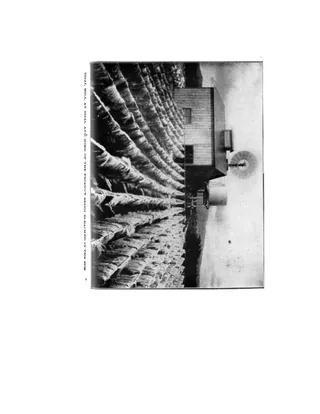
Third article in a series on the fibre industry in Hawaii, arguing that sisal (Agave rigida sisalana) is the soundest fibre crop for the islands. It covers US import values 1894-1903, plant description, soil, propagation, nursery work, transplanting, harvesting, extraction machinery (the raspador type and the Todd machine at Ewa), drying and baling, diseases and pests, and by-products. It closes with a detailed cost and profit account of the Hawaiian Sisal Co. plantation at Ewa, Oahu. Illustrations show the Ewa plantation, a sisal mill, and laborers cutting fibre. A short unrelated item on banana crates for Barbados follows.
Improvement in Preparing Jute Twine, US Patent No. 40520
Patent · 1 page
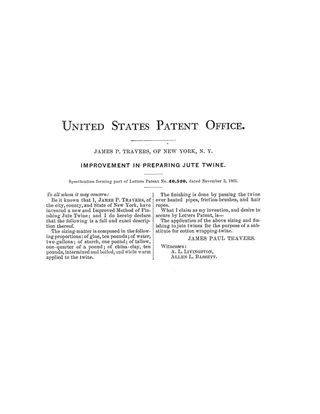
US patent No. 40,520, granted to James P. Travers of New York on November 3, 1863, for a method of sizing and finishing jute twine. The sizing is made of glue, water, starch, tallow and china-clay, boiled and applied warm. The twine is then finished by passing it over heated pipes, friction-brushes and hair ropes. The claim is for using this treatment so that jute twine can substitute for cotton wrapping-twine.
New Zealand Flax
Article · 4 pages
A short 1876 natural-history sketch of New Zealand flax (Phormium tenax), describing its appearance, range and habitat. It covers Maori uses of the plant, including stripping fibre with a mussel shell and weaving mats, rugs, garments, baskets, nets, lines and canoe sails. It closes with the unsolved problem of cleaning the fibre by machine and its 1870 use in rope-making.
Ply-Split Braiding
Article · 6 pages
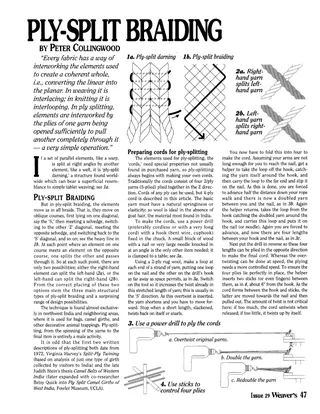
Peter Collingwood introduces ply-split braiding, a technique in which one cord is split through its plies to let another pass through, used in northwest India for camel girths and bags. The article explains how to make four-ply cords with a power drill, how to mount them on a starting rod, and how to work plain oblique twining (short and long rows with a quarter twist between splittings). It also covers color patterning with twined linkings, slits, cylindrical and 3-D forms, and turning a braid through a right angle, and mentions two further structures to be covered in later articles.
Reel
Rees's Cyclopedia, 1819
Article · 1 page
An encyclopedia entry on reels from Rees's Cyclopedia. It describes rope-makers' and sail-makers' reels (bench-reel, log-reel, twine-reel, yarn-reel, hand-reel), then reels in the manufactories, including the small hand reel and the common reel or windlace used for skeins. It cross-references other articles for silk reeling and milling.
119 documents found