Textile Documents › Publications › Publication: English Encyclopedia
19 documents found
Sort: 
Arkwright, Sir Richard
English Encyclopedia, 1867
Article · 3 pages
Encyclopedia biography of Sir Richard Arkwright (1732-1792), inventor of the water-frame for roller spinning of cotton. It covers his early career as a barber and wig-dealer, his patents of 1769 and 1775 and the legal disputes over them, the roller-drawing mechanism, and the mills at Cromford and with Jedediah Strutt. It also describes how his strong cotton warp yarn enabled all-cotton calicoes, the growth of cotton imports, and his family and character.
Cotton
English Encyclopedia, 1867
Article · 2 pages
A two-page encyclopedia entry on cotton as a botanical product, from the English Encyclopedia. It explains that cotton is the seed hair of Gossypium species, compares its cellular structure under the microscope with the woody tissue of linen, and describes the plant. It also covers the wild and cultivated range of cotton in the Old and New World, how climate affects staple length and quality, and the difference between the cotton plant and the cotton tree (Bombax).
Cotton (commercial)
English Encyclopedia, 1867
Article · 1 page
A one-page introductory entry on cotton from the Arts and Sciences division of the English Cyclopaedia. It refers readers to the Natural History division for the botany of Gossypium and the cotton species, then outlines the plan for treating the British cotton manufacture and its spread to other countries. Three articles are announced: Cotton Cultivation and Supply, Cotton Manufacture, and Cotton Trade and Consumption. Only this introduction is present, with no technical detail on machines or processes.
Cotton Cultivation and Supply
English Encyclopedia, 1867
Article · 5 pages
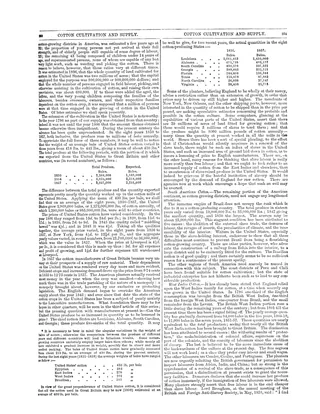
An encyclopedia article on the growing and supply of raw cotton in the 1860s, written from a British viewpoint. It describes sea-island and upland cultivation, picking, ginning and baling in the United States, with figures on acreage, yields, slave labour, exports to Britain, and prices. It then surveys other supplying regions, including the West Indies, India, Egypt and North Africa, and ends with a table of costs for West African cotton delivered to Liverpool.
Cotton Manufacture
English Encyclopedia, 1867
Article · 6 pages
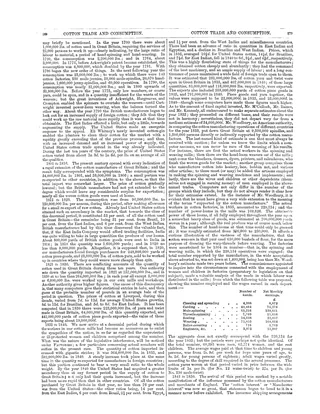
An encyclopedia article on the cotton trade and consumption, chiefly in Great Britain, from 1700 to the late 1850s. It traces consumption of raw cotton, the effect of the inventions of Arkwright, Hargreaves, Crompton and Cartwright, exports of yarn and piece goods, mill employment and wages, and the founding of the Cotton Supply Association in 1857. Later pages briefly survey cotton manufacture in France, Switzerland and other countries, with statistical tables on imports, exports and capital.
Cotton Trade and Consumption
English Encyclopedia, 1867
Article · 6 pages
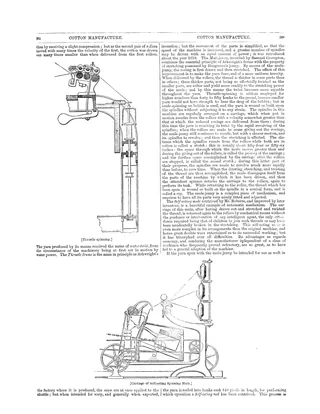
An encyclopedia article titled "Cotton Manufacture" covering the history of cotton cloth making from antiquity in India, China, Egypt, Spain and Italy to its establishment in England. It describes the inventions of Hargreaves, Arkwright, Crompton, Cartwright, Radcliffe and Roberts, then walks through the mill processes: mixing, scutching or willowing, carding, drawing, roving, throstle and mule spinning, reeling and thread making. Engravings show the spinning jenny, Arkwright's frame, drawing and roving machines, the throstle and the self-acting mule. It closes with yarn prices, patent counts and a description of the Lancashire cotton mills.
Damask
English Encyclopedia, 1867
Article · 1 page
A short encyclopedia entry on damask, a figured woven cloth of flax and silk thought to originate in Damascus. It covers linen damask for table linen, the shift of manufacture from Germany to Scotland and Ireland, the draw-loom and the many pattern changes it required, and the introduction of silk damask weaving to England by Flemish refugees in 1567. It also notes the later use of mixed-fiber damask for furnishing fabrics.
Dyeing
English Encyclopedia, 1867
Article · 4 pages
An encyclopedia article on the art and chemistry of dyeing, covering its history from the ancient Tyrian purple through modern dye-drugs. It explains mordants, the affinity of dyes for wool, silk and cotton, and the preparation (scouring) of fibres. It gives detailed recipes for black dyes on wool and silk and for browns, followed by remarks on copper boilers, dye-plant cultivation, Scottish Highland dyes and factory legislation.
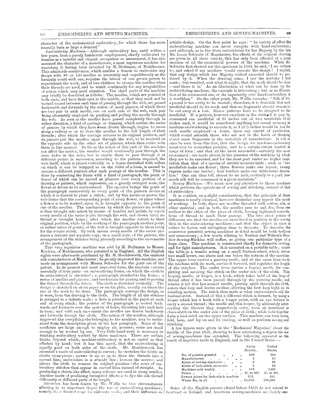
Embroidering and Sewing Machines
English Encyclopedia, 1867
Article · 3 pages
An encyclopedia article on embroidery and sewing machines, in three parts: hand-embroidery, embroidering machines, and sewing machines. It covers the history of embroidery, the Berlin work pattern trade, Heilmann's multi-needle embroidering machine as improved by Houldsworth and Schwabe, and Newton and Wilson's Boudoir Sewing-Machine. It closes with statistics on the spread of sewing machines in Britain and the United States and their use in clothing manufacture.
Fibre, Vegetable
English Encyclopedia, 1867
Article · 1 page
A short encyclopedia entry defining vegetable fibre as a very fine spiral thread found inside plant cells and tubes. It describes its role in forming elastic spiral vessels, its occurrence in anther linings and on some seeds such as Collomia linearis, and distinguishes it from the woody fibre that makes up hemp and flax thread. The entry is botanical rather than a textile-processing account.
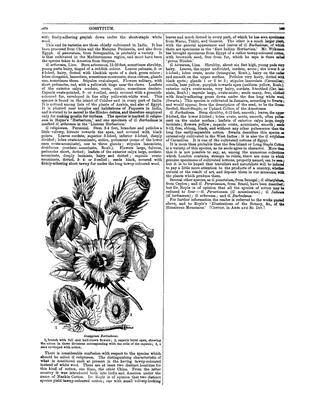
Gossypium (Cotton)
English Encyclopedia, 1867
Article · 2 pages
An encyclopedia article on Gossypium, the cotton plant genus, covering its botany, geographic range and cultivation limits. It reviews the ancient history of cotton in America, India, Egypt and the Persian Gulf, citing Pliny, Herodotus, Theophrastus and Arrian, and argues that mummy-cloth was linen, not cotton. It then describes the main species (G. herbaceum, arboreum, religiosum, hirsutum, Barbadense) and the American commercial types such as Nankeen, Upland and Sea-Island cotton. One page has a botanical engraving of Gossypium Barbadense.
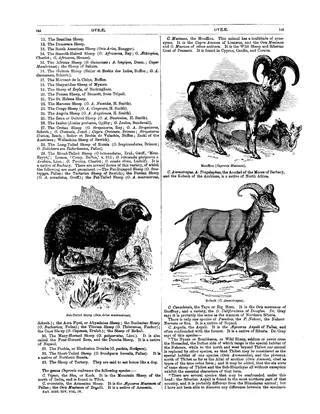
Oveae (Sheep)
English Encyclopedia, 1867
Article · 3 pages
A short natural-history encyclopedia entry on the Oveae, the sub-tribe of the Bovidae that includes domestic sheep and their wild relatives. It gives Dr. J. E. Gray's classification of the genera (Ovis, Caprovis, Pseudois, Ammotragus) and lists 33 varieties of the common sheep from the British Museum Catalogue, including Merino, Southdown, Shetland and fat-tailed breeds. It then describes wild species such as the mouflon, aoudad (Kebsch), bighorn and argali, with engravings of the mouflon, Kebsch, fat-tailed sheep and argali.
Rope Making
English Encyclopedia, 1867
Article · 5 pages
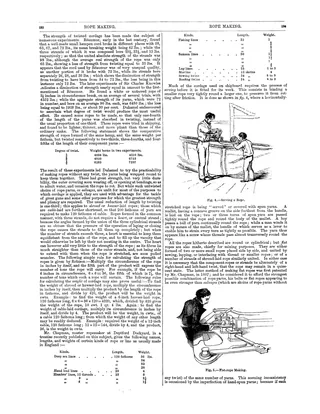
A five-page encyclopedia article on rope making, covering the structure of rope (fibres, yarns, strands, rope, cablet) and why twist gives cohesion. It describes hand spinning of rope-yarns in the ropewalk, tarring, warping, laying with the top, cable-laid and plaited ropes, serving, and flat ropes. It also covers machine-making (Huddart, Lang, Sherman), strength experiments by Réaumur, Knowles and Duhamel, tar preservatives, hemp and alternative fibres, and wire rope with comparison tables. Five engraved figures illustrate the processes.
Silk Manufacture
English Encyclopedia, 1867
Article · 3 pages
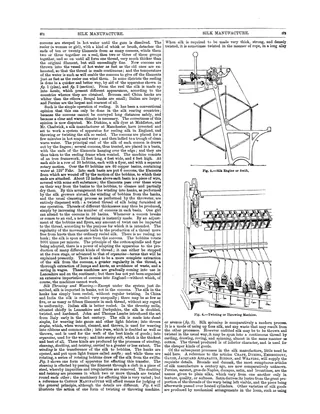
An encyclopedia article on the silk industry, covering the history of sericulture from China through Byzantium, Italy, France and England, and attempts to rear silk-worms in India and elsewhere. It describes cocoons, reeling by hand and by machine (including the Dickins and Chadwick apparatus for reeling and throwing in England), and the throwing of silk into singles, tram and organzine. It also covers silk spinning from waste, types of silk fabrics, the history of the English silk trade and its duties, and import and export statistics to 1860. Five engravings show reeling apparatus, a silk swift, a throwing machine and hand spinning.
Spinning
English Encyclopedia, 1867
Article · 1 page
A short encyclopedia entry defining spinning as two distinct manufacturing operations: spinning of animal and vegetable fibres into thread, and spinning of soft metals. It describes fibre spinning as forming a continuous uniform thread from aligned fibres by twisting. It contrasts the spindle, distaff and spinning-wheel, which produce a single thread, with cotton spinning machinery that can produce nearly two thousand threads at once. It refers readers to other entries on cotton, linen, silk, and woollen and worsted manufacture.
Weaving
English Encyclopedia, 1867
Article · 5 pages
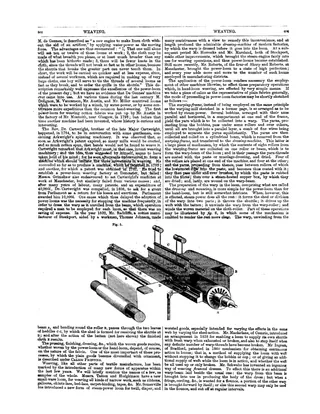
An encyclopedia article on weaving from the mid-19th century. It covers weaving in ancient Egypt, Greece and Rome, then warping with the warping-mill, beaming, and drawing-in on a simple two-heddle loom. It goes on to plain weave, stripes, checks and twills, and to the development of the power-loom (De Gennes, Cartwright, Radcliffe). It ends with a note on design education in Lyons and a section on Bonelli's electric loom. Illustrated with engravings of a warping-mill, a hand loom and a power-loom.
Wool
English Encyclopedia, 1867
Article · 4 pages
A mid-19th-century encyclopedia article on wool from the sheep-breeding side, taken from the English Encyclopedia. It covers sheep classification, age and teeth, and the qualities of the fleece (fineness, staple, elasticity, felting, and the microscopic serrations of the fibre). It surveys British breeds, both short-woolled (Southdown, Dorset, Ryeland, Cheviot, black-faced Scots) and long-woolled (Leicester, Lincoln, Cotswold), and describes Bakewell's improvements. It ends with shearing, lambing and feeding practice, and the diseases of sheep and their treatment.
Wool and Wool Trade
English Encyclopedia, 1867
Article · 5 pages
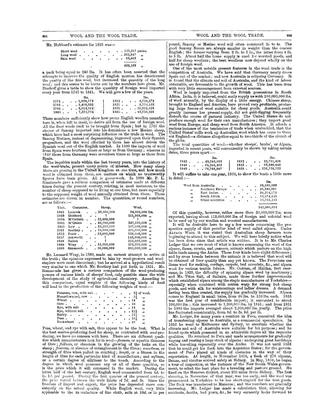
Encyclopedia article on wool as a commodity, mainly the history of English legislation on wool export and import from Edward I through the 1820s, and the conflict between landowners and manufacturers. It also gives statistics on English wool production, foreign wool imports (1771-1860), estimates of sheep numbers, qualities manufacturers look for in wool, competition from Saxony merino and Australia, and a closing section on alpaca wool and Charles Ledger's transfer of alpacas to Australia.
Woollen and Worsted Manufactures
English Encyclopedia, 1867
Article · 6 pages
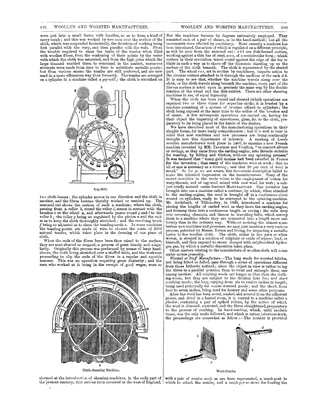
An encyclopedia article on the woollen and worsted industries as they stood in the mid-19th century. It distinguishes clothing-wools from combing-wools and gives a brief history from antiquity. It then describes the processing stages: sorting, scouring, willying, teazling with the gig-mill, cloth shearing, hand and machine combing, the breaking-frame and roving. It closes with sections on regional varieties of the trade and on employment and value statistics. Illustrations show a gig-mill, a cloth-shearing machine, a combing-wheel and a roving machine.
19 documents found