Textile Documents › Publications › Publication: Weaver's
7 documents found
Sort: 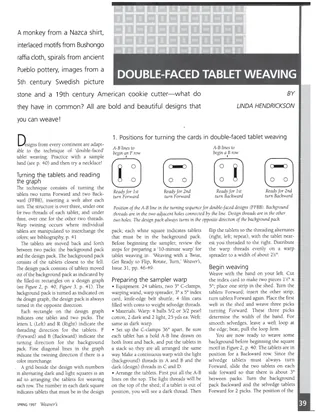
Double-Faced Tablet Weaving
Article · 4 pages · weaving drafts
An article by Linda Hendrickson introducing double-faced tablet weaving, in which two packs of tablets (background and design) are turned in opposite directions in an FFBB sequence to produce reversible motifs. It explains how to read the design graph, set up a 24-tablet sampler warp in pearl cotton, and weave a square-motif sampler, and gives troubleshooting advice for common errors such as wrong turning direction, tangled threads and unclear sheds. It ends with a project for a double-faced necklace using 48 tablets, with a design graph, finishing instructions for plied neck cords and fringe, and a short bibliography.
Ply-Split Braiding
Article · 6 pages
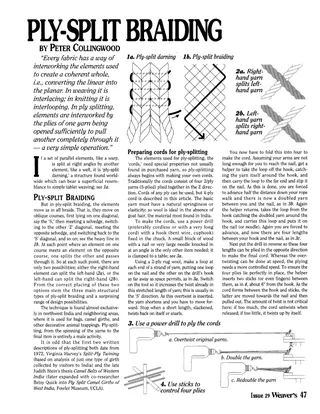
Peter Collingwood introduces ply-split braiding, a technique in which one cord is split through its plies to let another pass through, used in northwest India for camel girths and bags. The article explains how to make four-ply cords with a power drill, how to mount them on a starting rod, and how to work plain oblique twining (short and long rows with a quarter twist between splittings). It also covers color patterning with twined linkings, slits, cylindrical and 3-D forms, and turning a braid through a right angle, and mentions two further structures to be covered in later articles.
Ply-Split Braiding II
Article · 4 pages · weaving drafts
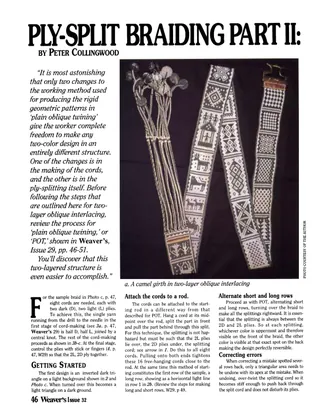
Second part of Peter Collingwood's series on ply-split braiding, explaining two-layer oblique interlacing, a structure that allows free two-color designs that look identical on both sides. It gives step-by-step directions for a sample braid with eight 4-ply cords (2 dark, 2 light plies each), including attaching cords to a rod, alternating long and short rows, and leaving no twist or a half twist between splittings to change color. It also covers correcting errors, ways of joining the two layers at the selvedges, pocket formation, designing on a 45° diamond grid, and use of more than two colors. Illustrated with photos of an Indian camel girth and sample braids, and with design grids and a splittings diagram.
Single Course Oblique Twining
Article · 4 pages
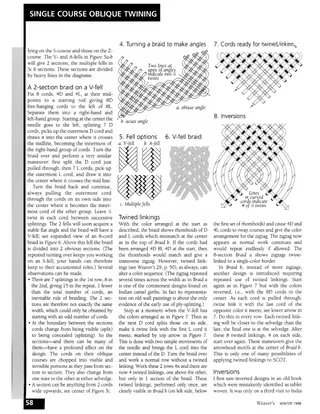
Third article in Peter Collingwood's series on ply-split braiding, covering single course oblique twining (SCOT). It explains how cords are split on an oblique fell, then covers curves and angles, multiple fells (V- and A-fells), twined linkings for color changes, and inversions that curve the cords into ovals. It closes with ideas for further exploration and is illustrated with photographs of sample braids and diagrams of the cord movements.
Spaced Out Tablet Warps!
Article · 4 pages
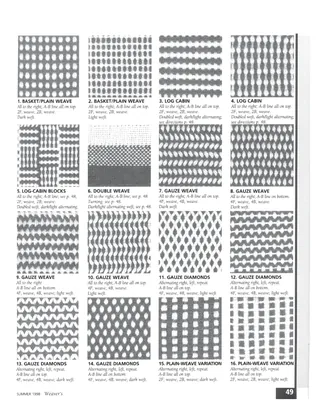
Linda Hendrickson explains how to put a reed on a tablet-weaving warp so the result is a soft, drapable fabric rather than a firm warp-faced band. The article gives equipment and materials for a 16-section sampler in 5/2 pearl cotton, with instructions for building a portable tablet loom from a board, tensioning blocks and C-clamps. It also covers sleying tablets in a reed, using a shed stick, and turning sequences for each section. The sampler covers basket/plain weave, log cabin, double weave, gauze weave, gauze diamonds and a plain-weave variation. Photos, diagrams and a page of simulated cloth images illustrate the process, and a short bibliography is included.
Tablet-Woven Gauze Scarves
Article · 2 pages
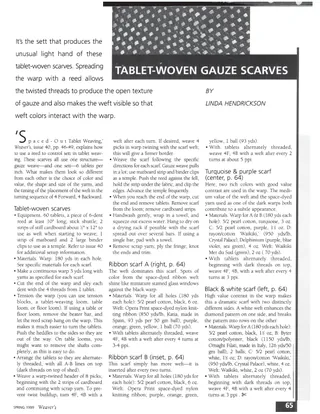
Project article by Linda Hendrickson giving instructions for four tablet-woven gauze scarves, all made with 60 tablets threaded alike and sett at 6 tablets per inch using a reed. The scarves differ in yarn choice, color and value, and in how often the weft is placed in the 4 forward, 4 backward turning sequence. It lists equipment, setup, weaving, finishing and the materials for each scarf, including ribbon, turquoise and purple, and black and white versions.
Weaving with a Twist
Article · 4 pages · weaving drafts
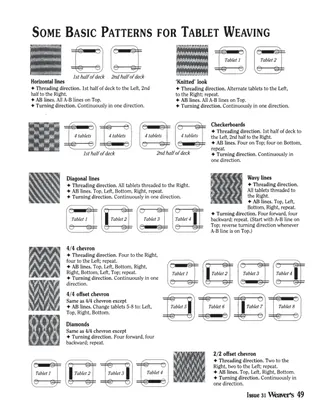
An introductory article on tablet (card) weaving, the first in a series, by Linda Hendrickson. It explains the weaving process and three pattern variables (threading direction, position of the A-B line, and turning direction), describes simple tools such as a warping wand, warp spreader and C-clamp loom, and gives step-by-step instructions for the '10-minute warp' to make eight bookmarks or a sampler. A closing chart gives nine basic band patterns (horizontal lines, checkerboards, diagonals, wavy lines, chevrons, diamonds) specified by threading, A-B line positions and turning sequence.
7 documents found