Textile Documents › Publications › Publication: Oxford Encyclopedia
20 documents found
Sort: 
Brocade
Oxford Encyclopedia, 1828
Article · 2 pages
Two-page encyclopedia entry on brocade as a commercial fabric of gold, silver, or silk enriched with flowers and ornaments. It explains how the meaning of the word broadened over time and how gilt wire is spun onto yellow silk thread. It also describes Vaucanson's rolling machinery for flattening the gilding, made for the Lyons manufacture, and ends with advice on cleaning brocades with spirits of wine.
Calico
Oxford Encyclopedia, 1828
Article · 1 page
A short encyclopedia entry defining calico as a plain-woven cotton cloth of medium thickness, between sheeting and muslin. It gives the origin of the name from Calicut on the Malabar coast and notes the beginnings of calico manufacture in Lancashire and of calico printing in London.
Carpet
Oxford Encyclopedia, 1828
Article · 1 page
A short encyclopedia entry defining the carpet as a woollen floor covering and sketching its history and manufacture. It notes the probable Asian origin, Turkey carpets as the finest ornamental kind, and production in France, Italy and Britain. It names Wilton, Kidderminster, Stirling and Kilmarnock as British centers.
Cloth
Oxford Encyclopedia, 1828
Article · 2 pages
An encyclopedia article on cloth that gives a brief history of weaving and the spread of the woollen, linen and cotton industries in Britain. It then describes in detail how English broadcloth was made in Wiltshire: scouring, dyeing, oiling, scribbling and carding, spinning, warping and sizing, weaving, fulling, burling, dressing, shearing, and pressing.
Cotton
Oxford Encyclopedia, 1828
Article · 3 pages
An encyclopedia article on cotton, covering the botany, cultivation, harvesting, ginning and diseases of the cotton plant, followed by a section on cotton manufacture. The manufacture section traces British cotton spinning from the distaff and spindle through Hargreaves's jenny, Arkwright's roller spinning and Compton's mule, and describes batting, carding, drawing, roving and spinning. It ends with a survey of commercial cotton grades by origin and figures on the growth of British cotton manufacture to 1801.
Damask
Oxford Encyclopedia, 1828
Article · 1 page
A short encyclopedia entry defining damask as a tweeled (twilled) fabric of silk, linen, or cotton, with its supposed origin in Damascus. It notes the spread of silk damask manufacture from the continent to England through Dutch and Flemish weavers in Elizabeth's reign, and its later restriction to linen and cotton table linen. It also describes the loom setup, with five leaves of front mounting plus a draw loom harness for common damasks and eight leaves for the finest patterns drawn on squared paper.
Dying
Oxford Encyclopedia, 1828
Article · 40 pages
A long encyclopedia article on the art of dyeing, covering textile fibres (silk, wool, cotton, flax) and other materials. It opens with a history from biblical and ancient Egyptian, Indian, Greek and Tyrian purple practice through Italy (Rosetti's Plictho), the Gobelins and Colbert's regulations. It then covers the theory of colour and affinity, mordants such as alum, tin and iron, and fibre preparation (scouring, fulling, galling). The main body gives dyeing methods for each colour (red, scarlet, yellow, blue, black, brown, green, purple, orange) on wool, silk, and cotton and linen, with dye-stuffs including madder, cochineal, kermes, lac, weld, quercitron, indigo, woad and logwood. It ends with calico-printing and a paragraph-numbered index.
Indigo
Oxford Encyclopedia, 1828
Article · 1 page
A short encyclopedia entry on indigo dye made from Indigofera tinctoria. It covers the plant's history from Pliny onward, where it is grown, how it is cultivated, and the vat fermentation, beating, settling, draining and drying steps used to make cake indigo. It closes with uses in laundry bluing, watercolors and dyeing, and the main producing regions in the Americas.
Lace
Oxford Encyclopedia, 1828
Article · 1 page
An encyclopedia entry on lace as a manufacture, describing pillow or bobbin lace made in Buckinghamshire and Bedfordshire and the Nottingham machine imitations. It explains the point-net and warp-net frames, both variants of the stocking frame, and John Heathcoat's 1809 bobbin-net machine that reproduces twisted pillow lace. It closes with remarks on the state of the Nottingham lace trade and the preference for French and Flemish laces.
Loom
Oxford Encyclopedia, 1828
Article · 3 pages
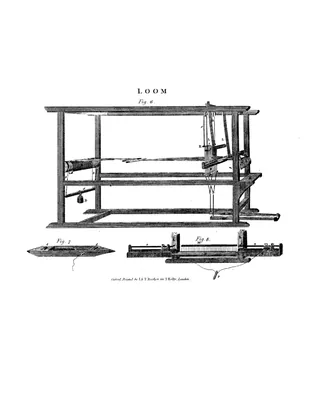
An encyclopedia entry on the loom, defining it as the weaver's frame and describing a plain-weave silk loom illustrated on an engraved plate. It explains the cloth beam and yarn beam, the two heddles (called lambs) worked by treadles, the swinging reed frame, and the shuttle race with pickers driven by a hand-held stick. It also describes the weaver's sequence of operations and the speed of an expert weaver.
Mohair
Oxford Encyclopedia, 1828
Article · 1 page
A short encyclopedia entry defining mohair as the hair of a goat found around Angora in Turkey, and as the camblet fabrics made from it. It distinguishes smooth plain mohair from watered mohair, which is calendered, and notes versions with wool, cotton, or thread wefts.
Mulberry
Oxford Encyclopedia, 1828
Article · 1 page
A one-page encyclopedia entry on the mulberry tree, referring readers to the entry Morus. It describes the Devonshire practice of adding mulberry juice to cider, and discusses the use of mulberry leaves to feed silkworms, noting the encouragement from the crown under James I and the failure of English sericulture for lack of enough trees.
Muslin
Oxford Encyclopedia, 1828
Article · 1 page
A short encyclopedia entry defining muslin as a fine cotton cloth with a downy knot on its surface. It lists several East Indian types, especially from Bengal (doreas, beteiles, mulmuls, tanjebs), and describes jaconet, a muslin between cossae and mulmul in fineness. It notes that jaconet suits tambour and needlework embroidery and was made in England and Scotland.
Rope
Oxford Encyclopedia, 1826
Article · 6 pages
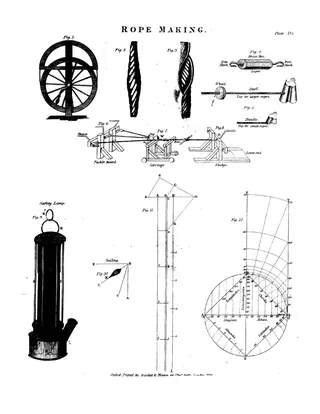
An encyclopedia article on rope and rope making from an early 19th-century Oxford encyclopedia. It covers the physics of rope rigidity (experiments by Amontons, Desaguliers, Coulomb), fibre sources such as hemp, the principles of spinning yarns, and the laying of strands into rope on a rope-walk with the tackle-board, sledge, top and woolders. It ends with tarring and Du Hamel's strength tests of white versus tarred cordage. One plate (Plate 135, Rope Making) illustrates the tools and machinery.
Sewing Machines
Oxford Encyclopedia, c. 1900-1910
Article · 3 pages
An encyclopedia article on the history of the sewing machine, from Thomas Saint's 1790 English patent through the inventions of Hunt, Howe, Wilson, Singer, Grover & Baker, and Willcox & Gibbs. It covers key mechanisms such as the eye-pointed needle, lock-stitch, shuttle and feed motions, the patent litigation and the 1856 combination of the major companies, and specialized industrial machines. It ends with United States production statistics for 1900.
Silk
Oxford Encyclopedia, 1828
Article · 3 pages
An encyclopedia article on silk covering its natural origin, its early history, the life cycle of the silkworm, and the reeling and spinning of raw silk. It traces the spread of silk manufacture from China and Cos through Persia, Greece, Rome, Sicily, Italy, France and England. It also gives practical accounts of cocoon selection, reeling, floretta (waste silk), and the chemistry of silk gum and its yellow colouring matter.
Spinning
Oxford Encyclopedia, 1828
Article · 2 pages
An encyclopedia article on spinning, outlining the progression from the spindle and distaff to the spinning wheel. It describes Mr. Antis's improved wheel with a reciprocating bobbin, Hargreaves's spinning jenny, the slubbing machine or billy, and Arkwright's roller spinning. It closes with the adaptation of roller frames to flax and worsted, including the wet-spinning of flax.
Tapestry
Oxford Encyclopedia, 1828
Article · 2 pages
An encyclopedia article on tapestry covering its supposed origins and early manufactories in the Netherlands, France (Paris, Gobelins), and England (Mortlake). It then describes in detail the two kinds of tapestry weaving, high warp (vertical loom) and low warp (horizontal loom), including loom parts, tools such as the broach, reed, flute and needle, and the weaver's working method.
Weaving
Oxford Encyclopedia, 1828
Article · 2 pages
An encyclopedia entry defining weaving and describing the construction and operation of the common treadle loom, including lams (headles), treadles, lay or batten, breast bar, knee roll and yarn beam. It also explains the flying shuttle, its boxes and drivers, and how it lets one weaver work wide cloth. It ends with cross-references to the articles Cloth and Loom.
Wool
Oxford Encyclopedia, 1828
Article · 2 pages
An encyclopedia article on wool, defining it as the soft curly hair of sheep and other ruminants and distinguishing it from hair by its uniform growth and shedding. It summarizes early chemical studies, notably Berthollet's work in the 1780s on wool's reaction with alkalies and acids. It also covers fleece and the grades of wool from England, Spain and France, and the 1791 Edinburgh Society for the Improvement of British Wool, which imported and distributed sheep and gave premiums for Shetland breed improvement.
20 documents found