Textile Documents › Publications › Publication: American Naturalist
6 documents found
Sort: 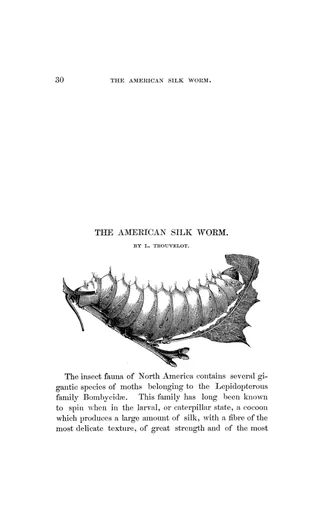
American Silk Worm, Part 1
Article · 9 pages
First part of L. Trouvelot's article on native North American silk-producing moths, published in the first issue of the American Naturalist (1867). It surveys eight or ten American species and judges which could yield usable silk, concluding that only Telea Polyphemus is practical. Trouvelot recounts his efforts since 1860 to raise the Polyphemus worm, then describes the moth's natural history: emergence from the cocoon, wing development, egg-laying, hatching and moulting. The text breaks off with 'To be continued'.
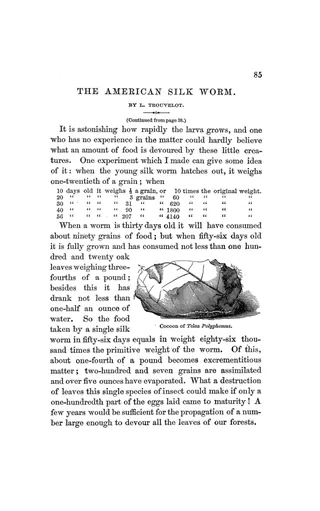
American Silk Worm, Part 2
Article · 10 pages
Second installment of L. Trouvelot's article on the American silk worm, Telea (Antheraea) polyphemus, from the first volume of American Naturalist. It covers larval growth and food consumption, cocoon spinning, the pupa, the silk reservoirs ("gut"), natural enemies such as birds and ichneumon parasites, and descriptions of the larva, pupa and egg. It ends with practical instructions for selecting and storing cocoons, hatching the moths, pairing, and rearing the young larvae on oak and other foliage. The article is continued in a later issue.
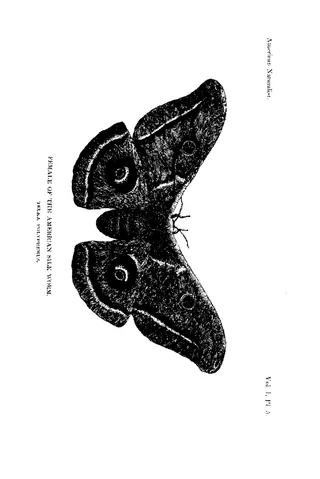
American Silk Worm, Part 3
Article · 7 pages
The concluding part of L. Trouvelot's article on rearing the American silk worm (Telea polyphemus) in the United States. It describes raising larvae outdoors in netted woodland and under a screened shade, with practical advice on feeding branches, moulting, water and cocoon handling. It also reports experiments on the cold tolerance of chrysalids, whether the pupa needs air (cocoons coated with starch and shellac), the impossibility of a second brood, and delaying hatching by cold storage. Two plates show the female and male moths.
Cynthia Silk-Worm
Article · 10 pages
An 1868 article by W. V. Andrews urging American cultivation of the Cynthia silk moth (Samia cynthia) as a source of silk, after disease struck the mulberry silkworm (Bombyx mori) in Europe. He compares it with native American silk moths and with the Yama-mai, sorts out confusion over its identity in the literature, and gives a journal of his own rearing on ailanthus, including life-cycle dates and open-air feeding. He closes with economic arguments for silk-culture and for government support, and notes the difficulty of reeling the hard cocoons.
New Zealand Flax
Article · 4 pages
A short 1876 natural-history sketch of New Zealand flax (Phormium tenax), describing its appearance, range and habitat. It covers Maori uses of the plant, including stripping fibre with a mussel shell and weaving mats, rugs, garments, baskets, nets, lines and canoe sails. It closes with the unsolved problem of cleaning the fibre by machine and its 1870 use in rope-making.
Otter Sheep
Article · 1 page
A short note in the American Naturalist reprinting Timothy Dwight's account, from his travels of about 1798, of the Otter (Ancon) sheep of Mendon, Massachusetts. A short-legged, club-footed breed arose from twin lambs and was propagated by one farmer. The sheep were quiet, could not climb stone walls, and had wool comparable to ordinary sheep. Bristol introduces the passage for naturalists.
6 documents found