Textile Documents › Publications › Publication: The Americana
15 documents found
Sort: 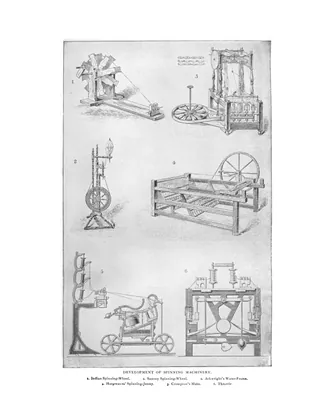
American Textile Industry
Article · 9 pages
An encyclopedia article surveying the growth of the American textile industry from household production in colonial times to the factory system of about 1900. It covers colonial homespun and linsey-woolsey, early mills such as Slater's at Pawtucket and the Waltham mill, and the power looms of Lowell, Crompton and Bigelow. It also treats the cotton, wool, worsted, silk and knit-goods branches, with an illustrated plate of spinning machinery and a statistical table of US textile industries in 1900. It ends with a call for technical schools for textile workers.
Bamboo
The Americana, 1903
Article · 2 pages
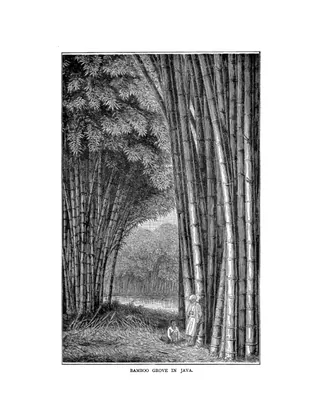
A short encyclopedia entry on bamboo from The Americana, describing it as a group of tropical and sub-tropical tree-like grasses with over 200 species, most abundant in southern Asia and America. It covers their size, rapid growth, and the many uses of the stems, leaves, shoots and seeds (building, utensils, basketry, hats, paper, food), plus notes on ornamental cultivation. A halftone photograph of a bamboo grove in Java accompanies the text.
Basket
The Americana, 1903
Article · 2 pages
Encyclopedia entry on baskets from The Americana (1903). It traces the origin of the word from Britanno-Celtic roots and Roman references, treats basketry as a forerunner of weaving and pottery, and surveys materials such as willow, bamboo, rattan, palm and New Zealand flax. It describes the basic process of making an osier basket (slath, ribs, rim and handle) and closes with the decline of Native American basketry and efforts to revive it in Indian schools.
Bleaching
The Americana, 1903
Article · 2 pages
A two-page encyclopedia article on the bleaching of textiles, as published in The Americana (1903). It covers the history of chlorine and bleaching powder, then describes the processes for cotton (singeing, kier boiling, bleaching liquor, souring, starching, calendering), linen, wool and silk. It also mentions the Mather-Thompson steaming process and the electrolytic Hermite process.
Cordage
The Americana, 1903
Article · 3 pages
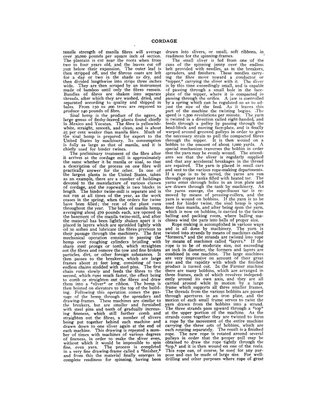
An encyclopedia article from The Americana (1903) describing the cordage industry. It covers the fibres used for rope (manila, sisal, hemp, jute), their preparation, and how they are drawn, spun into yarn and tarred. It then explains how yarn is formed into strands and laid into rope and cables by machine and on the ropewalk.
Cordage Industry
The Americana, 1903
Article · 4 pages
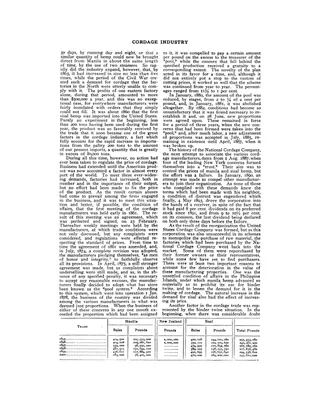
An encyclopedia-style article on the history of the American cordage (rope-making) industry. It traces rope-walks from John Harrison's first walk in Boston in 1642 through the shift to factory production after 1830, the major cordage firms, and later centers in the Midwest. It also covers price-fixing agreements, the "pool system," the National Cordage Company trust and its 1893 failure, the binder twine trade, and a table of manila, New Zealand and sisal fiber imports for 1895-1900.
Cotton Ginning Machinery
Article · 5 pages
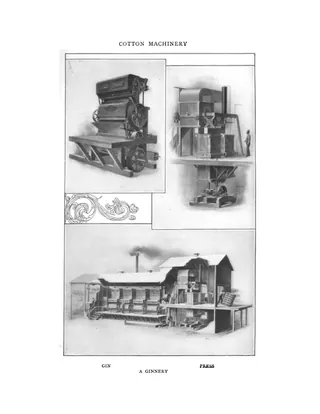
An encyclopedia-style article by J. R. Fordyce, a ginning machinery manufacturer, describing how seed cotton is separated from its seed and baled in the early 1900s. It covers the churka, the Whitney saw gin, the McCarthy roller gin, the layout of a gin house, and each machine in sequence: telescope, pneumatic elevator, feeder, gin, flue, condenser and press. It also covers square and round bale presses, compresses, and the growth of US cotton exports and crop size. Illustrated with a line-drawing plate of cross-sections and a plate of photographs of a gin, a press and a ginnery.
Cotton Industry
Article · 8 pages
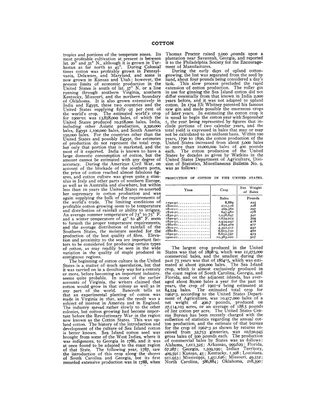
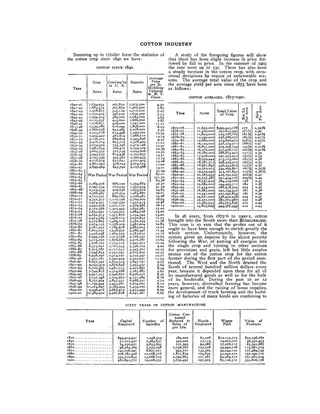
An encyclopedia article on cotton from The Americana, covering its history and early use, botany of the Gossypium species, and the differences between Upland and Sea Island cottons. It also discusses cultivation, plant diseases and insects, production costs, the cotton-seed by-products industry, the growth of cotton manufacturing in New England and the South, and world and U.S. production statistics. It ends with a bibliography, and a table of U.S. crop figures from 1790-91 to 1900-01 appears.
Cotton Industry
Article · 4 pages
An encyclopedia article on the history and economics of the American cotton industry, from the early South and the saw-gin through the 1900-01 crop. It covers Whitney and Holmes's gin patents, homespun production, price swings, post-Civil War credit and tenant systems, and the growth of southern cotton mills against northern ones. Statistical tables give crop, consumption, export and price data for 1840-1901, acreage and yield for 1875-1901, sixty years of manufacturing (1830-1900), and northern versus southern mill consumption.
Damask
Article · 10 pages
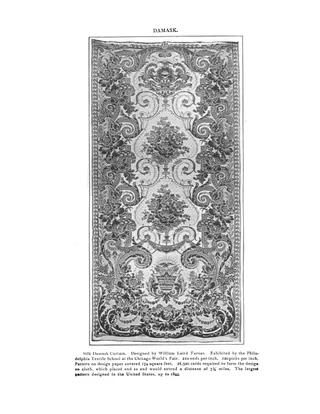
An encyclopedia-style article on damask and its manufacture by William Laird Turner. It traces weaving from antiquity and the draw loom to Damascus damask and the Jacquard machine, then describes Jacquard parts, warp preparation, designing, design paper, and card stamping. It closes with notes on fine damask fabrics and brocatelle, including their shaft arrangements. A full-page plate shows a silk damask curtain designed by the author for the Philadelphia Textile School.
Dyeing
Article · 3 pages
An encyclopedia article on dyeing from The Americana (1903) that surveys the preparation of cotton, linen, silk and wool fibers, dyeing machinery, and the role of substantive and adjective dyes and mordants. It lists six methods of dyeing and gives 76 numbered typical recipes organized by color (reds, blues, yellows and oranges, greens, purples, blacks, drabs, browns) and by fiber. It closes with references to period dyeing manuals.
Dyestuffs
Article · 2 pages
An encyclopedia article from The Americana (1903) surveying dyestuffs used to color textile fibers and fabrics. It classifies them as animal dyes (cochineal, kermes, lac, galls), vegetable dyes by plant part (madder, logwood, fustic, quercitron, safflower, saffron, indigo, woad, lichens, weld), and artificial colors (pigments and coal-tar series such as aniline, phenol, azo and anthracene colors). It notes the colors each produces, the fibers it suits, and its permanence or mordant use.
Lace
Article · 4 pages
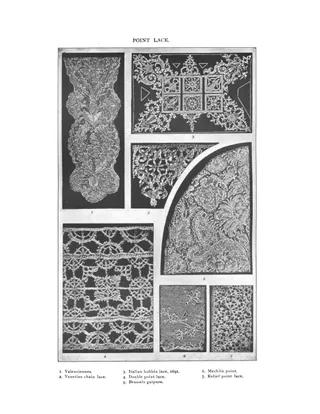
A four-page encyclopedia article on lace by Charles Richards Dodge. It defines lace and surveys its uncertain origins, then separates needle-point, bobbin or pillow, and machine-made lace. It covers the main named varieties (Venetian, Alençon, Brussels, Mechlin, Valenciennes, Honiton and others), the threads used, lace-making in Europe and in colonial and peasant traditions, and the history of lace machines. A plate shows seven lace samples.
Loom
The Americana, 1903
Article · 2 pages
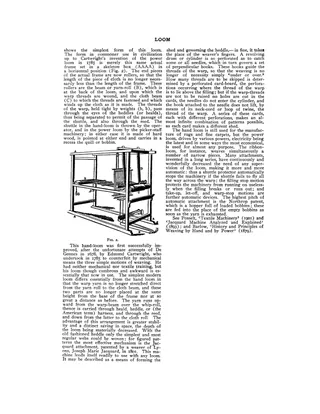
A short encyclopedia entry on the loom from The Americana. It traces the loom from the simple rectangular hand-loom frame to the framed horizontal hand loom with warp beam, cloth beam, heddles, reed and shuttle. It then covers Cartwright's power loom of 1785, the Jacquard attachment of 1801, and later automatic devices such as the Northrop bobbin-feeding patent. It includes two simple line drawings and ends with references to Posselt and Barlow.
Textiles or Textile Fabrics
Article · 3 pages
An encyclopedia article defining textiles or textile fabrics and explaining in general terms how woven cloth is made. It covers the basic action of the loom, plain weave, twill, satin, gingham, damask, brocade, ribbed silks and velvet (cut, uncut and pile upon pile), plus metallic threads and a brief history of decorative weaving in Egypt, Western Asia and Europe. It closes with a bibliography of works on textile design, Oriental carpets, medieval fabrics and church vestments.
15 documents found