Textile Documents › Topic: Hosiery
107 documents found
Sort: 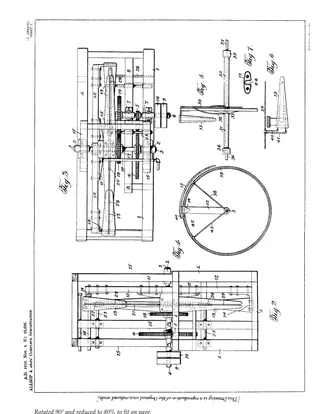
Improvements in Singeing Machines, GB Patent No. GBA25686
Patent · 7 pages
British complete specification (No. 25,686 of 1910) for a hosiery singeing machine invented by three Philadelphia manufacturers under the International Convention. The machine carries curved stocking supports on radial arms rotating past gas burner tubes that singe loose fibres. The operator loads stockings in much the same position as with the old board forms. A chain-driven stripping finger running faster than the supports removes the stockings, and an optional water-cooling circuit through the hollow supports allows singeing of stockings in the "green" state. Includes claims and two sheets of drawings.
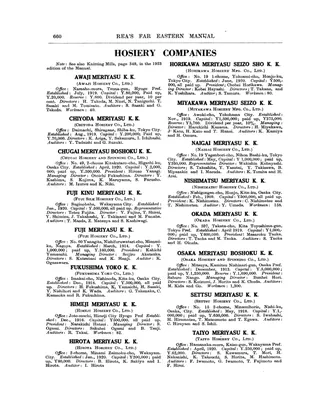
Hosiery Companies (Japanese)
Rea's Far Eastern Manual, 1922
Article · 2 pages
A two-page directory of Japanese hosiery companies from the 1922 edition of Rea's Far Eastern Manual. Each entry gives the company's Japanese and English names, office address, date established, capital and paid-up capital, and its directors and auditors. Some entries also list reserves, dividends, or the number of workmen. Companies are in Osaka, Tokyo, Yokohama, Nagoya, Wakayama, Himeji and other areas.
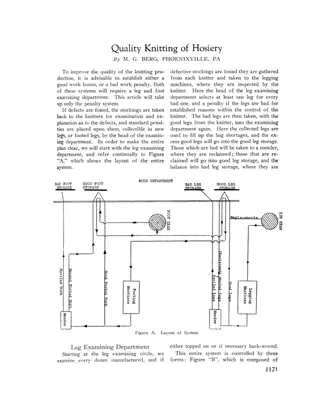
Quality Knitting of Hosiery
Article · 6 pages
A 1930 trade-journal article by M. G. Berg describing a penalty system for controlling the quality of knitting in a hosiery mill. It explains how leg and foot examining departments inspect production, collect replacement and penalty legs or footed stockings from knitters, and route good and bad work through storage and menders. Punched-coupon cardboard forms (Figures A to G) provide weekly records, payroll data, and analysis of the causes of bad work.
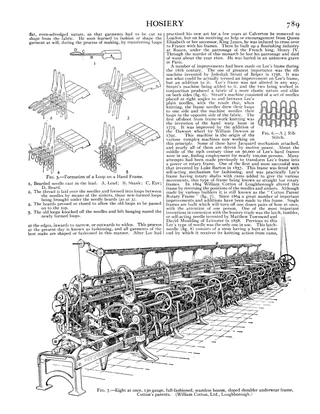
Hosiery
Article · 3 pages
Encyclopedia Britannica (11th edition) article on hosiery and the machine knitting industry. It defines hosiery as loop-structure fabrics, distinguishes frame-work (weft) knitting from warp knitting, and traces the history of knitting from the 15th century. It describes William Lee's 1589 stocking frame and later developments: Strutt's rib machine, the Dawson wheel, Cotton's rotary frame, the latch needle, Brunel's circular frame, and the Lamb flat machine. Illustrated with figures of loop structures, a hand stocking frame, needle types and loop formation.
Hosiery
Article · 1 page
A short encyclopedia entry on hosiery, defined as stocking manufacture and more broadly all knitted goods made by hand or machine. It outlines the origins of stockings and the invention of knitting, William Lee's 1589 stocking frame, and the spread of the industry in colonial and 19th-century America. It ends with U.S. production figures for 1899 and 1909.
Stocking
Rees's Cyclopedia, 1819
Article · 7 pages
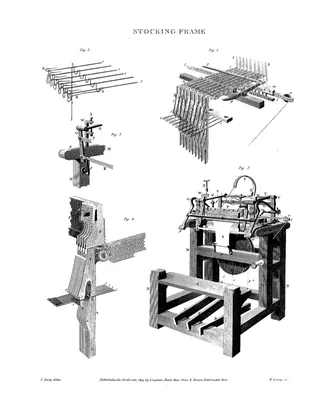
Encyclopedia article on stockings and the stocking frame from Rees's Cyclopedia (1819). It covers the disputed origins of knitting and the stocking loom, the account of William Lee's invention in 1589, the framework knitters' company, and the hosiery trade in Leicestershire and other English towns. The later pages give a detailed mechanical description of the frame: needles, sinkers, jacks, the presser-bar, treadles and the sequence of movements that forms a course of loops. An engraved plate by J. Farey and W. Lowry illustrates the machine.
Hosiery and Knit Goods
Article · 2 pages
A short encyclopedia article on the American hosiery and knit goods industry circa 1906. It compares the speed of hand knitting with machine knitting and gives the size and location of the industry. It then describes how socks and stockings are machine-knitted, using a cuff machine, a Jacquard-controlled cylinder machine and a transfer cup. It ends with the preparation of lisle cotton yarn by combing, gassing and chemical treatment, and with dyeing and pressing.
A Stocking in Rhyme
Other · 1 page
A single-page set of rhymed instructions for knitting a stocking on four needles, numbered as pattern No. 80. The verses cover casting on, ribbing with a seam stitch, narrowing for the leg, working and closing the heel, picking up gusset stitches, and shaping and closing the toe, with specific stitch and row counts.
Advertisement
Auto Knitter Hosiery Co,, 1925
Ephemera · 1 page
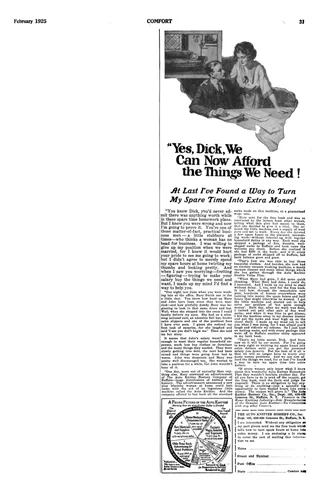
A one-page magazine advertisement from Comfort, February 1925, for the Auto Knitter Hosiery Co. of Buffalo, N.Y. It is written as a wife's letter to her husband, telling how she earns extra money knitting wool socks at home on the Auto Knitter machine, which the company buys back at a guaranteed rate. It includes a photograph, a pie-chart diagram of how the Auto Knitter dollar is divided, and a coupon for a free book.
Automatic Knitting Machine, US Patent No. 552806
Patent · 25 pages
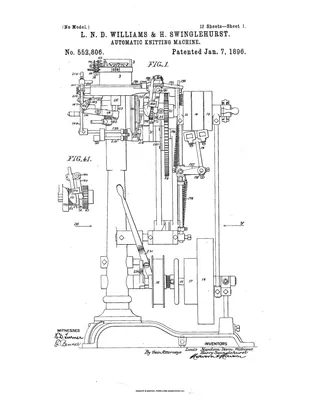
US Patent No. 552,806, granted January 7, 1896 to Louis N. D. Williams of Ashbourne and Harry Swinglehurst of Philadelphia, for an automatic circular knitting machine that makes socks and stockings. Twelve sheets of drawings show the needle cylinder, cam box, needle lifters, thread-feeding mechanism, pattern chain and clutch and belt-shifting gear. The specification explains how the machine switches between rotary and reciprocating motion to form the heel and toe pocket, shapes the leg by varying needle draft, and adds a reinforcing thread at intervals. It ends with numbered claims.
Coralline Dye-Injurious Effect Therefrom
Manufacturer and Builder, 1869
Article · 1 page
A short 1869 magazine item reporting a case in which a French chemistry professor, Mr. Bidard of Rouen, wore stockings with red silk lines dyed with coralline. The wearer suffered painful burn-like inflammation and mild poisoning, certified by two physicians in Havre. Analysis found the red dye was coralline, derived from carbolic acid, while the lilac ground was harmless aniline violet.
Des Vers a Soie et de Leur Éducation [About Silkworms and Raising Them]
Book · 374 pages · French
A French treatise of 1824 on raising silkworms according to the practice of the Cévennes, followed by a survey of silk products and a note on making silk stockings. It covers mulberry cultivation and grafting, hatching the eggs, the rearing room and its equipment, the molts and diseases, spinning of the cocoons, and preserving the seed. It then covers killing the chrysalids, reeling silk (including with a steam-heated basin), grades of silk, and uses of waste material such as floret, bourette, filoselle and silk waste. The last part is a long set of notes keyed to pages of the main text.
Knitting Department
Article · 2 pages
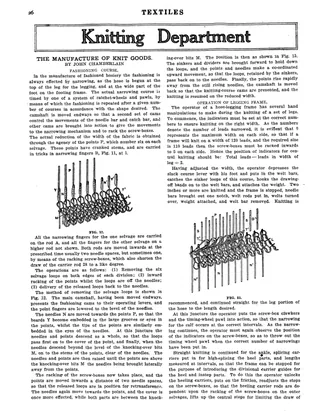
A two-page installment of the Knitting Department in Textiles by John Chamberlain, on the manufacture of fashioned hosiery on flat knitting frames. It explains the fashioning (narrowing) course, in which points remove and retransfer selvage loops, and the operator's tasks on the legging frame and footing frame. It ends with a short note on a wire take-up attachment for yarn slack on a knitting machine. Two figures (Figs. 12 and 13) show needles and points during loop transfer.
Process of Weaving, US Patent No. 1942152
Patent · 5 pages
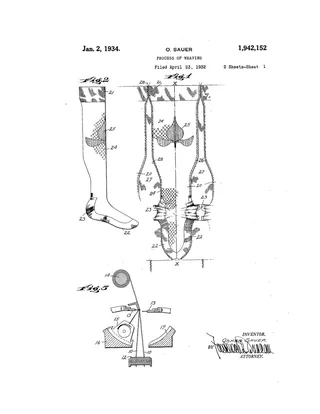
US Patent 1,942,152 (granted Jan. 2, 1934) by Oskar Sauer of Philadelphia describes a method of weaving fabrics with a three-dimensional surface, aimed mainly at woven lace hosiery blanks. Fullness at the heel is formed on a Levers lace machine by selectively suppressing warp shifting and interrupting take-up, with warp threads drawn from individual beams. The text covers the machine's operation, blanks with selvages separated by lacer threads, an alternative on an ordinary loom with partial shuttle throws, and four method claims. It includes two sheets of drawings of the stocking blank, mesh fabric and machine details.
Knitting Department
Article · 3 pages
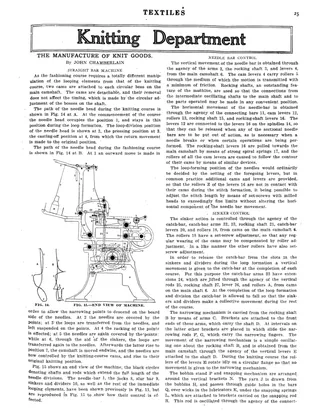
Three pages from the Knitting Department of the trade journal Textiles (pp. 25-27). John Chamberlain's installment on the manufacture of knit goods covers the straight bar (fashioning) knitting machine: needle-head paths for knitting and fashioning courses, needle bar, sinker and narrowing mechanism control, and care, adjustment and fault-finding for good selvages. Shorter items follow on grades of silk hosiery (pure dye, dipped, ingrain) and a patented thread-cutting attachment for looping machines.
Manufacture of Fashioned Knit Goods, Part 1
Article · 6 pages
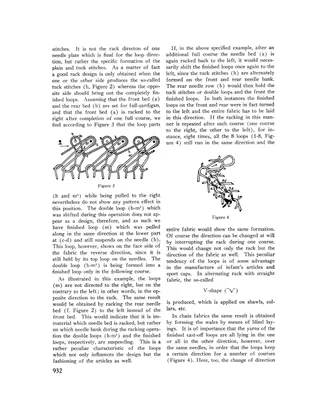
First part of an article on how fashioned (shaped-on-the-machine) knitted goods are manufactured, by Karl Aberle of Reutlingen. It compares fashioned articles with garments cut from piece goods and lists the main shaping methods: changing loop form, loose and tight loops, changing loop direction by racking, widening, narrowing and gussets. It covers stitch changes for connected sleeve parts, needle selection on flat and circular machines, rib dial adjustment on hosiery machines, rack stitch and tuck stitches, and widening by adding needles. Five diagrams illustrate sleeve sections, loop structures, racking and carrier-limited widening. The article ends with "To be continued".
Knitting Department
Textiles, c. 1919-1920
Article · 3 pages
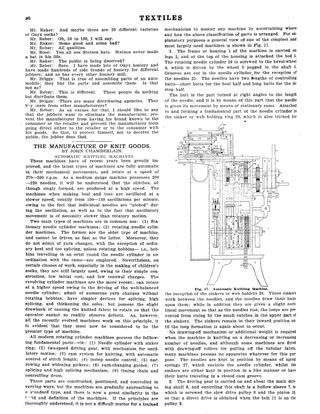
Three pages from the "Knitting Department" of the trade journal Textiles. The first part covers a warning to American manufacturers about currency exchange rates and imports, citing the closure of Hongkong knitting mills, and a congressional hearing on trademarks and jobber branding in the hosiery trade. The main part is the start of John Chamberlain's "The Manufacture of Knit Goods," which describes automatic hosiery knitting machines in detail, with a line drawing (Fig. 17) and numbered parts. It covers the needle cylinder, sinkers, driving gear, cams, narrowing and widening pickers, yarn changing, splicing, and the timing chain.
Knitting Mills, Hosiery and Underwear Factories
Rea's Far Eastern Manual, 1922
Article · 5 pages
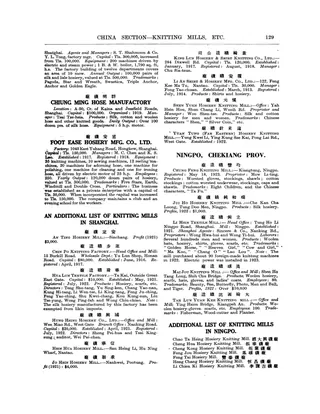
A directory of Chinese knitting mills, hosiery and underwear factories from the 1922-23 edition of Rea's Far Eastern Manual. Entries are grouped by city: Shanghai, Ningpo, Kashing, Sungkiang, Hongkong and other Chinese centers such as Hangchow, Harbin, Hankow, Peking and Tientsin. Each entry gives, where known, the address, capital, founding date, managers or directors, equipment, output, trademarks and sometimes financial results. Mill names are also given in Chinese characters.
The Silk Stocking an Inventor's Fate
Article · 2 pages
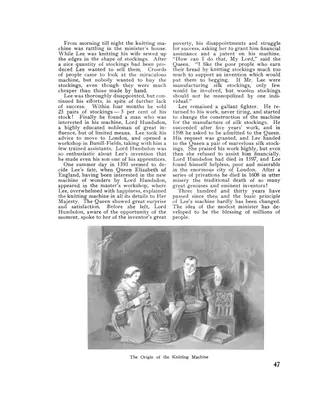
A short, popular and somewhat romanticized account of William Lee, the English clergyman who invented the stocking frame (mechanical knitting machine) in 1589-1593. It tells how he was moved by watching his sweetheart Mary hand-knit, built the machine, moved to London under Lord Hunsdon's patronage, and was refused a patent by Queen Elizabeth I, even after producing silk stockings in 1598. Lee died in poverty in 1608. A halftone illustration titled "The Origin of the Knitting Machine" accompanies the text.
Stocking Frame
Article · 1 page
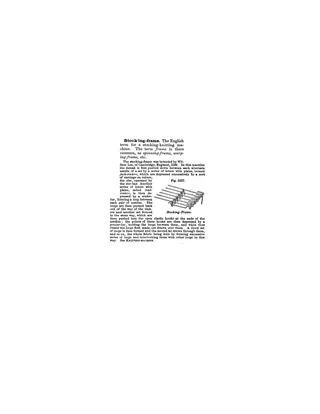
A short dictionary entry on the stocking-frame, the English term for a stocking-knitting machine, invented by William Lee of Cambridge in 1589. It explains how jack-sinkers, lead-sinkers, the slur-bar and the presser-bar form and interlock loops on a row of hooked needles. An engraving (Fig. 5837) shows the machine.
Cyclopedia of Textile Work, Vol. 5: Knitting, Knit Goods, Finishing
Book · 388 pages
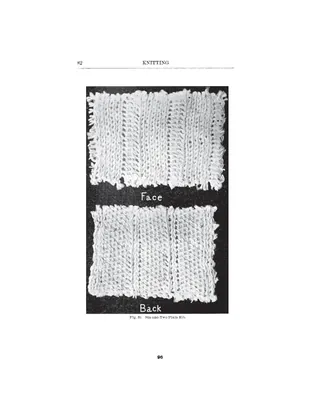
Volume 5 of the seven-volume Cyclopedia of Textile Work, an American Technical Society correspondence-school reference on machine knitting. It covers cylinder spring needle and latch needle circular machines, stationary needle cylinder and Leighton flat-head machines, hand and full-automatic hosiery machines, fancy and lace-effect hosiery, and full-fashioned machines. The final section deals with knit goods finishing: sewing and finishing machines such as the Merrow and Willcox & Gibbs, and machines for underwear. Text includes yarn number tables, needle and cam mechanics, machine adjustment instructions, hand-knitting instructions for mittens and gloves, and review questions. It is heavily illustrated with machine drawings and photographs of fabric swatches and knitting rooms.
Knitting
Article · 3 pages
Encyclopedia article on knitting, defining it and distinguishing it from crochet, netting, braiding and weaving. It covers hand knitting terms and needles, William Lee's 1589 stocking frame and later improvements (Strutt's ribber, Brunel's circular machine, power knitting, the latch needle), and US knitting industry statistics through 1909. It ends with a short bibliography of works on knitting and hosiery manufacture.
"The Stocking-Knitter"
Textile Mercury, 1889
Article · 2 pages
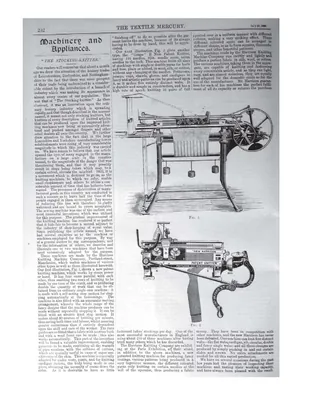
Article from The Textile Mercury of July 20, 1889, describing domestic and small-shop knitting machines made by the Harrison Knitting Machine Company of Manchester, including a four-cam patent machine and the 'Grape' B New Patent Knitter, and the threat such machines posed to the hosiery trade of the East Midlands. The scan continues onto a second page with a short piece on an improved rubbing motion for the Bolette condenser used in cotton yarn preparation, followed by trade notes and local mill news from English towns.
Treinis System of Designing
The Melliand, July 1930
Article · 2 pages
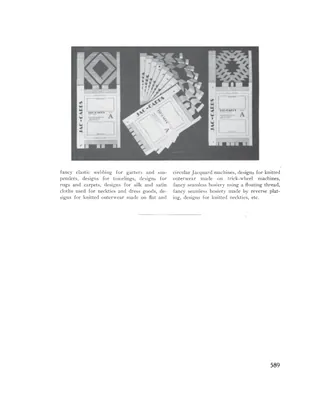
A short trade article from The Melliand describing the patented Treinis system of mechanical design creation, developed by Leonard R. Treinis of Brooklyn and licensed to mills. Designs are laid out on numbered "Jac-cards" and new patterns are produced by rearranging the order of the cards, so that one set of hosiery selectors can serve many designs. The article lists the textile applications suggested for the method, including hosiery, knitted outerwear, webbing, rugs, towelings, neckwear and worsted weaves. Illustrations show a master design for seamless hosiery, rearranged variations and photographs of the punched card stacks.
Knitted Fabrics
Book · 178 pages · weaving drafts
A volume in Pitman's Common Commodities and Industries series on the knitting industry, covering the history of hand and machine knitting, yarn preparation, the principles of knitted fabrics, hand-knitting machines, and the manufacture of hosiery, underwear, fancy fabrics, outer garments and gloves. It closes with trimming and finishing processes such as scouring, milling, pressing, singeing and drying. Illustrated with line drawings and photographs of machines, needles, stitch structures and fabric swatches. The scan includes the publisher's advertising pages and dust cover.
A History of the Machine-Wrought Hosiery and Lace Manufacturers
Book · 608 pages
A 1967 Burt Franklin reprint of William Felkin's 1867 history of machine knitting (hosiery) and machine-made lace in England and abroad. It traces hand-knitting and the hand loom, William Lee's stocking frame, the framework knitters' charter, Strutt's Derby rib frame, warp machines, and Heathcoat's bobbin net machine. Later chapters cover Luddism, the Levers, pusher and Jacquard lace machines, the lace and hosiery trades to 1867, and the French and Saxon industries. It is illustrated with plates of machines, mechanism diagrams, portraits and lace samples, and includes statistical tables of frames and wages.
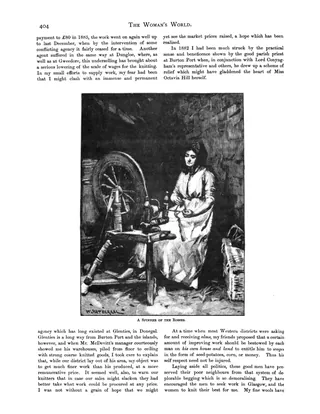
Some Irish Industries : II.--The Knitters of the Rosses
Article · 6 pages
A magazine article from The Woman's World, part of the series 'Some Irish Industries', describing the Rosses district of western Donegal and its hand-knitting trade. The author describes the landscape, poverty, customs and folklore of the islands and coast, then explains how knitting, spinning and hand-loom cloth were encouraged by Lord George Hill at Gweedore and bought by hosiery agents. She also describes her own scheme, run from a London 'stocking room' with Father Bernard at Burton Port, which supplies fine wool and pays local women for socks, gloves and jerseys. It also touches on wages, competing agencies, Donegal embroidery and sprigging, homespun cloth, plant and lichen dyeing, tuck-mill finishing, and the appeal for a pier at Kincaslough.
Posselt's Textile Journal, Vol. 6, No. 5 (May 1910)
Periodical · 60 pages · weaving drafts
May 1910 issue of Posselt's Textile Journal, a monthly trade periodical of the American textile industries. Its main articles cover the history of the knitting industry and knitting machinery, reinforced, full fashioned and rib top hosiery, drying, bleaching and dyeing of knit goods, and a trade mark directory. Technical pieces include silk quiller devices, silk yarn count calculations (denier and dram), air conditioning for mills, granite weaves obtained by four changes (with drawdowns), the Jacquard machine, stop motions, the duplex carding system, and preventing tendering of sulphide-dyed cotton. The issue also has market reviews, mill news, a textile workers' bureau, a buyers' index and many machinery and dye advertisements.
Höchstleistung durch Schnelläufermaschinen in der Wirkerei und Strickerei [Maximum Output through High-Speed Machines in Knitting and Hosiery Manufacture]
Article · 2 pages · German
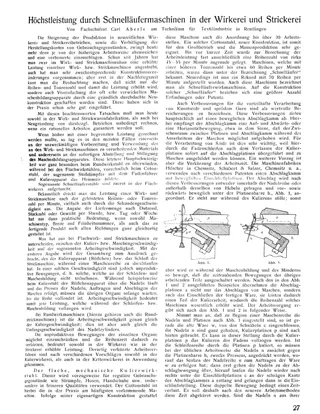
A 1927 German-language article by Carl Aberle of the Reutlingen textile technical school on raising output in knitting and hosiery manufacture with high-speed machines. It explains the difference between knitting speed and working speed, then describes improvements to flat Cotton frames, notably a movable knock-over comb with enclosing sinkers. It also covers high-speed circular knitting machines, including the Terrot system and the Haaga loop-wheel frame. Three cross-section diagrams of needle and sinker mechanisms illustrate the text, and the article ends with "Fortsetzung folgt" (to be continued).
Knitting: -- Processes and Machinery
Article · 3 pages
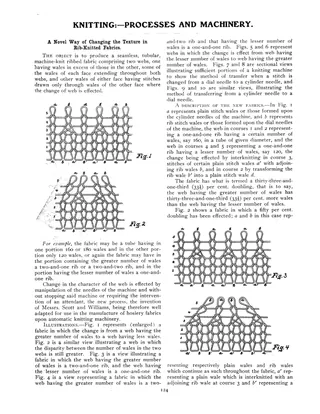
Two short technical pieces on knitting machinery from Posselt's Textile Journal, December 1907. The first describes a process by Scott and Williams for changing the number of wales in seamless tubular rib-knitted fabric, for example from one-and-one to two-and-one or two-and-two rib. It does this by transferring stitches between dial and cylinder needles without stopping the machine. The second describes H. A. Klemm's needle-bed with alternating long and short grooves and filling pieces, which allows a higher gauge in straight-frame and circular machines. Both are illustrated with fabric diagrams and machine sections.
Manufacture of Fashioned Knit Goods
Article · 3 pages
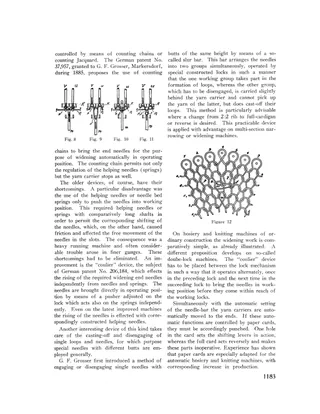
Concluding installment of Karl Aberle's article on making fashioned (shaped) knit goods on flat and tubular knitting machines. It covers widening of double-sided rib and cardigan fabrics, the special difficulty of widening tubular work, and Grosser's patented method of widening tubular fabric without holes. It also describes automatic widening devices (counting chains, counting Jacquard, the "coulier" device, slur bar, punched paper cards), illustrated with needle-bed, lock, and loop diagrams in Figures 6-12.
Tricot [Knitting]
Article · 1 page · French
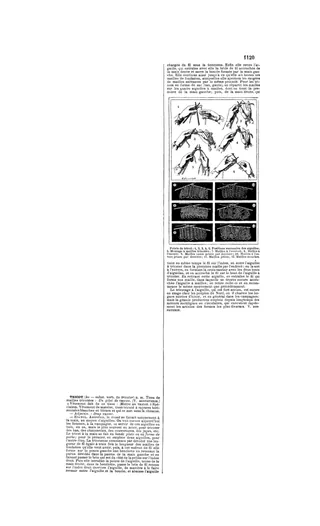
A one-page French encyclopedia entry on 'tricot' (knitting) from the Nouveau Larousse Illustré. It defines the word and explains hand knitting with two needles for flat pieces and four or five for seamless items such as stockings and gloves, covering casting on and forming stitches. An illustrated plate shows successive needle positions, cast-on and basic stitches (knit, purl, twisted, yarn-over, speckled). It notes that hand knitting persists in northern countries and rural areas while industry uses straight or circular knitting machines, and refers readers to the entry on bonneterie.
Bags for the Woman Who Reads
Article · 2 pages · weaving drafts
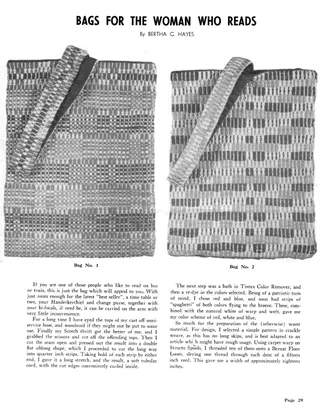
A short 1942 article in Weaver describing two handwoven shoulder bags for carrying reading material, woven in crackle weave with carpet warp. The weft strips are cut from the tops of discarded hosiery, which are stretched into tubular cords and re-dyed red and blue. The article gives the construction method, treadling sequences for both bags, threading notes for Structo Spools on a 15-inch reed, and a draft with tie-up.
Fulling
Article · 1 page
A brief encyclopedia entry defining fulling as the scouring and pressing of cloth, stuffs and stockings to cleanse, thicken and strengthen them, done by water mill. It notes the use of fuller's earth and soap, and describes hand, foot and machine fulling of stockings and caps with various ingredients such as urine and chalk-softened water.
Knit Goods Management Based on Visible Facts
Article · 8 pages
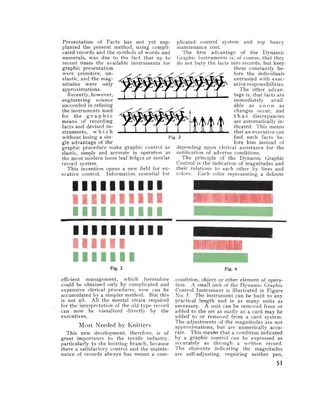
A 1929 article from the first issue of The Melliand arguing that knitting mills should manage materials and production with graphic, visual control instruments rather than written and numerical records. It describes a 'Dynamic Graphic Control' system of color-coded indicator units, a Graphic Calculator (slide-rule style) for material and production requirements, a Graphic Planner using weekly colored cards, and a Graphic Locator for tracking orders. Figures include comparative charts, a Gantt-style chart and planning boards. The content concerns factory management in hosiery, underwear and outerwear plants, not weaving or knitting technique.
Knitting: -- Processes and Machinery, Part 1
Article · 5 pages
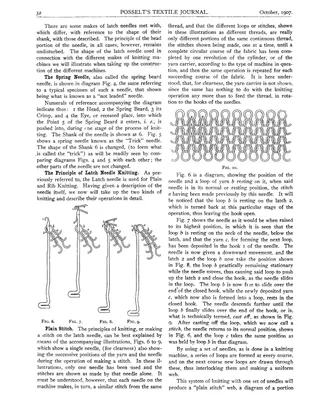
First installment of E. A. Posselt's study of knitting processes and machinery, from Posselt's Textile Journal, October 1907. It opens with the history of the stocking frame and the competing stories about William Lee's invention, then names later improvers of knitting machinery. It describes the latch needle and the spring beard needle, with numbered part diagrams. It explains how plain stitch, 1:1 and other rib stitches, and tuck stitch are formed and how the resulting fabrics differ. Knitted fabrics are classed as hosiery, ribbed goods and flat goods.
Method of Making Tubular Seamless Lace, US Patent No. 3453928
Patent · 13 pages · weaving drafts
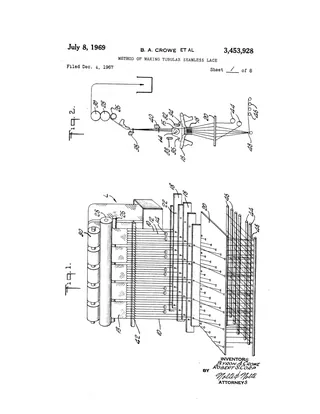
US Patent 3,453,928, granted July 8, 1969 to Byron A. Crowe and Robert S. Corp of Coventry, R.I. (assignors to Wildwood Company), describes a method of making tubular seamless lace on a flat-bed Leavers lace machine. Warp threads are divided into front and back groups and crossed or decrossed in step with the bobbin carriage motions, so stockings, gloves and leotards come off the machine without seams. The document has eight sheets of drawings (machine parts, Jacquard action, thread-path diagrams, lace pattern charts), the specification with 8 claims, and a 1970 certificate of correction adding claims 9-13 for the fabric itself.
Napper
Article · 1 page
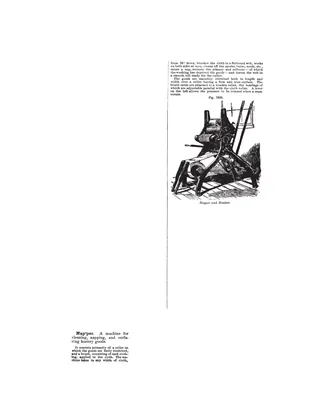
A short entry from Knight's New Mechanical Dictionary describing the napper, a machine for cleaning, napping and surfacing hosiery goods. It explains how the cloth is stretched over a roller and brushed with card clothing to raise a nap and restore softness after washing. Includes an engraved illustration (Fig. 1800) of a napper and brusher.
Spider's Silk
Harper's New Monthly Magazine, c. 1850-1851
Article · 2 pages
A two-page magazine article, reprinted from Dickens's Household Words, on early eighteenth-century attempts to use spider silk as a textile fibre. It describes M. Bon's collection of silk spiders, his cleaning, boiling and carding of their egg cocoons, and the gloves and stockings he made from the silk. It also covers M. Reaumur's objections: the thread was weaker, the lustre poorer, the spiders cannibalistic, and the yield too small. The article closes by calling spider silk an untried raw material.
Advertisement
Gearhart Knitting Machine Co., c. 1919
Ephemera · 2 pages
A two-page sales mailing from the Gearhart Knitting Machine Co. of Clearfield, Pennsylvania, promoting its hand-cranked family knitting machine and a plan under which the company supplies yarn and pays buyers for knitting socks and hosiery at home. Page 1 is a sales letter with a company letterhead and an illustration of the original Gearhart family knitter. Page 2 reproduces customer testimonial letters from across the United States reporting earnings, output and ease of learning.
Knitting
Article · 1 page
A short encyclopedia article defining knitting as forming a single yarn into a looped fabric with needles or wires. It distinguishes hand knitting from frame-work knitting, and describes needle types and materials, the main yarn fibers, and stitch variations such as purling and slipping. It also notes hand knitting as a domestic art and as a cottage industry in parts of Scotland, Ireland and the Shetland Islands.
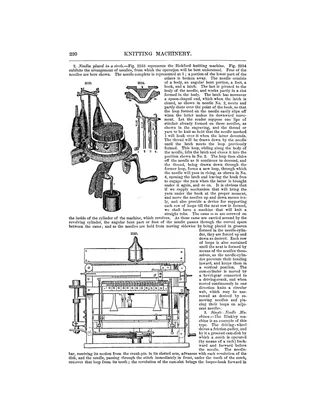
Knitting Machinery
Article · 5 pages
A five-page encyclopedia article from Appletons' Cyclopaedia of Applied Mechanics on knitting machinery as of the 1880s. It covers the manufacture and gauging of spring-beard knitting needles, hosiery yarn designation, and hand knitting machines (straight-bed, circular, and single-needle types such as the Lamb, Bickford and Hinkley machines). It then describes power machines, both straight and circular, the Tompkins upright rotary machine with its output figures, and the Tompkins cone-winder. Illustrated with engravings and diagrams of needle action.
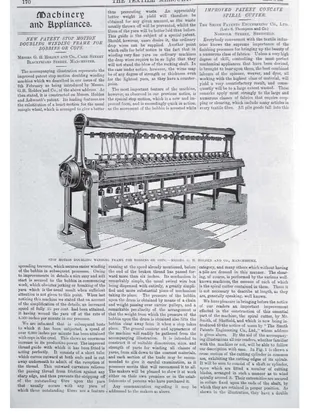
Machinery and Appliances
Textile Mercury, 1890
Article · 2 pages
Two-page article from The Textile Mercury (8 March 1890) in its Machinery and Appliances column. It describes Holden and Co.'s patent stop motion doubling winding frame for bobbins or cops, with a heart-motion traverse, a special thread guide and a quick stop motion. It also covers the Smith Patents Engineering Co.'s concave spiral cutter blades for cloth shearing machines. Short notes follow on the hosiery trade in Brazil and on the superstition about red underwear.
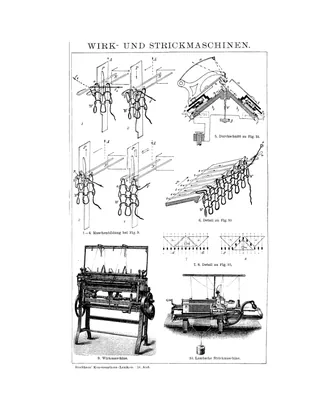
Wirkmaschine [Hosiery Machine]
Article · 6 pages · German
A German encyclopedia article on the knitting or hosiery machine (Wirkmaschine) from Brockhaus' Konversations-Lexikon, 14th edition. It explains the difference between weft-knitting (Kulierstuhl) and warp-knitting (Kettenstuhl) frames, flat and circular machines, and the hook and latch needles, sinkers and presser used in loop formation. It covers William Lee's 1589 hand frame, the Paget and Cotton frames, and the Lamb flat knitting machine of 1866, and lists literature on the subject. A plate of numbered illustrations shows stitch formation, machine sections and details.
Elegant Lace Patterns
1884
Book · 76 pages
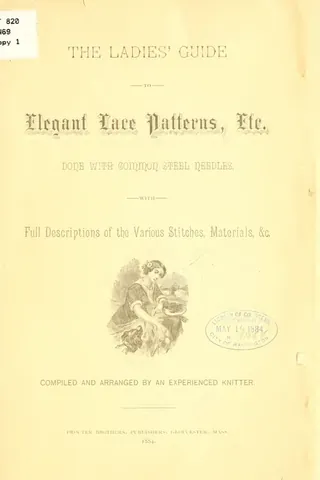
An 1884 American pattern book of hand-knitting instructions compiled by an anonymous experienced knitter and published by Procter Brothers of Gloucester, Mass. It opens with an introduction, materials and a glossary of knitting terms. It then gives row-by-row directions for wide and narrow lace edgings and insertions, knitted quilts and tidies, and stockings, socks, baby boots and shoes, and mittens, followed by general stitch patterns. The book ends with advertisements for baking powder, knitting cotton and a physician.
Ipswich Mills and Factories; Fine Thread, Lace and Hosiery in Ipswich
Monograph · 52 pages
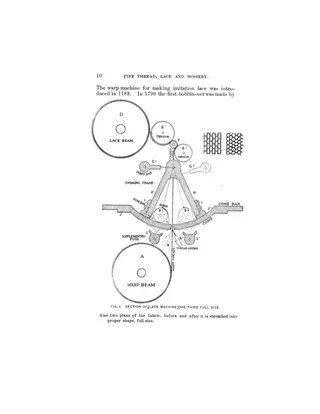
Publication XIII of the Ipswich Historical Society, containing two papers and the proceedings of the December 7, 1903 annual meeting. Jesse Fewkes traces the history of spinning, hosiery (stocking frame) weaving and bobbin-net lace machinery, including the Luddite riots in Nottingham and the English lace workers who came to Ipswich, Massachusetts, in the 1820s. T. Frank Waters surveys the mills and factories of Ipswich from colonial grist and saw mills through the cotton, lace and hosiery industries. The volume ends with the president's and curator's reports, donations, and member lists.
Knitting Machines
Article · 8 pages
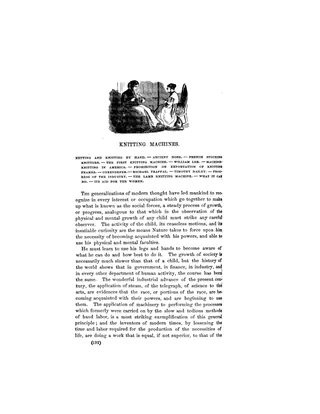
A chapter from an 1872 American industrial survey tracing the history of knitting from early netting and hand-knitted hose through William Lee's 1589 stocking frame and its spread to England and America. It covers colonial hand-knitting by women, export restrictions on frames, early American machine knitters and the move from home to factory production. It ends with a promotional description of the Isaac W. Lamb hand knitting machine and the Lamb company works at Chicopee Falls, Massachusetts.
Pletení [Knitting]
Ottův slovník naučný, 1897
Article · 14 pages · Czech
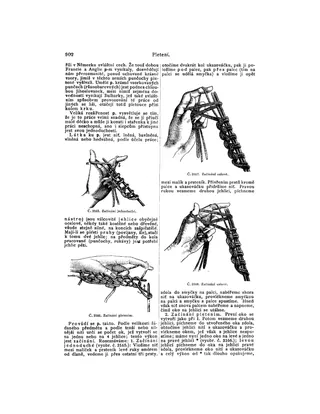
Encyclopedia article on knitting (pletení) from the Czech Ottův slovník naučný. It covers hand knitting with needles (casting on, plain, purl, English and decreased stitches), the history of knitting, and machine knitting on hand and power frames (stávky): weft-knitted (kulírované) and warp-knitted (řetízkové) goods, needles, sinkers, and circular and flat machines such as those of Terrot, Lamb and Berthelot. A final section describes frame-worked cord plaiting or netting ("pletení v rámci", mistakenly called Egyptian knitting), with a bibliography. Illustrated with numbered line drawings of stitches, machine parts and frames.
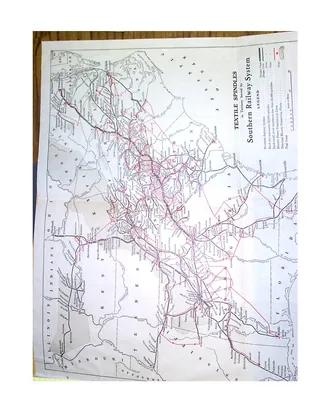
Textile Directory
Southern Railway System, 1929
Other · 23 pages
A January 1929 directory of textile manufacturing plants in the territory served by the Southern Railway System, listing 1,182 plants with 13.8 million spindles, 273,566 looms and 57,763 knitting machines. It opens with a statistical introduction and bar charts on the growth of cotton spindles and cotton consumption in southern versus other US mills since 1880. The bulk is tables by state and post office giving each company's looms, spindles, power source and goods made, for cotton mills, knitting and hosiery mills, and bleaching, dyeing and finishing plants, with a summary of machinery and a closing map of spindle locations, power lines and coal areas.
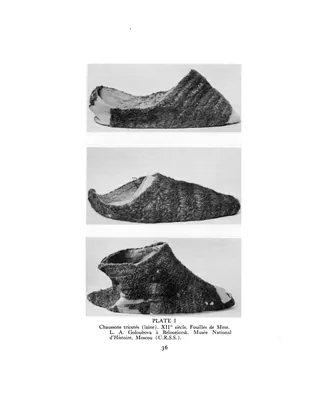
La Bonneterie au Moyen-Age [Hosiery in the Middle Ages]
Article · 12 pages · French
A French-language article surveying the history of hand knitting from its obscure origins through the Middle Ages and into the 16th century. It reviews theories about early knitting (Norbury's Arab frame hypothesis), Coptic Egyptian socks of the 3rd-6th centuries, 12th-14th century finds from Russia and Poland, liturgical gloves, Spanish pillow covers and gloves from Las Huelgas, English knitters' guilds and masterpiece requirements, and silk stockings. Illustrated with four plates of museum pieces.
107 documents found