Textile Documents › Publications › Publication: Textiles
62 documents found
Sort: 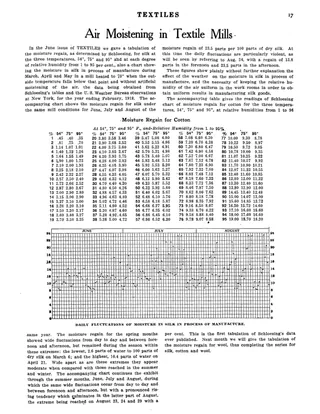
Air Moistening in Textile Mills, Part 1
Textiles, July 1919
Article · 1 page
A single-page article from the trade journal Textiles on controlling humidity in textile mills. It continues a series on Schloesing's moisture regain data, with a chart of daily moisture fluctuations in silk during June, July and August 1917-18 in a mill without artificial moistening, using New York Weather Bureau data. It also prints a table of moisture regain for cotton at 54°, 75° and 95° F for relative humidities of 1 to 95 percent, and says a wool table will follow the next month.
Air Moistening in Textile Mills, Part 2
Textiles, August 1919
Article · 2 pages
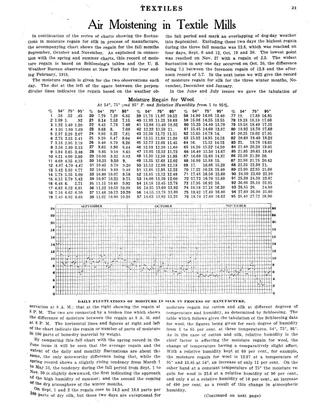
A two-page installment from the trade journal Textiles in a series on air moistening in textile mills. It presents a chart of daily moisture regain for silk in process of manufacture for September to November, based on Schloesing's tables and U.S. Weather Bureau observations for New York in 1917-18. It also gives a full table of moisture regain for wool at 54°, 75° and 95° F across relative humidity of 1 to 95 percent, with comments on how humidity and temperature affect regain.
Air Moistening in Woolen and Silk Mills
Article · 2 pages
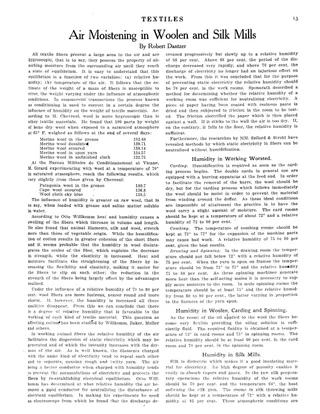
A two-page article by Robert Dantzer on controlling air humidity and temperature in woolen, worsted and silk mills. It covers how fibers absorb moisture, the effect of humidity on fiber strength and elasticity, and how static electricity is dispersed. It gives recommended temperatures and relative humidity for carding, combing, drawing, spinning, silk throwing, schappe (silk waste) work and weave rooms, and describes methods for neutralizing static electricity. The pages also carry short items on a cloth room daily report form, the Third International Cotton Conference, wool transport by motor, and paper cloth in Spain.
Boiling-Off Silk
Article · 1 page
A one-page technical article on the rinsing stage of boiling-off (degumming) silk, by chemical engineer J. L. Girard. It explains why soap cannot be fully removed and why a trace of fatty acid gives silk its 'craquant' handle. It lists the conditions for good rinsing: soft water free of lime and magnesia, soaps such as oleine or olive oil that rinse well, a weak soda (lisbordage) bath, and an acid avivage finish. It also gives practical notes on temperature and equipment.
Boiling-Off Silk, Part 1
Article · 2 pages
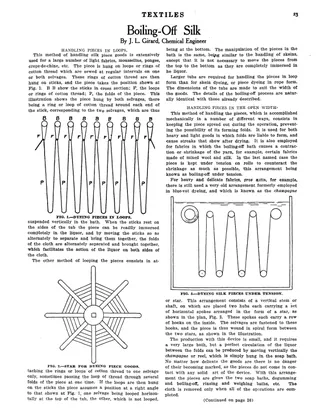
An article by chemical engineer J. L. Girard on how silk piece goods are handled during boiling-off (degumming) in the dye house. It describes hanging pieces in loops of cotton thread on sticks, and keeping pieces in open width using the old 'champagne' star frame and a jigger-type machine that boils off under tension. Figures show the loop method, the star frame plan and silk pieces under tension.
Boiling-Off Silk, Part 2
Article · 1 page
A one-page installment of J. L. Girard's series on boiling-off (degumming) silk, dealing with delicate fabrics such as Alencon tulle, "Illusion" net and "Islande" silk lace that fray under ordinary degumming. It explains why circulating-liquor methods fail and describes the "cushion process," in which the wide piece is wound, folded into a cushion, joined into a ring and handled like a skein in the soap bath, sometimes inside a cloth sack.
The Construction of Weaves, Part 1
Article · 2 pages · weaving drafts
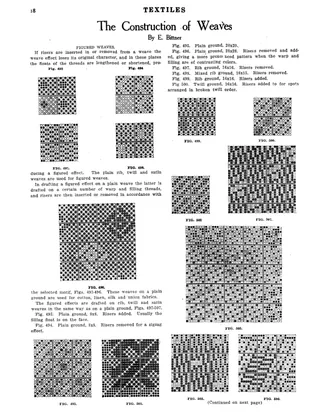
A two-page installment of E. Bittner's series on the construction of weaves, dealing with figured weaves. It explains how inserting or removing risers in plain, rib, twill and satin grounds lengthens or shortens floats to produce figured effects. Figs. 493-507 are drawdown diagrams with captions giving the ground type, repeat size and whether risers were added or removed.
The Construction of Weaves, Part 2
Article · 1 page · weaving drafts
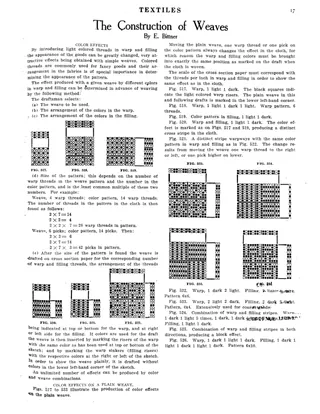
A single-page installment of E. Bittner's series on the construction of weaves, covering color effects. It explains how to work out in advance the look of a weave with colored warp and filling threads, including finding the pattern size as the least common multiple of the weave and color repeats, and drafting on cross-section paper. Figures 517 to 526 show color effects on plain weave, such as cross stripes, warp stripes and block effects, each with a caption giving the color order.
Construction of Weaves, Part 3
Article · 1 page · weaving drafts
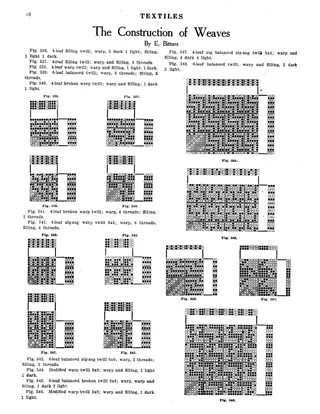
A single page from E. Bittner's series on the construction of weaves, printed in Textiles. It presents weaving drafts for figures 536-548, each with threading, tie-up, treadling and drawdown, showing twill constructions in dark and light thread arrangements. Captions identify 4-leaf and 6-leaf filling, warp and balanced twills, broken twills, zig-zag twills and modified warp twills.
Construction of Weaves, Part 4
Article · 1 page · weaving drafts
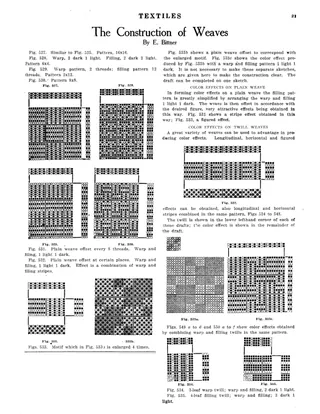
A single page from E. Bittner's series on the construction of weaves, showing figs. 527-535 with their captions. It covers color effects on plain weave, made by offsetting the weave with warp and filling arranged 1 light 1 dark, and introduces color effects on twill weaves, with 3-leaf warp twill and 4-leaf filling twill examples. The page mostly consists of drawdown-style drafts with short explanatory text.
Construction of Weaves, Part 4
Article · 2 pages · weaving drafts
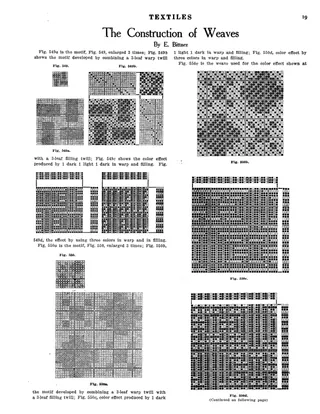
Two pages from Textiles (vol. 15) containing part 4 of E. Bittner's series on the construction of weaves, which covers motifs developed with 3-leaf warp and filling twills and their color effects (Figs. 549-550f). The same pages also carry a section of John Reynolds's 'The Practical Fixing of Cotton Looms', on timing the still box motion and adjusting the 6 and 1 box motion.
Construction of Weaves, Part 5
Article · 2 pages · weaving drafts
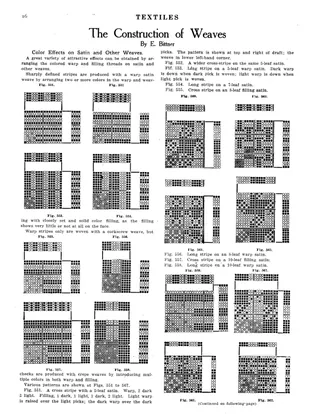
Two pages from Textiles (pp. 16-17) carrying a part of E. Bittner's series on the construction of weaves. This part covers color effects on satin and other weaves: stripes and checks made by arranging colored warp and filling threads on satin, corkscrew, crepe, basket, radiating twill and thousand-square weaves (Figs. 551-567), each with a draft. Page 17 also has an unrelated article by Dr. Louis J. Matos on identifying textile fibers under the microscope and with chemical tests, covering wool kemps, natural and tussah silk, and a wool/silk reagent comparison.
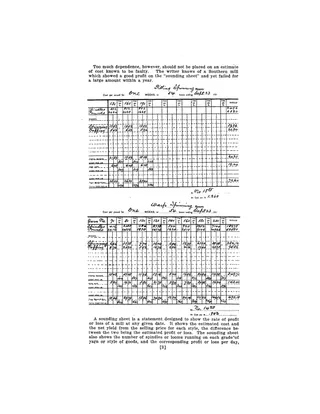
Cost Finding for Textile Mills
Monograph · 36 pages
Second edition of a booklet from the journal Textiles on cost accounting methods for textile mills. It explains how to compile departmental statistics and calculate the cost per pound or per yard for cotton, woolen, worsted, hosiery and knit underwear mills. It includes sample cost sheets for carding, spinning, spooling, warping, dressing, weaving, finishing, waste and loom efficiency, plus worked examples of yarn cost, machine production and fixed charges. The last pages hold advertisements for textile books, a Fahrenheit-Centigrade table and a subscription notice.
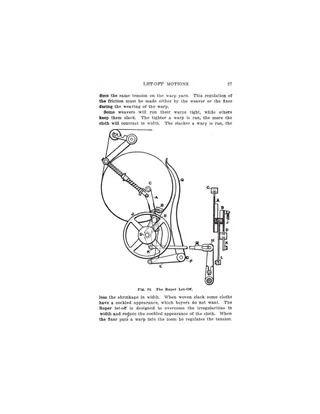
Cotton Loom Fixing
Book · 130 pages · weaving drafts
A practical manual for cotton-mill loom fixers by John Reynolds, instructor at the New Bedford Textile School. It covers adjusting and timing the mechanisms of plain, dobby, leno, box and automatic looms: shedding cams, picking, beating-up, let-off and take-up motions, filling and warp stop motions, temples, dobbies, leno doups, box motions, the Northrop and Stafford looms, and the jacquard machine. It is illustrated with many line drawings of loom parts and includes a few dobby chain drafts. Trade advertisements appear at the back.
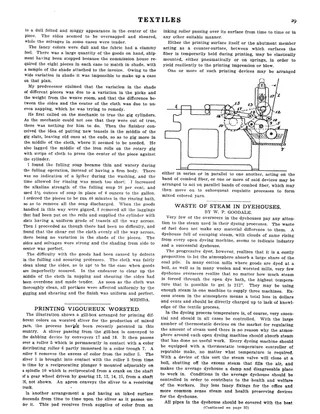
Dyeing, Bleaching and Finishing
Article · 2 pages
Two pages from the trade journal Textiles (pp. 28-29) on wool and worsted wet processing. They cover German carbonizing machines for raw stock and piece goods, a finisher's account of fixing uneven shade and finish in cassimere through better fulling soap and scouring, a patented gill-box for printing colors on worsted sliver, and W. P. Goodale's article on wasted steam in dyehouses. Two line diagrams illustrate the carbonizing machine and the sliver-printing mechanism.
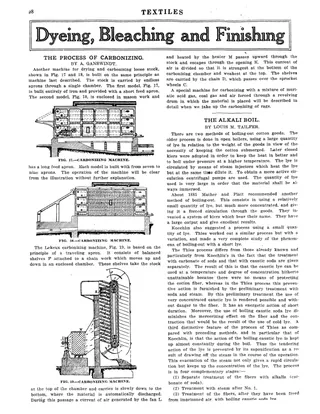
Dyeing, Bleaching and Finishing, Part 1
Article · 2 pages
Two pages from the 'Dyeing, Bleaching and Finishing' feature in the trade journal Textiles (pp. 28-29). The first part, by A. Ganswindt, describes carbonizing machines for drying and carbonizing loose stock (Figs. 17-19, including the Lekeux machine). The second, by Louis M. Tailfer (translated from L'Industrie Textile), covers the alkali boil for cotton goods, comparing open boilers, closed kiers, the Mather and Platt and Koechlin methods, and the Thies process with its four stages. It includes details on lye concentration, kier design, and an example treatment of printing cloths.
Dyeing, Bleaching and Finishing, Part 1
Article · 2 pages
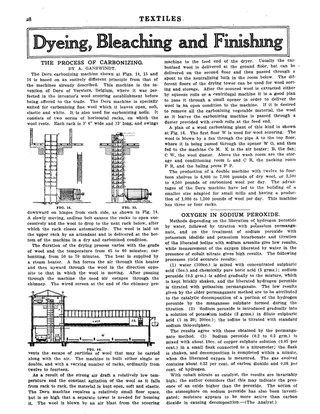
Two pages from the 'Dyeing, Bleaching and Finishing' feature in the trade journal Textiles (pp. 28-29). They describe the Deru wool carbonizing machine and plant layout, a method for determining oxygen in sodium peroxide, a patented machine for dyeing variegated (parti-colored) yarn, and the need for standardized dyestuff shades for the Chinese market.
Export Trade and the Bolsheviki
Textiles, August 1919
Article · 2 pages
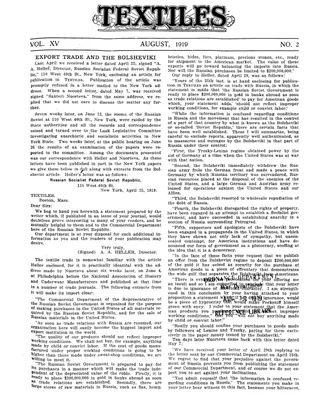
An editorial from the trade journal Textiles (August 1919) reprinting correspondence between the magazine and representatives of the Russian Soviet government's New York commercial office (A. A. Heller and Santeri Nuorteva). The Soviet side offered an article promoting export trade and a $200,000,000 gold deposit for purchases; the editor refused to publish it and answered with strongly anti-Bolshevik arguments. The piece also covers the June 1919 raid on the Soviet offices and the Lusk Committee hearing, and closes with a political call to oppose Bolshevism.
French Worsted Drawing
Article · 1 page
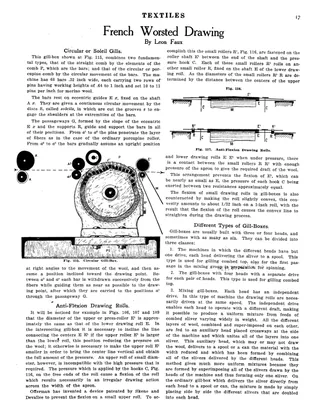
A one-page 1915 article from the periodical Textiles by Leon Faux on French worsted drawing machinery. It describes the circular (soleil) gill-box with its rotating bars and eccentric guides, anti-flexion drawing rolls that keep small upper rolls from bending under pressure, and the three classes of gill-boxes, including mixing gill-boxes. Illustrated with machine diagrams (Figs. 115-117).
French Worsted Drawing
Article · 1 page
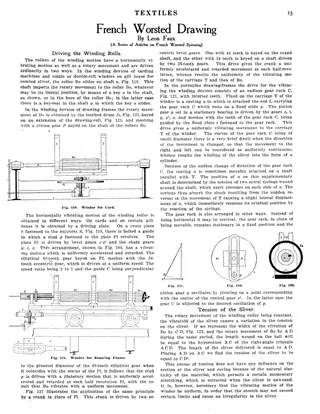
One page from a series on French worsted spinning by Leon Faux, covering how the winding rolls of carding machines, gill boxes and drawing frames are driven. It explains the horizontal vibrating motion of the winder using driving plates, elliptical and eccentric gears, cranks and gear racks, and discusses the resulting tension on the sliver. Illustrated with mechanical figures of winders and a tension diagram.
French Worsted Drawing, Part 1
Article · 1 page
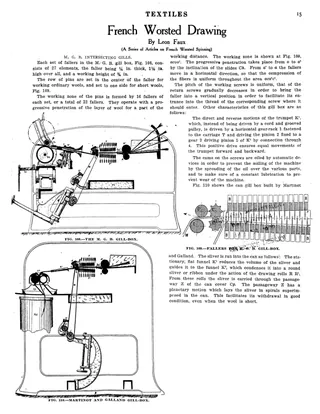
A one-page installment from a series on French worsted spinning by Leon Faux, describing the M. G. B. intersecting gill box used in worsted drawing. It covers the fallers' dimensions, pin placement, working zone, screw pitch, trumpet drive and automatic oiling, and also the Martinot and Galland can gill box that lays sliver in spirals in the can. Three technical diagrams (Figs. 108-110) illustrate the machines.
French Worsted Drawing, Part 2
Article · 1 page
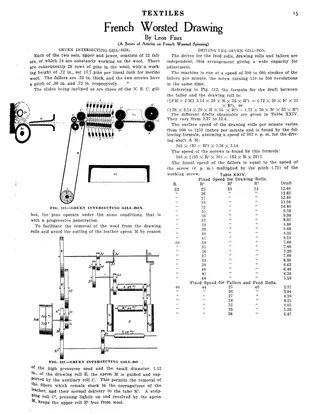
A single page from Leon Faux's series on French worsted spinning, describing the Gruen intersecting gill-box used in worsted drawing. It covers the fallers, pin rows and screw pitch for merino wool, the leather apron and drawing roll arrangement, and the independent drives. It gives formulas for draft and roll and screw speeds, with Table XXIV listing gear combinations and resulting drafts from about 3.4 to 13.4. Two schematic figures (Figs. 111 and 112) show the machine and its gearing.
French Worsted Spinning
Article · 1 page
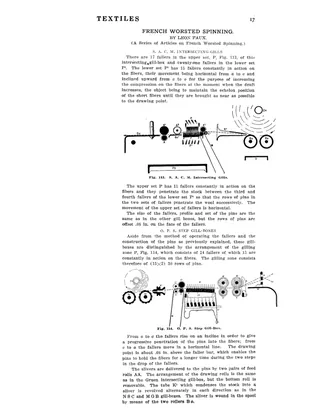
A single-page installment from Leon Faux's series on French worsted spinning, describing two types of gill-box used to prepare wool for drawing. It covers the S.A.C.M. intersecting gills, with their upper and lower sets of fallers, and the O.P.S. step gill-box, including faller counts, pin arrangement, drawing point, and sliver delivery. Two line diagrams (Figs. 113 and 114) illustrate the machinery.
Identification of Textile Fibers
Article · 1 page
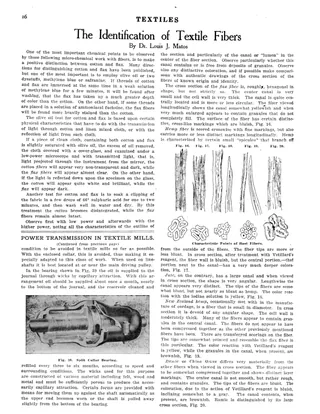
A one-page 1915 article from Textiles by Dr. Louis J. Matos on microscopic and chemical methods for identifying textile fibers. It describes dye, olive oil and sulphuric acid tests for telling cotton from flax, then the cross-section and longitudinal features of the bast fibers flax, hemp, jute, New Zealand hemp and ramie, with figures 16-20. The page also carries the continuation of an unrelated article on power transmission in textile mills.
Identification of Textile Fibers
Article · 2 pages
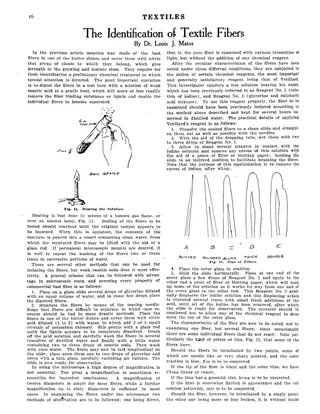
A two-page article from the journal Textiles on identifying bast fibers and cotton by microscope. It describes digesting fibers in weak caustic soda to remove lignin, mounting them on slides, and applying Vetillard's iodine and glycerine-sulphuric acid reagents. It gives tip shapes and color reactions for flax, ramie, hemp, jute and cotton, and explains how to cut and examine fiber cross sections with a razor. Illustrations show heating the solution, fiber tip profiles, a binding dish, slicing and a section lifter.
The Identification of Textile Fibers
Article · 2 pages
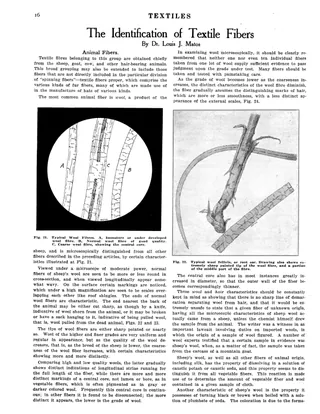
Two pages from the journal Textiles, part of a series by Dr. Louis J. Matos on identifying textile fibers by microscope and simple chemical tests. This installment covers animal fibers, mainly sheep's wool: its scale structure, fiber ends, central core, how grade relates to coarseness, and the gradual transition from wool to hair. It also gives the caustic alkali solubility test and the plumbate of soda test for the sulphur in wool. Figures 21-24 show wool fibres, a follicle, wool in the grease, and cattle hairs. The pages also carry a mill order blank description and a note on the 1916 Third International Cotton Conference.
The Identification of Textile Fibers
Article · 2 pages
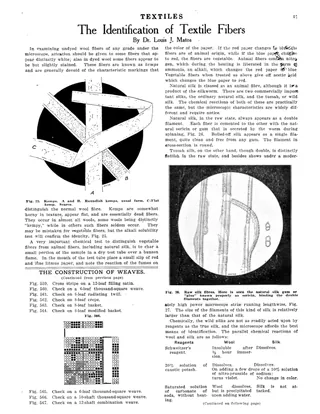
A two-page article from the trade journal Textiles on identifying textile fibers under the microscope and by simple chemical tests. It covers kemp fibers in wool, the litmus test for separating animal from vegetable fibers, and the differences between cultivated (raw and boiled-off) silk and tussah silk. A table compares wool and silk reactions to reagents, and the article ends with a note on mounting wool fibers for microscope slides. Page 2 also carries the start of an unrelated article on bearings and power transmission in textile mills.
The Identification of Textile Fibers, Part 1
Article · 2 pages
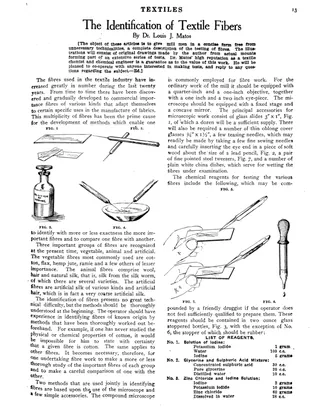
An introductory article in a series on testing textile fibres for mill workers, by textile chemist Dr. Louis J. Matos. It outlines the vegetable, animal and artificial fibre groups, the microscope and accessories needed, and gives formulas for sixteen chemical reagents. It also describes how to isolate fibres and mount them on slides, and how to apply reagents under a cover glass, with a few first identification examples such as cotton and caustic soda or copper solution tests.
The Identification of Textile Fibers, Part 2
Article · 1 page
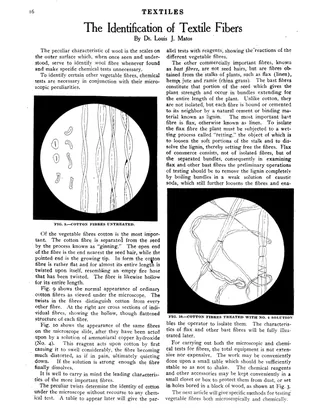
A single page from a series on identifying textile fibers by microscope and chemical tests. It describes the twisted, hollow, ribbon-like form of cotton fibers and how they swell and dissolve in ammoniacal copper hydroxide (reagent No. 4). It also introduces bast fibers (flax, hemp, jute, ramie), the role of lignin and retting, and the basic equipment for fiber testing. Two microscope figures show untreated and treated cotton.
Knitting Department
Article · 3 pages
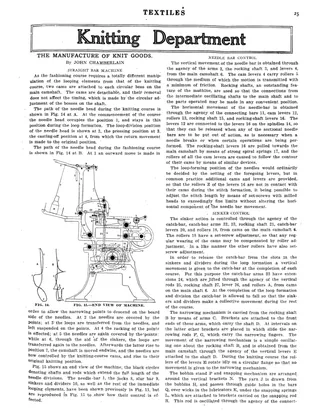
Three pages from the Knitting Department of the trade journal Textiles (pp. 25-27). John Chamberlain's installment on the manufacture of knit goods covers the straight bar (fashioning) knitting machine: needle-head paths for knitting and fashioning courses, needle bar, sinker and narrowing mechanism control, and care, adjustment and fault-finding for good selvages. Shorter items follow on grades of silk hosiery (pure dye, dipped, ingrain) and a patented thread-cutting attachment for looping machines.
Knitting Department
Article · 2 pages
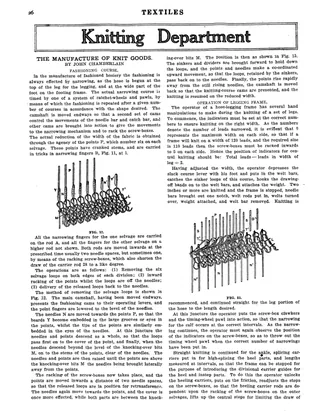
A two-page installment of the Knitting Department in Textiles by John Chamberlain, on the manufacture of fashioned hosiery on flat knitting frames. It explains the fashioning (narrowing) course, in which points remove and retransfer selvage loops, and the operator's tasks on the legging frame and footing frame. It ends with a short note on a wire take-up attachment for yarn slack on a knitting machine. Two figures (Figs. 12 and 13) show needles and points during loop transfer.
Knitting Department
Textiles, c. 1919-1920
Article · 3 pages
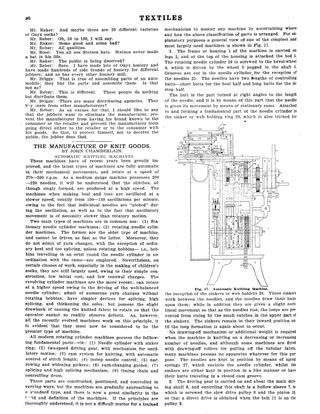
Three pages from the "Knitting Department" of the trade journal Textiles. The first part covers a warning to American manufacturers about currency exchange rates and imports, citing the closure of Hongkong knitting mills, and a congressional hearing on trademarks and jobber branding in the hosiery trade. The main part is the start of John Chamberlain's "The Manufacture of Knit Goods," which describes automatic hosiery knitting machines in detail, with a line drawing (Fig. 17) and numbered parts. It covers the needle cylinder, sinkers, driving gear, cams, narrowing and widening pickers, yarn changing, splicing, and the timing chain.
Knitting DepartmentaDyeing, Bleaching and FinishingFrench Worsted Drawing
Article · 2 pages
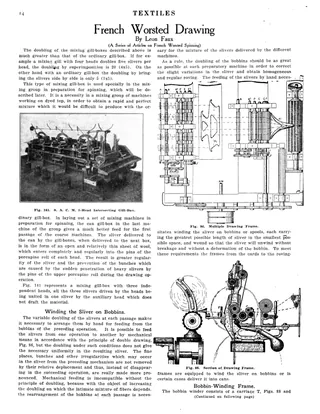
Two pages from the trade journal Textiles (pp. 14-15). The first is a continuation of Leon Faux's series on French worsted spinning, covering mixing gill-boxes, doubling of slivers, and winding sliver onto bobbins with a bobbin-winding frame. The second is the start of J. L. Girard's article on purifying water for silk processes, explaining how lime in rinse water forms insoluble soaps that dull silk, and contrasting water treatment for dyeing with that for boilers.
Lighting of Textile Mills
Article · 1 page
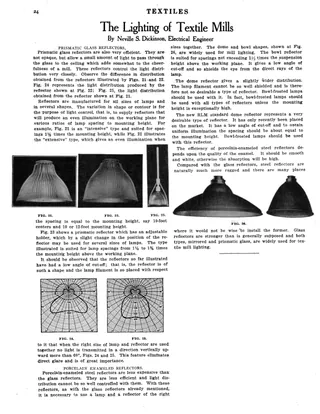
A single page from an article on lighting textile mills by electrical engineer Neville S. Dickinson, discussing prismatic glass reflectors and porcelain-enameled steel reflectors. It covers light distribution, lamp spacing relative to mounting height, low-angle cut-off to avoid glare, and the use of bowl-frosted lamps. Photographs of reflector fixtures and polar distribution diagrams accompany the text.
Mechanics of Textile Processes
Article · 1 page
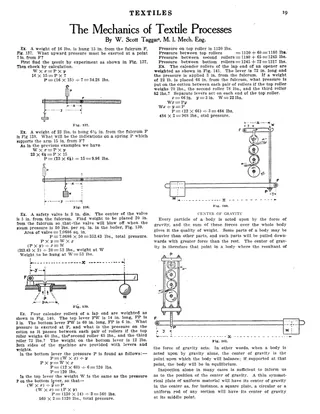
A single page from a serial instalment of W. Scott Taggart's "The Mechanics of Textile Processes," giving worked examples of lever and moment calculations (W × x = P × y). The examples include a safety valve and the weighted calender rollers of a cotton lap machine or opener, where the pressure between each pair of rollers is calculated. It ends by introducing the center of gravity.
The Mechanics of Textile Processes (Straight-Line Textile Calculations, Part 5)
Article · 1 page
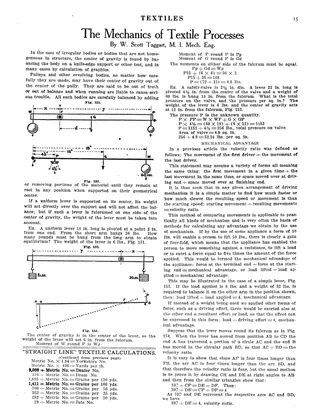
A single page from the magazine Textiles, from W. Scott Taggart's series on the mechanics of textile processes. It covers centers of gravity and balancing of pulleys, worked lever-moment problems (a weighted lever and a safety-valve lever), and the concepts of mechanical advantage and velocity ratio for levers. The foot of the page continues a 'Straight Line' textile calculations table of yarn count conversions from the metric number to Yorkshire, denier, dram, jute and grains-per-length systems.
The Mechanics of Textile Processes, Part 1
Article · 1 page
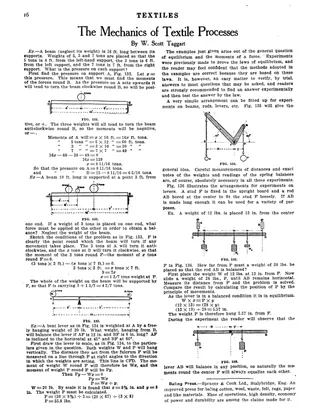
A single page from a series by W. Scott Taggart on the mechanics underlying textile machinery. It works through numerical examples of beams, moments and levers: finding the pressure on each support of a loaded beam, balancing a beam on a fulcrum, and a bent lever with hanging weights. It also describes simple experiments with spring balances and a pivoted rod to check the laws of equilibrium. The page ends with a short trade notice for a baling press for cotton, wool, waste and rags.
The Mechanics of Textile Processes, Part 2
Article · 2 pages
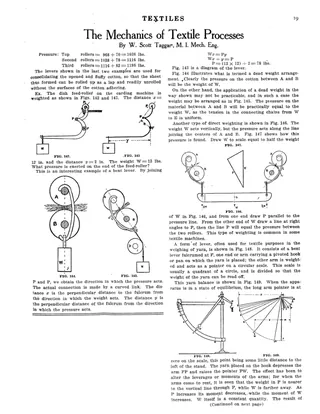
Two pages from a serial article on the mechanics of textile machinery, applying lever principles to weighting arrangements on cotton machines. Worked examples cover roller pressures, the bent lever weighting the dish feed-roller on a carding machine, dead-weight arrangements and the graphical finding of roller pressure. It also explains the bent-lever yarn balance and the lea strength tester, which uses a weighted pointer on a quadrant scale (Figs. 142-150).
Misbranding of Merchandise
Textiles, July 1919
Article · 3 pages
An article from the trade journal Textiles (July 1919) arguing for federal legislation against misbranding of merchandise. It favors the Barkley Misbranding Act, modeled on the British Merchandise Marks Act, over "shoddy" labeling bills, and summarizes the bill's main provisions. Shorter pieces follow: a critique of the American Red Cross for turning surplus knitting yarn into cloth and blankets at a cost above market value, and a note on a weekly repair-shop time-table form for textile mill managers.
Power Transmission in Textile Mills
Article · 2 pages
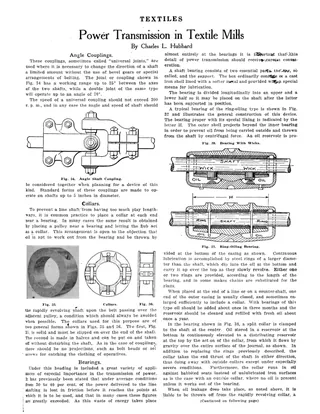
Two pages from the 1915 trade journal Textiles. The first part of Charles L. Hubbard's article on power transmission in textile mills covers angle couplings (universal joints), shaft collars, and bearings, including ring-oiling, split-collar, and wick-fed types, with notes on lubrication and friction losses. The scan also includes an article by Dr. Louis J. Matos on identifying textile fibers, with chemical and microscopic tests to tell cotton from flax and descriptions of flax, hemp, jute, New Zealand hemp, and ramie.
Power Transmission in Textile Mills, Part 1
Article · 2 pages · weaving drafts
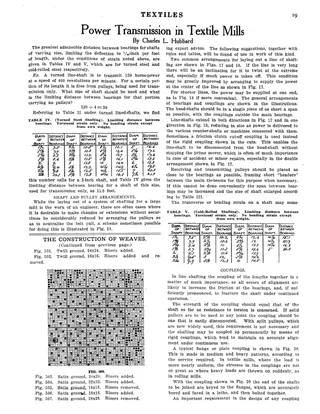
Two pages from a serialized textile-industry magazine article by Charles L. Hubbard on power transmission in mills. It covers limiting distances between bearings for turned and cold-rolled steel line shafts (Tables IV and V), a worked horsepower example, shaft and pulley layouts, and types of shaft couplings (flange, forged, side-clamp, double cone, internal clamp). Page 1 also carries a continuation of a separate series, 'The Construction of Weaves,' with captions and drawdown grids for twill and satin grounds with risers added or removed (Figs. 501-507).
Power Transmission in Textile Mills, Part 2
Article · 2 pages
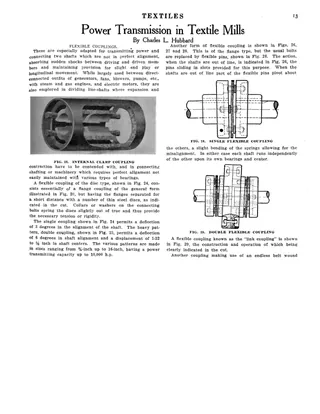
Two pages from a series on mechanical power transmission in textile mills, covering shaft couplings. The first section describes flexible couplings (disc, flange with flexible pins, link, belt, and insulated types) and their allowable shaft misalignment and size ranges. The second section covers clutch couplings (jaw and friction types) used to cut sections of line shafting in and out. Illustrated with Figs. 23-33 of couplings.
Practical Fixing of Cotton Looms
Article · 2 pages
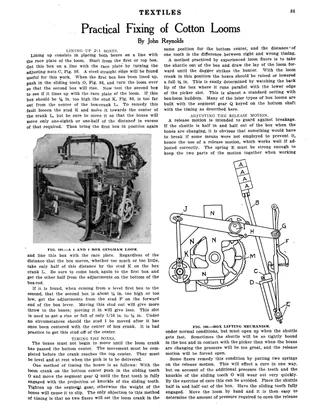
A two-page installment of John Reynolds's series on practical loom fixing, covering how to line up and time 2-and-1 and 4-and-1 drop-box motions on cotton looms. It also covers adjusting the release motion, fitting pickers and the picker spindle, and avoiding skip boxes on gingham looms, with figures of a 4 and 1 box gingham loom and its box lifting mechanism. Page 2 also carries Samuel S. Dale's "Straight Line" Textile Calculations on sizing rubber thread, and a short note on an acid transport tank.
Practical Fixing of Cotton Looms
Article · 1 page
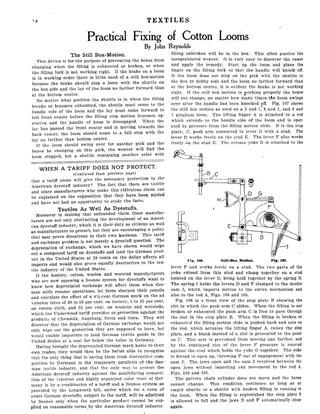
A page from a 1915 series in the trade journal Textiles, by John Reynolds, on repairing and adjusting cotton looms. It explains the still box-motion, which stops the drop boxes from changing when the filling breaks or runs out. It covers how to check that the brake is working and describes each part of the mechanism (lifting finger, stop plate, push arm, levers, release yoke, springs and double cam), illustrated with line drawings. The scan also carries the end of an unrelated article on tariffs and the American dyestuff industry.
Practical Fixing of Cotton Looms
Article · 2 pages
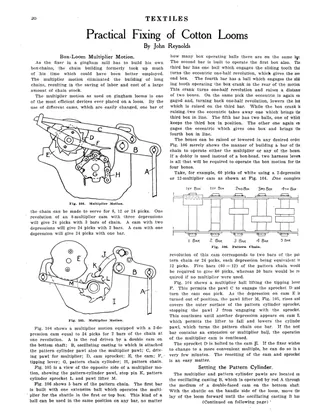
A two-page installment of a series on loom fixing, describing the multiplier motion used on gingham box looms. It explains how interchangeable cams let one bar of the pattern chain serve for 8, 12 or 24 picks, and how chain bars are built to operate the shuttle boxes. It also covers the parts of the mechanism (pawls, sprockets, tipping lever, pawl lifter) and begins the procedure for setting the pattern cylinder.
The Practical Fixing of Cotton Looms
Article · 1 page
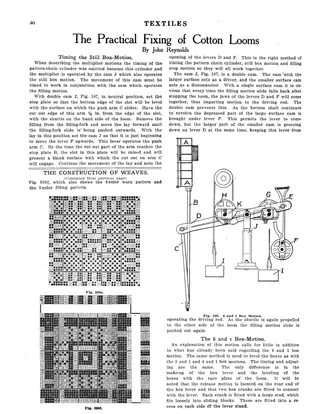
A single-page excerpt from a serial article on adjusting cotton looms, covering the timing of the still box motion with its double cam J, the pattern chain cylinder and the filling stop motion, and a short section on the 6 and 1 box motion. It is illustrated with a mechanical diagram of the 6 and 1 box motion. The page also carries the end of a separate article, "The Construction of Weaves," with two color-pattern grids (Figs. 550e and 550f) showing a 4-color warp pattern and 3-color filling pattern.
Practical Fixing of Cotton Looms, Part 2
Article · 2 pages
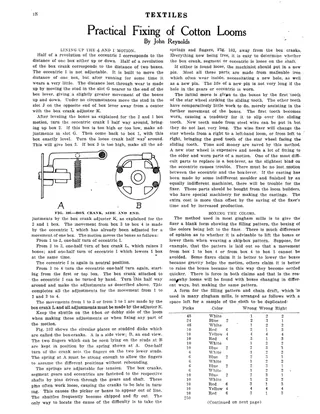
Part of a serial trade article on adjusting and repairing cotton looms with multiple-box (drop-box) motions. This installment covers lining up the 4-and-1 box motion, including the eccentric, box crank, adjuster and box lever, along with wear problems in pins, star wheels and castings. It then explains how to box the colors for gingham filling patterns, with sample forms listing picks, colors and box orders for 4-box and 3-box patterns.
Questions and Answers, Part 1
Textiles, c. 1919
Article · 2 pages
Two questions-and-answers items from the trade journal Textiles. The first explains how to calculate change gears and picks per inch on a plain loom's take-up motion, using a constant of picks per tooth of the change gear. The second describes the 'straight line' method of analyzing a cloth sample: a 1/300th square yard die, thread counting, weight per yard, yarn number conversions, and boiling out with caustic to find the cotton/wool percentage. It gives formulas (a) to (u) and a worked example for a mixed woolen cloth.
Questions and Answers, Part 2
Textiles, c. 1919
Article · 1 page
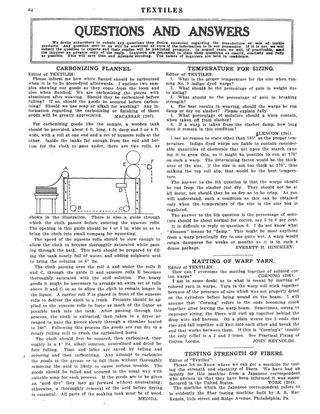
A single-page 'Questions and Answers' column from the trade journal Textiles, answering subscriber inquiries on mill practice. Topics include carbonizing white flannel with sulphuric acid (with a diagram of the tank and rolls), size temperature and moisture for indigo-dyed cotton warps on the slasher, matting of colored cotton warp yarns, and where to obtain a fiber strength testing machine.
The Scouring of Wool
Article · 2 pages
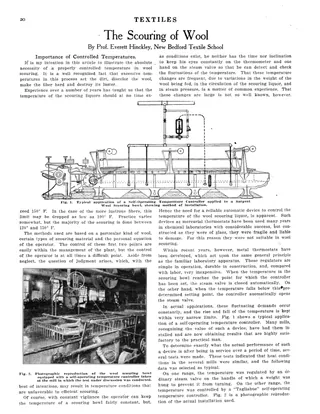
A short trade-journal article arguing that wool scouring liquors must be held at controlled temperatures, ideally 120-130°F and never above 150°F. It compares a hand-controlled steam valve with a self-operating thermostatic controller on a Sargent scouring bowl, using recording-thermometer charts. Hand control varied by 28°F over a day, while the controller held about 123°F within 1°. Page 2 ends with an unrelated editorial item on government employees, "How the 'Flapper' Works."
62 documents found