Textile Documents › Authors › Author: Louis J. Matos
6 documents found
Sort: 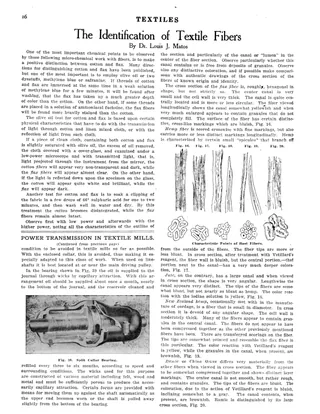
Identification of Textile Fibers
Article · 1 page
A one-page 1915 article from Textiles by Dr. Louis J. Matos on microscopic and chemical methods for identifying textile fibers. It describes dye, olive oil and sulphuric acid tests for telling cotton from flax, then the cross-section and longitudinal features of the bast fibers flax, hemp, jute, New Zealand hemp and ramie, with figures 16-20. The page also carries the continuation of an unrelated article on power transmission in textile mills.
Identification of Textile Fibers
Article · 2 pages
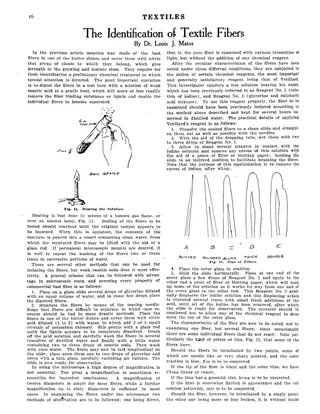
A two-page article from the journal Textiles on identifying bast fibers and cotton by microscope. It describes digesting fibers in weak caustic soda to remove lignin, mounting them on slides, and applying Vetillard's iodine and glycerine-sulphuric acid reagents. It gives tip shapes and color reactions for flax, ramie, hemp, jute and cotton, and explains how to cut and examine fiber cross sections with a razor. Illustrations show heating the solution, fiber tip profiles, a binding dish, slicing and a section lifter.
The Identification of Textile Fibers
Article · 2 pages
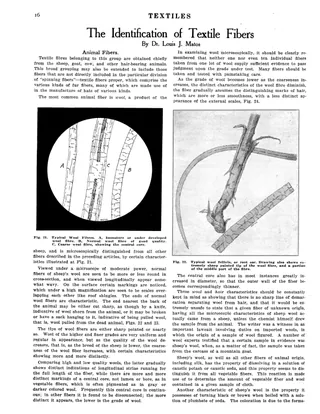
Two pages from the journal Textiles, part of a series by Dr. Louis J. Matos on identifying textile fibers by microscope and simple chemical tests. This installment covers animal fibers, mainly sheep's wool: its scale structure, fiber ends, central core, how grade relates to coarseness, and the gradual transition from wool to hair. It also gives the caustic alkali solubility test and the plumbate of soda test for the sulphur in wool. Figures 21-24 show wool fibres, a follicle, wool in the grease, and cattle hairs. The pages also carry a mill order blank description and a note on the 1916 Third International Cotton Conference.
The Identification of Textile Fibers
Article · 2 pages
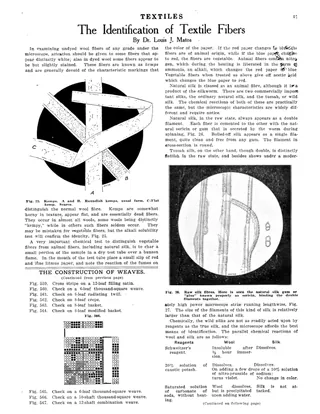
A two-page article from the trade journal Textiles on identifying textile fibers under the microscope and by simple chemical tests. It covers kemp fibers in wool, the litmus test for separating animal from vegetable fibers, and the differences between cultivated (raw and boiled-off) silk and tussah silk. A table compares wool and silk reactions to reagents, and the article ends with a note on mounting wool fibers for microscope slides. Page 2 also carries the start of an unrelated article on bearings and power transmission in textile mills.
The Identification of Textile Fibers, Part 1
Article · 2 pages
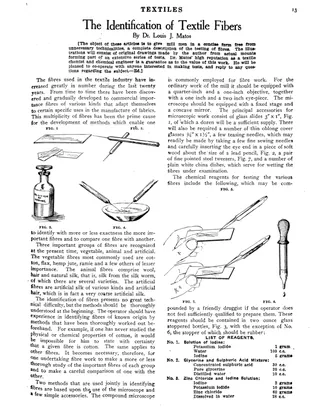
An introductory article in a series on testing textile fibres for mill workers, by textile chemist Dr. Louis J. Matos. It outlines the vegetable, animal and artificial fibre groups, the microscope and accessories needed, and gives formulas for sixteen chemical reagents. It also describes how to isolate fibres and mount them on slides, and how to apply reagents under a cover glass, with a few first identification examples such as cotton and caustic soda or copper solution tests.
The Identification of Textile Fibers, Part 2
Article · 1 page
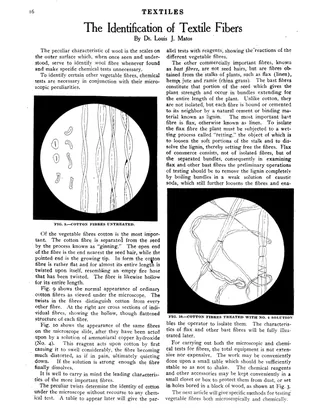
A single page from a series on identifying textile fibers by microscope and chemical tests. It describes the twisted, hollow, ribbon-like form of cotton fibers and how they swell and dissolve in ammoniacal copper hydroxide (reagent No. 4). It also introduces bast fibers (flax, hemp, jute, ramie), the role of lignin and retting, and the basic equipment for fiber testing. Two microscope figures show untreated and treated cotton.
6 documents found