Textile Documents › Authors › Author: Charles L. Hubbard
3 documents found
Sort: 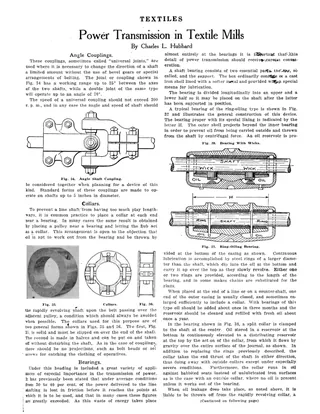
Power Transmission in Textile Mills
Article · 2 pages
Two pages from the 1915 trade journal Textiles. The first part of Charles L. Hubbard's article on power transmission in textile mills covers angle couplings (universal joints), shaft collars, and bearings, including ring-oiling, split-collar, and wick-fed types, with notes on lubrication and friction losses. The scan also includes an article by Dr. Louis J. Matos on identifying textile fibers, with chemical and microscopic tests to tell cotton from flax and descriptions of flax, hemp, jute, New Zealand hemp, and ramie.
Power Transmission in Textile Mills, Part 1
Article · 2 pages · weaving drafts
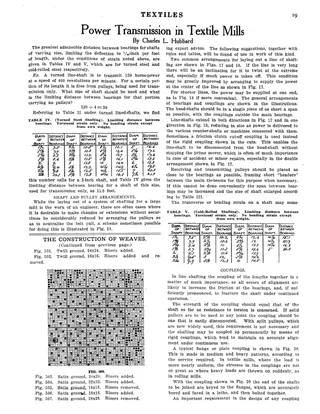
Two pages from a serialized textile-industry magazine article by Charles L. Hubbard on power transmission in mills. It covers limiting distances between bearings for turned and cold-rolled steel line shafts (Tables IV and V), a worked horsepower example, shaft and pulley layouts, and types of shaft couplings (flange, forged, side-clamp, double cone, internal clamp). Page 1 also carries a continuation of a separate series, 'The Construction of Weaves,' with captions and drawdown grids for twill and satin grounds with risers added or removed (Figs. 501-507).
Power Transmission in Textile Mills, Part 2
Article · 2 pages
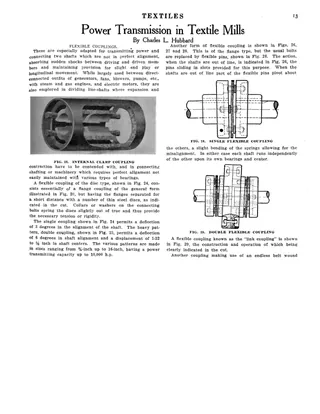
Two pages from a series on mechanical power transmission in textile mills, covering shaft couplings. The first section describes flexible couplings (disc, flange with flexible pins, link, belt, and insulated types) and their allowable shaft misalignment and size ranges. The second section covers clutch couplings (jaw and friction types) used to cut sections of line shafting in and out. Illustrated with Figs. 23-33 of couplings.