Textile Documents › Topic: Figured weaves and drawloom weaving
221 documents found
Sort: 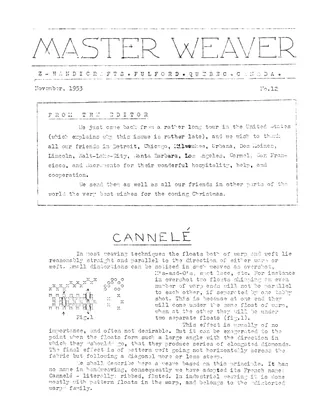
Cannelé
Master Weaver, November 1953
Article · 2 pages · weaving drafts
A short article from Master Weaver No. 12 (November 1953) describing cannelé, a handweaving technique in which short warp floats pull a heavier pattern weft into diagonal lines and elongated diamonds. It explains the principle with float diagrams and threading, tie-up and treadling drafts for counterbalanced and rising-shed looms. Practical advice covers float length, warp and weft yarns (10/2 cotton at 24 epi, candlewick, chenille, silk cord or ribbon), and beating. The page also carries a short editor's note about a tour of the United States.
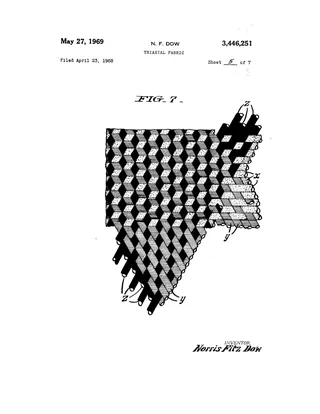
Triaxial Fabric, US Patent No. 3446251
Patent · 12 pages
US Patent 3,446,251, granted May 27, 1969 to Norris Fitz Dow (assignor to General Electric), describing triaxial woven fabrics made of three sets of yarn courses crossing at about 60 degrees. The text explains how interlocking intersections prevent slippage and give nearly isotropic strength, including bias strength. Fifteen figures show variants differing in porosity, density, paired or floating yarns, twill-like and long-float arrangements. The patent closes with 23 claims and a list of references cited. Seven drawing sheets precede the specification.
Draw-Loom
Article · 1 page
A short dictionary entry defining the draw-loom as the predecessor of the jacquard loom, used for figure-weaving. It explains how warp threads pass through loops in strings arranged in groups that a draw-boy pulls in the order set by a pattern design on squared paper. It also briefly describes a mechanical draw-boy with a grooved half-wheel traveling along a toothed bar.
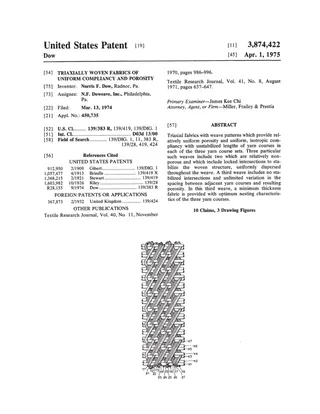
Triaxially Woven Fabrics of Uniform Compliancy and Porosity, US Patent No. 3874422
Patent · 8 pages
US Patent 3,874,422, granted April 1, 1975 to Norris F. Dow of N.F. Doweave, Inc., describes triaxially woven fabrics with uniform porosity and isotropic compliancy. Three weaves are described: the "bi-satin", the "double basic", and the "substrate" weave. They are built from three yarn sets (wefts plus 1 o'clock and 11 o'clock warps) crossing at about 60 degrees, and the text covers yarn paths, selvage configurations and ten claims. The fabrics are intended for reinforcing molded or curved articles. The scan includes two certificates of correction dated 1979 and 1983, and drawings of the three weave structures.
Draw Loom 4
Master Weaver, November 1963
Article · 1 page · weaving drafts
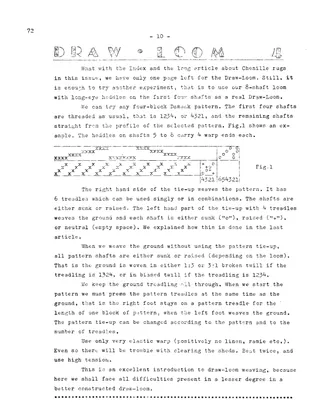
A one-page installment in the Master Weaver series on the draw loom, describing how to use an 8-shaft loom with long-eye heddles on the first four shafts as a simple draw loom for four-block damask patterns. It explains the threading, a split tie-up with 6 pattern treadles and 4 ground treadles, and the ground treadling in broken or biased twill. It ends with practical advice on warp elasticity, beating, and tension. A threading and tie-up diagram is included.
Loom, US Patent No. 1964
Patent · 4 pages
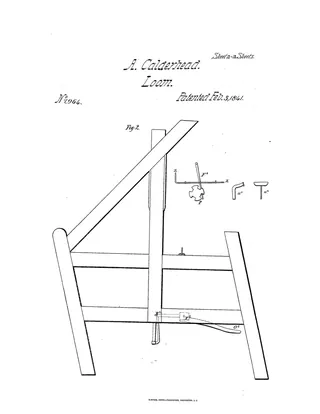
US Patent No. 1,964 (February 3, 1841; reissued May 13, 1857) granted to Alexander Calderhead of Philadelphia for a figure-weaving mechanism. It replaces the draw-loom harness with independent metallic heddles lifted or lowered directly by a rotating pattern apron and trunk, operated by a foot lever and ratchet wheel. The scan includes the specification, the claim, and one drawing sheet showing the loom frame.
Simple Draw-Loom Weaving
Article · 4 pages · weaving drafts
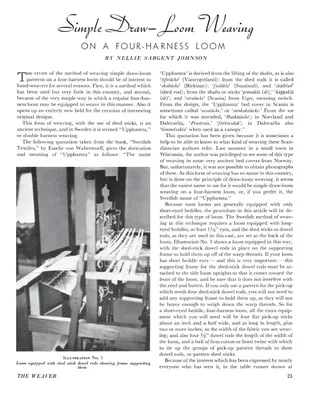
Nellie Sargent Johnson explains how to weave simple draw-loom (Swedish "Upphamta") patterns on an ordinary four-harness loom with short-eyed heddles, using flat pick-up sticks and dowel-rod shed sticks tied up with twine. She gives complete directions for a table runner (warp, weft colors, herringbone threading, pick-up pattern drafts, and the order of dowel-rod lifts) and for a second green linen runner. Illustrations show a loom setup, threading drafts, pick-up drafts, and runners including an antique Italian piece, a Swedish linen runner, and a Guatemalan cotton and silk runner.
Two Harness Method
Master Weaver, January 1954
Article · 5 pages · weaving drafts
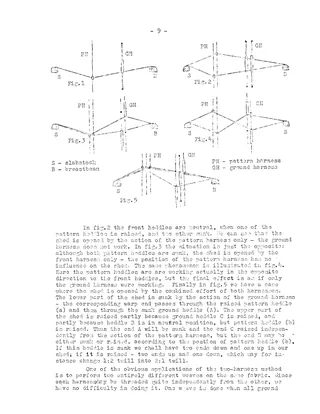
An article from Master Weaver explaining the two-harness method, in which a ground harness and a hand-operated pattern harness are threaded together so multiblock patterns can be woven without a dobby or jacquard. It covers the advantages and drawbacks, the loom construction, the three heddle positions (raised, sunk, neutral), and how the tie-up works, using twill examples. It also shows how to make draw-downs for this method, including a spot-weave example. The scan ends with a short 'From the Classics' excerpt on taste from John Murphy's Treatise on the Art of Weaving.
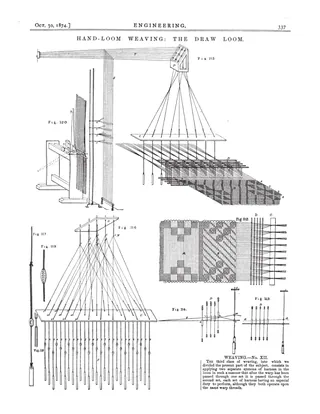
Weaving. -- No. XII: Hand Loom Weaving; The Draw Loom
Article · 2 pages · weaving drafts
Part XII of Alfred Barlow's series "Weaving" in Engineering, covering hand-loom damask weaving on the draw loom. It explains the two-harness system, in which a pattern harness forms the large outline and a ground harness works the detail intersections, here a five-leaf twill. It describes the leashes, comber board, pulley box, tail cords, simple cords, lingoes and mails, with a page of engineering diagrams (Figs. 112-120). It also gives a brief account of the origin of damask weaving and its supposed introduction to England in 1567.
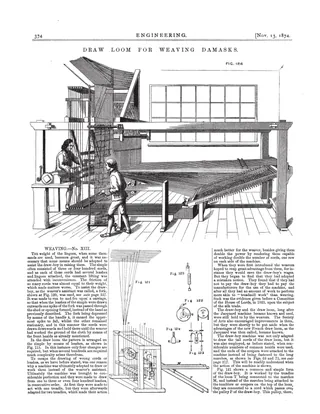
Weaving. -- No. XIII: Draw Loom for Damask Weaving
Article · 2 pages
Installment XIII of Alfred Barlow's 'Weaving' series, as printed in Engineering, covers the draw-boy and the draw loom used for damask weaving. It explains how the draw-boy's work of lifting the simple cords was assisted by a fork and later by a draw-boy machine with a pecker, ratchet wheel, and knotted cords worked from the treadles. It also describes a French eighteenth-century draw loom for figured velvet damasks with 400 pulleys and a bobbin frame, and compares it to the Jacquard. The text refers to Figs. 120-126, with an engraved view of the draw loom and mechanical diagrams.
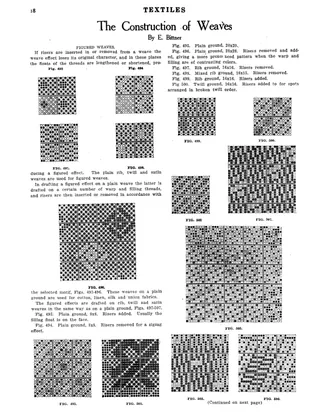
The Construction of Weaves, Part 1
Article · 2 pages · weaving drafts
A two-page installment of E. Bittner's series on the construction of weaves, dealing with figured weaves. It explains how inserting or removing risers in plain, rib, twill and satin grounds lengthens or shortens floats to produce figured effects. Figs. 493-507 are drawdown diagrams with captions giving the ground type, repeat size and whether risers were added or removed.
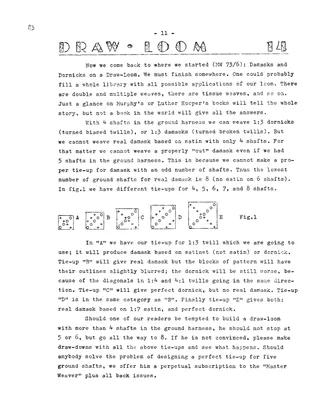
Draw Loom 14
Master Weaver, September 1965
Article · 2 pages · weaving drafts
A two-page installment in the Master Weaver series on draw looms, concluding the discussion of damasks and dornicks. It explains why real satin-based damask needs eight ground shafts and compares tie-ups for 4 to 8 shafts (Fig. 1). It also gives draw-downs for dornick and damask on four ground shafts (Fig. 2). The closing remarks say a converted standard loom is only suitable for study and demonstration, and advise on the depth and harness spacing of a purpose-built draw loom.
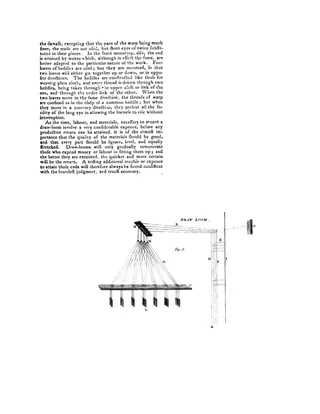
Draw-Loom
Rees's Cyclopedia, 1819
Article · 3 pages
An encyclopedia article on the draw-loom from Rees's Cyclopedia, describing how the harness (mails, weights, pulleys, tail cords, simples and lashes) is built and mounted, and how a pattern is read on from design paper by two operators. It also covers the 'patent' draw-loom introduced at Dunfermline that lets one weaver work alone, and the draw-loom as used for carpets and for spot weaving. A Fig. 3 engraving labels the parts of the loom.
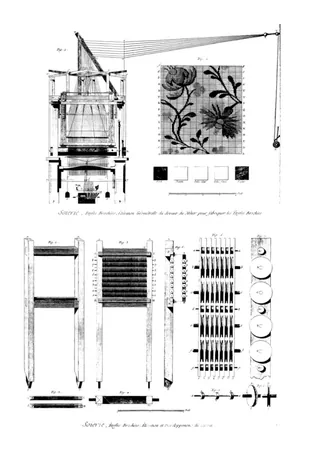
Encyclopedia: Weaving Plates, Part VI - Broché
Illustration · 6 pages · French · weaving drafts
A set of six pages reproducing engraved plates on silk weaving from Diderot and d'Alembert's Encyclopédie, Part VI of a series of weaving plates, devoted to brocaded fabrics (étoffes brochées). The plates show the brocade drawloom in perspective, side and front elevation, with its cords, pulleys, harness and heddles, a pattern cartoon with a color key, the rame and sample cords, the lacs, and a 'new machine for the tire' (draw mechanism). Captions are in French; the title page credits Philippe Demoule for preparing the set.
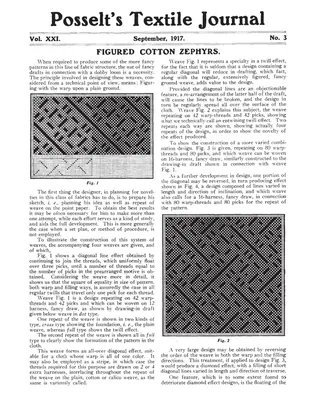
Figured Cotton Zephyrs
Article · 2 pages · weaving drafts
Two pages from Posselt's Textile Journal, September 1917, mainly an article on designing figured cotton zephyr fabrics: figuring with the warp on a plain ground, woven on dobby looms with fancy draws. Four weaves are explained (42- and 80-thread repeats, 12- and 16-harness drafts), including diagonal and entwining twill effects, diamond reversals, and the use of a 400 jacquard machine for sample production. The scan also includes the continuation of H. Barlow's article on terry pile fabrics, covering temples and loom measurements of cloth width versus reed width.
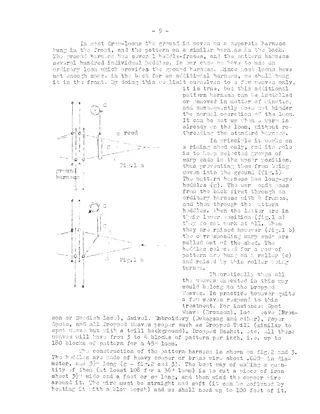
Pattern Harness and How to Make It
Master Weaver, January 1953
Article · 5 pages · weaving drafts
Article from Master Weaver (No. 7, January 1953) describing a removable pattern harness that hangs in front of an ordinary four-harness loom to give free block patterning without a draw-loom. It gives construction details (wire heddles, cumber board, roller with nails, treadle and spring), explains setup, threading, and operation, and lists weaves suited to it such as spot weave, lace weave, swivel, paper spots and dropped twill. Diagrams illustrate the loom and parts, and a small draft shows Paper Spots. The first page opens with the end of a letter excerpt on weave names (Bronson, summer-and-winter, crackle, shadow weave).
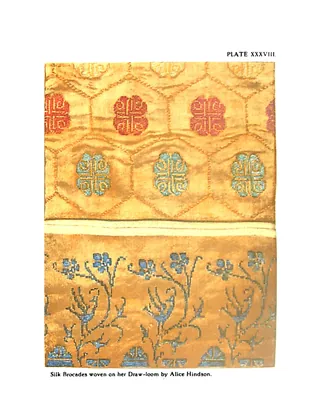
The New Draw-Loom
Book · 236 pages · weaving drafts
Luther Hooper's 1932 handbook describes the construction and operation of his 'new draw-loom', a hand-operated pattern-weaving loom for handicraft weavers. It opens with the traditional draw-loom, including a master weaver's 1800 description, then covers building the frame, comber board, pulley box, monture, simple and shed-lifting appliance. Later parts describe a series of looms (Nos. II to IV) for warp effect, weft effect and brocaded weaving, and four specifications for full-sized looms for linen damask and silk tissues and damask. It includes plates, point-paper designs, harness diagrams, a glossary and a publisher's book list.
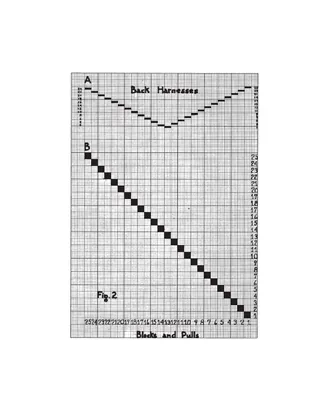
Weaving on a Draw-Loom
Monograph · 40 pages · weaving drafts
Instruction manual for weaving on the Purrington draw-loom, an eight-harness front loom combined with 25 back pattern (draw) harnesses, based on the Swedish "dragrustning" principle. Part I gives the text and explanation of diagrams, covering designing for the draw-loom, warping, threading, tie-up and weaving of four weaves: damask, spot weaves (Swedish lace, spot-bronson), summer and winter, and double weave. Part II contains the illustrative diagrams: harness and pull arrangements, threading drafts, tie-ups, shed diagrams, cross-sections and flat views of the cloth. It includes a foreword by the loom's maker, a preface, and a bibliography of English, Swedish and Finnish weaving books.
The Bulletin of the Needle and Bobbin Club, Vol. 42, Nos. 1 & 2 (1958)
Periodical · 44 pages
Combined issue (Vol. 42, Nos. 1 & 2, 1958) of the Bulletin of the Needle and Bobbin Club. Peter Thornton discusses an 18th-century treatise on designing patterns for flowered silks in G. Smith's Laboratory (1756), comparing English and French practice, describing the types of figured silks, and arguing that Anna Maria Garthwaite may have been its author, with plates of Spitalfields silk designs. Edith A. Standen examines an unusual tapestry given to the Metropolitan Museum of Art in 1956, asking whether it is Portuguese, and illustrates its emblematic border scenes. The issue closes with club notes, an obituary and a list of officers.
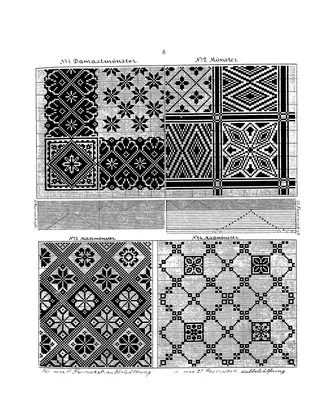
Allt för Fosterlandet [All for the Native Land]
Book · 47 pages · Swedish · weaving drafts
A Swedish-language manual on drawloom and damask-type pattern weaving, built around Lovisa Nylander's patented loom. It describes the loom and its parts (pattern shafts, draw board, treadles, beater with jerk mechanism), yarn, sizing and reeds, warping, threading, tie-ups and the draw sequence for figures. A large part is plates of damask and drawloom patterns with borders, rosettes and a Swedish coat of arms, plus drafts for twill, satin and double weave. Later sections cover shawls, felts, quilting, double cloth and rules for beginners.
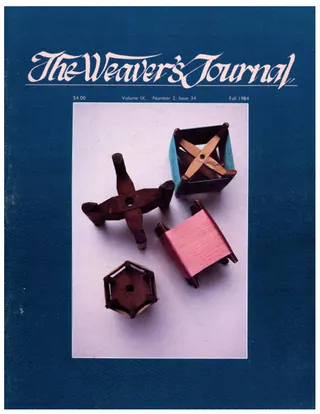
Weaver's Journal, Vol. IX, No. 2 Issue 34 (Fall 1984)
Weaver's Journal, Fall 1984
Periodical · 84 pages · weaving drafts
Fall 1984 issue (Vol. IX, No. 2, Issue 34) of The Weaver's Journal, a quarterly for textile craftspeople. Features include Helen Sellin's study of the weave structure of a Chinese drawloom silk, Madelyn van der Hoogt on turned drafts in double two-tie unit weave (with profile drafts, tie-ups and treadling plans for tied Beiderwand, summer and winter, overshot and related structures), and articles on soft drink mix dyes, natural dyeing with household materials, antique fiber tools (wheels, swifts, winders, shuttles), textile conservation, fibers for spinning, Japanese weaving tools, a handspun ramie blouse, a 5-shaft Bronson belt woven on 4 shafts, heathered yarns, finishing techniques from Guatemala, and the fiber heritage of the Salish. Departments cover complex looms, fashion trends, letters, a conference on complex weaves, news, reviews of books on Guatemalan dress and American textiles, a calendar of exhibits, classifieds, and many advertisements.
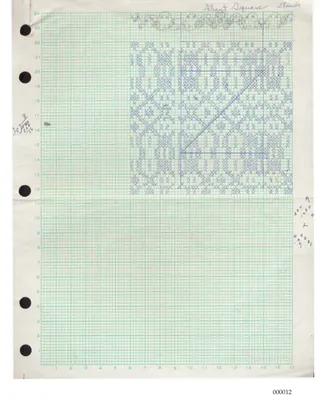
Hand-drawn draft
Ephemera · 2 pages · weaving drafts
Two pages of hand-drawn graph-paper weaving drafts, apparently for a 'Wheat Sequence' pattern on 28 shafts. The first page shows a drawdown grid with x-marked cells forming repeating diagonal and lozenge motifs. The second page shows strips with a tie-up and treadling labeled for the pattern and for plain weave. Much of the handwriting is illegible.
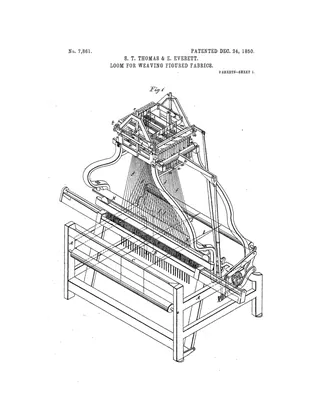
Loom for Weaving Figured Fabrics, US Patent No. 7861
Patent · 6 pages · weaving drafts
US Patent No. 7,861, granted December 24, 1850, to Samuel T. Thomas of Lowell and Edward Everett of Lawrence, Massachusetts, for an improved Jacquard loom for weaving figured fabrics. It replaces the knot-cord with horizontal harness bars that carry the mail cords (heddles), so the warp strain is more even in broad work and mountings can be changed more easily. It also describes a mechanism that rotates the pattern prism with a compound slide-rod and pawl movement. The document has three sheets of patent drawings, the specification and two claims.
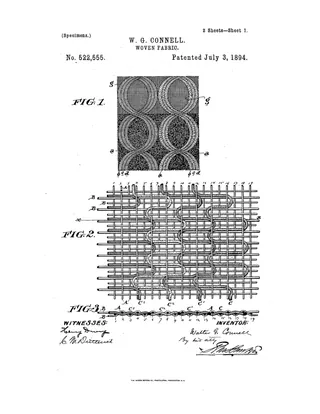
Woven Fabric, US Patent No. 522555
Patent · 5 pages · weaving drafts
US Patent No. 522,555, granted July 3, 1894 to Walter Glen Connell of Philadelphia, for a woven fabric. Pattern and color are made by additional sectional filling threads that travel laterally within the sheds and are bound in by the warp, over a body of ordinary warp and weft. The patent has two sheets of drawings (a fabric swatch, an enlarged weave diagram, a cross-section and a diagram of thread manipulation), a specification and seven claims. A companion loom patent (Serial No. 452,264) is mentioned.
Novelty from Abroad
Article · 1 page · weaving drafts
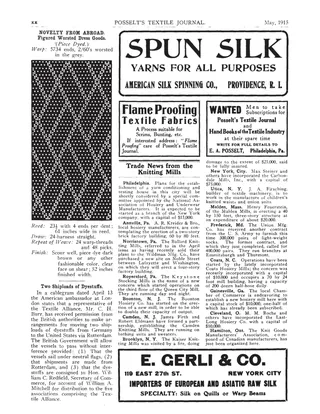
A single page from the May 1915 issue of Posselt's Textile Journal. It gives specifications for a piece-dyed figured worsted dress goods fabric from abroad, with a drawdown of the weave and the warp, reed, draw, repeat and finish details. The page also carries a news item on two shiploads of German dyestuffs allowed through to the United States, knitting mill trade news, and advertisements.
Die Technik der Gebildweberei einst und jetzt [The Technique of Pictorial Weaving Then and Now]
Article · 2 pages · German
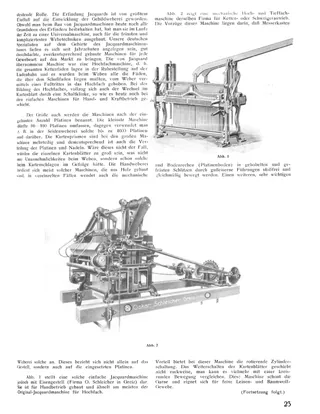
A German-language article from Melliand's Textilberichte tracing the history of shed-forming mechanisms for pictorial and figured weaving, from ancient frame looms to the Jacquard machine. It covers the Kegelstuhl and Zampelstuhl, the inventions of Bouchon, Falcon, Reynier, Vaucanson and Waldhör, and Jacquard's punched-card machine. The second page describes modern hand-operated and mechanical high- and low-shed Jacquard machines by the firm O. Schleicher of Greiz, illustrated with two line drawings. The article ends with "Fortsetzung folgt" (to be continued).
Weaving of Lengthwise Pleats
Article · 3 pages · weaving drafts
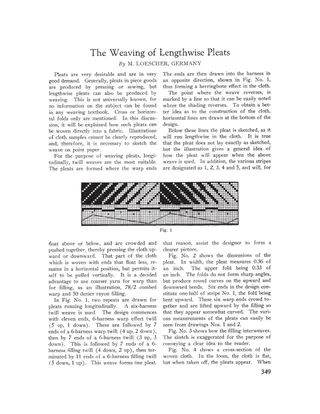
An article by M. Loescher of Germany explaining how lengthwise pleats can be woven directly into cloth using twill weaves, rather than pressed or sewn afterward. It gives step-by-step twill-group sequences on 6- and 8-harness threadings for several pleat designs (Figs. 1-8), with pleat dimensions, reed spacing and shrinkage allowances, yarn choices (coarser warp than filling), and notes on satin weaves, color effects and finishing. Most designs have repeats that need a Jacquard loom or many harnesses.
An Account of Mr. James Christopher Le Blon's Principles of Printing, in Imitation of Painting, and of Weaving Tapestry in the Same Manner as Brocades
Article · 7 pages
An 18th-century Philosophical Transactions article by Cromwell Mortimer describing J. C. Le Blon's method of printing in natural colours from three plates using red, yellow and blue, and its extension to weaving tapestry on a draw loom. It contrasts the traditional flat (low-warp) and upright (high-warp) tapestry methods at Brussels and the Gobelins with Le Blon's loom-woven approach, which a common draft-weaver and draw-boy could carry out much faster and more cheaply. It also describes the mounting of the loom with rings (males), lingoes, packthreads, simples and potlarts guided by a squared pattern.
Damask
English Encyclopedia, 1867
Article · 1 page
A short encyclopedia entry on damask, a figured woven cloth of flax and silk thought to originate in Damascus. It covers linen damask for table linen, the shift of manufacture from Germany to Scotland and Ireland, the draw-loom and the many pattern changes it required, and the introduction of silk damask weaving to England by Flemish refugees in 1567. It also notes the later use of mixed-fiber damask for furnishing fabrics.
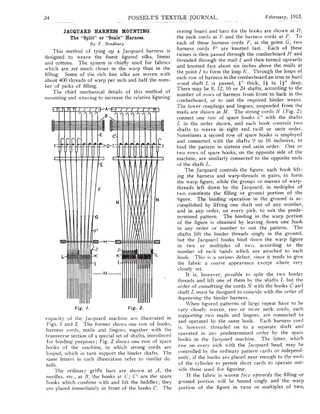
Jacquard Harness Mounting
Article · 2 pages
A short technical article by F. Bradbury on the "split" or "scale" Jacquard harness mounting, used for weaving fine figured silks, linens and cottons set much closer in the warp than the filling. It explains, with two labelled diagrams, how spare hooks and binder shafts are connected to bind the ground and figure in eight or sixteen end twill or satin order, and how this increases the figuring capacity of the machine. The second page also carries a separate article by W. Stoll on lustering cotton goods by chemical, mechanical and coating methods.
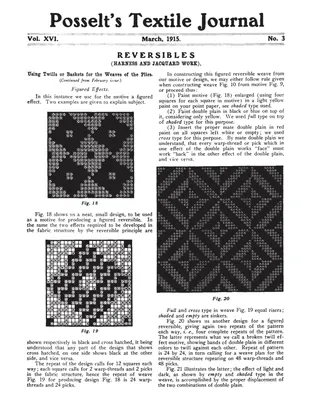
Reversibles
Article · 2 pages · weaving drafts
A two-page installment from Posselt's Textile Journal (March 1915) continuing a series on reversible fabrics for harness and jacquard work, here using twills or baskets for the weaves of the plies. It explains how to build figured reversible weaves from a motive, using double plain and its mate, with worked examples (Figs. 18-22) including a broken twill effect and double plain arranged 2:1. The scan also includes the start of an unrelated article on ring spinning.
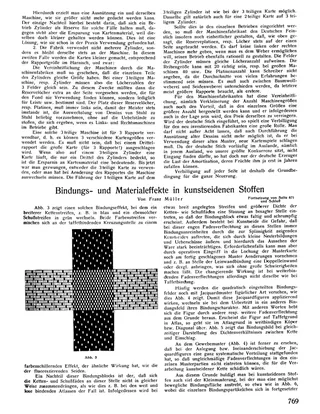
Bindungs- und Materialeffekte in kunstseidenen Stoffen [Weave and Material Effects in Rayon Fabrics]
Article · 2 pages · German · weaving drafts
The concluding part of Franz Müller's article on weave-structure and material effects in rayon (Kunstseide) fabrics. It discusses block-type binding effects where warp and weft color stripes cross in plain weave, and how jacquard figures change binding (e.g., satin figure on plain ground, twill on satin ground). It also covers the fragility of rayon warps, low warp densities, the use of unplied rayon, and rayon's prospects for replacing natural silk. Figures show binding diagrams and fabric samples. The scan begins with the end of an unrelated piece on standardizing jacquard machines, cylinders and punched cards.
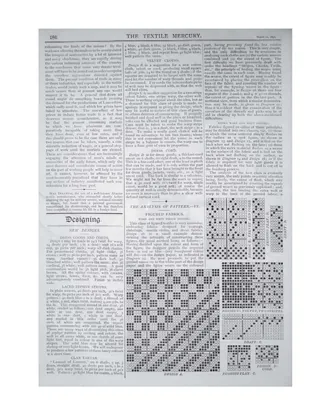
Designing
Textile Mercury, 1892
Article · 2 pages · weaving drafts
Two pages from The Textile Mercury of 12 March 1892 with a trade design column and the sixth part of a series on pattern analysis. The design column gives sett, yarn counts and colour suggestions for dress goods, laced zephyr stripes, the Lamont clan tartan, velvet and cord cloths, and a thickset dress cord, illustrated with drafts and pegging plans. The analysis installment covers figured fabrics: warp and weft weave figures, extra warp and weft figures, double-cloth figures, and methods of finding the repeat of a figure, with numbered designs and diagrams.
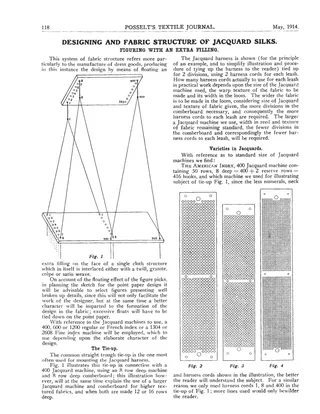
Designing and Fabric Structure of Jacquard Silks
Article · 2 pages
Installment of a serial article from Posselt's Textile Journal on designing Jacquard silk dress goods in which the figure is produced by floating an extra filling over a single cloth ground (twill, granite, crepe or satin). It explains the straight trough tie-up of the Jacquard harness and comberboard, and compares standard machine sizes (400 and 600 American index, 600 French index, 1304 Fine index, 2608 Double Fine index) by hooks, needles and speed. It ends with a worked example of calculating warp threads per inch and the size of the design sketch for point paper. Figures show a tie-up diagram, card layouts and a fabric sketch; the article is marked to be continued.
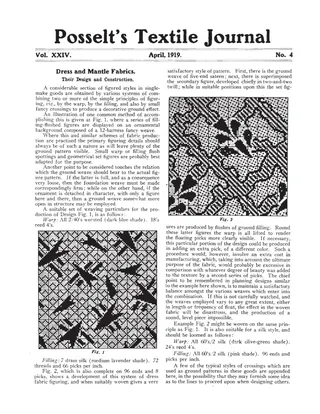
Dress and Mantle Fabrics
Article · 2 pages · weaving drafts
Two pages from Posselt's Textile Journal (April 1919) on the design and construction of dress and mantle fabrics. The first article describes combining warp figuring, filling figuring and fancy ground weaves, with weaving particulars (yarns, reed, thread counts) for two figured designs on a 12-harness fancy ground and a five-end sateen ground. It then shows ground weaves (bold twill, three-and-two warp rib in diagonal stripe, check-effect rib) with fabric specifications. A second article, "Clay Twills," discusses construction and settings of clay worsted cloth with a 3-and-3 twill, including a calculation of ends per inch.
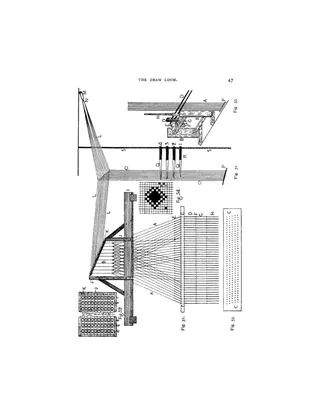
Jacquard Mechanism and Harness Mounting
Book · 369 pages · weaving drafts
A 1912 technical treatise on Jacquard weaving by Fred Bradbury, a textile professor in Belfast. It traces the development of figure weaving from treadle looms and the draw loom through the early French and British Jacquard precursors, then describes single lift, double lift, double cylinder, cross border and twilling Jacquard machines, with their driving and counterpoise systems. Later chapters cover gauze/leno Jacquards, the swivel and gauze reed, pressure and split harness mechanisms, harness mounting and its calculations, and card preparation (design, stamping, repeating and lacing machines). The book is heavily illustrated with mechanical line diagrams and includes worked problems and an index.
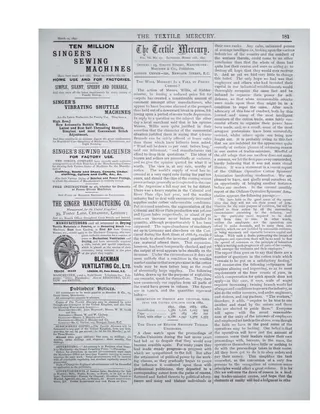
Textile Mercury, Vol. 6, No. 151 (March 12, 1892)
March 12, 1892
Periodical · 18 pages · weaving drafts
Issue of The Textile Mercury, a Manchester trade weekly, dated March 12, 1892. It combines editorial commentary and trade news on wool, cotton, linen, silk and jute markets, labour disputes, Board of Trade returns and chambers of commerce proceedings. Technical content includes the sixth instalment of 'The Analysis of Pattern' on figured fabrics, with pegging plans and design grids, an illustrated article on an improved Lamb-principle knitting machine, bleaching and dyeing notes, and spinning patents.
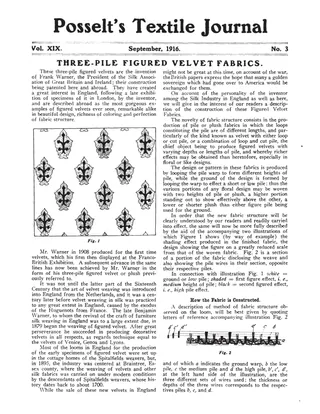
Three-Pile Figured Velvet Fabrics
Article · 2 pages · weaving drafts
A 1916 article from Posselt's Textile Journal describing Frank Warner's patented three-pile figured velvet, in which pile loops of three different heights produce shaded floral designs on a Jacquard loom. It explains the pile wires, the hand-cutting trevette knife and power-loom knife wires, and the difference between terry (loop) and cut velvet pile. A shorter second section covers A. Beaumont's patented combined cloth, which binds an inner and an outer fabric of different yarn qualities; it is illustrated with eight weaving plans.
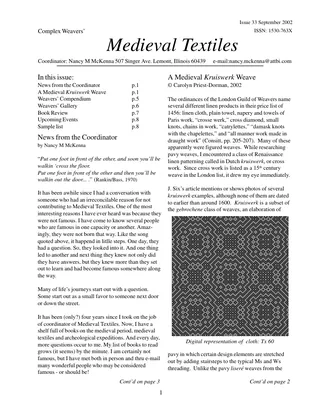
Complex Weavers Medieval Textiles Study Group Newsletter 33
Nancy M. McKenna · September 2002
Web Doc · 8 pages · weaving drafts
Issue 33 (September 2002) of the Complex Weavers Medieval Textiles Study Group newsletter. The main article by Carolyn Priest-Dorman discusses kruiswerk, a figured linen weave, and presents a 12-shaft draft of a c. 15th-century textile (Tx 60) from the Abbey of St. Truiden, Belgium, linking it to the 'crosse werk' of the 1456 London weavers' ordinances. The coordinator's news covers the Shroud of Turin restoration, the Genghis Khan tomb expedition, digitized Gutenberg and Vatican manuscripts, and the Halmyris martyrs' tombs. Other items include part III of a tapestry-weave sample series, a Weavers' Gallery of reconstructed cloth and pouches, a review of Fustat Finds, upcoming exhibitions, and a call for samples.
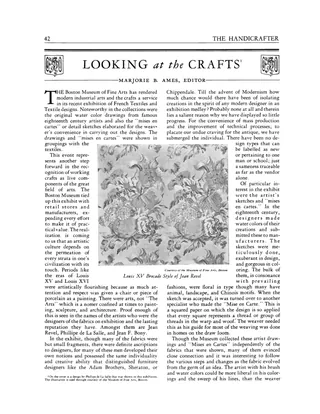
Looking at the Crafts
Article · 3 pages
A column from The Handicrafter (January/February 1930) edited by Marjorie B. Ames. It reviews the Boston Museum of Fine Arts exhibition of French 18th-century textiles, designers' watercolors and "mises en cartes" (squared-paper weaving guides for draw looms), and describes the new Craftsmen's Guild studio shop in Boston. It also announces a new course in tapestry and Oriental rug weaving at the Master Institute of Roerich Museum, New York, taught by Mme. Verita de Bertalan. The scan ends with a page carrying the continuation of a marionette-making article and advertisements.
Spanish Velvet Weave
Article · 15 pages
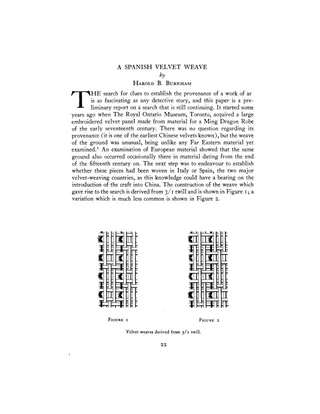
Harold B. Burnham reports on a velvet ground weave derived from 3/1 twill (one pile end to three main ends) that he argues is characteristic of Spanish velvet weaving of the late fifteenth to sixteenth centuries. He traces it through Spanish chests, vargueño desks, over two hundred ecclesiastical embroideries, confraternity banners, stamped velvets and three figured velvets. He contrasts it with Italian and Chinese velvets by yarn twist and ground construction. He also proposes that Spanish velvet drawlooms used 840 pulley cords and their divisions, against the Italian 800. A technical résumé at the end gives warp, pile, weft, selvage and figure-harness details for each illustrated piece.
Die Technik der Gebildweberei einst und jetzt [The Technique of Figured Weaving Then and Now]
Article · 2 pages · German · weaving drafts
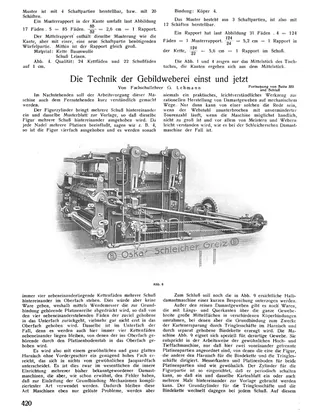
Concluding part of G. Lehmann's article on the technique of figured (damask) weaving, past and present. It describes how the Oskar Schleicher Greiz damask machine works, using a figure cylinder, turning knives and a plain harness to form the ground weave, and then a half-damask machine for fabrics with twill-bound borders and central fields. It opens with the end of a preceding passage on twill-bound tablecloth patterns, with repeat and shaft calculations. A second, unrelated article by M. Loescher on patterning pullover fabrics follows, covering ice, cock's-tread (houndstooth), windmill and waffle weaves, with small drawdown sketches.
Technologie de Tissage Unis et Façonnés [Weaving Technology: Plain and Figured Fabrics]
Book · 119 pages · French · weaving drafts
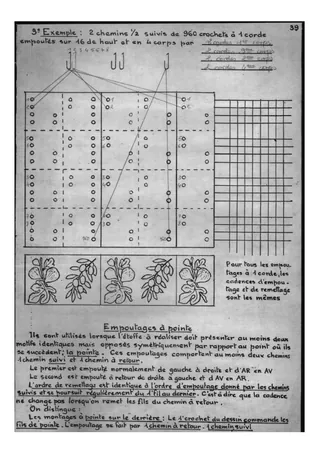
A French technical course manual from the Lycée Technique in Lyon, by G. Goux, on the technology of weaving plain and figured (patterned) fabrics. The first part covers loom layout, shed formation, beating, weaver's knots, the 104-hook Jacquard mechanism, warp tension brakes, reeds, and a long catalogue of weaving faults. The second part covers figured weaving: Jacquard, Vincenzi and Verdol mechanisms, card punching and weave pointing, tie-ups (empoutage), harness cording (colletage), warp threading exercises, selvedge control, and synchronized and Maltese-cross mechanisms. It is richly illustrated with technical diagrams, tables of hook counts, and handwritten and printed pages.
Technologie der Handweberei, II. Theil: Die Jacquardweberei [The Technology of Handweaving, Part II: Jacquard Weaving]
Book · 119 pages · German · weaving drafts
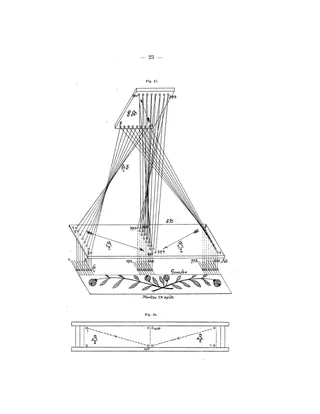
Third revised edition (Vienna, 1900) of Part II of a German-language handweaving textbook, devoted to Jacquard weaving. It covers the history of figured weaving from the draw loom through the Jacquard machine, the construction and operation of the machine, harness and tie-up arrangements, pattern drawing, card cutting and lacing, and brocading and lancé devices. Later chapters treat harness set-ups for complex fabrics (damask, shawl, gauze/leno), variants of the Jacquard machine, patent law in Austria-Hungary and Germany, and a price list for equipment. It is illustrated with 189 figures, and an index is included.
The Bulletin of the Needle and Bobbin Club, Vol. 48, Nos. 1 & 2 (1964)
Periodical · 49 pages
Double issue (Vol. 48, Nos. 1 & 2, 1964) of the Bulletin of the Needle and Bobbin Club. The main article, by Natalie Rothstein, studies nine English silks woven in Spitalfields from designs by Anna Maria Garthwaite (1742-1752). It covers the designs, the silk types (tobine, lustring, tabby, damask, brocade), and the mercers and weavers who bought them, including Lekeux, Vautier, Sabatier and Julins. A second article by Lisa Cook Terrace discusses an early 18th-century ink-on-parchment needlework or lace pattern, probably from New England and linked to a deed of 1719/20, with lace and embroidery comparisons. The issue ends with Club Notes and a list of officers.
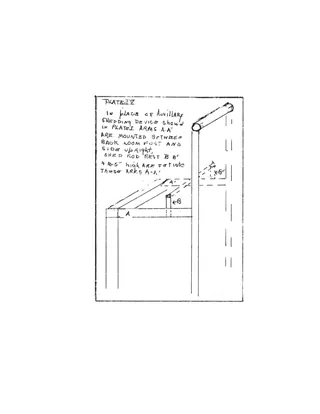
Damask on Four Harnesses
Monograph · 47 pages · weaving drafts
A 1958 monograph by Robert Fredric Heartz explaining how to weave damask-type figured cloth on a four-harness loom using split (long-eye) heddles and a shed-rod pick-up technique. It opens with a history of damask, the draw loom, the Jacquard and the Paisley shawl, then gives loom preparation, tie-up, pick-up methods, designing on squared paper, yarns and color. Numbered hand-drawn plates show loom modifications, tie-ups, and design motifs, including a Whig Rose adaptation, Summer and Winter, and cat tracks. It ends with notes on Paisley shawl production and an ad for a correspondence course in advanced handweaving.
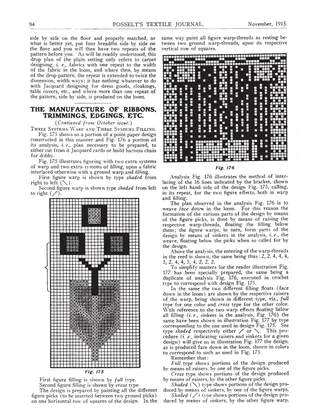
The Manufacture of Ribbons, Trimmings, Edgings, Etc.
Article · 2 pages · weaving drafts
Two journal pages continuing E. A. Posselt's series on making ribbons, trimmings and edgings, from the November 1915 issue of Posselt's Textile Journal. They explain figuring with two extra systems of warp and two of filling on a taffeta ground, using a point paper design (Fig. 175), its weave analysis (Fig. 176) and a symbol-coded duplicate (Fig. 177). The text covers raisers and sinkers, weaving face down in the loom, reed entering, and the warp and filling dressing (46 ends, 36 picks). Short notes follow on a patented dove-and-olive-branch ribbon design and on two patented lace edging designs.
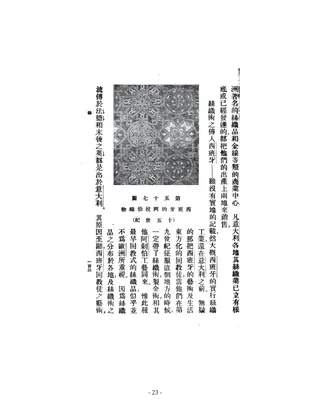
Silk: Its Production and Manufacture [Chinese Translation]
Book · 130 pages · Chinese · weaving drafts
A Chinese translation (Commercial Press, Shanghai, January 1924) of Luther Hooper's English handbook on silk, titled 蠶絲概論 (Outline of Sericulture/Silk). It covers silk's value and sources, silkworms and wild silk moths, the history of silk, sericulture, reeling, throwing (twisting), dyeing, and types of silk thread. It then treats silk weaving: ancient Chinese figured fabrics, simple and compound drawlooms, Jacquard punched-card harnesses, satin and damask (figured satin) weaves, the westward spread of silk weaving to Italy, Europe and England, and modern weaving. Illustrated with diagrams of looms, harnesses, weave patterns, reeling and throwing machinery, and photographs of historic textiles.
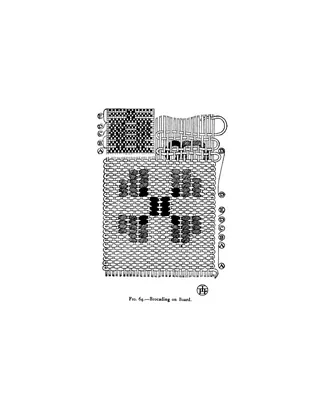
Hand-Loom Weaving: Plain and Ornamental
Book · 380 pages · weaving drafts
A comprehensive handbook on hand-loom weaving in the Artistic Crafts Series, edited by W. R. Lethaby, by Luther Hooper. It moves from the basics of spinning, flax preparation, warping, beaming and loom construction through simple pattern weaving (tapestry, brocading, twills, satins, double cloth, shedding motions, damask and velvet) to complex draw-loom, shaft monture, brocatelle, tissue, compound monture and figured-velvet weaving. It includes many line drawings of equipment, ruled-paper designs and drafts, plates of historic textiles, and a glossary.
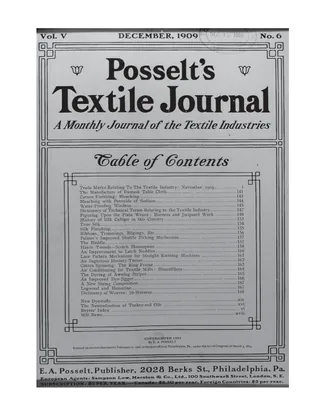
Posselt's Textile Journal, Vol. 5, No. 6 (December 1909)
Periodical · 55 pages · weaving drafts
December 1909 issue of Posselt's Textile Journal, a monthly US trade periodical. It covers cotton bleaching and finishing, water-proofing woolens, silk culture and finishing, ring spinning, humidifiers, dyeing (awning stripes, logwood, dyestuffs, soap scouring), and knitting and loom mechanisms such as Palmer's shuttle picking device and latch needles. Weaving content includes a continuing series on figuring upon the plain weave with harness and Jacquard work, ribbon weave plans, a dictionary of technical terms (letter J), and chart explanations for ten-harness weaves. The issue also carries trade mark listings, a Harris tweed article, a biographical notice of Joseph B. Bancroft, mill news and many machinery advertisements.
221 documents found