Textile Documents › Publications › Publication: Philosophical Transactions
9 documents found
Sort: 
An Account of Mr. James Christopher Le Blon's Principles of Printing, in Imitation of Painting, and of Weaving Tapestry in the Same Manner as Brocades
Article · 7 pages
An 18th-century Philosophical Transactions article by Cromwell Mortimer describing J. C. Le Blon's method of printing in natural colours from three plates using red, yellow and blue, and its extension to weaving tapestry on a draw loom. It contrasts the traditional flat (low-warp) and upright (high-warp) tapestry methods at Brussels and the Gobelins with Le Blon's loom-woven approach, which a common draft-weaver and draw-boy could carry out much faster and more cheaply. It also describes the mounting of the loom with rings (males), lingoes, packthreads, simples and potlarts guided by a squared pattern.
Analyses of Agricultural Yield. Part III. The Influence of Natural Environmental Factors upon the Yield of Egyptian Cotton
Article · 67 pages
A scientific paper by W. Lawrence Balls, Part III of his series on analyzing agricultural yield, studying how environmental factors such as water-table, soil fertility, soil depth, temperature, sowing date and variety affect flowering and bolling in Egyptian cotton. It draws on field experiments at Giza (the Terraces, 1909-1911, and spacing and sowing-date trials, 1912-1913), Talbia, Gemmaiza, Salaka, Mit Khalaf and Neguila. It discusses how daily flowering fluctuations can be pre-determined from main-stem and branch growth, and how a rising water-table curtails flowering. It includes many flowering-curve graphs and an appendix of data tables.
Concerning the manner of Spinning and Making an Incombustible Cloath thereof
Article · 4 pages
An abstract from Philosophical Transactions of a letter by Giovanni Ciampini of Rome describing asbestus (amiantus) and how to spin and weave it into incombustible cloth. It describes four varieties of the stone in his museum, his tests of it as a lamp wick and in fire, and the washing, carding and oiling steps used to prepare the fibers. He found that mixing asbestus filaments with flax on a distaff gave stronger thread than twisting them with plain thread on a reel. The article ends with advice on keeping asbestus cloth oiled and cleaning it by burning. It includes an engraved plate of the carding, reeling and oiling implements.
A Letter of the Curious Mr. Henry Barham, R. S. Soc. to Sir Hans Sloan, Bart., Vice-President of the Royal Society; Giving Several Experiments and Observations on the Production of Silk-Worms, and of their Silk in England, as made by Him Last Summer
Article · 3 pages
A 1719 letter from Henry Barham to Sir Hans Sloane, printed in the Philosophical Transactions, reporting his experiments raising silkworms at Chelsea Park from eggs obtained in Languedoc. He records hatching and spinning dates, counts and weighs cocoons, and measures the silk yield from winding (3,319 cocoons gave about 17 ounces of fine silk). From these figures he estimates the yield from an ounce of eggs and compares it with Augustino Gallo's figures for France and Italy, arguing that silk production in England can match other countries. He also says he can obtain two crops a year and that mulberry trees leaf twice a year in England.
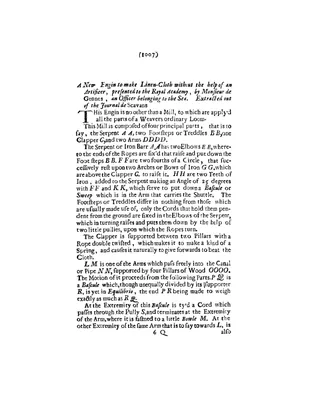
New Engine to make Linen-Cloth without the Help of an Artificer
Article · 3 pages
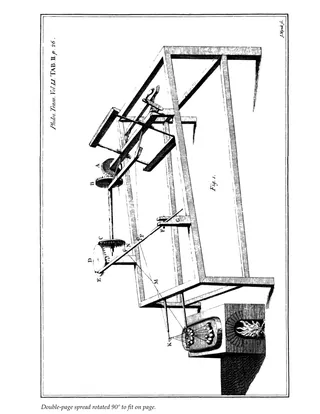
A short 1677 account, extracted from the Journal des Sçavans, of a mill-driven mechanical loom devised by Monsieur de Gennes, a naval officer, and presented to the Royal Academy. It describes the serpent (iron crank bar), treadles, clapper (beater), and shuttle-carrying arms with their pulleys, weights and whale-bone spring, and how they work together to open the shed, pass the shuttle and beat up. It ends with the claimed advantages: one mill driving 10 or 12 looms, wider cloth, fewer broken threads and lower labor cost.
New Improved Silk Reel
Article · 12 pages
Paper read to the Royal Society on 1 Feb. 1759 in which the Rev. Samuel Pullein describes a simplified silk-reeling machine intended to help silk culture in the American colonies. He explains the 'Vitrage' problem (gummed-together rounds of silk thread on the reel), compares band-driven reels with the Piedmontese toothed-wheel reel, and presents his version using only two toothed wheels and a winch-driven guidestick. He also describes a swivel-cross device for making the double croisure (twist) of the two threads. Two engraved plates (Tab. II and III) show the Piedmontese reel and his new design.
On a New Variety in the Breeds of Sheep (Part 2)
Article · 2 pages
An abstract of Colonel David Humphreys' letter to Sir Joseph Banks describing the Ancon or Otter breed of sheep, a short-legged variety that arose accidentally in Massachusetts in 1791. It covers how the breed was established, its inheritance in crosses, its deformities, and its inability to jump fences. It also notes the Ancon-Merino cross, whose fleece takes on the silky feel of merino wool, and the breed's likely extinction as Merinos spread.
Re: On a New Variety in the Breeds of Sheep (Part 2)
Article · 8 pages
A letter from Colonel David Humphreys to Sir Joseph Banks, read to the Royal Society in January 1813, describing the Ancon or Otter breed of sheep. The breed began in 1791 in Dover, Massachusetts, from a short-legged lamb born to Seth Wight's flock. The letter covers the breed's inheritance, crossing with common and Merino sheep, fleece quality, physical weaknesses, a dissection by Dr. Shattuck, and its decline after Merinos were introduced into New England.
Some Inquiries and Suggestions Concerning Salt for Domestick Uses; and Concerning Sheep ...
Article · 6 pages
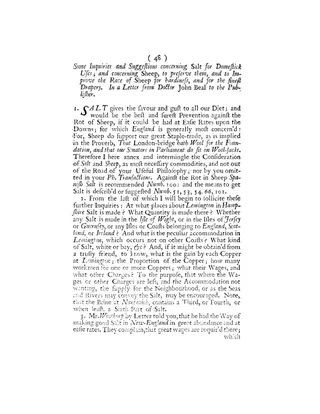
A letter from Dr. John Beal to the publisher of the Philosophical Transactions raising inquiries about salt production in England, Ireland and New England, and about its use in preventing rot in sheep. Beal cites classical authors (Varro, Columella, Palladius, Cato) on sheep husbandry and salt, and notes English saline springs and salt-making methods. He also proposes improving English sheep for hardiness, size and fine wool by importing rams and ewes from Spain, Italy and Greece, and comments briefly on the Irish linen and woollen manufactures.
9 documents found