Textile Documents › Topic: Textile printing
242 documents found
Sort: 
Chrome Green
Manufacturer and Builder, 1869
Article · 2 pages
A short 1869 article from The Manufacturer and Builder on chrome green pigment, reprinted from Moniteur Scientifique. It describes how MM. Casthelaz and Leune prepared a brilliant emerald 'imperial green' by slowly precipitating chrome salts by the wet process, using reagents such as zinc oxide, zinc carbonate, gelatinous alumina, iron or zinc. It presents this as a safer replacement for copper and arsenic greens in printing on stuffs, paper, paints, glass and ceramics.
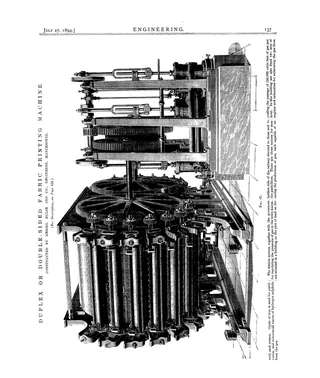
Duplex or Double-Sided Fabric Printing Machine
Engineering Weekly, July 27, 1894
Article · 1 page
A single page from an 1894 issue of the engineering journal Engineering, carrying a full-page engraving (Fig. 67) of a duplex, double-sided fabric printing machine built by Messrs. Hulse and Co., Engineers, Manchester. The caption refers readers to the description on page 134. The page also has unrelated text fragments about gas purification and gasworks equipment, apparently from an adjoining article.
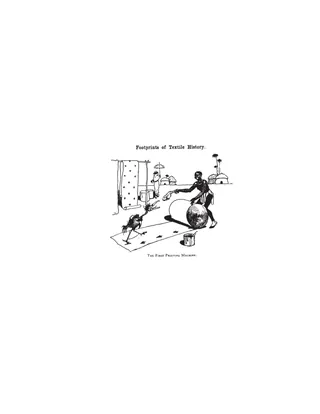
Footprints of Textile History
Other · 1 page
A single-page illustrated item from Posselt's Textile Journal titled 'Footprints of Textile History,' with the caption 'The First Printing Machine.' The cartoon-style drawing shows a figure pushing a large cylindrical roller over a long cloth laid on the ground, with a bucket of dye nearby. It is a humorous or imaginative depiction of the origins of textile printing, with little text.
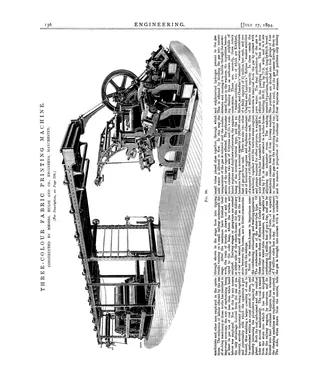
Three-Colour Fabric Printing Machine
Engineering Weekly, July 27, 1894
Article · 1 page
A single page from the engineering periodical Engineering (July 27, 1894) showing a perspective engraving (Fig. 66) of a three-colour fabric printing machine built by Messrs. Hulse and Co., Manchester. The machine is shown in side elevation with flywheel, printing cylinders, rollers and frame. The accompanying description is on page 134 and is not included here; the text on this page belongs to an unrelated article on gasworks plant.

Calico Printing
Article · 1 page
A very short dictionary entry defining calico painting as the art of producing designs or patterns in a variety of colors on calico and similar cotton fabrics. The scan consists of a single page with only a brief definition and no technical detail on methods or dyes.
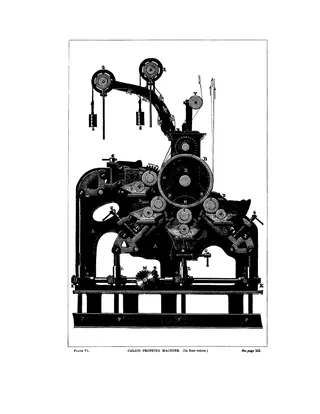
Calico Printing Machine
Article · 2 pages
A two-page entry from Knight's New Mechanical Dictionary describing the calico printing machine, with a plate showing a four-colour roller printing machine. The text explains the impression cylinder, engraved colour cylinders, colour troughs, doctor blades, and the fabric, doubler and blanket webs, and ends with references to further sources on calico printing.
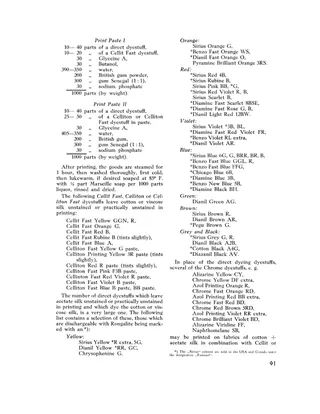
Printing of Acetate Silk and Fabrics Containing Acetate Silk
Article · 6 pages
A 1929 technical article from The Melliand on printing acetate silk (acetate rayon) and fabrics that mix it with other fibres. It surveys dyestuff classes for all-acetate fabrics (basic, acid, mordant, vat, Indigosol, Cellit Fast, Celliton) with fixing and discharge methods. It then covers mixed fabrics of cotton or viscose with acetate, wool with acetate, and real silk with acetate, with sample print paste recipes and dyestuff lists.
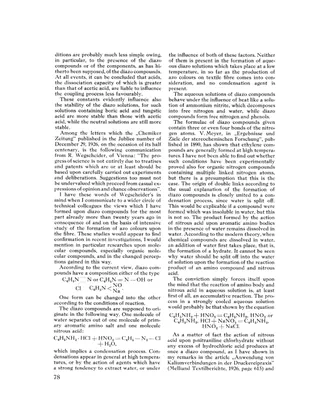
Stable Diazo Printing Colors and a New Explanation of the Constitution of Diazo Compounds
Article · 5 pages
A paper by Dr. W. Sieber, read at the Twelfth Congress of the International Society of Chemists and Colourists in Carlsbad, on stabilizing diazo printing colours used with beta-naphthol prepares on cotton. He reports that boric acid and tungstic acid can replace acetic acid, gives recipes for preparing the stable diazo colours from p-nitraniline, m-nitraniline or p-nitro-o-anisidine, and compares dissociation constants of the acids. The second half proposes a new explanation of the constitution of diazo compounds, arguing that nitrous acid first forms an addition (molecular) compound with the amine rather than a condensation product.
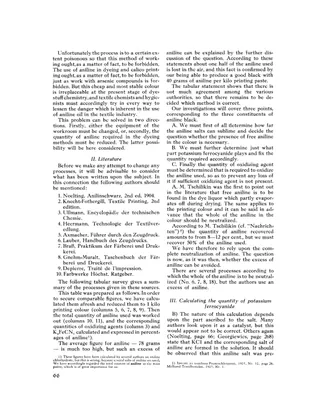
Steam Aniline Black
Article · 5 pages
Article by Professor N. Wosnessensky on steam aniline black for calico printing. It argues that the aniline content of printing colours can be cut sharply because roughly half is lost by evaporation, and it reviews 20 published recipes in a comparative table. It calculates the potassium ferrocyanide and sodium chlorate needed, reports volatility tests on aniline chlorhydrate, tartrate and ferrocyanide, and gives a working recipe using 40 g aniline per kilo of colour, which was used in production at the Trechgornaia Manufaktur.
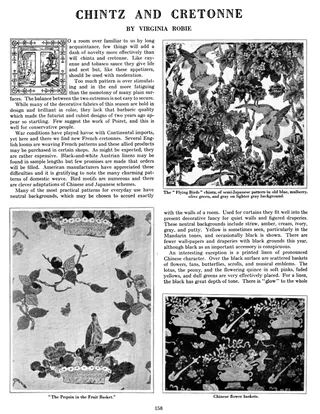
Chintz and Cretonne
Article · 2 pages
A two-page magazine article from The House Beautiful on chintz and cretonne as decorative fabrics for interiors, written during World War I. It describes current printed patterns such as 'Flying Birds', 'The Pequin in the Fruit Basket', 'The Bird and Rhododendron', 'The Green Peacock' and 'Dish of Fruit and Flowers', with their colors, motifs and suitable room uses. It also notes the effect of war on French imports and defines chintz versus cretonne, including the origin of the name cretonne.
Colour
Rees's Cyclopedia, c. 1802-1820
Article · 11 pages
An encyclopedia article on colour and colour-making in calico printing, from Rees's Cyclopedia. It sorts printers' colours into three classes: dyed colours raised on mordants, chemical colours with mordant mixed into the colouring matter, and colours held in solution by an acid or alkali. It gives recipes and chemical theory for iron and alumina mordants (iron liquor, red liquor), chemical black, berry-yellow, greens and tin solutions for scarlets. The final page appears to carry a separate passage on colour changes from chemical mixtures.
Gold-Printed Muslins
Living Age, 1846
Article · 1 page
A short 1840s notice of a muslin curtain fabric printed in gold by a galvanic process, patented by Messrs. Vallé and Company of Manchester. It presents the process as a cheaper substitute for gold and silver embroidery on window curtains and drapery, and says the gold printing keeps its brilliancy when washed. The piece is credited to the Year-Book of Facts.
Indigosols in Textile Printing
Article · 3 pages
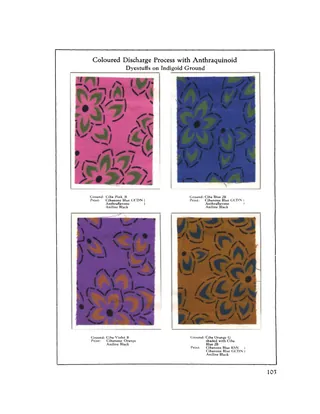
Specimen article from The Melliand on printing with Indigosol dyes, which are water-soluble, stable vat dyes, on cotton and viscose. It covers the chlorate steaming process, the Indigosol Developers, and the nitrite process for combining Indigosols with Rapid Fast Colours. It also covers aftertreatment and gives sample print paste recipes in a table. The two following pages show printed swatches: coloured discharge prints on indigoid grounds, and Naphtol AS combinations and Rapid Fast Colours on artificial mixed fabrics. The article ends with "To be continued".
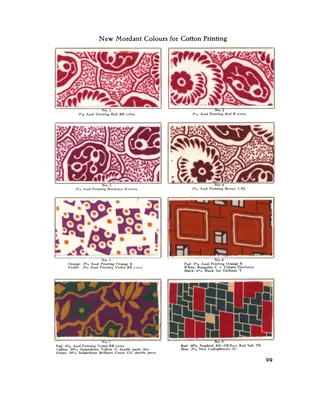
New Mordant Colours for Cotton Printing
Article · 3 pages
A 1929 specimen from The Melliand on Azol Printing Colours, a new series of chrome mordant dyestuffs from I. G. for printing cotton, especially upholstery goods and hangings. It covers the fastness properties, the available shades, a print-paste recipe with acid starch-tragacanth thickening and acetate of chrome, and steaming, padding and discharge methods. Sample swatch pages give the dye recipes used. The scan also includes a page of swatches from a following article, The Indigosols in Textile Printing by Kerth and Pfeffer.
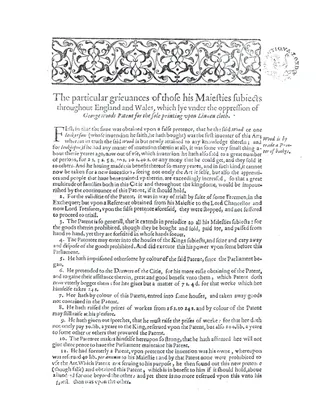
The particular grievances of those his Maiesties subjects throughout England and Wales, which lye under the oppression of George Woods Patent for the sole printing upon Linnen cloth
1621
Other · 1 page
A single-page printed broadside listing eleven grievances against George Wood's patent granting him the sole right to print on linen cloth in England and Wales. It argues that the patent was obtained on false pretences about the invention, allows seizure of goods and imprisonment, and has raised prices and impoverished the drawers and other tradespeople trained in the art. It is a primary source on early seventeenth-century patent monopolies and linen printing.
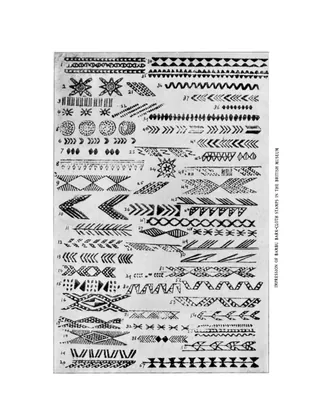
Series of Hawaiian Handicrafts
Article · 12 pages
A photographic series from the Bulletin of the Needle and Bobbin Club showing Hawaiian and other Pacific handicrafts, with photographs lent by the Bishop Museum in Honolulu. It illustrates bamboo printing stamps and their impressions, a carved Samoan siapo printing slab, Hawaiian tapa beaters (ie kuku), and tapa or kapa bark cloths from Hawaii, Niue, Tahiti and the Solomon Islands. It ends with a feather-netted Tahitian gorget and a feather cape. The text is limited to short captions and a brief note thanking Miss Gertrude Whiting for obtaining the photographs.
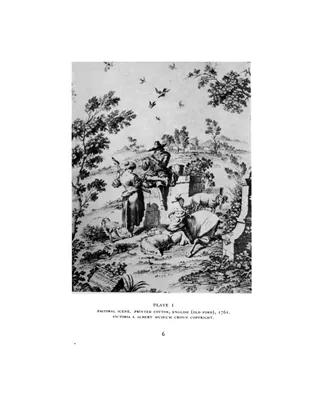
Some Pattern Sources of 18th and 19th Century Printed Cottons
Article · 20 pages
An article tracing the engravings that designers used as sources for the figure and animal motifs in 18th- and early 19th-century printed cottons, especially the toiles de Jouy made at Oberkampf's factory. It discusses the cartoons of Jean-Baptiste Huet and shows how figures were borrowed from Berchem, Rubens, Watteau, Boucher, Jacques Stella's Pastorales and Oudry's illustrations for La Fontaine's Fables. The text is a few pages, followed by sixteen plates that pair printed cotton details and cartoons with the engravings they drew on.
Specification of Mr. Eckhardt's Patent for Cloth Hangings Resembling Damask, Lace, &c.
Article · 3 pages
Specification of a British patent (dated April 30, 1793) granted to Francis Frederick Eckhardt of Chelsea for preparing linen and cotton cloth as wall hangings. The cloth is stretched on a frame and filled with a flour or starch paste mixed with wax, then coated with water-colours and sized. Ornaments in gold, silver or colours are printed or gilded on to imitate damask, lace and silk stuffs, and the surface is varnished so it can be washed. This is a printing and finishing process, not a woven structure.
Specification of the Patent Granted to Mr. William Gillispie for his Invention of an Improved Method and Process of Printing, Colouring, or Staining Linens, Calicos or other Cloths
Article · 6 pages
Text of the 1799 patent specification of William Gillispie, a calico-printer of Anderston near Glasgow, for a method of printing coloured cloths with white or multicoloured figures on coloured grounds. The cloth is first impregnated with a mordant, then printed with a vegetable acid to discharge the mordant where white is wanted and with other mordants where other colours are wanted, and finally dyed. The process is described in general terms and then as a detailed working sequence, ending with rinsing, bran cleaning and an oxygenated muriatic acid (chlorine) treatment.
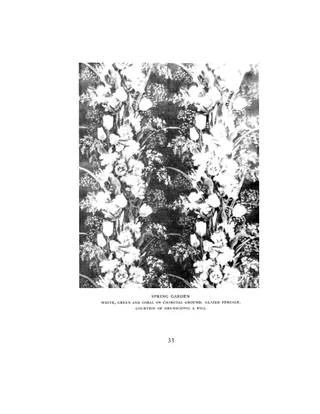
American Screen-Printed Fabrics
Article · 12 pages
An article by Zelina Comegys Brunschwig on the rise of American screen-printed decorative fabrics after the 1929 depression and World War II. It explains how screen printing works (silk screens, one screen per color, long printing tables, squeegee), compares it with wood-block and roller printing, and discusses dyes and the shift from imported to domestic production. Illustrated with printed fabric examples shown at the Slater Memorial Museum exhibition in Norwich, Connecticut, in spring 1948.
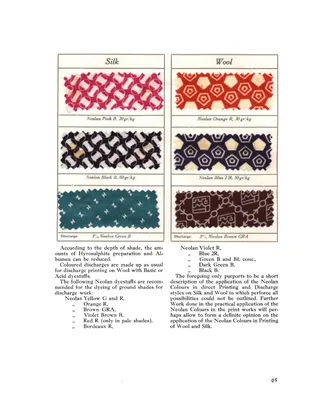
The Application of the Neolan Dyestuffs in Wool and Silk Printing
Article · 5 pages
A 1929 technical article by Dr. H. Bernhard on using Neolan dyestuffs (chrome-complex acid dyes) for printing silk and wool. It gives printing recipes with British gum thickening, glycerine, acetate of chrome and ammonium tartrate, plus steaming and finishing instructions. It also covers Vigoureux (slubbing) printing and hydrosulphite discharge printing on silk and wool, with lists of suitable Neolan colours. The final page shows printed swatches of silk and wool samples, including discharge effects.
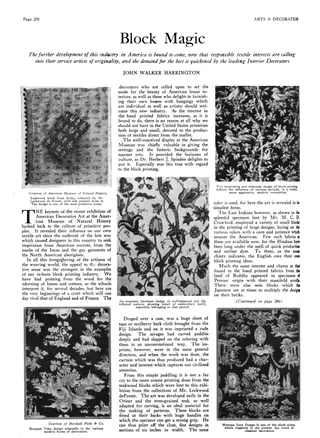
Block Magic
Article · 2 pages
A 1920 magazine article on the revival of hand block printing of textiles in America, prompted by an exhibition of American Decorative Art at the American Museum of Natural History. It surveys block-printed cloth from Fiji, India, Persia and Japan, describes how multi-block, multi-color prints are made and why they differ from machine and roller printing, and encourages amateurs to carve and print their own blocks. Illustrated with photographs of a teakwood block, and modern and Jacobean-style printed designs.
Calico Printing
Zell's Encyclopedia, 1876
Article · 2 pages
An encyclopedia article describing calico printing, the impressing of cotton, wool or silk fabrics with colored patterns using mordants and dyes. It covers the preparatory steps of singeing and bleaching, the four printing methods (hand blocks, machine blocks/Perrotine, copper plates, copper cylinders), and the five or six styles: mordant, discharge, resist, steam, spirit and pigment. It also touches on ancient Egyptian and Indian practice and compares English and French industry in 1876.
[Calico-printing terms from Knight's American Mechanical Dictionary]
Article · 1 page
A single page of dictionary entries from Knight's American Mechanical Dictionary (1876) defining terms used in calico printing. Entries cover styles (China blue, Delft blue, padding), machine parts (color-doctor, lint-doctor, ductor, sieve), the Perrotine block-printing machine, and materials and processes (dextrine, thickening, clearing, re-entering).

Chintz
Article · 1 page
A very short encyclopedia entry defining chintz. It gives the word's origin from the Hindi chint, meaning spotted or variegated, and describes the original Indian stained or painted calico. It also notes the later use of the term for a highly glazed, multicolored printed calico used for bed hangings and furniture coverings.
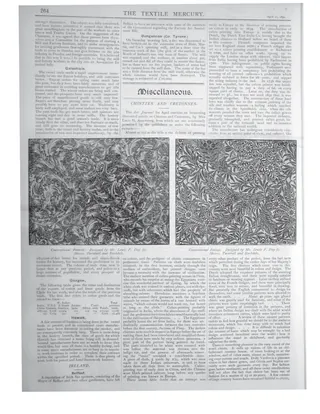
Chintzes and Cretonnes
Textile Mercury, 1891
Article · 2 pages
Extracts from an Art Journal article by Lucie H. Armstrong on chintz and cretonne, reprinted in The Textile Mercury, 11 April 1891. It traces calico printing from antiquity and India to Europe, covers English duties and prohibitions, and discusses Victorian taste and William Morris's block-printed chintzes at Merton Abbey. It also mentions Hindley and Turnbull and Stockdale, with a design by Lewis F. Day. The two pages also hold unrelated trade news and market reports.
Engraving With the Jacquard Machine
The Melliand, November 1930
Article · 5 pages
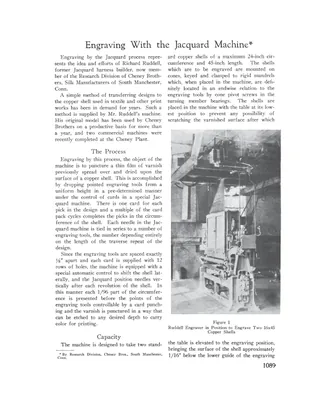
Describes the Ruddell engraver, a machine developed at Cheney Brothers (South Manchester, Conn.) that uses a special Jacquard head to puncture a varnish film on copper print-roller shells so they can be etched for textile printing. It explains the process, shell capacity, traverse and multiplier mechanisms, engraving tools, drive, repeat tie-up changes, re-etch work, and time required. It also covers card preparation and reports a 33% time saving and 40% cost reduction over the previous method. Six photographs show the machine and its parts.
Gardens, Games and Sentiment -- Some Sources of French Printed Cottons
Article · 17 pages
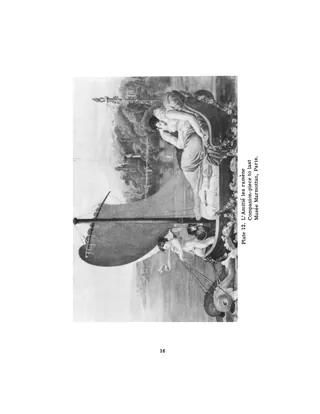
An illustrated article by Edith Appleton Standen tracing the printed-print and garden sources of designs on French copperplate-printed cottons (toiles) of about 1780-1820, mostly in the Metropolitan Museum. It covers four designs: the Tomb of Rousseau at Ermenonville with views of Bagatelle, the Strolling Players adapted from Jacques Callot's gypsy etching, Love and Friendship from Mallet-Prud'hon prints, and Riding at the Ring from the Tivoli Garden. Plates reproduce the textiles alongside the engravings, etchings and drawings the designers borrowed from.
Impression [Printing]
Article · 1 page · French
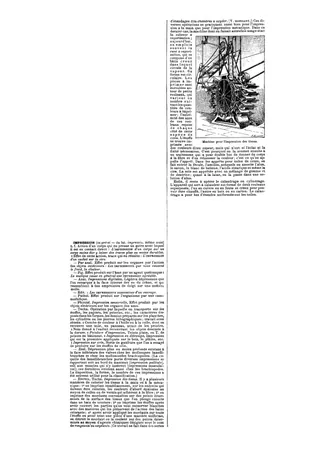
A page from the Nouveau Larousse Illustré (1904) on the entry 'Impression', with emphasis on the printing of textiles. It describes steaming vats (cuve à vaporisation), finishing (apprêt) for cotton, silk and wool, and calendering. It also outlines four methods of coloring fabrics: direct printing, mordant printing followed by dyeing, resist printing, and discharge printing. An engraving shows a machine for printing fabrics.
Improvements in Calico Printing
Scientific American, 1847
Article · 1 page
Short 1847 news item from Scientific American's New Inventions column on improvements at the Merrimack Print Works in Lowell, Massachusetts. It describes Milton D. Whipple's faster method of engraving copper cylinder rollers for calico printing, his patented machine for shearing threads and lint from cloth before printing, and his roller machine for printing paper hangings.
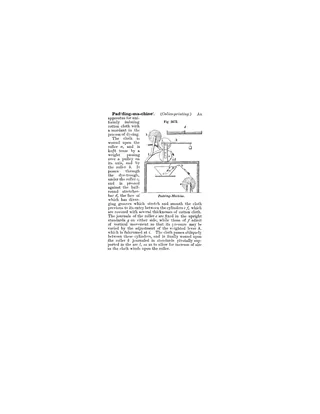
Padding Machine
Article · 1 page
A short dictionary entry describing a padding machine used in calico printing to evenly apply a mordant to cotton cloth during dyeing. It explains how the cloth passes from a tensioned roller through a dye-trough, over a grooved stretcher-bar, and between weighted padding cylinders before being wound onto a take-up roller. A line drawing (Fig. 3472) labels the parts.
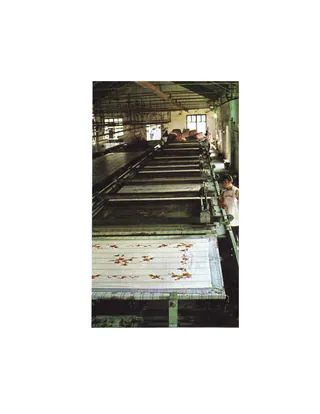
[Printing Machine in Bedsheet Factory]
China Pictorial, 1976
Illustration · 1 page
A single photograph from China Pictorial showing the interior of a bedsheet factory with a long industrial printing machine. A large piece of white fabric printed with a brownish-red floral or leaf pattern runs across the foreground over a roller. No text is legible on the page.
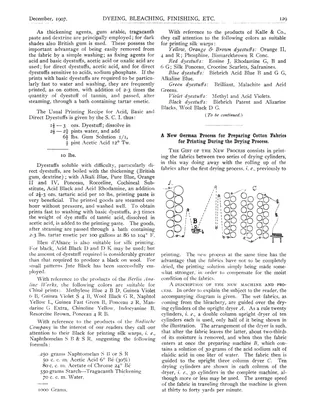
Printing of Silk Warps for the Manufacture of Chiné Silk
Article · 5 pages
A 1907 article from Posselt's Textile Journal, translated from an Austrian trade periodical, describing how silk warps are printed before weaving to make chiné silk. It covers laying out and moistening the warp, printing and drying on the table, thickening the colors with gum, steaming, washing and rolling up. It also gives gum and color paste preparation and lists of aniline dyes recommended by Cassella, S.C.I. Basel, Berlin Aniline Works, Badische and Kalle, with printing recipes. The scan also carries short pieces on a German process for printing cotton fabrics between drying cylinders, natural versus synthetic indigo, and a Russian machine for printing the fibre tips of napped fabrics.
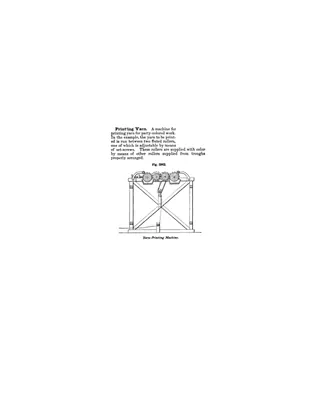
Printing Yarn
Article · 1 page
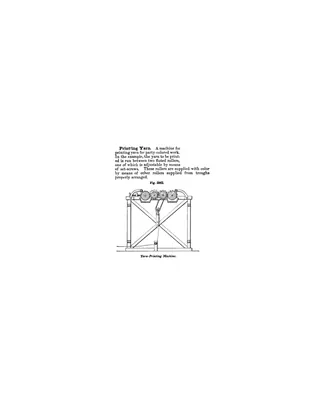
A short dictionary entry describing a machine for printing yarn in several colors for party-colored work. The yarn passes between two fluted rollers, one adjustable with set-screws, which receive color from other rollers fed from troughs. A front-elevation illustration (Fig. 2962) shows the timber-framed yarn-printing machine.
Printing Yarn
Article · 1 page
A short dictionary entry describing a machine for printing yarn in several colors for party-colored work. Yarn passes between two fluted rollers, one adjustable with set-screws, which are supplied with color from other rollers fed from troughs. It includes an engraving (Fig. 2962) of the yarn-printing machine in front elevation.
Romantic Period of Cotton Printing in France
Article · 10 pages
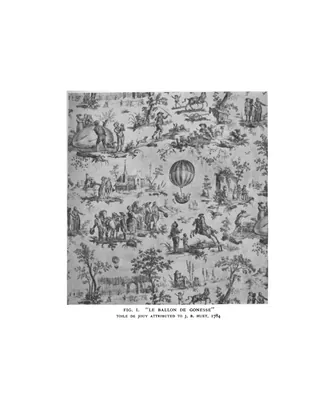
An article on the history of printed cotton (toile de Jouy and Indiennes) in eighteenth-century France. It traces the import bans on East Indian prints, the founding of Oberkampf's factory at Jouy-en-Josas in 1760, and the work of designer J. B. Huet. It covers block and copperplate printing, and prints commemorating balloon ascents and the Revolution, with four illustrated examples. It ends with the neo-classical designs of the Empire period and the decline after 1818.
Spanish Chintzes from the Royal Manufactory at Avila
Article · 6 pages
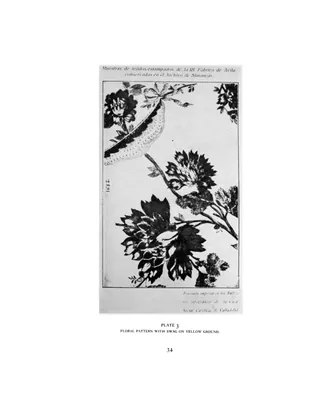
Article on the Royal Manufactory for Printed Cottons at Avila, Spain, founded in 1787 by two Englishmen and operating until 1799. It covers the Bourbon policy of establishing royal factories, the labor troubles and managerial failures at Avila, and the 1920 rediscovery of factory records and printed cotton samples in the archives at Simancas. Plates reproduce chintz samples with large floral patterns, swags, flowering baskets and stripes, which the author describes as French in parentage with a Spanish boldness of design and color.
System and Process for Forming a Fabric Having Digitally Printed Warp Yarns, US Patent No. 6328078
Patent · 19 pages
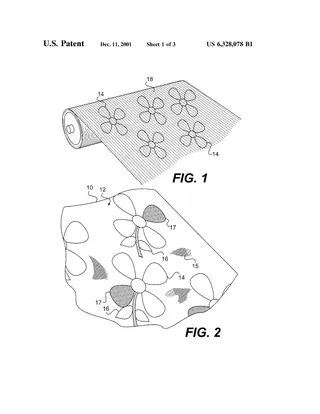
US Patent 6,328,078 (issued Dec. 11, 2001) to Martin Wildeman, Jeffrey A. Carpenter and Lawrence F. Houghton, assigned to Tietex International. It describes a process and system for digitally printing a pattern, for example by ink jet, onto moving warp yarns before weaving, so the printed design shows in the finished fabric. It also covers controllers that keep the printed pattern aligned with a woven (e.g. jacquard) pattern, optional warp sizing, ink curing, and warp yarns printed and stored on a beam for later weaving. The scan includes a USPTO database printout and the printed patent with drawings (Figs. 1-4).
Textile Industry at the Vienna Exhibition -- No. XVI
Article · 3 pages
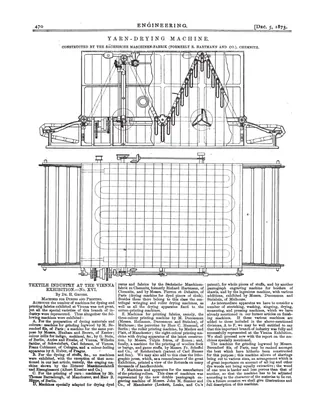
Installment No. XVI of Dr. H. Grothe's series on textile machinery at the 1873 Vienna Exhibition, printed in the journal Engineering. It surveys the machines for preparing dyestuffs, printing yarn and fabrics, drying, and making printing rollers, with detailed descriptions of a continuous yarn-drying machine from the Sächsische Maschinenfabrik, a three-colour roller printing machine, and an eight-colour Perrotine printing machine by C. Bialon (formerly Hummel) of Berlin. Illustrated with engineering drawings of the yarn dryer and the Perrotine.
Transfer Nature's Patterns
Article · 3 pages
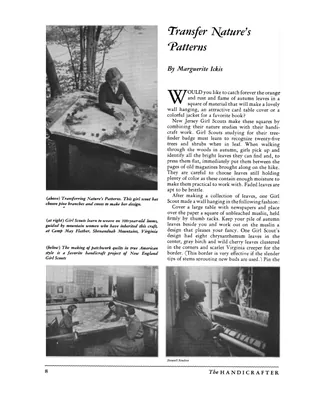
An illustrated 1932 magazine article on handicraft projects for Girl Scouts. The main project is leaf-print textile squares: pressed autumn leaves are pinned to muslin, the background is sprayed or splattered with India ink, and the leaf shapes are colored with wax crayons and set with a steam iron. Photo captions also show Girl Scouts weaving on old looms and primitive cord looms at camps, making patchwork quilts, pottery, basketry, a sampler book cover, a paper ballet backdrop, and a decorated tepee. There are no weaving drafts.
Tungfeng Printing and Dyeing Mill
China Pictorial, 1975
Illustration · 1 page
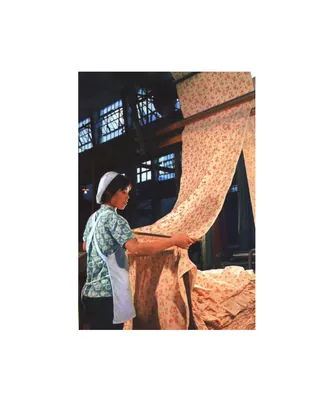
A single-page colour photograph from China Pictorial, 1975, No. 2, showing a worker at the Tungfeng Printing and Dyeing Mill. She lifts and drapes a length of pink floral-printed cotton over a long wooden rail. No printed text appears on the page, so the catalog record supplies the context.
Yarn Printer
Article · 1 page
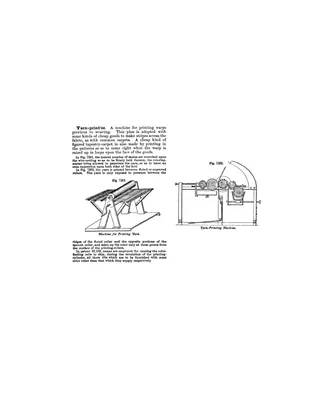
A short dictionary entry from Knight's American Mechanical Dictionary describing yarn-printing machines that print color onto warps before weaving. It explains the use for making stripes in cheap goods such as common carpets and for cheap figured tapestry carpet, and describes two machines: one holding skeins on wire netting, and one using fluted or engraved rollers. A patent (83,103) for color-feeding roll control is mentioned.
Block Prints from India for Textiles
Monograph · 30 pages
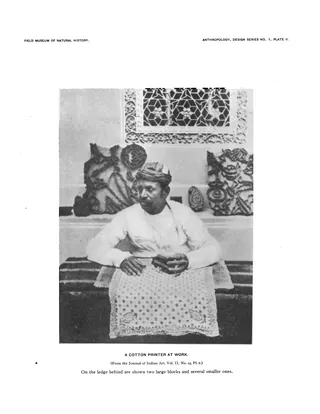
A 1924 Field Museum design portfolio presenting full-size ink impressions of wooden textile printing blocks collected at Ahmadabad, India, by Dr. George A. Dorsey. A short text explains how blocks are carved, how dyes, mordants and resists are applied, and how multiple blocks combine for multicolor borders. The 24 plates show border, all-over, floral, special and two-color designs, with brief captions explaining how the blocks are used. A photograph of a cotton printer at work and photographs of two blocks are also included.
The Bulletin of the Needle and Bobbin Club, Vol. 33, Nos. 1 & 2 (1949)
Periodical · 45 pages
Double issue (Vol. 33, Nos. 1 & 2, 1949) of the Bulletin of the Needle and Bobbin Club with three articles. Nancy Graves Cabot traces the engravings and paintings that supplied figures and scenes for 18th-century printed cottons (toiles de Jouy), especially those of Jean-Baptiste Huet, with many paired plates of cartoons and source engravings. Lois K. Williams describes a series of petitpoint war embroideries made in wool and silk on canvas, and Gertrude Whiting covers Swiss bobbin lace, its history, pattern books, Neuchâtel lace-making and lace patterns, with plates. The issue ends with club notes and a list of officers.
Calico Printing
Article · 6 pages
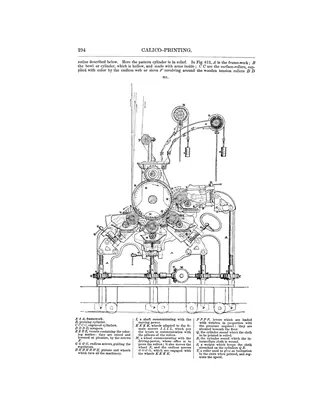
An encyclopedia article from Appletons' Cyclopaedia of Applied Mechanics describing the industrial printing of designs on cotton cloth. It covers mordants, thickeners and the eight styles of calico printing, the nineteen steps of the madder style, and the engraving of copper printing cylinders by steel die and mill. It also describes cylinder, surface-roller and perrotine block printing machines, and the starching and finishing of printed cloth. Engravings of the machines are included, along with a list of reference works.
Calico Printing
Article · 4 pages
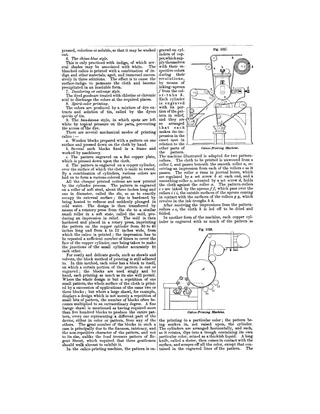
A dictionary article on calico printing from Knight's American Mechanical Dictionary. It traces the history of printing figured designs on cloth from China, India, Egypt and Europe to the introduction of calico printing in England and France. It then describes the main printing styles (madder, steam, padding, resist, discharge, china-blue, bandanna) and the mechanical methods: wood blocks, copper plates and engraved cylinders. Two figures show calico-printing machines with pattern rollers, color troughs and prism-type printers.
"Calico-Printing and Turkey-Red Dyeing" from Industries of Scotland
Monograph · 10 pages
A chapter from David Bremner's 'The Industries of Scotland' (1869) on calico-printing and Turkey-red dyeing. It sketches the ancient history of dyeing, the introduction of calico-printing into Europe and Britain, the legal restrictions and excise duties, and the five styles of printing. It then describes in detail the Dalquhurn Dyeworks and Cordale Printfield of William Stirling & Sons near Renton, covering bleaching, mordants, madder dyeing, discharge printing, block and hydraulic-press printing, output and wages.
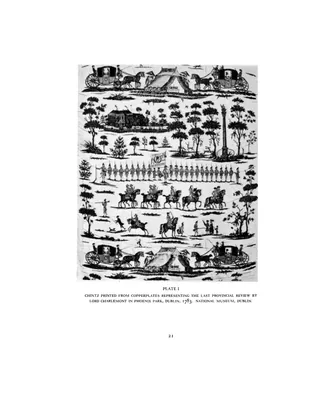
Cotton Printing in Ireland in the Eighteenth Century
Article · 9 pages
An article tracing the history of cotton and linen printing in eighteenth-century Ireland, drawn from premiums, petitions, advertisements and directories. It covers early block and wax-resist printing at Palmerstown and Ballsbridge, the copperplate printing at Drumcondra, Leixlip and Temple-Oge, and the later copper-cylinder printing of Edward Clarke. It centers on the "Volunteer Furniture" chintz of 1783, printed with Lord Charlemont's review in Phoenix Park, which is illustrated as Plate I and described as the only securely identified Irish chintz.
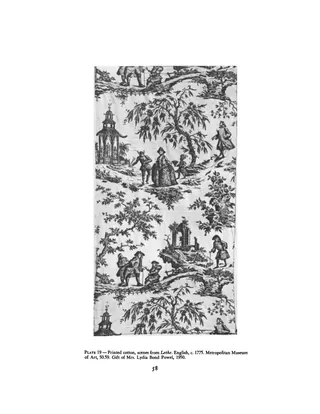
Garrick on Cotton
Article · 22 pages
Article by Edith A. Standen on an English copperplate-printed cotton (toile) long called French, now identified as showing scenes from David Garrick's play Lethe (1740, revised 1749). She identifies the characters (Lord Chalkstone, Aesop, Mrs. Riot played by Kitty Clive, the Old Man, the Fine Gentleman) and traces their sources in contemporary engravings. She dates the Metropolitan Museum example to 1774 or later from the blue warp threads in the selvedge required by the English Act of 1774. The scan has 19 plates, mostly English embroideries from the Museum of Fine Arts, Boston (c. 1500-1686), plus the printed cotton as Plate 19.
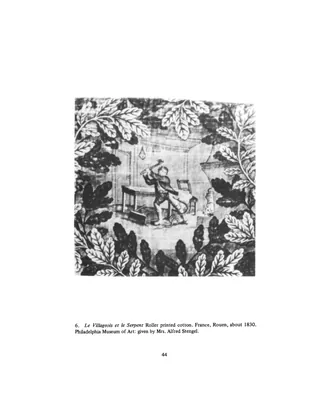
Henry Clouzot Collection of Printed Textiles at the Philadelphia Museumof Art: Highlighting Some Early Dutch Printed Fabrics
Article · 22 pages
Article by Marianne Carlano on the 354 printed textile samples that Henri Clouzot sold or gave to the Pennsylvania (now Philadelphia) Museum of Art in 1929 and 1937. It covers the history of the acquisition, the French toiles from Jouy, Nantes, Rouen and Alsace, and the printing techniques (woodblock, copperplate, roller). Most attention goes to three early Dutch woodblock-printed and painted linens of about 1680, dated through close study of costume, hats, and motifs such as the stag, tulips, and chinoiserie. It closes with an English roller-printed Cossack design. Footnotes list Clouzot's writings and archival sources, and the article has twelve figures of textiles and related paintings.
242 documents found