Textile Documents › Publications › Publication: Arts and Decoration
13 documents found
Sort: 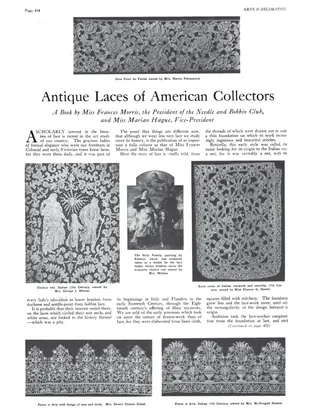
Antique Laces of American Collectors
Arts and Decoration, 1919-1920
Article · 2 pages
A review in Arts & Decoration of the folio book on antique laces by Frances Morris and Marian Hague, both of the Needle and Bobbin Club. It outlines the book's history of lace from sixteenth-century Italy and Flanders: reticella, punto in aria, Venetian and Burano needle laces, bobbin lace, and the eighteenth-century French and Belgian net laces. It also covers the pattern books of Isabella Parasole and the Needle and Bobbin Club's exhibition at the Metropolitan Museum. Photographs show pieces owned by American collectors.
Artistic Triumph of American Silks
Arts and Decoration, 1919-1920
Article · 2 pages
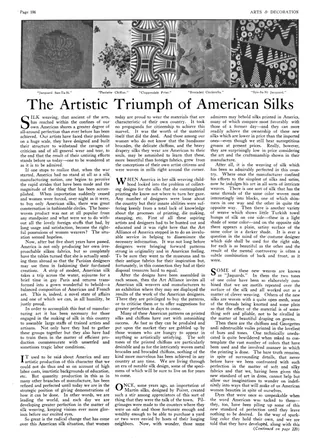
A two-page magazine article from Arts & Decoration praising the rapid growth of the American silk industry after World War I cut off imports. It describes the role of the Art Alliance of America in educating designers and holding seasonal pattern exhibitions for manufacturers, and surveys new silk weaves (block effects, double-faced textured silks, Jacquards, open mesh), printed chiffons and Georgettes, dyes, and trade-named fabrics. The first page has a header strip of five captioned silk samples.
Block Magic
Article · 2 pages
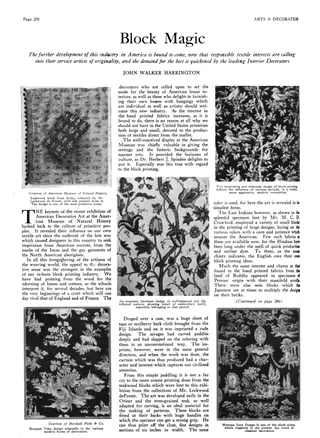
A 1920 magazine article on the revival of hand block printing of textiles in America, prompted by an exhibition of American Decorative Art at the American Museum of Natural History. It surveys block-printed cloth from Fiji, India, Persia and Japan, describes how multi-block, multi-color prints are made and why they differ from machine and roller printing, and encourages amateurs to carve and print their own blocks. Illustrated with photographs of a teakwood block, and modern and Jacobean-style printed designs.
Charm of Lace
Article · 2 pages
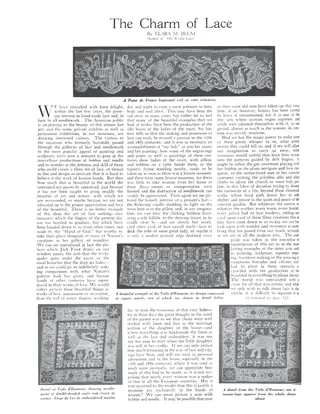
A two-page 1921 magazine article by Clara M. Blum on the history and appeal of handmade lace, written to encourage American appreciation and collecting. It discusses lace as a pastime of court ladies, peasants and nuns, and describes its uses in costume, church textiles and household furnishings from the 16th to 19th centuries. Illustrated examples include a Point de France baptismal veil or trimming and a Renaissance Toile d'Honneur of filet and drawn work used as a marriage canopy.
Darned Filet Net
Article · 1 page
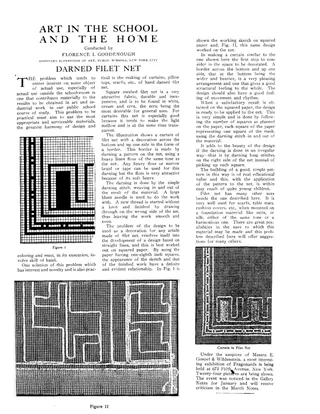
A short article from a school art column explaining how to make curtains, pillow tops and scarfs by darning patterns onto square-meshed filet net. It covers choice of net and heavy linen floss, the darning stitch and blunt needle, designing straight-line borders on squared paper, and placing a heavier border along the bottom and one side. Two figures show the working sketch on squared paper and the finished curtain.
Decorative Value of Woven Cane Chairs
Article · 2 pages
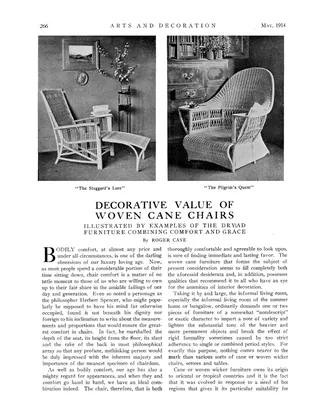
A two-page magazine article from Arts and Decoration (May 1914) promoting woven cane chairs as comfortable, decorative furniture for informal living rooms and summer homes. It discusses the oriental and tropical origins of cane furniture and its adaptation by English craftsmen, and illustrates Dryad furniture models such as "The Sluggard's Lure," "The Pilgrim's Quest," "John Peel" and "Sesame." It is about furniture design and decoration rather than weaving technique.
Early Decorative Weaving in America
Article · 4 pages
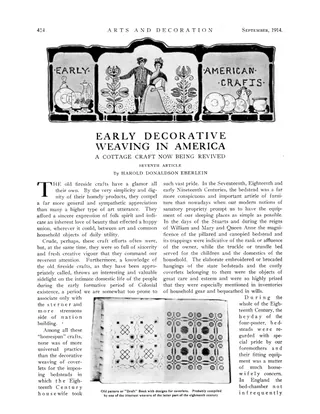
A 1914 magazine article, the seventh in a series on early American crafts, surveying decorative coverlet weaving in Colonial and early nineteenth-century America. It covers home weaving versus itinerant and professional weavers, the sharing of pattern drafts, pattern names, vegetable dyes and colors, and the revival of the craft in the Southern mountains at Berea College and Asheville. Illustrated with photographs of blue, red and white coverlets and a page from an old draft book.
Lace in America
Article · 2 pages
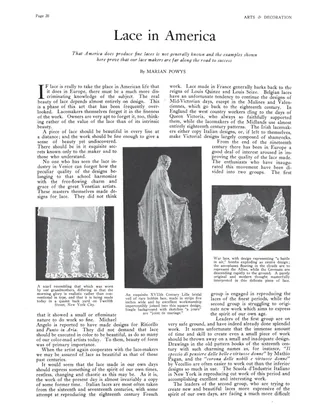
A 1919-1920 magazine article by Marian Powys arguing that lace should be judged by the quality of its design, and that American lacemaking deserves more notice. She surveys how European lace traditions keep copying older patterns, describes efforts to revive historic lace and to create new designs, and discusses Devon pillow lace (Honiton), Point d'Angleterre and early lacemakers at Ipswich, Massachusetts. The article ends with advice on choosing and wearing lace, and is illustrated with photographs of American-made pieces including a bridal veil, a war lace, and fans.
Luxurious Linens and Rare Laces
Arts and Decoration, June 25, 1930
Article · 3 pages
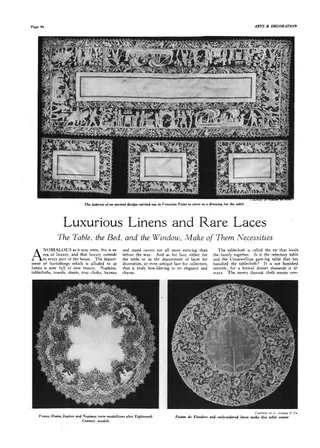
A 1930 magazine article from Arts & Decoration on luxury household linens and laces for the table, bed and windows. It discusses damask tablecloths, lace and embroidered table sets and doilies (Venetian point, Burano, Valenciennes, Pointe de Flanders), drawn-work or cut-work 'new filet' made in the linen itself, lace bed spreads, and curtain choices for different house styles. Illustrated with photographs of lace table dressings, a table scarf, a bed cover and a curtain.
Renaissance Tapestries
Article · 4 pages
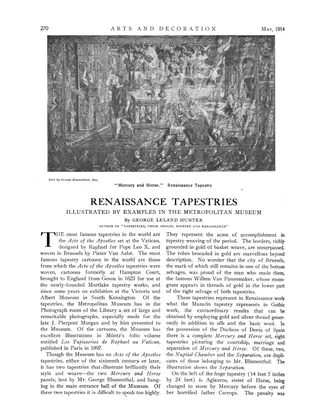
A 1914 magazine article by George Leland Hunter surveying Renaissance tapestries in the Metropolitan Museum of New York. It discusses the Mercury and Herse panels woven in Brussels by Willem Van Pannemaker, the Roman Triumph and Roman Colosseum tapestries, Grotesque-ornament panels, verdure tapestries, and a set of German Story of Christ panels. It also mentions the Raphael Acts of the Apostles and Scipio series for context. Illustrated with halftone photographs of several tapestries.
Swedish Weaving
Article · 1 page
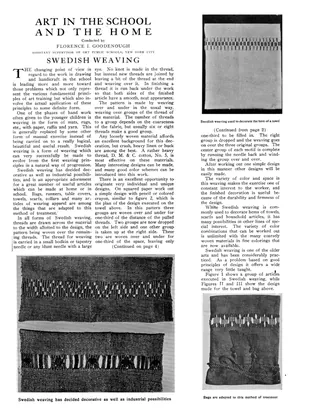
A short magazine article from an art-education column on Swedish weaving, a surface darning embroidery worked over groups of threads on loosely woven fabrics such as huck, crash, or heavy linen. It gives instructions for planning a design on squared paper, choosing needle, thread, and fabric, and finishing threads, with a worked example for a towel hem. It suggests uses in schools and the home, including bags, runners, towels, and collars.
Tapestry Weaving in America
Arts and Decoration, 1919-1920
Article · 2 pages
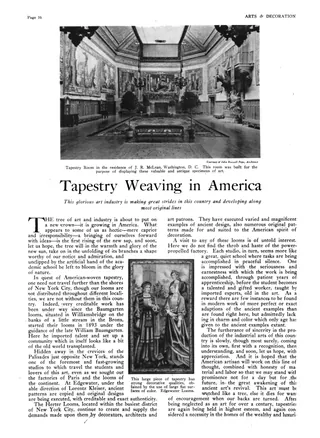
A two-page magazine article from Arts and Decoration surveying the state of tapestry weaving in the United States around 1919. It profiles the Baumgarten looms (founded 1893 in Williamsbridge, Bronx), the Edgewater Looms under Lorentz Kleiser, and the Herter Looms in New York City. It also briefly describes the tapestry process (cartoons, high and low warp, cotton warp, wool and silk wefts, dyeing) and encourages patrons to buy American-made tapestries. Photographs show the J. R. McLean tapestry room in Washington and tapestries from the Edgewater, Herter and Baumgarten looms.
Tenafly Weavers
Arts and Decoration, 1919-1920
Article · 1 page
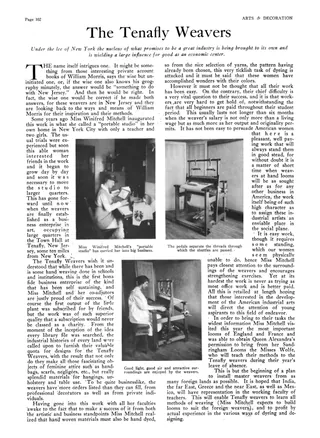
A 1919-1920 magazine article describing the Tenafly Weavers, a hand-weaving business founded by Miss Winifred Mitchell and based in the Town Hall at Tenafly, New Jersey. It covers the group's origins in a "portable studio", its products (handbags, scarfs, hangings, upholstery and table fabrics), hand dyeing, worker pay and training, and plans to bring in master weavers from England and other countries. Three photographs show Miss Mitchell and weavers at work at the looms.
13 documents found