Textile Documents › Topic: Satin and sateen
300 documents found
Sort: 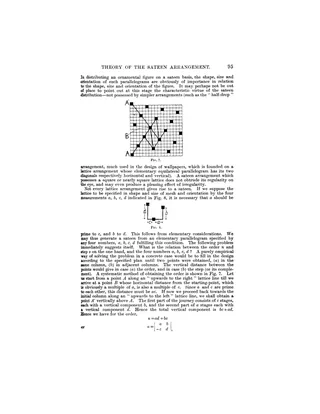
Mathematical Theory of the Sateen Arrangement
Article · 6 pages · weaving drafts
A mathematical paper by S. A. Shorter on the sateen (satin) arrangement of points on squared paper, used both for weave construction and for distributing ornamental repeats. It restates the two classical rules (order and step prime to each other; complementary steps give mirror images) and adds a third rule from rotation by a right angle to count distinct sateens of a given order. It then develops the 'sateen lattice', gives formulas for order and step from lattice measurements, and discusses 'twilliness' and 'perfect' sateens, with a table of the first seven. Diagrams of sateen grids illustrate the argument.
Regular Satins
Ralph E. Griswold · June 9, 2004
Web Doc · 4 pages · weaving drafts
A short pattern book by Ralph E. Griswold collecting all regular satin structures for 5 to 20 shafts, generated by a program using the standard definition of satin counters. The pages show grid drawdowns grouped by size (5x5 through 20x20), each labeled with the number of its WIF file on handweaving.net. Kris Bruland digitized the patterns as WIFs, and the booklet serves as a visual index for browsing and identifying them.
Satin
Article · 1 page
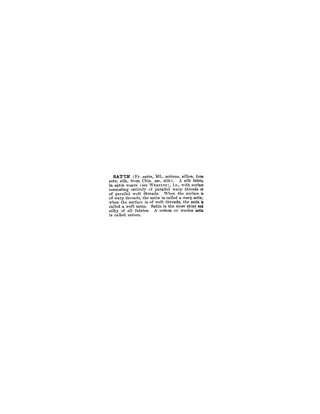
A short encyclopedia entry defining satin as a silk fabric in satin weave, whose surface is made up entirely of parallel warp threads or parallel weft threads. It gives the word's etymology and distinguishes warp satin from weft satin. It also notes that cotton or woolen satin is called sateen.
Satin
Zell's Encyclopedia, 1876
Article · 1 page
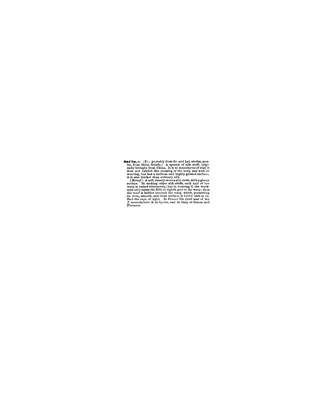
A short encyclopedia entry defining satin as a glossy silk fabric originally brought from China. It explains that satin is woven by raising only a fifth or eighth of the warp, so the weft is hidden and the surface is smooth and reflective. It names Lyons, Genoa and Florence as chief centers of manufacture.
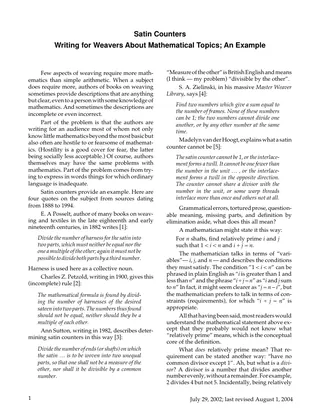
Satin Counters: An Example of Writing for Weavers about Mathematics
Ralph E. Griswold · July 29, 2002
Web Doc · 2 pages
A short essay by Ralph Griswold using satin counters as an example of how weaving books explain mathematical topics. It quotes five authors' descriptions of how to choose a satin counter, points out their incompleteness or unclear wording, and restates the rule in mathematical terms (relatively prime i and j with i + j = n). It ends with a table of the smaller satin counters for 2 to 24 shafts and a note on prime shaft numbers.
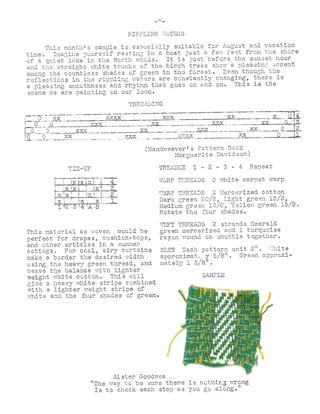
Warp & Weft, Vol. 1, No. 10 (August 1948)
August 1948
Periodical · 8 pages · weaving drafts
Issue 10 (August 1948) of Warp and Weft, a small newsletter edited by Gladys Rogers Brophil of Chicago. It includes a monthly four-shaft sample draft, 'Rippling Waters', with threading, tie-up, and yarn and sett notes, plus an article on satin weave covering warp-face and weft-face satins and the fabrics made in them. Shorter pieces include reflections on why people weave, a Christmas craft tip, a hint for storing thread scraps in mesh bags, and a poem about weavers. The last page carries advertisements for Marglad looms and for the Brophil Weaving Studio.
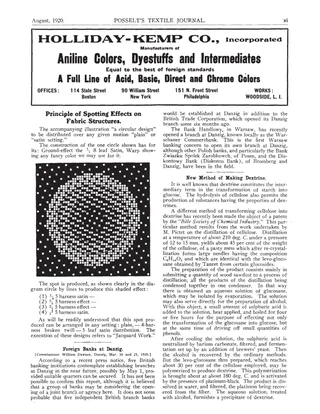
Principle of Spotting Effects on Fabric Structures
Article · 1 page
A short 1920 article by E. A. Posselt on producing circular spot effects on fabric structures, particularly over satin grounds. It explains that the spot is built from a sequence of 5-harness satin and 2/3 and 3/2 effects, and can be distributed over plain, 4-harness broken twill or 5-leaf satin settings, for Jacquard work. The page includes a grid diagram of the circular spot design.
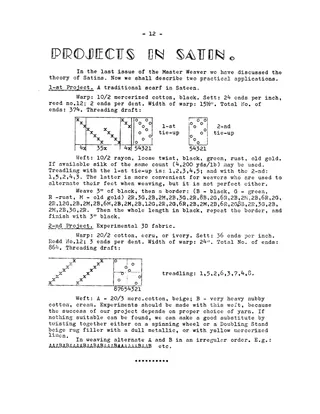
Projects in Satin
Master Weaver, March 1957
Article · 1 page · weaving drafts
A one-page article from Master Weaver giving two practical satin projects that follow a theoretical discussion in the previous issue. The first is a black mercerized cotton scarf in sateen with a colored rayon weft border, given with warp, sett, threading, two alternative tie-ups and treadling. The second is an experimental 3D fabric on an 8-shaft satin threading, using a fine cotton warp and alternating fine and heavy nubby wefts in an irregular order.
Satins & Sateens
Master Weaver, January 1957
Article · 4 pages · weaving drafts
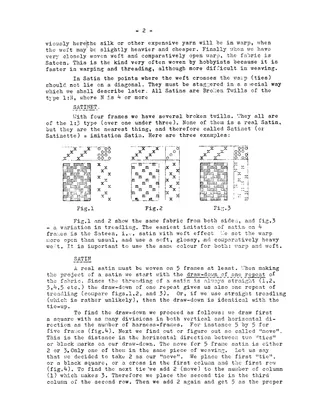
An article from Master Weaver No. 31 (January 1957) explaining satin and sateen weaves, opening with a legend about silk prices in the Roman Empire. It distinguishes true satin, plain satin and sateen, describes four-shaft satinet, and shows how to draw down a satin on 5 or more shafts using the 'move' rule. It also explains which shaft counts yield satins, includes a table of satins from 5 to 16 shafts with their moves, and gives advice on yarn and sett.
Sattin and Sattinet
Article · 1 page
Two brief dictionary-style entries from the first edition of the Encyclopedia Britannica. Satin is defined as a glossy silk fabric whose very fine warp stands out to cover the coarser weft, and sattinet as a light, thin, usually striped satin used chiefly for ladies' summer nightgowns.
Swatch Page - Satin Weave and Damask
Article · 2 pages · weaving drafts
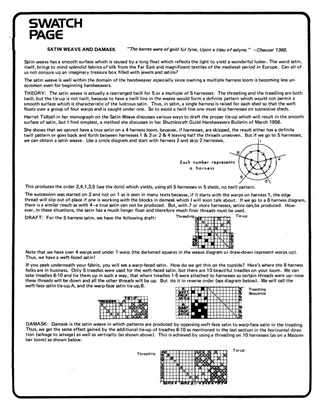
A swatch-page article from Minnesota Weaver explaining the satin weave and its extension to damask. It covers the theory of satin as a rearranged twill on 5 or more shafts, using a circle diagram to derive the 2,4,1,3,5 order, and gives drafts for weft-faced and warp-faced satin on 5 shafts. It then extends these to a 10-shaft block damask threading and tie-up. It also gives sett recommendations for linen, silk, cotton and wool, design variations, a glossary and references.
Wool, Cotton and Silk Designing and Fabric Structure for Harness Work: Lesson 3.
Article · 5 pages · weaving drafts
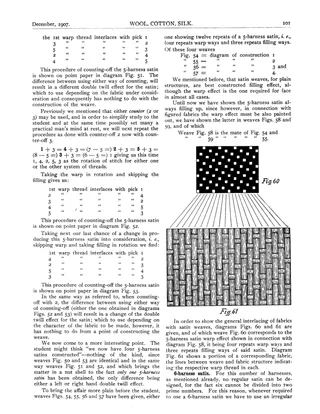
Lesson 3 of Posselt's textile school series, on satin weaves as the third of the foundation weaves. It explains how satins differ from twills, gives the rule for constructing them with a counter number, and works through the 5-harness satin in full, showing the four counting-off variants and why they yield only one weave. It then covers the 6-harness irregular satin (large crow foot twill) and the 7-, 8-, 10- and 12-harness satins, with drawdown figures and a set of review questions.
Construction of Weaves, No. 2
Monograph · 22 pages · weaving drafts
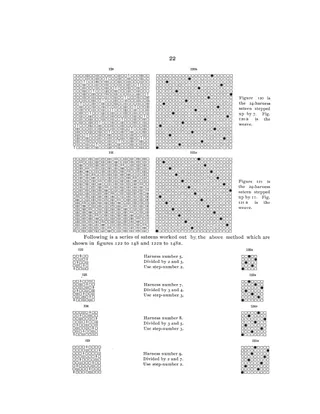
Part No. 2 (June 1900) of Charles G. Petzold's serial textbook on the construction of weaves for textile schools, designers, overseers, loom fixers and webdrawers. It finishes the twill section with curved twills, fancy twills and diagonals, and steep twills. It then gives a long treatment of sateens: the step-number rule, a series of sateens from 5 to 25 harness with drafts and drawdowns, 4- and 6-harness sateens, divided step-numbers, and interchanged sateens. Two woven-silk portrait plates (Schiller and William Tell) and Lawrence, Mass. mill-supply advertisements are included.
Designing
Textile Mercury, 1890
Article · 2 pages · weaving drafts
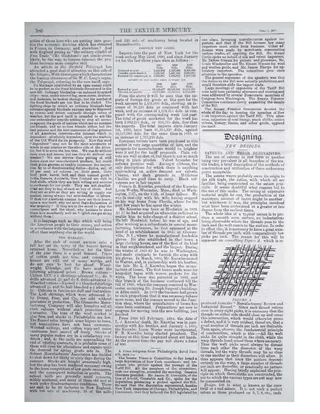
Two pages from The Textile Mercury of 7 June 1890 containing a 'Designing' column on sateens and their derivatives. It explains sateen construction principles (high ends per inch, few picks, weft lying straight) and discusses 4-, 5-, 6- and 7-end sateens with their uses in coatings, dress goods, doeskins and Venetian cloth. It also covers tying a back to a sateen face, illustrated by small drafts (Designs 108-120), and gives a linen dress design with fruit and foliage figures, with warp and weft specifications. The first page also carries unrelated trade news on the US tariff, markets and dry goods imports.
Satin Weaves and Some of the Uses to Which They are Applied
Baldwin's Textile Designer, January 1889
Article · 2 pages · weaving drafts
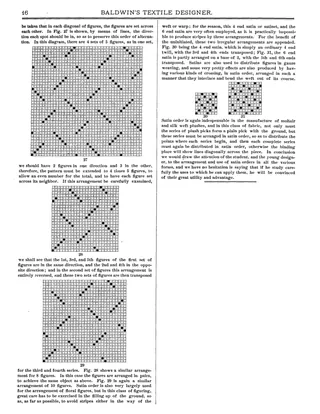
A two-page article, reprinted from the English Journal of Fabrics and continued from an earlier volume, on using satin order to arrange small geometrical and floral figures in woven cloth. It explains how spots are placed in satin order to avoid diagonal lines and 'cocked' effects, and gives diagrams for 5, 8 and 10 figure arrangements. It also describes the 4 end and 6 end irregular satins and notes satin order in gauze weaving and in mohair and silk weft plushes.
August, 1913
Article · 1 page
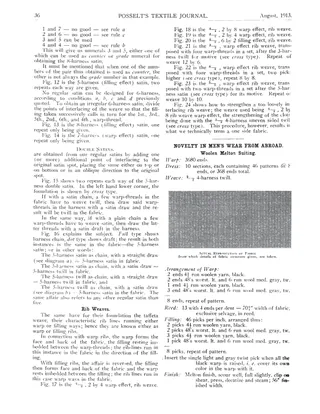
A single page from Posselt's Textile Journal, August 1913, continuing a series on fabric weave construction. It finishes the discussion of regular satins (8-, 5-, 6- and 7-harness), then covers double satins, satin drafting versus straight drafting, and rib weaves (warp and filling ribs, Figs. 17-24). It closes with the start of a mill-style fabric analysis of a woolen melton men's suiting on a 4-harness twill, giving warp and filling arrangement, reed, picks per inch, and finishing.
Designing
Textile Mercury, 1890
Article · 2 pages · weaving drafts
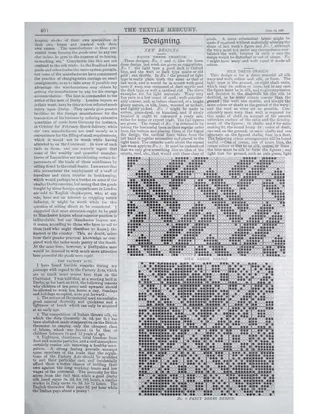
Two pages from The Textile Mercury of 14 June 1890 on textile design for power-loom dress goods. They present fancy dress and silk dress designs (No. 1, No. 2 and a 24-shaft figured design on eight-shaft satin ground) with notes on colours, yarns, reed and drafting order. A continuing sateen weaves lesson explains the eight-end sateen and its derivatives (buckskin, twilled hopsack, Mayo or Campbell twill) and how to tie backing warp or weft, with numbered design grids 120-136 and a floral design (Figure 18) for dress fabrics.
Designing
Textile Mercury, 1890
Article · 2 pages · weaving drafts
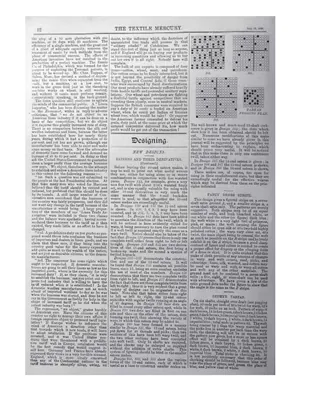
Two pages from The Textile Mercury's "Designing" column, continuing the series on sateens and their derivatives. The text covers 11-, 12-, 13-, 14-, 15- and 16-end sateens, with numbered designs (150-169) shown as grid diagrams, and the construction of a 48-thread check (Design 160) using the 12-end sateen in warp and weft twill sections. It also gives a fancy dress stripe on seven-shaft satin grounds and a six-shaft Zephyr Tartan with warp and weft color orders, yarn counts and setts. The first page also carries unrelated trade commentary on ramie and the linen tariff.
Designing
Textile Mercury, 1890
Article · 2 pages · weaving drafts
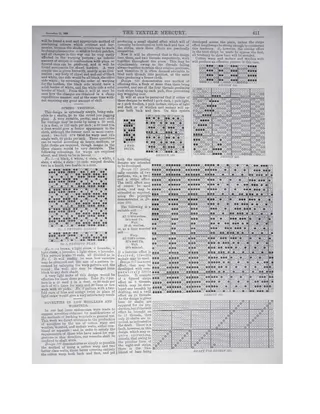
Two pages from The Textile Mercury, 13 December 1890, with the end of a trade editorial, a 'Foreign Correspondence' column from New York, and the 'Designing' section. The design section covers reversible five-end satins for shawls and rugs, a four-shaft spring vesting design with warp colourings and setts, and novelties in low woollens and worsteds using cotton warp with woollen, worsted and mohair wefts (designs 209-212). The designs are illustrated with drafts, pegging plans and drawdowns.
Designing and Fabric Structure
Article · 2 pages · weaving drafts
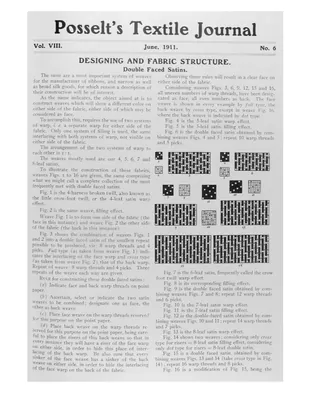
An installment of Posselt's "Designing and Fabric Structure" series on double faced satins, from Posselt's Textile Journal, June 1911. It explains how two warp systems and one filling are combined so each side of the fabric shows a different color, with a rule for constructing the weaves and Figs. 1-16 covering 4- to 8-leaf satin combinations. It then shows how to produce checkerboard and spotted figured effects by exchanging face and back colors (Figs. 17-20), with warp dressing and repeat sizes. The second page also begins a continuation on producing figures in smooth ribbons (Figs. 167-169).
Master Weaver, No. 31 (January 1957)
Periodical · 13 pages · weaving drafts
Issue No. 31 (January 1957) of Master Weaver, a bi-monthly bulletin for handweavers published by Z-Handicrafts in Fulford, Quebec. It contains an article on satins and sateens covering the history, satinet on four shafts, the method of finding the move and drawing down satins, and a table of satins for 5 to 16 frames. It also has an opinion piece on weaving gadgets, a second article on cross-weave (pickets and riddles on four shafts, with a rayon scarf project), and instructions for building and using a doubling stand for winding two yarns together.
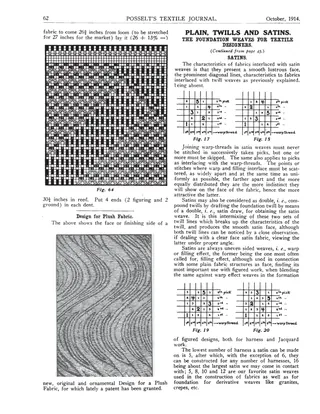
Plain, Twills and Satins
Article · 3 pages · weaving drafts
A continuation of Posselt's series on the foundation weaves for textile designers, covering satin weaves. It explains the characteristics of satin, the rule for constructing regular satins by dividing the harness number into two counters, and the four ways to build the 5-harness satin (Figs. 17-22). Plates show regular satins (5 to 12 harness) and irregular satins (4, 6, 8, 10 and 12 harness). The scan opens with the end of a plush fabric design and closes with a short article on indigo-dyed yarn streaks caused by micro-organisms.
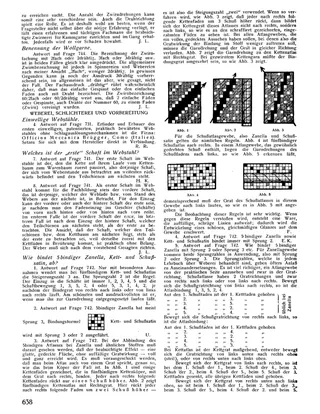
Technische Auskünfte [Technical Inquiries]
Article · 4 pages · German · weaving drafts
A four-page installment of the 'Technische Auskünfte' (technical inquiries) column from Melliand's Textilberichte, 1927, listing reader questions Nos. 759-772 and published answers to earlier questions. Questions cover mercerizing, dyeing, fire-sprinkler systems, silk degumming, and weaving acetate rayon. The longest section is a set of seven answers on how to set up five-end satin, atlas and zanella weaves, discussing the step (Steigungszahl/Sprungzahl), twill-line direction relative to yarn twist, and a table of binding sequences for 5 to 17 shafts, with small weave diagrams. Other answers deal with the first shaft of a loom, rayon weft in underpick shuttles, velvet and cord weaving, and warp stress. The issue ends with a finishing recipe for blue mollino and a list of sources sought.
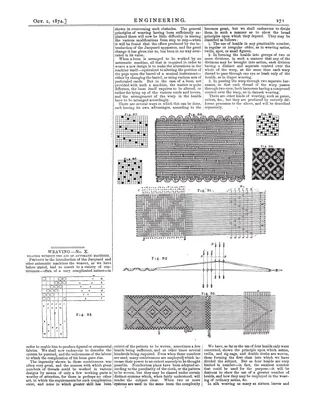
Weaving. -- No. X: Weaving Without the Aid of Automatic Machines
Article · 2 pages · weaving drafts
Installment No. X of a serial on weaving from the periodical Engineering, describing how figured and ornamental cloth was woven on looms without Jacquard or other automatic machines. It classifies the systems of using healds (heddles) and explains satin weaves of five, eight and sixteen leaves, then shows how twills and small figures or spots are made with a few headles. Figures show the warp plan, the section of the shed, and the threading and treadling plan with circles marking raised headles and numbered treadles. It ends by introducing the draw-boy machine, to be covered with the draw loom.
Construction of Weaves, No. 3
Monograph · 22 pages · weaving drafts
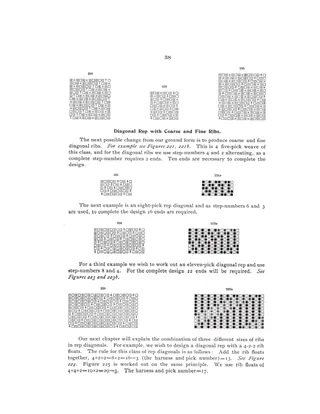
Part 3 (July 1900) of Charles G. Petzold's serial textbook on the construction of weaves, intended for textile schools, designers, overseers, loom fixers and webdrawers. It covers sateen weaves (including sateens with additional binders), diagonal rep and corkscrew weaves, reps with coarse and fine ribs, reps in broken and undulated lines, reps with increasing and decreasing floats, and chevron, cross and herringbone twills. Most pages are drawdown grids (figures 181-259) with rules for step-numbers and for calculating harness and pick counts. It includes woven portraits of Goethe and Columbus and trade advertisements for Lawrence, Mass. mill suppliers.
Design and Fabric Structure
Article · 3 pages · weaving drafts
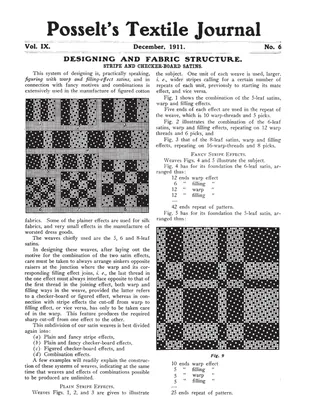
Pages from the December 1911 issue of Posselt's Textile Journal in the series on designing and fabric structure. The first part covers stripe and checker-board satins built from 5-, 6- and 8-leaf satins in warp and filling effects, including plain and fancy stripes, plain, fancy and figured checker-boards, and combination effects with plain weave, with repeat sizes and harness requirements. The second part begins an explanation of gauze (leno) weaving, covering standard and whip (doup) threads, ground and doup harnesses, bottom and top doups, and the drawing-in of the warp.
Designing
Textile Mercury, 1892
Article · 2 pages · weaving drafts
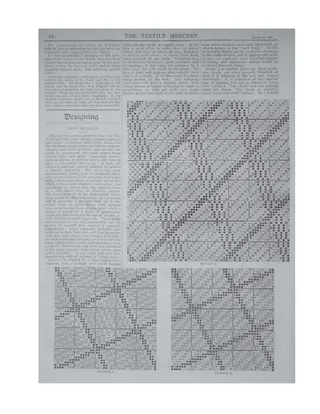
Two pages from The Textile Mercury of January 16, 1892, with a column on new designs for cotton dress goods and a piece on geometrical sateen figuring. The first part discusses spring fashions and gives details for Designs A and B (dobby drafts and pegging plans, thread counts, picks, finishes, colours). The second part explains how sateen skeleton arrangements (5-end and 8-end) can be combined with twills for dress fabrics and coatings, illustrated by Designs 4, 5 and 6. Drafts and pegging plans appear on both pages.
Reeding and False Twill
Article · 4 pages · weaving drafts
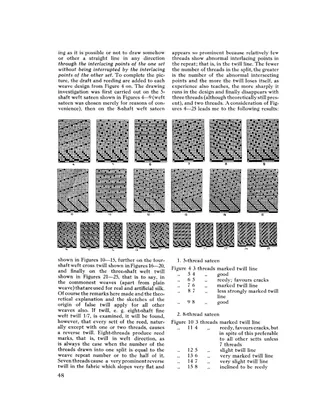
A 1929 article from The Melliand on how the choice of reed pitch (number of threads per dent) can produce false twill lines in silk, artificial silk and mixed fabrics. The author uses point-paper drawdowns to predict, before reeding, which reeding is suitable for a given weave and sett. He tests 5-shaft and 8-shaft weft sateens, a 4-shaft cross twill and a 3-shaft twill with 3 to 8 threads per dent, and rates each as good, reedy or showing a twill line. He also discusses the effect of coarse weft and of yarn twist direction, and distinguishes this fault from false twill caused by faulty binding of double cloths.
Satin and Other Weaves
Monograph · 22 pages · weaving drafts
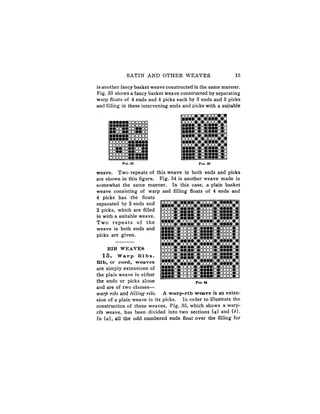
An International Correspondence Schools instruction paper (Serial 507) on the construction of satin weaves and weaves derived from them. It explains how satin bases are chosen, warp- and filling-flush satins, irregular 6-end satins, and double satins, and includes a table of satin orders for 5 to 12 ends. It then covers satin derivatives, granite weaves, basket weaves, warp and filling ribs, unequal ribs, corkscrew weaves, and honeycombs. Most pages carry small drawdown figures, and practice exercises follow two of the sections.
Baldwin's Textile Designer, Vol. 2, No. 1 (January 1889)
Baldwin's Textile Designer, January 1889
Periodical · 20 pages · weaving drafts
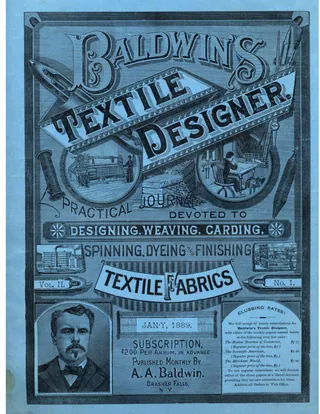
January 1889 issue (Vol. 2, No. 1) of Baldwin's Textile Designer, a monthly trade journal for woolen and cotton mill people, published by A. A. Baldwin at Brasher Falls, N.Y. It mixes mill-management essays, finishing and flocking, oil testing, wool electricity, water softening, trade news and a biographical sketch of J. M. Masson with technical content. The technical content includes a Designs department with pattern drafts and weaves (Patterns 1-11) for woolen and worsted suitings, with warp and filling color sequences, and an article on satin weaves and satin-order figure arrangements. Advertisements for textile books, looms and supplies fill the front and back pages.
Designing
Textile Mercury, 1890
Article · 2 pages · weaving drafts
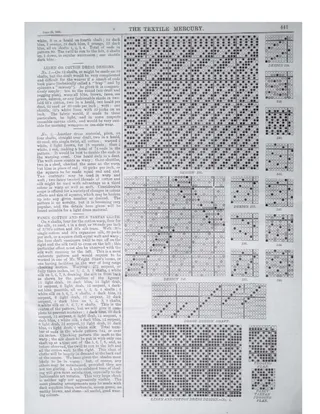
Two pages from The Textile Mercury (June 1890) containing the 'Designing' column, which continues a series on sateens and their derivatives, covering nine-end and ten-end sateens and their relation to twills (Designs 135-146). It also gives a fancy worsted waistcoating design with warp and weft particulars, a Galatea stripe, two linen/cotton dress designs, and a fancy cotton and silk tartan cloth, with threading drafts and pegging plans. The first page also carries dyeing recipes for wool, silk, cotton and hosiery, and an article on fixing alumina mordants on cotton, wool and silk.
Construction of Weaves, Part 5
Article · 2 pages · weaving drafts
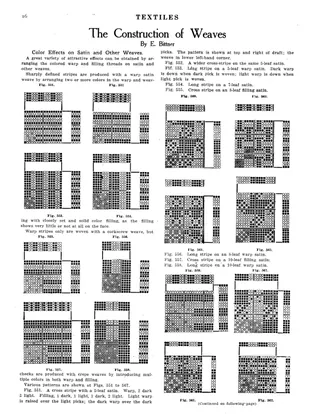
Two pages from Textiles (pp. 16-17) carrying a part of E. Bittner's series on the construction of weaves. This part covers color effects on satin and other weaves: stripes and checks made by arranging colored warp and filling threads on satin, corkscrew, crepe, basket, radiating twill and thousand-square weaves (Figs. 551-567), each with a draft. Page 17 also has an unrelated article by Dr. Louis J. Matos on identifying textile fibers under the microscope and with chemical tests, covering wool kemps, natural and tussah silk, and a wool/silk reagent comparison.
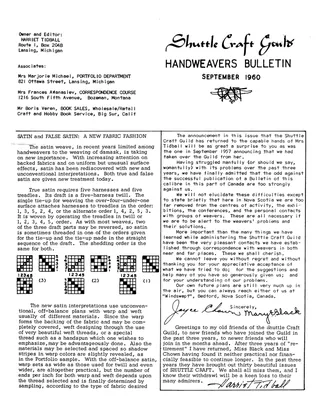
Shuttle-Craft Bulletin (September 1960)
Periodical · 4 pages · weaving drafts
September 1960 issue of the Shuttle Craft Guild Handweavers Bulletin, marking Harriet Tidball's return as owner and editor from Mary Black and Joyce Chown in Nova Scotia. It explains true five-harness satin and four-harness false satin (broken 3/1 twill), with threading and tie-up notes. It also covers Lily Mills' Super-Sheen 50/3 mercerized cotton, an essay on tension as a textile engineering problem (warp and weft tension, balance, selvages), and an announcement of the Japanese sample book Nippon Hand Weaves in Kusakizome Dyes.
Posselt's Textile Journal, Vol. 1, No. 3 (December 1907)
Periodical · 60 pages · weaving drafts
December 1907 issue (Vol. 1, No. 3) of Posselt's Textile Journal, a monthly trade and educational magazine for the textile industries. It carries lessons on satin weaves and Jacquard designing, a treatise on fixing the Knowles fancy worsted loom, and installments on the testing of fibres, cotton spinning, and silk from fibre to fabric. It also includes a Dictionary of Weaves (eight- and nine-harness drawdowns), a dictionary of textile terms, articles on knitting machinery, dyeing, printing and finishing, and reinforced concrete construction and lighting for mills. Advertisements and mill news fill the rear pages.
Textiles, Vol. 15, No. 6 (December 1919)
Textiles, December 1919
Periodical · 48 pages · weaving drafts
December 1919 issue of Textiles, a monthly technical journal of the textile trade published in Boston and edited by Samuel S. Dale. It carries serial technical articles on French worsted drawing, textile calculations, mechanics, power transmission, fibre identification, wool scouring, silk-water purification, knit goods manufacture, and vigoureux printing of worsted. Page 16 includes weave draft diagrams from E. Bittner's series on color effects on satin and other weaves. The issue also has an editorial on protection versus free trade, a metric-system controversy chronology, a questions and answers column, trade news, market prices, and many advertisements for dyes, machinery and supplies.
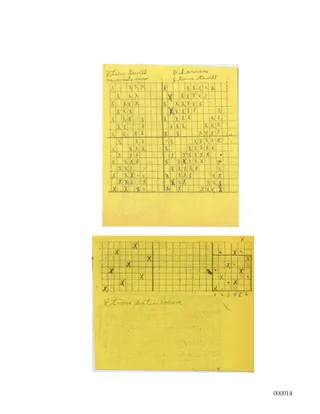
Handwritten drafts and notes
Ephemera · 5 pages · weaving drafts
Five handwritten sheets of weaving drafts on squared graph paper, marked with X grids. They include 8-shaft twill and satin drafts (labeled '8 twine twill' and '8 twine satin weave') and drawdowns with face/back (F/B) labels and lift-order number sequences. One page carries the note 'Thames section'. The notes are brief and appear to be a weaver's working drafts.
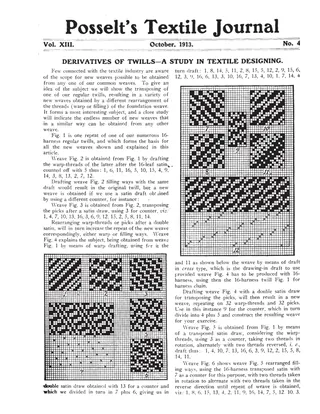
Derivatives of Twills -- A Study in Textile Designing
Article · 2 pages · weaving drafts
An article from Posselt's Textile Journal explaining how new weaves can be derived from a single 16-harness regular twill by rearranging its warp threads or picks. It gives thirteen numbered weave diagrams with drafting orders based on satin counters, double satin draws, transposed satins, and sets of threads, along with cross-type drawing-in drafts. The scan ends with the opening of an unrelated piece on increasing the figuring capacity of Jacquard machines by W. Watson.
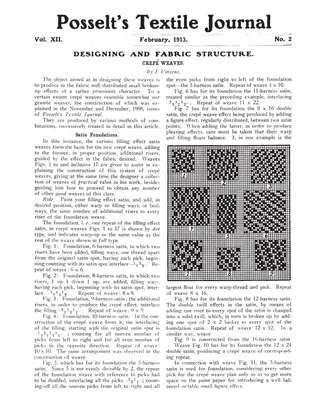
Designing and Fabric Structure
Article · 2 pages · weaving drafts
Two pages from Posselt's Textile Journal, February 1913, on textile design and fabric structure. The first is J. Vinzenz's installment on crepe weaves built from satin foundations, with rules and descriptions for weaves Figs. 1-17 (5- to 16-harness satins and double satins) and their repeats. The second page finishes the crepe weave descriptions and begins an article on warp-pile fabrics made with an extra warp, covering terry and velvet pile and the wires used to form them.
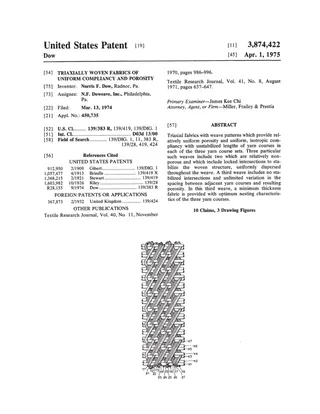
Triaxially Woven Fabrics of Uniform Compliancy and Porosity, US Patent No. 3874422
Patent · 8 pages
US Patent 3,874,422, granted April 1, 1975 to Norris F. Dow of N.F. Doweave, Inc., describes triaxially woven fabrics with uniform porosity and isotropic compliancy. Three weaves are described: the "bi-satin", the "double basic", and the "substrate" weave. They are built from three yarn sets (wefts plus 1 o'clock and 11 o'clock warps) crossing at about 60 degrees, and the text covers yarn paths, selvage configurations and ten claims. The fabrics are intended for reinforcing molded or curved articles. The scan includes two certificates of correction dated 1979 and 1983, and drawings of the three weave structures.
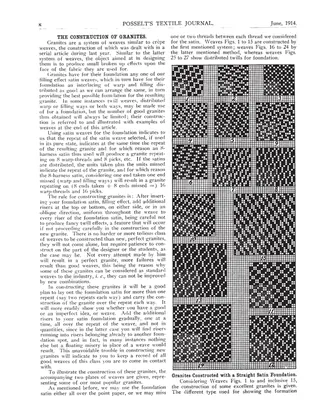
The Construction of Granites
Article · 2 pages · weaving drafts
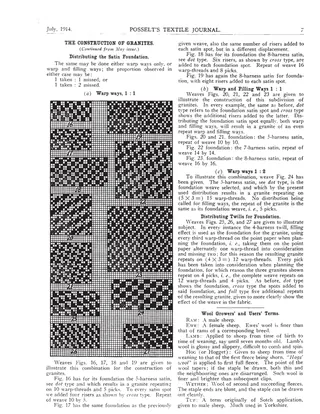
Part of a serial article by E. A. Posselt explaining how granite weaves (small broken-up effects similar to crepe weaves) are constructed from filling-effect satin foundations. It gives the rule of adding risers to each foundation satin point, advice on avoiding twill effects, and describes a plate of weaves, Figs. 1 to 15, built on 8- to 16-harness satins. The scan also includes two unrelated short pieces on finishing and sizing cotton and linen cleaning and dusting cloths and on New Jersey's woolen and worsted industry statistics for 1913.
The Construction of Granites
Article · 1 page · weaving drafts
A single page from Posselt's Textile Journal, continuing a series on constructing granite weaves. It explains how to build granites by distributing a satin foundation warp-ways or warp-and-filling-ways (1:1 and 1:2 proportions) and by distributing twills as a foundation, with weave draft Figs. 16-27 showing foundation spots (dot type) and added risers (cross type). The page also includes a short glossary of wool growers' and users' terms (ram, ewe, lamb, hog, wether, tup).
Construction of Weaves, No. 4
Monograph · 21 pages · weaving drafts
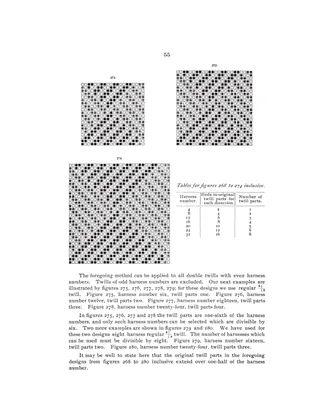
Part No. 4 (1900) of Charles G. Petzold's serial textbook on the construction of weaves, intended for textile schools, designers, loom fixers and webdrawers. It covers serpentine twills, cross twills in four directions, braided or interlaced cross twills, cross twills starting at different heights, cross twills in sateen position, and discontinued or broken twills. The text gives rules for calculating harness numbers, twill parts and repeat sizes, and is illustrated with numbered drawdowns (figures 260-308). It includes a woven portrait of Abraham Lincoln and advertisements for Lawrence, Mass. mill suppliers.
Correct Reeding of Weaves, Part 2
Article · 3 pages · weaving drafts
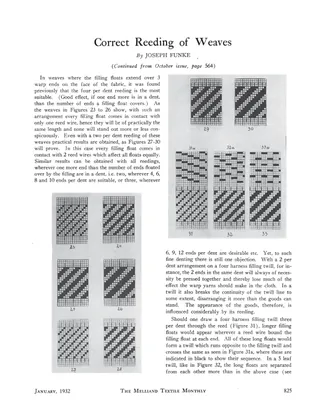
Second part of Joseph Funke's article on how the number of warp ends per dent in the reed affects the appearance of woven cloth. It examines filling twills (4-, 5- and 6-harness) and satin-type weaves, showing how different reeding plans produce uniform, elongated or shortened filling floats and visible lines in the twill. The text is illustrated with drawdown figures (Figures 23-44) and closes with a summary of the most and least suitable reeding rules.
Designing
Textile Mercury, 1892
Article · 2 pages · weaving drafts
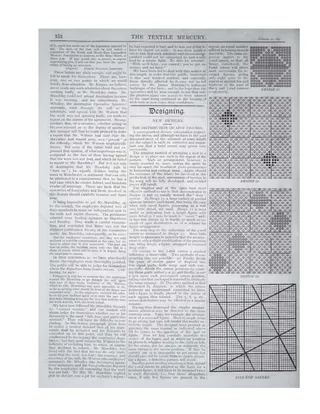
Two pages from The Textile Mercury of 27 February 1892 on textile design. The first part explains how to distribute spot figures in a repeat: the simple drop system (Designs 11 and 12), the 4-end sateen arrangement (Design 13), 5-, 7- and 8-end sateen placement, and how to handle reversed figures. The second part gives an original dobby design for a reversible cotton vesting cloth with two differently coloured faces, with a draft, pegging plan and drawdown. It specifies 64 picks, 15 shafts and a 96-end draft, along with suggested yarn counts, sett and colour combinations.
Designing
Textile Mercury, 1890
Article · 2 pages · weaving drafts
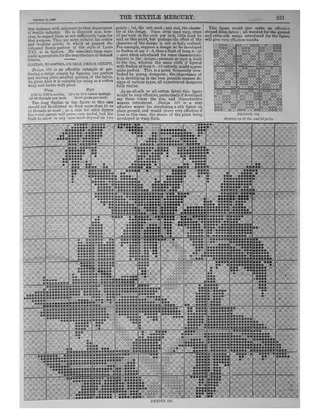
Two pages from The Textile Mercury of 11 October 1890. The first page is mostly dyeing and chemistry notes (printing blue on Congo red, effect of wool oiling on dyeing, a new yellow dye, indigo valuation) followed by the start of a 'Designing' section on using microscopic organisms as motives for textile decoration. The second page continues with Professor Schricker's designs and a note on Design 188, a cotton, worsted or silk dress stripe with warp and weft specifications and sateen flush advice, plus drawdown grids for Designs 188 and 189.
Designing and Fabric Structure for Harness Work: Granite Weaves
Article · 2 pages · weaving drafts
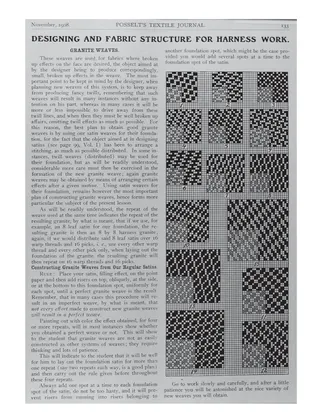
A two-page lesson from Posselt's Textile Journal (November 1908) on designing granite weaves for harness-loom work, which produce small, broken-up effects on the fabric face. It explains building granite weaves from satin foundations by adding risers to each foundation spot, and describes a plate of 15 granite weaves built on 8- to 16-harness satins, with a closing exercise. Page 2 begins a separate short piece on yarn strength, elasticity, twist and contraction by twist, criticizing old hand-testing methods.
Dictionary of Technical Terms Relating to the Textile Industry
Article · 2 pages
Two pages from Posselt's Textile Journal, June 1912, continuing a serialized dictionary of textile terms. The entries run alphabetically from Sabrinawork through Satsuma crepe, covering fabrics, fibers, dyestuffs, finishing materials and loom parts, with a long group of satin varieties and an entry on satin weaves. The second page also begins an unrelated article, "The Ring Frame. Notes," on power testing of spinning frames.
Dictionary of Textile Terms
Article · 4 pages
Installment of E. A. Posselt's alphabetical 'Dictionary of Textile Terms' from Posselt's Textile Journal, September 1919, covering entries from Sabrinawork through Set Check. Entries define fabrics, fibres, dyes and finishing chemicals, tartans, machinery and loom parts, and weaves, including the many satin varieties, satin weaves, serge, seersucker, Saltillo blankets and Oriental rug knots. It is a short-entry reference with no weaving drafts.
Double Warp Effects
Article · 1 page · weaving drafts
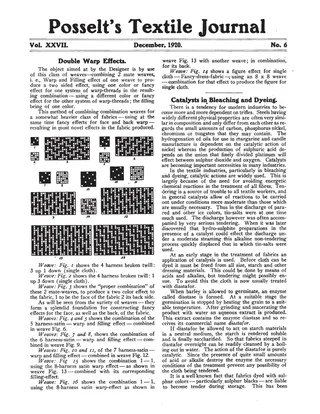
A one-page article from Posselt's Textile Journal on double warp effects, in which two mate weaves (warp-effect and filling-effect) are combined so the cloth has a different color or fancy effect on face and back warp, with a single color of filling. Sixteen drawdown figures show broken twills and 5-, 6-, 7- and 8-harness satins and their combinations, plus a figure effect for single cloth. The page also begins a separate short article on catalysts in bleaching and dyeing, covering diastafor desizing and tendering.
Practical Weaving Suggestions, Vol. 3-70 (1970): Satin Honeycomb; a Six Harness Colonial Weave
Periodical · 4 pages · weaving drafts
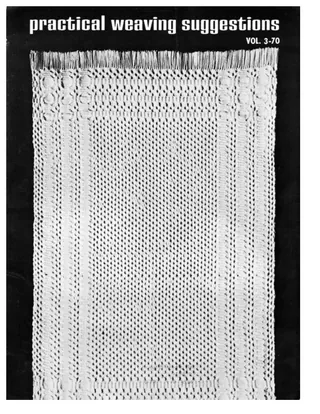
A leaflet from Lily Mills' Practical Weaving Suggestions by Margaret Newman on Satin Honeycomb, a six-harness colonial weave used for white cotton counterpanes. It gives a threading draft, tie-up, treadling, sett and yarn requirements for a 14" x 21" mat, plus advice on tension, beating, draw-in and edges. A second section offers three four-harness honeycomb variations (conventional, reversed tabbies, twill) woven on napkins in perle cotton, and general rules for weaving honeycomb.
300 documents found