Textile Documents › Authors › Author: Ralph E. Griswold
152 documents found
Sort: 
16-Harness Patterns: The Fanciest Twills of All
Ralph E. Griswold · October 22, 2004
Web Doc · 12 pages · weaving drafts
A browsing catalog of 16-harness twill patterns from Irene K. Wood's book 16 Harness Patterns: The Fanciest Twills of All, which reproduces patterns from the weaving notebooks of Fred A. Pennington. Ralph Griswold derived small black-and-white drawdown images from the WIFs digitized by Kris Bruland and posted on handweaving.net. The patterns are arranged by size, width first, and each is labeled with the number of its WIF file (e.g. 34686 for 34686.wif). A few duplicate patterns are included.
An Album of Textile Designs by Thos. R. Ashenhurst
Ralph E. Griswold · June 4, 2004
Web Doc · 97 pages · weaving drafts
A browsing guide to the more than 7,000 weaving patterns in Thos. R. Ashenhurst's An Album of Textile Designs. Kris Bruland digitized the patterns, corrected errors in more than 240 of them, and published WIFs at handweaving.net. Ralph Griswold derived thumbnail drawdowns from the WIFs and arranged them by size, width first, from 2 x 9 up to 33 x 11. Each thumbnail is labeled with the number of its WIF file, so a pattern of interest can be identified and downloaded.
Analysis of Weave Structures, Part 1
Ralph E. Griswold · December 16, 2001
Web Doc · 5 pages · weaving drafts
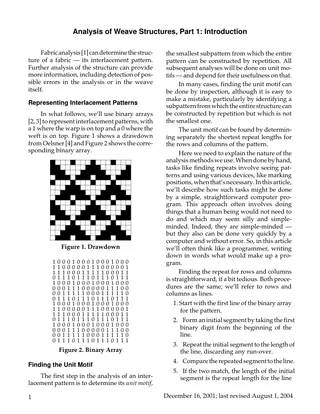
Introductory article by Ralph Griswold on computational analysis of weave structures. It represents interlacement patterns as binary arrays (1 for warp up, 0 for weft up) and gives a step-by-step, program-style procedure for finding a pattern's unit motif by computing row and column repeat lengths and their least common multiple. It then introduces line patterns, circular permutations, canonical forms and block-length patterns, and works through an 8 x 8 example drawn from Oelsner's Handbook of Weaves, ending with a complete line analysis of the rows and columns.
Analysis of Weave Structures, Part 2: A Canonical Form
Ralph E. Griswold · March 4, 2002
Web Doc · 4 pages
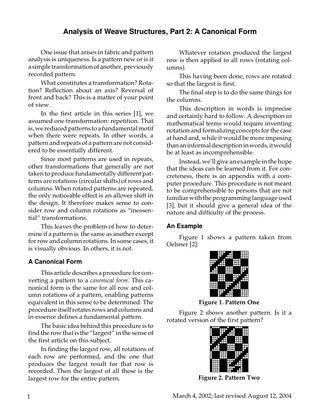
A short article by Ralph Griswold on determining whether two weave or fabric patterns are the same apart from row and column rotations (circular shifts). It describes a procedure for reducing a binary pattern to a canonical form that is identical for all rotated versions. A worked example compares two patterns, one taken from Oelsner's Handbook of Weaves, using a 24 by 20 binary array. An appendix gives the procedure in the Icon programming language.
Atlas D'Armures Textiles by B. Fressinet
Ralph E. Griswold · November 18, 2004
Web Doc · 83 pages · weaving drafts
A browsing catalog of the roughly 2,900 weave patterns in B. Fressinet's Atlas d'Armures Textiles (about 1900), compiled by Ralph Griswold in 2004 from WIF files supplied by Dusan Peterc and hosted on Handweaving.net. Small black-and-white drawdown thumbnails are grouped by size (threads by picks, e.g. 4 x 8, 8 x 24, 16 x 48, 20 x 80), with each pattern's WIF number printed beneath it. The patterns include twills, satins and other diagonal and block structures. The document is mainly useful for finding a pattern and then downloading its WIF.
Atlas de 4000 Armures [Atlas of 4000 Weaves]
Ralph E. Griswold · January 26, 2005
Web Doc · 154 pages · French · weaving drafts
A browsing index of the weave structures (armures) in Louis Serrure's Atlas de 4000 Armures, one of the largest pattern books. Ralph Griswold derived small black-and-white drawdown thumbnails from the WIF files digitized by Kris Bruland. The thumbnails are grouped by repeat size, width first, from 2 x 2 up to 80 x 40. Each is labeled with the number of its WIF file on handweaving.net. A short introduction explains the organization and says the material may be used for individual projects but not republished.
Befriending Sequences
Ralph E. Griswold · September 13, 2001
Web Doc · 6 pages · weaving drafts
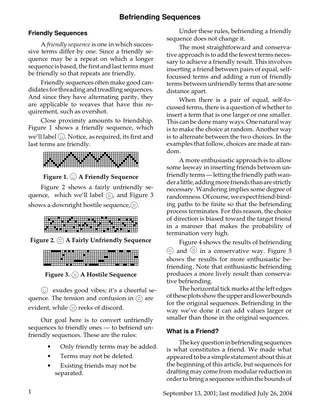
A short article by Ralph Griswold on 'befriending' sequences for weave drafting: converting sequences whose successive terms do not differ by one into 'friendly' sequences usable as threading and treadling orders. It describes conservative and enthusiastic (randomized) befriending, modular reduction and expansion on a shaft wheel, and applies the methods to the Fibonacci sequence modulo 8. An appendix presents 240-end by 240-pick drawdowns on eight shafts using direct and twill tie-ups, derived from Fibonacci and prime sequences.
Bindungs-Lexikon für Schaftweberei [Dictionary of Weave Structures for Loom Weaving]
Ralph E. Griswold · February 14, 2005
Web Doc · 100 pages · German · weaving drafts
A browsing index of the weave patterns in Franz Donat's Bindungs-Lexikon für Schaftweberei (Dictionary of Weave Structures for Loom Weaving), compiled by Ralph Griswold from WIFs digitized by Kris Bruland. Thumbnail drawdowns are grouped by size, width first (from 2 x 2 up to 56 x 24), and each is labeled with the number of its WIF file on handweaving.net. The introduction notes that the book has a color section and a black-and-white section, that it holds patterns not in Donat's Large Book of Textile Patterns, and that a few patterns are duplicated.
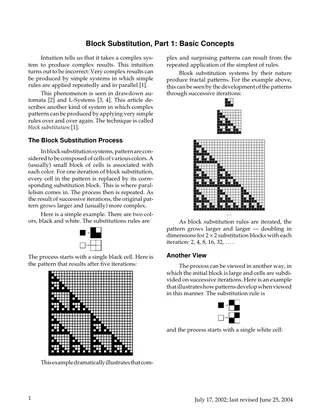
Block Substitution, Part 1: Basic Concepts
Ralph E. Griswold · July 17, 2002
Web Doc · 3 pages
A short introductory article by Ralph Griswold explaining block substitution, a system in which each cell of a pattern is repeatedly replaced in parallel by a small block of cells, producing complex fractal patterns from simple rules. It works through a 2x2 black/white example and a subdivision view that yields the Morse-Thue carpet, noting its use as a non-repeating weave. It also notes the limits on the number of 2x2 rule systems and points to larger blocks and more colors in later parts.
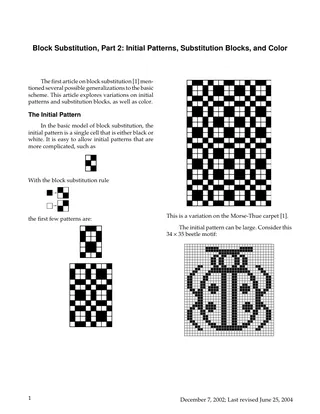
Block Substitution, Part 2: Initial Patterns.Substitution Blocks. and Color
Ralph E. Griswold · December 7, 2002
Web Doc · 4 pages
Second article in Ralph Griswold's series on block substitution, a method of generating cellular patterns by repeatedly replacing each black or white cell with a small block of cells. It covers more complex and large initial patterns (including a 34 x 35 beetle motif), substitution blocks of non-square dimensions, rules with special effects such as color reversal, magnification and line extension, and the use of more than two colors. Illustrated with black-and-white and color pattern examples; no weaving drafts are included.
Character Sets
Web Doc · 9 pages
A short 2004 web document reproducing Appendix B (Characters) from The Icon Programming Language, 3rd edition, as a reference for string drafting. It explains ASCII, Latin-1, ECS and EBCDIC character sets and gives tables of decimal, octal and hexadecimal codes with glyph columns for several platforms. It closes with a table of the ASCII control characters and their functions.
Classical Collection, Volume 1
Ralph E. Griswold · January 26, 2005
Web Doc · 55 pages · weaving drafts
A pattern book of thumbnail drawdowns of classical handweaving patterns, compiled by Ralph Griswold in 2005 from drafts that Kris Bruland posted as WIF files on Handweaving.net. The patterns are organized by size, width (shafts) first, from 2 x 3 up to 30 x 30. Each thumbnail is labeled with a five-digit number that matches a WIF file, such as 04571 for 04571.wif, so readers can browse for a pattern and download its draft. The introduction explains the organization and says the material may be used for individual projects but not republished.
Classical Collection, Volume 2
Ralph E. Griswold · January 26, 2005
Web Doc · 79 pages · weaving drafts
A visual index of classical weaving patterns from Ralph Griswold's Classical Collection, Volume 2. Small black-and-white drawdown thumbnails are grouped by draft size (width x height, from 11 x 11 up to 31 x 31), and each carries a catalog number that matches a WIF file on Handweaving.net. Kris Bruland posted the WIFs, and the thumbnails were derived from them so readers can browse for patterns and identify the ones they want. The drawdowns show twills, diamonds, and block designs. The only text is a short introduction and the size headings and numbers.
Code Drafting, Part 7: Crackle
Ralph E. Griswold · May 8, 2004
Web Doc · 2 pages · weaving drafts
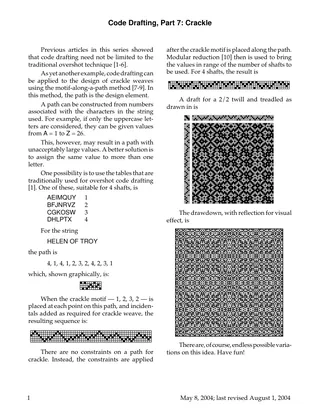
Part 7 of Ralph Griswold's Code Drafting series applies code drafting to crackle weave using the motif-along-a-path method. A text string such as HELEN OF TROY is converted to a path of numbers with a 4-shaft code table, the crackle motif 1, 2, 3, 2 is placed at each path point, and incidentals are added. Modular reduction then brings the values into range for 4 shafts. The article shows the resulting draft on a 2/2 twill threading and tie-up with its drawdown, and a reflected drawdown. A reference list points to the earlier parts of the series and to Griswold's crackle articles.
Code Drafting: Part 1 -- Introduction
Ralph E. Griswold · February 28, 2004
Web Doc · 4 pages · weaving drafts
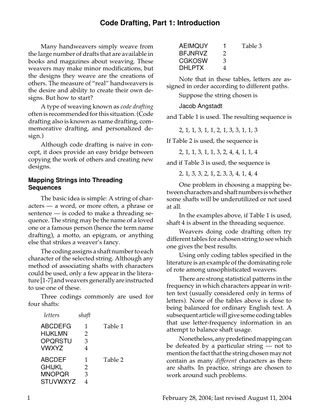
An introductory article by Ralph Griswold on code drafting (also called name drafting or commemorative drafting), in which a string of characters is mapped to shaft numbers to generate a threading sequence. It explains three common four-shaft letter-to-shaft tables, worked examples using the name "Jacob Angstadt", and how to add incidentals to achieve alternating parity for overshot. It also covers reflecting the sequence for symmetry and an alternative method of building parity into the code table. It ends with references to the literature and a page of four sample drafts.
Code Drafting: Part 2 -- Balanced Code Tables
Ralph E. Griswold · February 29, 2004
Web Doc · 2 pages
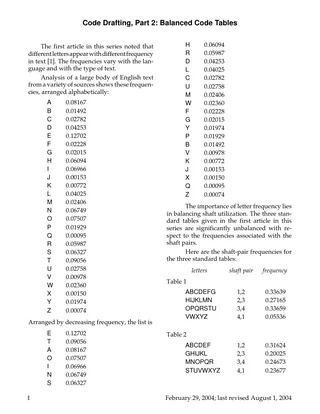
A short web article by Ralph Griswold, the second in a series on code drafting, in which letters of text are mapped to shaft pairs on a four-shaft loom. It gives English letter-frequency tables, alphabetical and by decreasing frequency, and shows that the three standard code tables from Part 1 are unbalanced in shaft-pair use. It then presents three frequency-balanced tables (Tables 4-6) and explains how they were built, with examples of strings that defeat the balance.
Code Drafting: Part 3 -- A Larger Character Set
Ralph E. Griswold · March 3, 2004
Web Doc · 5 pages
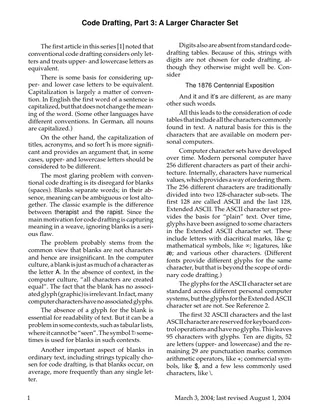
Third article in Ralph Griswold's code drafting series, which converts text into weave drafts by assigning characters to shafts. It argues that code drafting should include blanks, digits and upper- and lowercase letters, and uses the 95 printable ASCII characters as a basis. It gives character frequencies from 1,830 'farberisms' (69,675 characters) and a four-shaft balanced 95-character code table for overshot. The last page shows a sample woven wall hanging made from the string 'Screw the &*%^$#/@\ dummies!'.
Code Drafting: Part 4 -- Adaptive Tables
Ralph E. Griswold · March 6, 2004
Web Doc · 3 pages
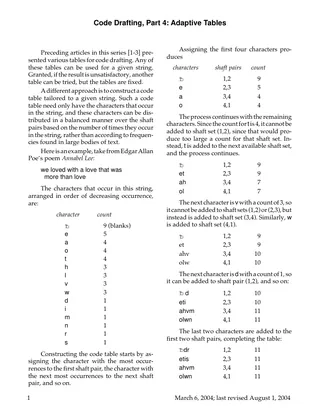
Part 4 of Ralph Griswold's code drafting series, describing how to build a code table tailored to a particular string rather than using a fixed table. Characters are assigned to shaft pairs according to how often they occur in the string, giving a balanced distribution. The worked example uses a line from Poe's poem Annabel Lee and compares the result with a table based on frequencies in large bodies of text. A pattern derived from the table appears at the end.
Code Drafting: Part 5 -- Message Drafting
Ralph E. Griswold · March 10, 2004
Web Doc · 3 pages · weaving drafts
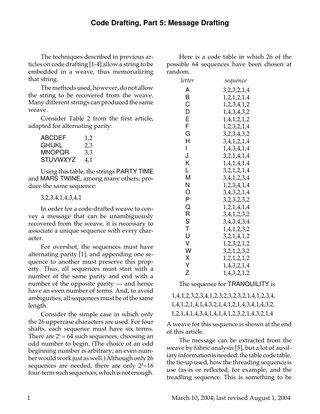
Part 5 of Ralph Griswold's Code Drafting series, on message drafting: embedding a text in an overshot weave so the message can be recovered. Earlier methods could not be reversed because different strings gave the same sequence, so he assigns each letter a unique six-term sequence of alternating parity for four shafts. He gives a randomly chosen 26-letter code table and works out the sequence for the word TRANQUILITY. A drawdown of the resulting weave is on the last page, and the text notes limits and the cryptographic aspect.
Code Drafting: Part 6 -- Point Twills
Ralph E. Griswold · March 13, 2004
Web Doc · 3 pages · weaving drafts
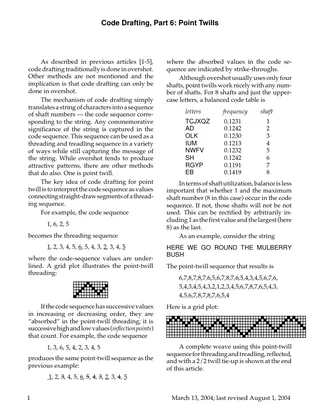
Part 6 of Ralph Griswold's Code Drafting series applies code drafting, which turns a text string into a sequence of shaft numbers, to point twills instead of overshot. Code-sequence values are treated as inflection points joined by straight-draw runs in the threading, and values that continue an ascending or descending run are absorbed. The article gives an 8-shaft balanced code table for uppercase letters and works through the example 'HERE WE GO ROUND THE MULBERRY BUSH'. It ends with a drawdown of that example, threaded and treadled with the point-twill sequence, reflected, with a 2/2 twill tie-up.
A Collection of Old Weaving Patterns
Ralph E. Griswold · June 29, 2002
Web Doc · 541 pages · weaving drafts
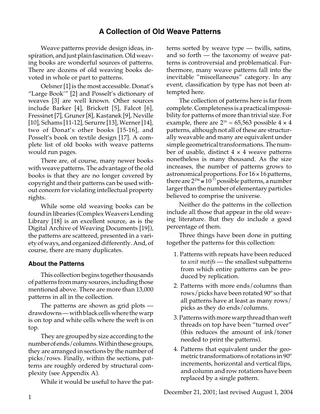
A three-volume compilation by Ralph Griswold of over 12,000 (the text also says 13,000 and 15,000) weave patterns drawn from old, copyright-free weaving and textile design books. The patterns are shown as black-and-white drawdown grids, grouped by number of ends (4 to 96) and then by number of picks, and roughly ordered by structural complexity. The front matter explains how the patterns were reduced to unit motifs, rotated, and de-duplicated, lists the source books, and gives appendices on structural complexity, how the collection was built, and copyright of patterns. Volume 1 covers 4 to 12 ends, Volume 2 covers 13 to 16 ends, and Volume 3 covers 17 to 96 ends.
Color Alternates
Ralph E. Griswold · January 26, 2005
Web Doc · 16 pages · weaving drafts
A visual pattern book by Ralph Griswold showing thumbnail drawdowns of color-alternate weaves, produced by rearranging the rows and columns of base patterns. The patterns are grouped by size (width first, from 3 x 6 up to 60 x 48), and each is labeled with a five-digit number matching a WIF file on handweaving.net. It serves as a browsing index for finding and downloading the corresponding drafts.
Color Complementation, Part 1: Color-Alternate Weaves
Ralph E. Griswold · August 21, 2004
Web Doc · 6 pages · weaving drafts
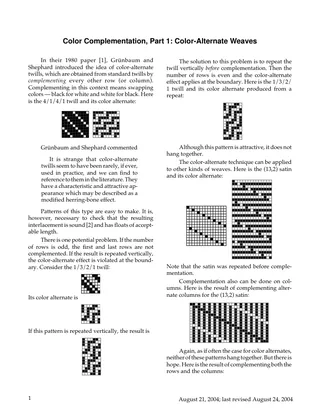
A short article by Ralph Griswold on color-alternate weaves, a technique from Grünbaum and Shephard (1980) in which every other row or column of a weave draft is complemented (black and white swapped). It illustrates the idea with a 4/1/4/1 twill, a 1/3/2/1 twill and a (13,2) satin, and discusses repeating the pattern before complementation and whether the resulting fabric hangs together. The last four pages show a crackle weave with its row, column and row-column color alternates. A future article on other complementation schemes is promised.
Color Complementation, Part 2: Complementation Sequences
Ralph E. Griswold · September 29, 2004
Web Doc · 5 pages · weaving drafts
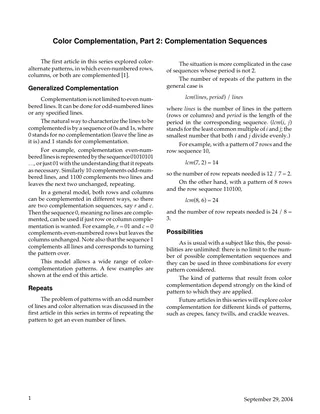
Second article in Ralph Griswold's series on color complementation in woven patterns. It generalizes color alternation by describing which rows and columns are complemented with repeating binary sequences (r for rows, c for columns), and gives a formula for the number of pattern repeats needed using the least common multiple. Figures at the end show complementation variants of a crepe pattern, a fancy twill, and a crackle weave drawdown.
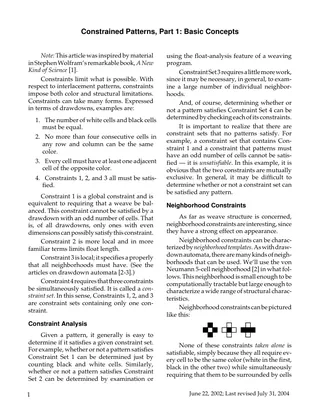
Constrained Patterns, Part 1: Basic Concepts
Ralph E. Griswold · June 22, 2002
Web Doc · 2 pages
A short web article by Ralph Griswold introducing constraints on interlacement patterns (drawdowns), inspired by Stephen Wolfram's A New Kind of Science. It explains global and local constraints such as balanced cell counts and limited float length, and defines constraint sets and satisfiability. It then introduces neighborhood constraints using von Neumann 5-cell templates, noting that plain weave satisfies one template set, and outlines questions about analyzing patterns and constraint sets, to be continued in later articles.
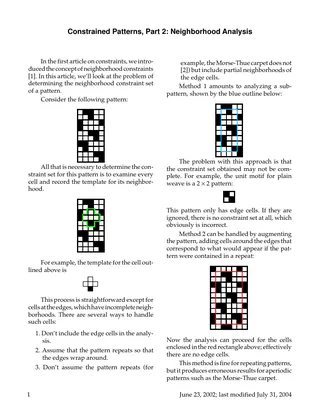
Constrained Patterns, Part 2: Neighborhood Analysis
Ralph E. Griswold · June 23, 2002
Web Doc · 3 pages
A short web article by Ralph Griswold on how to determine the neighborhood constraint set of a black-and-white cell pattern by examining each cell's neighborhood template. It compares three ways of handling edge cells with incomplete neighborhoods: ignoring them, wrapping the pattern as a repeat, and keeping partial neighborhoods. It discusses the Morse-Thue carpet, an aperiodic pattern whose constraint set has 18 templates, and random patterns, which may use all 32 possible constraints. It is illustrated with grid diagrams and neighborhood templates.
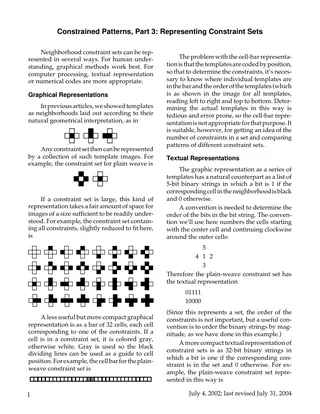
Constrained Patterns, Part 3: Representing Constraint Sets
Ralph E. Griswold · July 4, 2002
Web Doc · 2 pages
A short web article by Ralph Griswold on ways to represent sets of neighborhood constraints used to define patterns. It covers graphical forms (template images and a 32-cell bar), textual forms (5-bit binary strings and 32-bit strings), and numerical base-10 codes. Plain weave serves as the running example, with constraint codes 15 and 16 and a 32-bit code of 98305. It is the third part of a series on constrained patterns.
Construction of Weaves, Charles G. Petzold
Ralph E. Griswold · June 17, 2004
Web Doc · 28 pages · weaving drafts
A browsing index of weave patterns from Charles G. Petzold's 1900-1901 monographs 'Construction of Weaves', compiled by Ralph Griswold in 2004. Kris Bruland digitized the patterns and corrected errors, and WIF files are on handweaving.net. The pages show small black-and-white drawdown thumbnails grouped by size (width first, from 2 x 2 up to 66 x 66), each labeled with the number of its WIF file.
Continued Fractions in Weave Design - I
Ralph E. Griswold · July 12, 2000
Web Doc · 5 pages
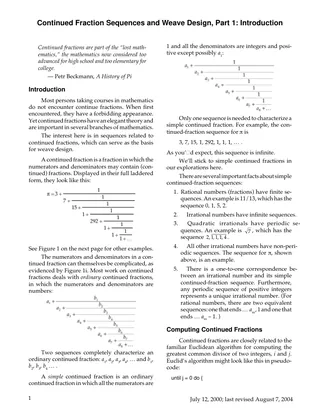
An introductory paper by Ralph Griswold on continued fractions as a source of number sequences for weave design. It explains ordinary and simple continued fractions, the sequences for rational, quadratic irrational and other irrational numbers, and how to compute them with Euclid's algorithm. It also covers periodic patterns such as those for tan(1) and e-1. A gallery of continued fraction expansions and three generated tabby and twill weave patterns (from the square roots of 10089 and 9949) hint at later applications. It ends with references and a note that quadratic irrationals will be the topic of the next article.
Crackle Weave, Part 1: Designing with Blocks and Motifs
Ralph E. Griswold · April 30, 2004
Web Doc · 3 pages · weaving drafts
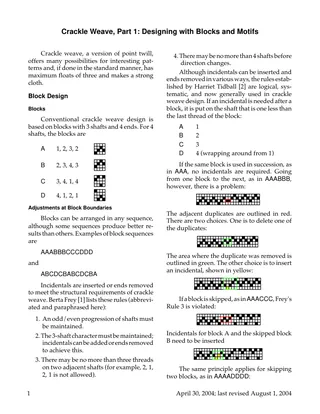
A short article by Ralph Griswold on designing crackle weave, a version of point twill, using blocks and motifs. It gives the four-shaft block threadings (A-D), the rules of Berta Frey and Harriet Tidball for inserting incidentals or deleting ends at block boundaries, and extends the approach to six or more shafts. It also presents a motif-along-a-path approach to design, illustrated with drawdowns, and ends with a large sample pattern image.
Crackle Weave, Part 2: Tie-Ups and Treadlings
Ralph E. Griswold · May 8, 2004
Web Doc · 2 pages · weaving drafts
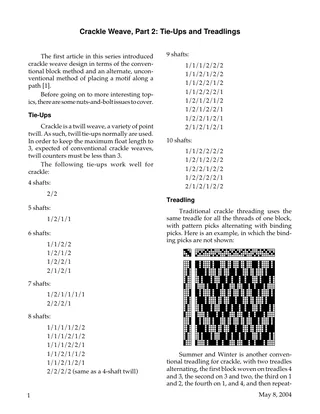
A short two-page web document by Ralph E. Griswold, the second in a series on crackle weave, covering tie-ups and treadlings. It lists recommended twill-type tie-ups for 4 to 10 shafts that keep floats to a maximum of 3, and describes treadling approaches: traditional block treadling with binding picks, Summer and Winter style, treadling as drawn in, and using different crackle sequences for threading and treadling. Draft examples with drawdowns illustrate each method, and references point to Part 1 and the Master Weaver Library.
Crackle Weave, Part 3: Path Design
Ralph E. Griswold · May 8, 2004
Web Doc · 3 pages · weaving drafts
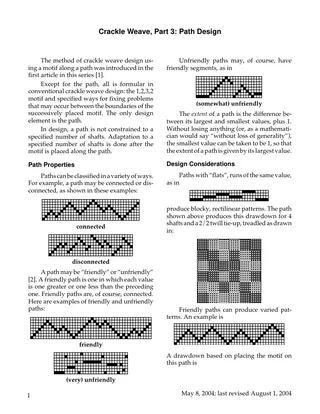
Part 3 of Ralph Griswold's crackle weave series explains designing with a 1,2,3,2 motif placed along a path. It defines path properties (connected, disconnected, friendly, unfriendly, extent) and shows how flats, friendly paths and disconnected paths affect the resulting drawdowns. It also covers float lengths, palindromic enhancement, modular reduction to fit a given number of shafts, and the very large number of possible paths to explore.
Crackle Weaves
Ralph E. Griswold · June 6, 2004
Web Doc · 90 pages · weaving drafts
A pattern book by Ralph Griswold presenting thumbnail drawdowns of computer-generated crackle weave designs, each labeled with the number of its downloadable WIF file at handweaving.net. The patterns come from a program that randomly varies motif, tie-up, and path, and are grouped by shape (square, wide, tall) and then by size, from about 92 x 92 up to 599 x 599. A short introduction explains the method and cites Griswold's three-part Crackle Weave series.
Creating Weavable Color Patterns, Part 1
Ralph E. Griswold · November 13, 2001
Web Doc · 3 pages
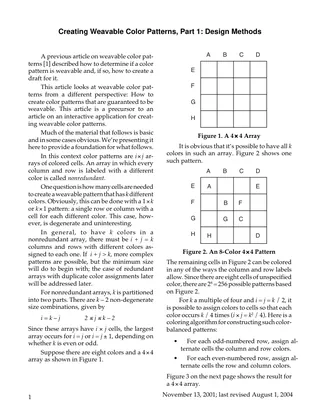
A short web article by Ralph Griswold on designing color patterns that are guaranteed to be weavable in color-and-weave work. It defines color patterns as arrays of colored cells with labeled rows and columns, discusses how many cells are needed for k colors, and gives a coloring algorithm for balanced patterns. It lists eight transformations that preserve weavability, such as duplicating, deleting, rearranging, rotating and flipping rows and columns, and illustrates them with grid figures and example patterns.
Creating Weavable Color Patterns, Part 2
Ralph E. Griswold · November 15, 2001
Web Doc · 6 pages
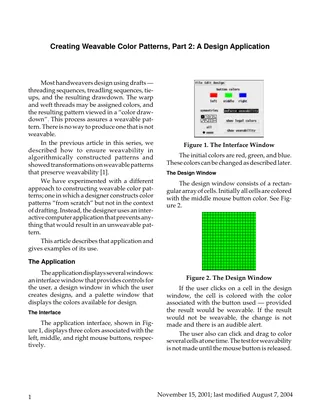
Ralph Griswold describes an interactive computer application for designing color patterns that are guaranteed to be weavable, without working through threading, treadling and tie-up drafts. The article explains the interface, design and palette windows, symmetry options, layouts (including a Fibonacci-based layout), toggles for enforcing weavability and showing legal colors, and the menus. It closes with notes on user experience and five example designs created with the program.
Design Inspirations from Multivariate Polynomials, Part 1
Ralph E. Griswold · September 13, 2001
Web Doc · 7 pages
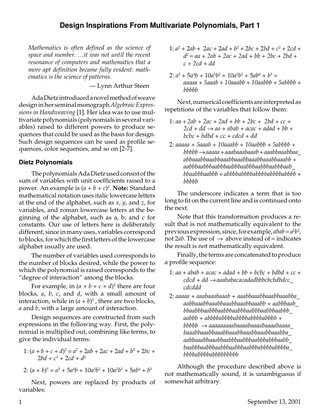
Ralph Griswold explains Ada Dietz's method of generating weave design sequences from multivariate polynomials raised to powers. He walks through expanding a polynomial, replacing powers with repeated variables, interpreting coefficients as repetitions, and concatenating terms into a profile sequence. A table gives sequence lengths for 1 to 9 variables and powers 1 to 6. An appendix shows drawdown-style pixel images for polynomials with 2 to 9 variables and powers 2 to 4, used as threading and treadling sequences. A reference list of earlier writings on algebraic expressions in weaving is included.
Design Inspirations from Multivariate Polynomials, Part 2
Ralph E. Griswold · September 30, 2001
Web Doc · 10 pages · weaving drafts
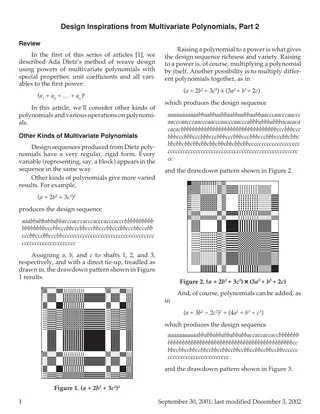
Second article in Ralph Griswold's series on generating weave design sequences from multivariate polynomials, extending Ada Dietz's method. It covers polynomials with non-unit coefficients and exponents, multiplication and addition of polynomials, negative and fractional coefficients, polynomial division, modular reduction, differentiation and integration. Each operation is illustrated with design sequences and black-and-white drawdowns. Appendices show modular reductions (mod 2 to 12), successive derivatives and successive integrals of (a+b+c)^4.
Design Sequences: Meandering Strings
Ralph E. Griswold · May 7, 2002
Web Doc · 3 pages · weaving drafts
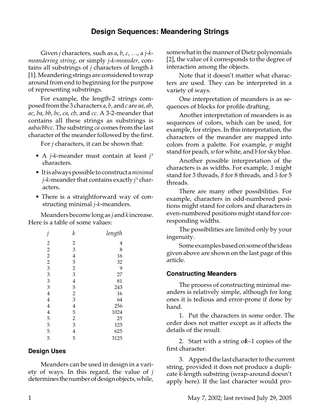
A short article by Ralph Griswold on using j-k-meandering strings, sequences containing every substring of length k over j characters, as a source of design sequences. It gives a table of minimal meander lengths, a step-by-step method for constructing them with a worked 3-2 example, and suggests interpreting the characters as profile-draft blocks, stripe colors, or thread widths. The last page shows profile drafts for mirrored 3-2 and 3-3 meanders and striped color sequences from 3-3, 3-4 and 4-3 meanders.
Designing Weave Structures Using Boolean Operations, Part 1
Ralph E. Griswold · October 20, 2001
Web Doc · 5 pages
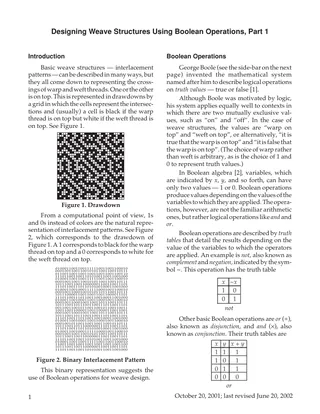
A short illustrated article by Ralph Griswold on using Boolean algebra to design weave structures. It represents drawdowns as binary arrays (1 = warp on top, 0 = weft on top) and explains the basic Boolean operations (and, or, exclusive or, equivalence, implication) with truth tables. It then applies them to arrays, combining a plain-weave or twill ground with a motif to make spot weaves, following Oelsner's diversified weaves, and combining twill with basket weave. It closes with cautions about long floats and loom resources and points to a second part on arrays of operations.
Designing Weave Structures Using Boolean Operations, Part 2
Ralph E. Griswold · November 29, 2001
Web Doc · 3 pages
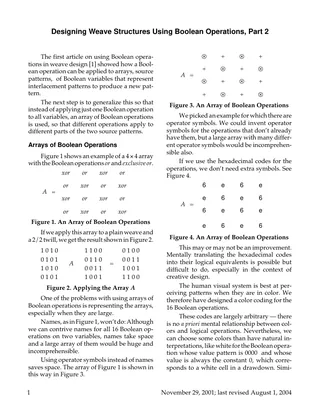
The second article in Ralph Griswold's series on Boolean operations in weave design extends the method from one operation applied to two source patterns to an array of different operations applied cell by cell. It compares ways of representing operation arrays (names, operator symbols, hexadecimal codes, and a 16-operation color code) and shows examples built from plain weave and 2/2 twill. It also covers 'deficient' operations (0, 1, x, y), which force white, black, or one source pattern's cells into the result, and closes by announcing computer programs for the next article.
Designing Weave Structures Using Boolean Operations, Part 3: A Design Program
Ralph E. Griswold · February 7, 2002
Web Doc · 6 pages
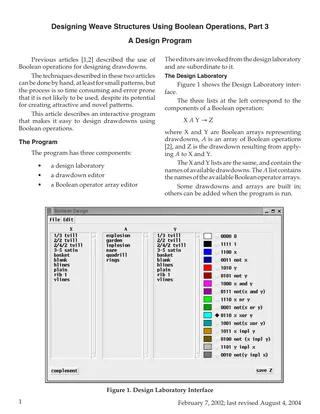
Part 3 of Ralph Griswold's series on designing weave structures with Boolean operations describes an interactive program that automates the process. The program has a design laboratory, a drawdown editor and a Boolean operator array editor. The design laboratory combines two drawdowns (X and Y) with an operator array (A) to produce a result drawdown (Z). The article walks through the interface with screenshots, covering menus, dialogs, editing tools and the color palette for operators. It ends with the program's limitation to 32 x 32 drawdowns and operator arrays.
Designing with Farey Fractions
Ralph E. Griswold · May 11, 2001
Web Doc · 9 pages · weaving drafts
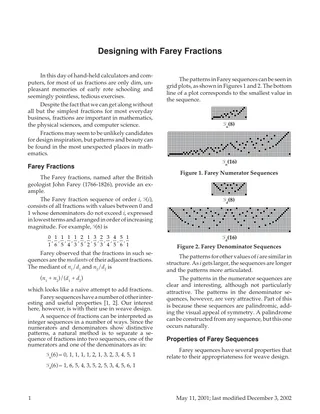
Ralph Griswold explains how Farey fraction sequences can be used to generate weaving drafts. He splits each sequence into numerator and denominator sequences, then uses them as threading and treadling with direct and twill tie-ups. He also covers fixes for repeated values, palindromes, interleaved sequences, concatenated orders, and point-twill derivations. Drawdown figures illustrate each variation, and tables give sequence lengths and point-draw lengths for orders 4 to 32.
Designing with Fractal Sequences
Ralph E. Griswold · February 11, 2004
Web Doc · 4 pages · weaving drafts
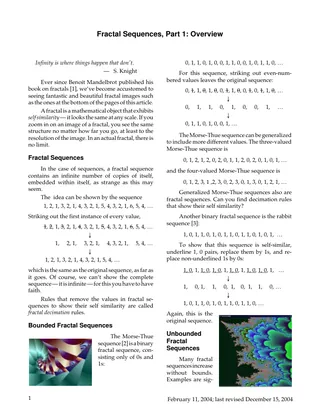
A short web article by Ralph Griswold introducing fractal sequences and how they can be used in weave design. It explains self-similarity and decimation rules, then covers bounded sequences (Morse-Thue, rabbit), unbounded ones (signature sequences, Kimberling sequences), and periodic sequences. It shows how to adapt them as threading and treadling sequences via modular reduction and as warp and weft color sequences, with sample drafts and a color swatch. It closes with advice on choosing sequences and finding them in the On-Line Encyclopedia of Integer Sequences, plus references.
Designing with L-Systems, Part 10: Profile Drafts
Ralph E. Griswold · June 12, 2004
Web Doc · 2 pages · weaving drafts
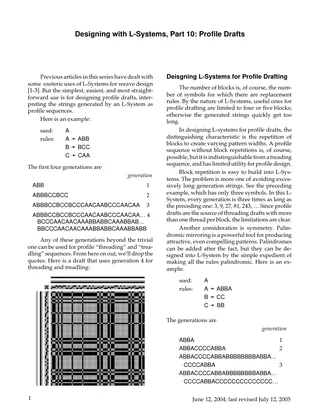
Part 10 of Ralph Griswold's series on designing with L-Systems, showing how to interpret L-System strings as profile (block) threading and treadling sequences. It gives two worked examples with seeds, rewriting rules and the first four generations, one with a three-times growth in length and one with palindromic rules, and shows profile drafts generated from generation 4. It also discusses limiting the number of blocks, using block repetition to vary pattern widths, and ideas such as separate L-Systems for threading and treadling or width-sequence interpretation.
Designing with L-Systems, Part 1: String Rewriting Systems
Ralph E. Griswold · April 6, 2002
Web Doc · 6 pages · weaving drafts
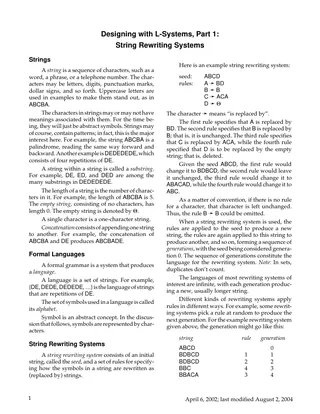
An introductory article by Ralph Griswold on string rewriting systems and Lindenmayer systems (L-Systems) as a basis for pattern design. It defines strings, formal languages, seeds, rules and generations, and shows that L-Systems apply all rules in parallel. Worked examples include the Morse-Thue and Fibonacci string sequences, and the Fibonacci string is interpreted as a profile pattern. A short sidebar covers Aristid Lindenmayer, and an appendix has plates of L-system graphics (spirals, snowflake-like curves, branching plant forms). References point to related Griswold documents and to the L-system literature.
Designing with L-Systems, Part 2: A Side Trip to Graphics
Ralph E. Griswold · June 20, 2002
Web Doc · 2 pages
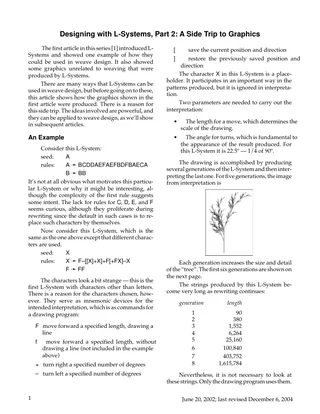
Second article in Ralph Griswold's series on L-Systems in weave design. It is a deliberate detour into graphics: it shows how string-rewriting rules, with characters read as drawing commands (forward, turn, save and restore position), produce branching tree images. It gives an example L-System with a 22.5-degree turn angle, a table of string lengths across eight generations, and a pointer to freeware such as Lparser. It says later articles will apply these ideas to weave design.
Designing with L-Systems, Part 3: Back to Basics -- T-Sequence Design
Ralph E. Griswold · April 2004
Web Doc · 3 pages · weaving drafts
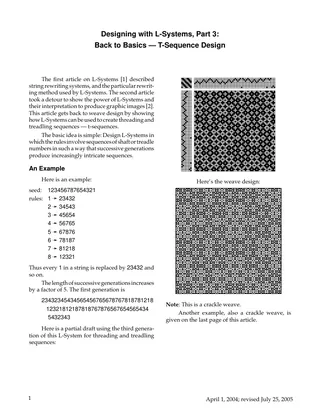
Third article in Ralph Griswold's series on using L-Systems (string rewriting systems) in weave design. It shows how rules operating on shaft and treadle numbers can generate threading and treadling sequences (t-sequences) that grow more intricate with each generation. An example L-System with eight rules and a 15-digit seed is given, with a partial draft and drawdown of a crackle weave, and a second crackle example on the last page. It also notes how to handle shaft numbers above 9 and previews later articles.
Designing with L-Systems, Part 4: Articulated L-Systems
Ralph E. Griswold · April 3, 2004
Web Doc · 2 pages
Part 4 of Ralph Griswold's series on designing with L-Systems, introducing articulated L-Systems that distinguish variables from constants. It explains defined versus undefined variables, shows undefined variables used as placeholders, and presents base L-Systems that can be supplemented with different definitions for the undefined variables. Worked examples show successive generations of string rewriting, such as S → STS with alternative rules for T.
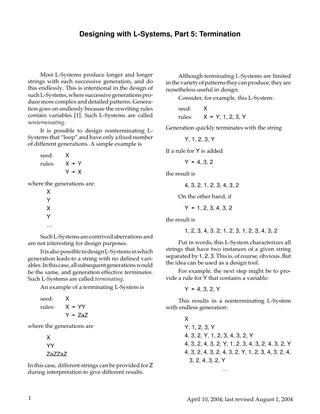
Designing with L-Systems, Part 5: Termination
Ralph E. Griswold · April 10, 2004
Web Doc · 2 pages
Part 5 of Ralph Griswold's series on designing with L-Systems, covering termination. It distinguishes nonterminating L-Systems, which generate longer strings endlessly, from terminating ones, where generation ends in a string with no remaining variables. Short worked examples with numeric strings show how terminating L-Systems and added rules can serve as design tools, and how adding a variable rule makes a system nonterminating again.
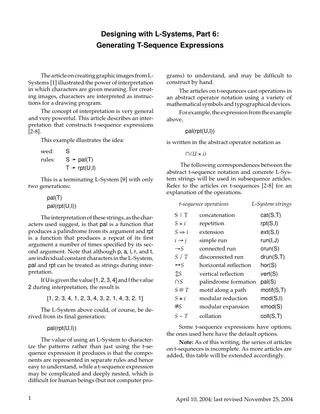
Designing with L-Systems, Part 6: Generating T-Sequence Expressions
Ralph E. Griswold · April 10, 2004
Web Doc · 2 pages
A short web article by Ralph Griswold in his L-Systems series that shows how L-System strings can be interpreted as t-sequence expressions. A small terminating L-System produces pal(rpt(U,I)), which evaluates to a palindromic repeat of a sequence. The article explains why separate rules make complex nested expressions easier to understand, and gives a table that maps abstract t-sequence operations (concatenation, repetition, extension, runs, reflection, palindrome, motif, modular reduction and expansion, collation) to concrete L-System function strings. A reference list points to the related t-sequence and L-System articles.
152 documents found